
lovethailand home >North Travel Attractions >Chiang Mai Travel Attractions >Phrao >Ban Pong > Wat Thung Noi
TL;DR: Wat Thung Noi is located at Ban Thung Noi, Moo 6, Ban Pong Subdistrict, Phrao District, Chiang Mai Province, open Daily, hours 08.00 – 17.00.
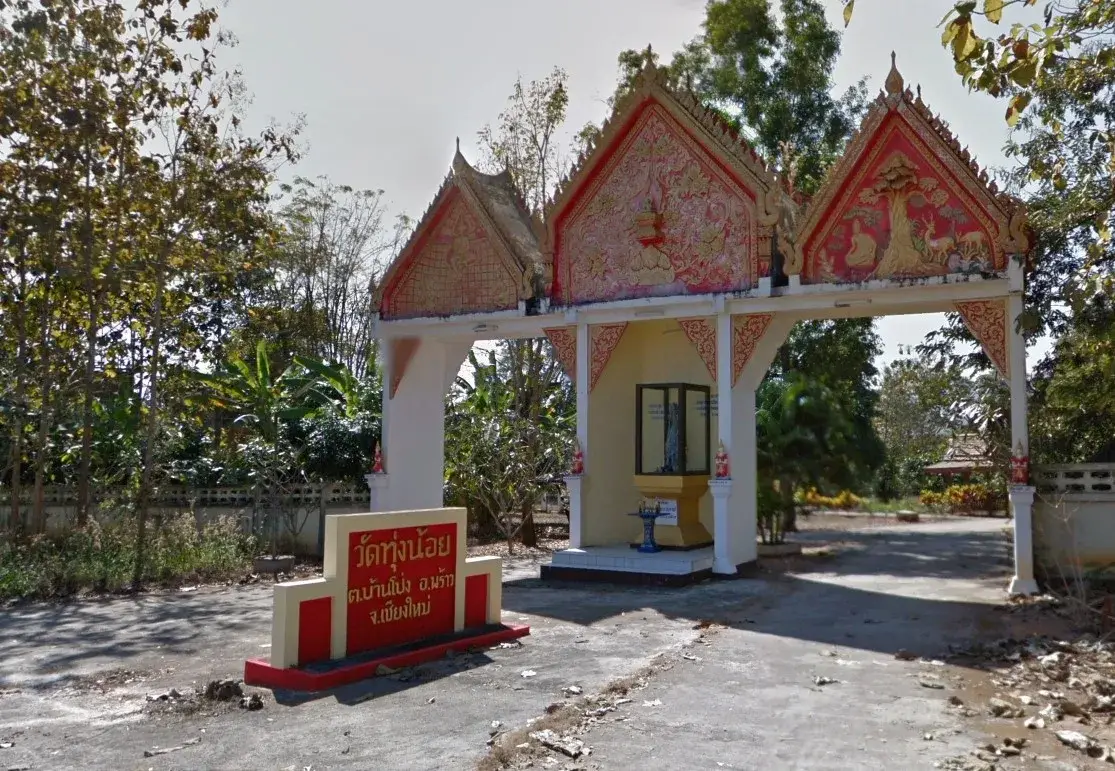
Wat Thung Noi
Open Days: Daily
Opening Hours: 08.00 – 17.00
Wat Thung Noi is a private-sector Buddhist temple under the Mahanikaya order located in Moo 6, Ban Thung Noi, Ban Pong Subdistrict, Phrao District, Chiang Mai Province. The temple was officially permitted to be established in 1858 and received its Wisungkham Sima in 1967. The current abbot is Phra Khru Athon Thammasarat Saratthiko. Wat Thung Noi is an important community temple of Ban Thung Noi and Ban Pong Subdistrict because its history is connected with old settlements, the Mae Ngat River, abandoned temple sites, relocation of the temple, and the memory of Khruba Insom Sumano, a revered monk of Phrao and Chiang Mai.
Ban Thung Noi is Moo 6 of Ban Pong Subdistrict, Phrao District. Ban Pong Subdistrict has a layered community history involving people of Lue, Khoen, Shan, Yong, and other northern Thai backgrounds, as well as later migrants from Doi Saket and Lampang. The name Ban Pong is linked with surface hot springs known locally as “pong.” The area around Ban Pong, Ban Thung Noi, and Nong Hai is also associated with the old settlement known as Wiang Wai. Wat Thung Noi therefore stands within a historical landscape of old villages, waterways, abandoned temples, and local memory.
Ban Thung Noi’s early community is remembered as having people from Chiang Saen and Wiang Pa Pao. One of its important historical sites is Ku Wiang Ying, a monument associated with local legends about King Mangrai and Chao Khun Khrueang. This context makes Ban Thung Noi more than a farming village. It is a place with inherited stories, old sacred sites, and a strong relationship between temple, village, river, and historical memory.
The history of Wat Thung Noi is especially interesting because the temple did not remain in only one location. Local history says the original Wat Thung Noi stood west of the present area beside the Mae Ngat River, where flooding occurred frequently. The temple was then moved to higher ground near Ku Wiang Ying, but that site lacked sufficient water. Later, during the time of Khruba Insom Sumano as abbot, the temple was moved to its present location. This history shows how village temples in rural Lanna had to adapt to geography, water, safety, and community needs.
The temple’s official establishment in 1858 makes Wat Thung Noi one of the old temples of Phrao District. In that period, a temple served not only as a place of worship but also as a moral classroom, ceremony ground, community meeting space, and spiritual center. Wat Thung Noi therefore grew from both religious faith and the social needs of Ban Thung Noi.
The temple received its Wisungkham Sima in 1967. In Thai Buddhist tradition, Wisungkham Sima is the sacred boundary used for important monastic acts. This status confirms the temple’s formal religious role and its ability to support Sangha ceremonies. Wat Thung Noi therefore combines deep community history with a recognized Buddhist institutional status.
Phra Khru Athon Thammasarat Saratthiko serves as the abbot of Wat Thung Noi. In a village temple, the abbot’s role is central to maintaining religious activities, temple buildings, annual merit-making, and the relationship between monks and local devotees. Through this continuing role, Wat Thung Noi remains an active spiritual center for Ban Thung Noi.
One of the most important figures connected with Wat Thung Noi is Khruba Insom Sumano, a monk widely respected by Buddhists in Phrao and Chiang Mai. His birth name was Insom Pranak. He was born on Friday, 13 October 1901, in Ban Pa Wai, Ban Pong Subdistrict, Phrao District. He entered temple life as a young temple boy at age 12, became a novice on 3 April 1914, and was ordained as a monk on 7 June 1921, with Khruba Sithi Wichayo as his preceptor.
Khruba Insom Sumano remained in the monastic life until his passing on 13 October 1997 at the age of 96, with 76 rains retreats. His royal cremation took place in 1999. His story gives Wat Thung Noi additional spiritual significance because the temple is linked with a respected monk whose life embodied discipline, devotion, and long service to Buddhism.
The main value of Wat Thung Noi lies in its identity as an old village temple that adapted to natural conditions over time. Its movement from a flood-prone riverbank area to higher ground and then to the present site reflects practical community wisdom. The temple’s history shows how monks and villagers worked together to find a stable place for monastic residence, worship, and annual ceremonies.
Wat Thung Noi is also closely connected with Ku Wiang Ying, the important historical site of Ban Thung Noi. The temple and Ku Wiang Ying together help visitors understand the area as a cultural landscape rather than as separate attractions. A visit to Wat Thung Noi is therefore best understood through the combined context of temple, old monument, Mae Ngat River, abandoned temple sites, and village memory.
The temple area today supports worship, merit-making, Dhamma listening, annual ceremonies, and local community activities. Unlike large tourist temples, Wat Thung Noi is valuable because it remains a living village temple. Local people continue to use the temple for Buddhist holy days, ordinations, funerals, annual merit-making, and community ceremonies.
Wat Thung Noi plays several roles in the local community. Religiously, it is a place for worship, merit-making, Dhamma listening, precepts, and Buddhist ceremonies. Socially, it is a place where villagers gather during important events. Historically, it connects Ban Thung Noi with the Mae Ngat River, Ku Wiang Ying, and old temple sites. Culturally, it helps preserve Lanna Buddhist traditions and the memory of Ban Pong’s old communities.
Temple activities at Wat Thung Noi follow the Buddhist calendar and local Lanna community traditions. Important activities include Buddhist holy day merit-making, Pha Pa, Kathin, Dhamma listening, Buddhist Lent, end-of-Lent activities, Northern Thai New Year, Loy Krathong, and annual village merit-making events. These activities keep the temple central to community life throughout the year.
Wat Thung Noi is suitable for visitors interested in old temples of Phrao, Ban Pong community history, the Wiang Wai old-settlement landscape, and the life of Khruba Insom Sumano. Visitors should appreciate the temple as a quiet community temple rather than expecting monumental architecture. Its value lies in age, atmosphere, local memory, and the relationship between monks and villagers.
A visit to Wat Thung Noi can be combined with nearby places in Ban Pong and Phrao District, such as Ku Wiang Ying, Wat Pa Wai, Wat Ban Pong, Wat Pa Lan, Wat Ku Bia, Mae Saluam Reservoir, and Mon Hin Lai Waterfall. This route combines village temples, ancient remains, old-town memory, agricultural landscapes, and natural sites in one journey.
Getting There is most convenient by private car, rental car, or local hired transport. From Chiang Mai city, travel toward Phrao District, then continue into Ban Pong Subdistrict and Ban Thung Noi, Moo 6. Travelers can search for “Wat Thung Noi, Ban Pong, Phrao, Chiang Mai” or use the coordinates 19.38813, 99.17457 in a map application before departure.
From Phrao town, Wat Thung Noi can be included in a Ban Pong half-day route with Ku Wiang Ying, Wat Ban Pong, and Wat Pa Wai. With more time, visitors can continue to Mae Saluam Reservoir, Wat Phra Chao Lan Thong, Wat Nam Phrae, or other nature and temple routes in Phrao District. This makes the visit more complete by combining Buddhism, local history, and the natural landscape of Phrao.
Visitors should dress modestly, speak quietly, respect monks and worshippers, avoid entering private monastic areas, and avoid touching sacred objects without permission. Photography should be done respectfully, especially during ceremonies. Since Wat Thung Noi is an active community temple, visitors should behave as guests in a living religious space.
In summary, Wat Thung Noi is a Mahanikaya private-sector temple in Ban Thung Noi, Moo 6, Ban Pong Subdistrict, Phrao District, Chiang Mai Province. Established in 1858 and granted Wisungkham Sima in 1967, the temple is led by Phra Khru Athon Thammasarat Saratthiko. Its main value lies in its old community history, the story of relocation from flood-prone land to the present site, its connection with Ku Wiang Ying and the Mae Ngat River, and its association with Khruba Insom Sumano. The temple is suitable for worship, merit-making, learning about Ban Pong history, and joining a cultural temple route through Phrao District.
| Name | Wat Thung Noi |
| Location | Ban Thung Noi, Moo 6, Ban Pong Subdistrict, Phrao District, Chiang Mai Province |
| Address | 174 Moo 6, Ban Thung Noi, Ban Pong Subdistrict, Phrao District, Chiang Mai 50190, Thailand |
| Open Days | Daily |
| Opening Hours | 08.00 – 17.00 |
| Temple Type | Private-Sector Buddhist Temple, Mahanikaya Order / Historic Community Temple Of Ban Pong |
| Coordinates | 19.38813, 99.17457 |
| Map Code | 7MFX95QF+7R |
| Contact | 089-854-1507 |
| Highlights | Old village temple of Ban Thung Noi, established in 1858, with a history of relocation from a flood-prone site to high ground near Ku Wiang Ying, and later to the present site during the time of Khruba Insom Sumano |
| History | Officially established in 1858 and granted Wisungkham Sima in 1967 |
| Abbot / Caretaker | Phra Khru Athon Thammasarat Saratthiko |
| Important Monk Connected With The Temple | Khruba Insom Sumano, a respected monk of Phrao and Chiang Mai whose life and memory are strongly connected with Wat Thung Noi |
| Community Context | Ban Thung Noi is remembered as a community with early settlers from Chiang Saen and Wiang Pa Pao, located within the broader Ban Pong old-settlement landscape associated with Wiang Wai, Mae Ngat River, and abandoned temple sites |
| Related Historical Sites | Ku Wiang Ying, Mae Ngat River, the former Wat Thung Noi site, and the high ground near Ku Wiang Ying where the temple was once relocated |
| Main Areas / Structures | Worship area, temple courtyard, merit-making area, Dhamma listening area, community ceremony area, and spaces used for annual Buddhist activities |
| Community Role | Spiritual center of Ban Thung Noi, place for worship, merit-making, Dhamma listening, Buddhist ceremonies, and preservation of Ban Pong community memory |
| Important Activities / Ceremonies | Buddhist holy day merit-making, Pha Pa, Kathin, Dhamma sermons, Buddhist Lent, end-of-Lent activities, Northern Thai New Year, Loy Krathong, and annual Lanna community merit-making events |
| Travel Information | Best reached by private car, rental car, or local hired transport from Chiang Mai toward Phrao District, then into Ban Pong Subdistrict and Ban Thung Noi, Moo 6 |
| Current Status | Active community temple in Ban Pong Subdistrict, listed in travel information, map databases, and Chiang Mai cultural community information |
| Nearby Tourist Attractions | 1. Ban Thung Noi School, about 0.2 km 2. Wat Pa Wai, about 1 km 3. Ku Wiang Ying, about 1.5 km 4. Wat Ban Pong, about 2 km 5. Wat Pa Lan, about 4 km 6. Wat Ku Bia, about 6 km 7. Mae Saluam Reservoir, about 12 km |
| Nearby Restaurants | 1. 135 Cafe, about 10 km, Tel. 083-549-6399 2. Jin Jum And Made-To-Order Food, about 11 km, Tel. 053-475-209 3. Krua Jae Kee, about 12 km, Tel. 084-488-8560 4. Krua Ban Mong, about 13 km, Tel. 099-345-0782 5. Rain Tree Cafe, about 15 km, Tel. 087-660-0933 6. Nong Prince Chicken Rice, about 17 km, Tel. 094-559-0182 |
| Nearby Accommodations | 1. Phrao Camping Village, about 10 km, Tel. 091-564-2641 2. PK Hotel / PK Hostel, about 10 km, Tel. 088-992-2444 3. Phrao Boutique Hotel, about 11 km 4. Inthang Boutique Hotel, about 12 km 5. Mae Wan Resort, about 18 km |
Frequently Asked Questions (FAQ)
Q: Where is Wat Thung Noi located?
A: Wat Thung Noi is located in Moo 6, Ban Thung Noi, Ban Pong Subdistrict, Phrao District, Chiang Mai Province 50190, Thailand.
Q: What is the history of Wat Thung Noi?
A: Wat Thung Noi is a private-sector Mahanikaya temple officially established in 1858 and granted Wisungkham Sima in 1967. Its history includes relocation from a flood-prone site beside the Mae Ngat River to high ground near Ku Wiang Ying, and later to its present site.
Q: Who is the abbot of Wat Thung Noi?
A: The abbot of Wat Thung Noi is Phra Khru Athon Thammasarat Saratthiko.
Q: How is Khruba Insom Sumano connected with Wat Thung Noi?
A: Khruba Insom Sumano is an important monk connected with Wat Thung Noi and is highly respected by Buddhists in Phrao and Chiang Mai. His life is part of the temple’s modern spiritual memory.
Q: What is the main highlight of Wat Thung Noi?
A: Its main highlight is its identity as an old village temple connected with the Mae Ngat River, Ku Wiang Ying, temple relocation history, and the memory of Khruba Insom Sumano.
Q: What kind of visit is Wat Thung Noi suitable for?
A: It is suitable for worship, merit-making, learning about Ban Pong community history, following the story of Khruba Insom, and joining a historical temple route through Phrao District.
Q: How can travelers get to Wat Thung Noi?
A: The most convenient way is by private car, rental car, or local hired transport from Chiang Mai toward Phrao District, then into Ban Pong Subdistrict and Ban Thung Noi, Moo 6.
Q: What places can be visited together with Wat Thung Noi?
A: Nearby places include Ku Wiang Ying, Wat Pa Wai, Wat Ban Pong, Wat Pa Lan, Wat Ku Bia, Mae Saluam Reservoir, and Wat Phra Chao Lan Thong.
 Category: ●Places of Worship
 Group: ●Temple
Last Update : 2 DayAgo
 Last Update : 2 DayAgo
 Click to Access the Navigation Map GPS
 Muang Chiang Mai(121)Chom Thong(47)Mae Chaem(25)Chiang Dao(33)Doi Saket(68)Mae Taeng(85)Mae Rim(69)Samoeng(29)Fang(71)Mae Ai(59)Phrao(70)San Pa Tong(103)San Kamphaeng(66)San Sai(73)Hang Dong(74)Hot(32)Doi Tao(22)Omkoi(11)Saraphi(74)Wiang Haeng(15)Chai Prakan(28)Mae Wang(32)Mae On(22)Doi Lo(34)Galyani Vadhana(1)


