
lovethailand home >North Travel Attractions >Chiang Mai Travel Attractions >Phrao >Khuean Phak > Wat Sahakon Plaeng Song
TL;DR: Wat Sahakon Plaeng Song is located at Ban Sahakon Plaeng Song, Moo 6, Khuean Phak Subdistrict, Phrao District, Chiang Mai Province.
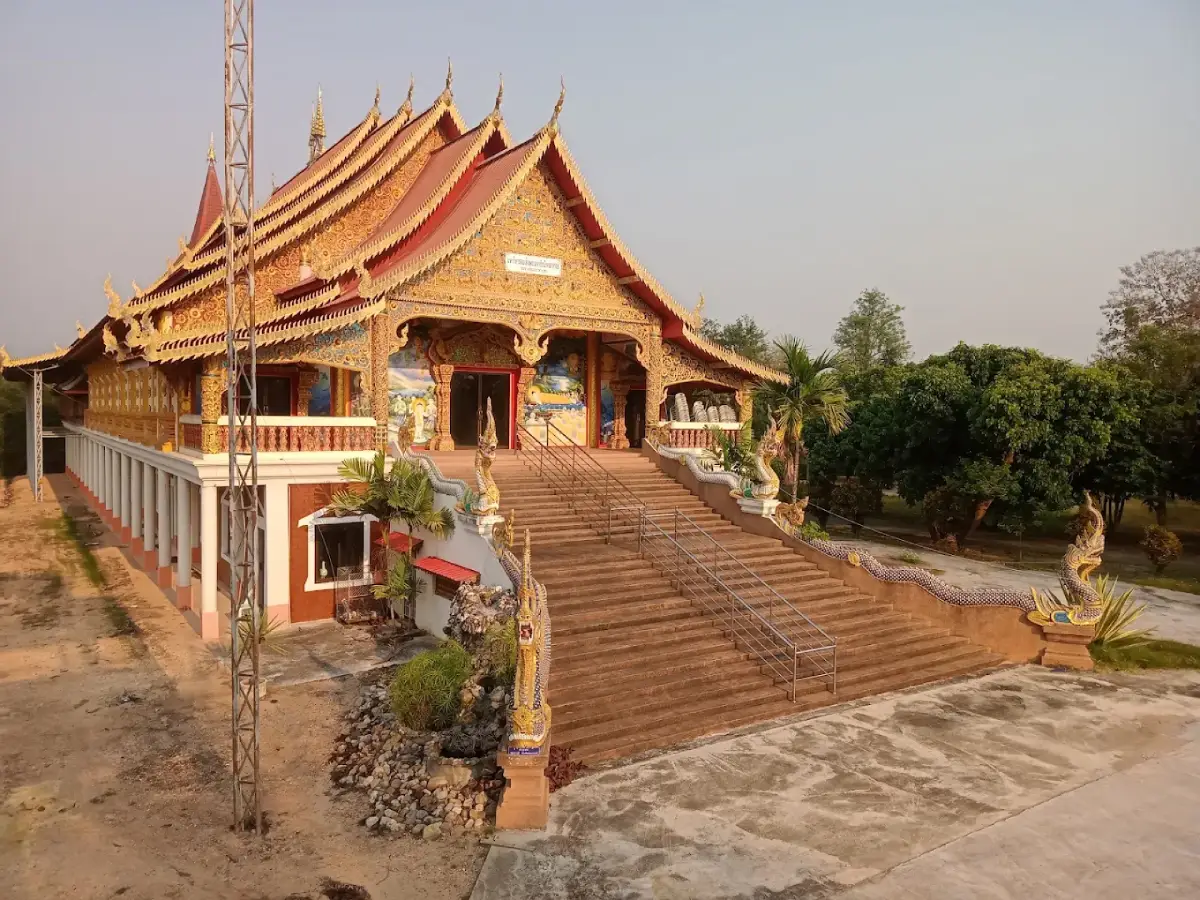
Wat Sahakon Plaeng Song
Operating day: Daily
Operating time: 08.00 - 17.00
Wat Sahakon Plaeng Song is a private-sector Buddhist temple under the Mahanikaya order in Ban Sahakon Plaeng Song, Moo 6, Khuean Phak Subdistrict, Phrao District, Chiang Mai Province. The temple covers about 16 rai of land, which was permitted for use by the Department of Cooperative Promotion. Wat Sahakon Plaeng Song is important because it stands within a cooperative-settlement community and on the site of an old abandoned temple associated with Phra Chao Luang. His Majesty the King visited local residents and granted royal funds for the construction of the temple. The temple also includes Sala Ruam Jai, a community hall created for public service, making it a spiritual, cultural, and community learning center for Ban Sahakon Plaeng Song.
Khuean Phak Subdistrict is located in Phrao District, Chiang Mai Province. It is a rural area connected with the Mae Ngat River, forests, farming land, and cooperative-settlement history. The older communities of the subdistrict include Ban Phae, Ban Sai Mun, and Ban Khuean Phak, while several other villages were established through government land allocation under the cooperative settlement system. Ban Sahakon Plaeng Song is one of these important settlement communities. Wat Sahakon Plaeng Song therefore reflects not only Buddhist faith but also the social history of settlement, land allocation, and community formation in Phrao.
Ban Sahakon Plaeng Song is one of the larger communities in Khuean Phak Subdistrict. Local development information records 515 residents and 288 households in the village. Because many residents came from different subdistricts and districts through the cooperative settlement process, the temple became especially important as a shared spiritual space. It gave the new community a place for worship, merit-making, Buddhist ceremonies, meetings, and the creation of common identity.
The history of Wat Sahakon Plaeng Song is closely connected with the former abandoned temple area known as Phra Chao Luang, or Dong Phra Chao Luang. During land preparation for the temple, several old objects were found, including fragments of Buddha images, pottery, and brass objects. These discoveries show that the site had earlier religious significance before the modern cooperative village was formed. Wat Sahakon Plaeng Song therefore has two layers of meaning: it is a Buddhist temple of a modern settlement community, and it preserves traces of an older sacred site.
The discovery of religious and cultural objects gives the temple a historical depth beyond that of an ordinary village temple. Fragments of Buddha images, pottery, and brass objects point to previous Buddhist use of the site. Although the full history of the abandoned temple is not completely documented, the preservation of these objects in the temple’s local museum helps keep community memory alive. The temple therefore functions as both a living Buddhist institution and a place of local heritage preservation.
Another major point of significance is the temple’s connection with royal benevolence. His Majesty the King visited local residents and granted royal funds for the construction of the temple. For the community, this story represents care for rural people and support for the creation of a spiritual center. The temple’s history is therefore tied not only to local faith but also to a remembered moment of royal support that remains meaningful for local residents.
Sala Ruam Jai is an important structure connected with the temple’s community role. A hall of this type is more than a multipurpose building. It serves as a place for meetings, merit-making, Dhamma listening, community events, and shared activities. The name “Ruam Jai,” meaning “uniting hearts,” matches the history of the village, where people from different places came together to build a new community. The hall and the temple helped give the village a common center.
Wat Sahakon Plaeng Song is a private-sector temple, meaning that local residents play a major role in supporting and maintaining it. The temple is sustained through community faith, merit-making, temple care, Buddhist festivals, support for monks, and participation in religious activities. This makes the temple closely connected with the everyday and annual life of Ban Sahakon Plaeng Song.
Today, Wat Sahakon Plaeng Song serves as a community learning center for culture and local wisdom. This role is especially important in a village formed by people from different areas. A learning center helps preserve village history, local knowledge, traditions, and the memory of the settlement process. The temple is therefore not only a place for worship but also a place where children, youth, and residents can learn about the roots of their community.
The learning role of the temple connects the past and present. The old objects found at the abandoned temple site, the story of settlement land allocation, the development of the village, and Buddhist traditions can all be passed on through community learning activities. Visitors therefore encounter not only religious buildings but also the story of how people built a village, a temple, and a shared identity.
Wat Sahakon Plaeng Song continues to organize activities that promote morality and ethics. Such activities are important in rural communities because the temple is a trusted and accessible public space. Moral and ethical programs can help children, youth, and adults learn responsibility, gratitude, compassion, peaceful coexistence, and the practical use of Buddhist principles in daily life.
The Sunday Buddhist education center is another important part of the temple’s role. It gives children and young people opportunities to learn Buddhist teachings, temple manners, chanting, worship practices, Buddhist history, and proper conduct in religious spaces. This makes the temple an ongoing educational space and helps younger generations stay connected with Buddhism and local culture.
Wat Sahakon Plaeng Song also supports cultural and traditional preservation. It is suitable for Buddhist holy day merit-making, Pha Pa, Kathin, Dhamma listening, Northern Thai New Year activities, Loy Krathong, and annual community merit-making events. Although public information does not document every annual event in detail, the temple’s role as a cultural and moral learning center clearly supports community religious and cultural life throughout the year.
During merit-making events, the temple becomes a place of community cooperation. People prepare the grounds, cook food, offer meals to monks, receive blessings, listen to Dhamma, and meet relatives and neighbors. These activities help strengthen unity, especially in a settlement community where people originally came from many different places. The temple gives residents a shared spiritual root and a shared memory.
The temple is also an important public space for the village. Ban Sahakon Plaeng Song is part of a wider local system that includes schools, farming land, roads, water resources, and community services. The temple links these physical elements with the emotional and spiritual life of residents. When the village needs a place for faith, meetings, ceremonies, or cultural transmission, Wat Sahakon Plaeng Song provides that central space.
Wat Sahakon Plaeng Song is suitable for travelers interested in community temples, cooperative settlement history, royal development memory, and Buddhist cultural learning. Visitors can pay respect, make merit, observe the community atmosphere, learn about the abandoned Phra Chao Luang temple area, and understand the temple’s role as a center for culture and local wisdom. The value of the visit lies in community history and living faith rather than only photography.
Wat Sahakon Plaeng Song can be combined with nearby temples and local attractions in Khuean Phak Subdistrict and Phrao District. Nearby places include Wat Khuean Phak, Wat Huai Bong, Wat Samakkhi Tham, Phra That Dok Kham, Nong Hiang Reservoir, Huai Mae Lat Reservoir, and Wat Tham Dok Kham. This route allows visitors to experience village temples, Buddhist heritage, community reservoirs, and the rural landscape of Phrao in one trip.
Getting There is most convenient by private car, rental car, or local hired transport. From Chiang Mai city, travel toward Phrao District, then continue into Khuean Phak Subdistrict and Ban Sahakon Plaeng Song, Moo 6. Travelers can search for “Wat Sahakon Plaeng Song, Khuean Phak, Phrao, Chiang Mai” in a map application before departure to plan the most suitable route.
From Phrao town, reaching Khuean Phak Subdistrict is easier than traveling from Chiang Mai city. Visitors who want to explore several places in one day can begin at Wat Sahakon Plaeng Song, then continue to Wat Khuean Phak, Wat Huai Bong, Phra That Dok Kham, and nearby reservoirs. Food and café stops in the Phrao area can be added to make the route more comfortable.
Visitors should dress modestly, speak quietly, respect monks and local worshippers, avoid entering private monastic areas, and avoid touching local heritage objects without permission. Photographs should be taken respectfully, especially around Buddha images, halls, and religious activities. Because the temple is an active community space, a visit should be based on respect for both the temple and the village’s history.
In summary, Wat Sahakon Plaeng Song is a Mahanikaya private-sector temple in Ban Sahakon Plaeng Song, Moo 6, Khuean Phak Subdistrict, Phrao District, Chiang Mai Province. The temple covers about 16 rai on land permitted for use by the Department of Cooperative Promotion. It stands on the former Phra Chao Luang temple area and is associated with royal support for temple construction. Today, it serves as a community cultural and local wisdom learning center, promotes morality and ethics, preserves local traditions, and runs a Sunday Buddhist education center. It is suitable for worship, merit-making, learning about community history, and joining a wider temple route through Phrao District.
| Name | Wat Sahakon Plaeng Song |
| Location | Ban Sahakon Plaeng Song, Moo 6, Khuean Phak Subdistrict, Phrao District, Chiang Mai Province |
| Address | Moo 6, Ban Sahakon Plaeng Song, Khuean Phak Subdistrict, Phrao District, Chiang Mai 50190, Thailand |
| Temple Type | Private-Sector Buddhist Temple, Mahanikaya Order |
| Temple Area | About 16 rai |
| Temple Land | Land permitted for use by the Department of Cooperative Promotion |
| Highlights | Temple on the former Phra Chao Luang abandoned temple site, royal support story, Sala Ruam Jai, community culture and wisdom learning center, and Sunday Buddhist education center |
| Community Context | Ban Sahakon Plaeng Song is a cooperative-settlement village formed through land allocation, with residents from multiple areas settling together |
| Moo 6 Community | Ban Sahakon Plaeng Song has 515 residents and 288 households according to local development information |
| History | Located on the former Phra Chao Luang temple area, where fragments of Buddha images, pottery, and brass objects were found during land preparation |
| Royal Connection | His Majesty the King visited local residents and granted royal funds for the construction of the temple |
| Main Areas / Zones | Buddha worship area, Sala Ruam Jai, temple courtyard, merit-making area, sermon area, community culture and wisdom learning center, and Sunday Buddhist education activity area |
| Religious And Community Role | Spiritual center for local residents, merit-making place, Dhamma listening area, moral and ethical learning space, tradition-preservation center, and local wisdom learning site |
| Important Activities / Ceremonies | Buddhist holy day merit-making, Pha Pa, Kathin, Dhamma sermons, morality and ethics activities, Sunday Buddhist education, and annual Lanna community merit-making events |
| Travel Information | Best reached by private car, rental car, or local hired transport from Chiang Mai toward Phrao District, then into Khuean Phak Subdistrict and Ban Sahakon Plaeng Song, Moo 6 |
| Current Status | Listed in temple directories, local information, and travel references; no public record found indicating permanent closure |
| Nearby Tourist Attractions | 1. Wat Khuean Phak, about 8 km 2. Wat Huai Bong, about 8 km 3. Nong Hiang Reservoir, about 9 km 4. Phra That Dok Kham, about 10 km 5. Huai Mae Lat Reservoir, about 12 km 6. Wat Tham Dok Kham, about 18 km |
| Nearby Restaurants | 1. Nong Prince Chicken Rice, about 1 km, Tel. 094-559-0182 2. Rain Tree Cafe, about 8 km, Tel. 087-660-0933 3. 135 Cafe, about 9 km, Tel. 083-549-6399 4. Jin Jum And Made-To-Order Food, about 10 km, Tel. 053-475-209 5. Krua Jae Kee, about 11 km, Tel. 084-488-8560 6. Krua Ban Mong, about 12 km, Tel. 099-345-0782 |
| Nearby Accommodations | 1. PK Hotel / PK Hostel, about 8 km 2. Phrao Boutique Hotel, about 9 km 3. Inthang Boutique Hotel, about 10 km, Tel. 084-849-5725 4. Phrao Camping Village, about 13 km, Tel. 091-564-2641 5. Mae Wan Resort, about 20 km |
Frequently Asked Questions (FAQ)
Q: Where is Wat Sahakon Plaeng Song located?
A: Wat Sahakon Plaeng Song is located in Ban Sahakon Plaeng Song, Moo 6, Khuean Phak Subdistrict, Phrao District, Chiang Mai Province 50190.
Q: Why is Wat Sahakon Plaeng Song important?
A: The temple is a Mahanikaya community temple covering about 16 rai. It serves as a spiritual center, cultural and local wisdom learning center, and Sunday Buddhist education center for Ban Sahakon Plaeng Song.
Q: How is the temple connected with the former Phra Chao Luang temple site?
A: The temple stands on the former Phra Chao Luang abandoned temple area, where fragments of Buddha images, pottery, and brass objects were found during land preparation.
Q: What is the royal connection of Wat Sahakon Plaeng Song?
A: His Majesty the King visited local residents and granted royal funds for the construction of the temple, and Sala Ruam Jai was created as a community service hall.
Q: What kind of visit is Wat Sahakon Plaeng Song suitable for?
A: It is suitable for worship, merit-making, learning about cooperative settlement history, studying local wisdom, and joining a temple route through Phrao District.
Q: What activities does Wat Sahakon Plaeng Song support?
A: The temple supports morality and ethics activities, cultural preservation, Sunday Buddhist education, Buddhist holy day merit-making, Pha Pa, Kathin, and annual community merit-making events.
Q: How can travelers get to Wat Sahakon Plaeng Song?
A: The most convenient way is by private car, rental car, or local hired transport from Chiang Mai toward Phrao District, then into Khuean Phak Subdistrict and Ban Sahakon Plaeng Song, Moo 6.
Q: What places can be visited together with Wat Sahakon Plaeng Song?
A: Nearby places include Wat Khuean Phak, Wat Huai Bong, Nong Hiang Reservoir, Phra That Dok Kham, Huai Mae Lat Reservoir, and Wat Tham Dok Kham.
 Category: ●Places of Worship
 Group: ●Temple
Last Update : 2 DayAgo
 Last Update : 2 DayAgo
 Click to Access the Navigation Map GPS
Wat Sahakon Plaeng Song Map
Recommend

 Muang Chiang Mai(121)Chom Thong(47)Mae Chaem(25)Chiang Dao(33)Doi Saket(68)Mae Taeng(85)Mae Rim(69)Samoeng(29)Fang(71)Mae Ai(59)Phrao(70)San Pa Tong(103)San Kamphaeng(66)San Sai(73)Hang Dong(74)Hot(32)Doi Tao(22)Omkoi(11)Saraphi(74)Wiang Haeng(15)Chai Prakan(28)Mae Wang(32)Mae On(22)Doi Lo(34)Galyani Vadhana(1)


