
lovethailand home >North Travel Attractions >Chiang Mai Travel Attractions >Doi Lo >Santi Suk > Wat Pa Suan Tham Rot
TL;DR: Wat Pa Suan Tham Rot is located at Ban Santi Suk, Moo 6, Santi Suk Subdistrict, Doi Lo District, Chiang Mai 50160, Thailand, open Daily, hours 08.00 - 17.00.
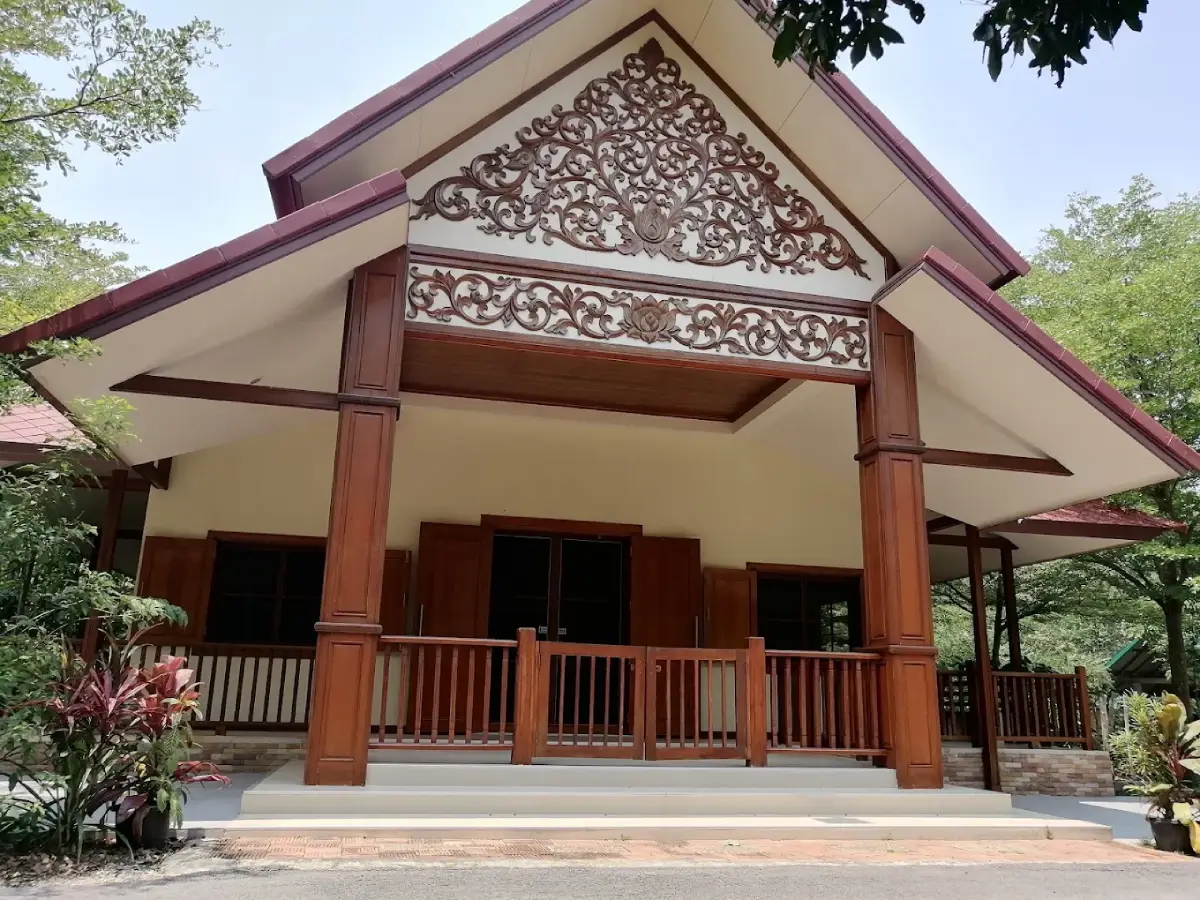
Wat Pa Suan Tham Rot
Open Days: Daily
Opening Hours: 08.00 - 17.00
Wat Pa Suan Tham Rot is a forest monastery in Ban Santi Suk, Moo 6, Santi Suk Subdistrict, Doi Lo District, Chiang Mai Province 50160. It is a public Buddhist temple belonging to the Dhammayut Nikaya tradition and is registered under temple code 650240401. The monastery developed from a small monastic residence and meditation setting before receiving formal temple status on 20 June 2013. It later received a royal Wisungkhamsima boundary measuring 20 meters by 40 meters, allowing formal Sangha ceremonies to be conducted within the designated sacred area.
The temple occupies approximately 46 rai according to current general information about the property. Its size gives Wat Pa Suan Tham Rot a noticeably different atmosphere from compact village monasteries located directly beside busy roads. The grounds allow more separation between monastic life and the outside community, helping preserve the quiet environment associated with the Thai forest tradition.
Early accounts of the monastery mention approximately 15 rai of land donated by local Buddhist supporters during the formative period. The land was associated with Thailand's agricultural land-reform system, and the community worked through the necessary land-use process as the monastic residence developed toward official temple status. The history therefore reflects a gradual community-led development rather than a single large construction project.
Formal establishment on 20 June 2013 was a major milestone. It placed Wat Pa Suan Tham Rot clearly within the Thai Sangha administration as a registered Dhammayut temple. Before that point, the site had already served as a monastic residence and place for meditation practice.
Wat Pa Suan Tham Rot belongs to the Dhammayut Sangha network in Doi Lo District together with other Dhammayut monasteries such as Wat Pa Santi Suk, Wat Huai Bong, Wat Phra Pa, and Wat Pa Rattana Suwan. Their presence demonstrates that Doi Lo's religious landscape includes both traditional Maha Nikaya village temples and forest-oriented Dhammayut monasteries.
This diversity is particularly visible in Santi Suk Subdistrict. Local Maha Nikaya temples include Wat Khanthawat, Wat Sila Mongkhon, Wat Nong Hiang, Wat Huai Din Chi, and Wat Mai Nong Hoi, while Wat Pa Suan Tham Rot and Wat Pa Santi Suk represent the Dhammayut tradition. Travelers interested in Thai Buddhism can therefore encounter different monastic traditions within a relatively small area.
During the monastery's early development, Phra Samphas Sambhaso was recorded as its first abbot. He was a Dhammayut monk whose practice was associated with the Thai forest tradition and the meditation lineage connected with Luang Pu Sim Buddhacaro of Wat Tham Pha Plong in Chiang Mai. At that time, the monastery emphasized practical training and meditation more strongly than formal classroom-style instruction.
The daily rhythm of the monastery during this early period included scheduled reading, meditation practice, and monastic duties. This approach reflects an important characteristic of forest monasteries: spiritual training is integrated into ordinary daily activity rather than separated into occasional religious events.
Study also had a role in the community. The monastery maintained copies of the Tipitaka and sought additional editions for monks and lay Buddhists to read. There were plans to read Buddhist scriptures aloud during the rains retreat, Buddhist holy days, and communal merit-making occasions. This balance between scripture and meditation illustrates the relationship between study and direct practice within the monastery's early identity.
Wat Pa Suan Tham Rot is therefore a relatively modern temple whose value does not depend on architectural antiquity. Its distinctive character comes from creating a quiet contemporary environment where monastic discipline and meditation can be practiced close to a rural community.
Local residents historically also referred to the monastery as “Wat Pa Phae.” For travelers and modern navigation, however, the name Wat Pa Suan Tham Rot should be used consistently because it is the registered temple name and helps distinguish the monastery from other forest temples.
The surrounding area of Ban Santi Suk and Ban Mai Nong Hoi remains largely rural. Agricultural plots, village roads, schools, community facilities, and several monasteries are located nearby, but Wat Pa Suan Tham Rot lies far enough from the busiest village center to retain the quieter atmosphere expected of a forest monastery.
The temple is located at approximately 18.54459, 98.79076, with the Plus Code 7MCWGQVR+R8. It lies about one kilometer northwest of Santi Suk School and close to Wat Mai Nong Hoi, Wat Pa Rattana Suwan, and Wat Pong Cho.
Wat Pa Suan Tham Rot has received a royal Wisungkhamsima boundary measuring 20 by 40 meters. A Wisungkhamsima is an officially recognized monastic boundary used for formal acts of the Sangha, particularly ordination. Receiving this boundary marked another stage in the monastery's development from a local forest residence into a fully established Buddhist institution.
Detailed current architectural information for the ubosot, vihara, principal Buddha image, stupa, bell tower, and individual monastic buildings is not sufficiently documented for precise descriptions. Visitors should therefore approach the monastery primarily for its forest setting, contemplative character, and active religious life rather than expecting a catalog of historic monuments.
Quietness is the monastery's strongest quality. Travelers accustomed to famous urban temples may find the experience very different. There is no need to rush from one photographic landmark to another. Walking slowly, sitting quietly, listening to the natural surroundings, and minimizing phone use are more appropriate ways to experience the setting.
Visitors interested in meditation should pay particular attention to forest-monastery etiquette. Monks' residential areas should not be entered without permission, meditation periods should not be disturbed, phones should be silenced, and people should not be photographed without consent. Clothing should cover shoulders and knees and remain appropriate for a working monastic environment.
Morning is generally the best time to visit. The rural Doi Lo climate is cooler before midday, and the monastery is usually at its quietest. Travelers planning to stay for meditation should bring only essential personal items and avoid creating unnecessary work for the resident monastic community.
Published visiting hours are 08.00 to 17.00 daily. No official admission charge is listed, and visitors may make voluntary merit donations. Anyone intending to stay for several days, participate in a specific meditation program, or arrive with an organized group should coordinate in advance rather than treating the monastery as an ordinary sightseeing attraction.
Although the early practice orientation was associated with the lineage of Luang Pu Sim Buddhacaro, Wat Pa Suan Tham Rot was not formally established as a branch monastery of another temple. A shared meditation lineage should therefore be distinguished from administrative branch status.
The monastery is important to the surrounding community because it provides a local option for people seeking the atmosphere of a forest temple and the Dhammayut tradition without traveling far into the mountains or to Chiang Mai city. Its location combines accessibility with relative seclusion.
This role complements rather than replaces the surrounding Maha Nikaya village temples. Many local temples focus strongly on Lanna festivals, community ceremonies, stupas, and village merit-making, while Wat Pa Suan Tham Rot places greater emphasis on quiet practice and meditation. Together, these traditions create a more diverse Buddhist landscape in Santi Suk.
Wat Mai Nong Hoi is one of the nearest temples, approximately 2 km away by local road. Its history is closely connected with the development of a planned rural settlement and agricultural land allocation. Visiting both temples reveals the contrast between a village-based Maha Nikaya temple and a forest-oriented Dhammayut monastery.
Wat Pa Rattana Suwan lies approximately 3 km north of Wat Pa Suan Tham Rot and is another Dhammayut monastery in Doi Lo District. It is a useful addition for visitors specifically interested in the local forest-monastery network.
Wat Pong Cho is approximately 4 km to the southwest by local road. From the Pong Cho area, travelers can continue toward the reservoir and the western natural landscape of Santi Suk.
Wat Pa Santi Suk is another Dhammayut temple within the same subdistrict, approximately 5 km away. Visiting both monasteries provides a useful overview of forest-oriented Buddhism within Santi Suk.
Wat Khanthawat in Ban Thung Pui is approximately 7 km away. It is a Maha Nikaya community temple associated with local Lanna monastic history, making it a strong contrast to the forest practice environment of Wat Pa Suan Tham Rot.
For nature, Pha Chor in Mae Wang National Park is one of the most worthwhile nearby destinations. Its eroded earth cliffs and pillars create a striking natural landscape reached by a walking trail. A visit can combine a quiet morning at the forest monastery with an afternoon nature walk.
The Pha Chor Tourist Center and Huen Inthanin Visitor Center can provide information about current trail conditions, particularly during the rainy season. Visitors should carry drinking water and wear comfortable walking shoes.
Food and café options are concentrated closer to the communities and Highway 108 rather than directly at the monastery. TigerMother cafe provides a convenient café stop, while Auntie Tui's Northern Thai Sausage offers northern Thai food and local products. Tatonyon Coffee Bar provides a relaxed wooden-house café atmosphere, Fa Thani Noodle Shop is suitable for a simple meal, and Goy Bakery offers baked goods and drinks.
Because these businesses are spread along local roads and the main highway, private transportation is highly useful. Most practical food stops are roughly 6-12 km from the monastery depending on the route.
Accommodation options in the wider Doi Lo area include Pimprajan Homestay, Huan Janto Homestay, Green Tree Resort, De Aerng Boutique Hotel, and Chiang Mai Inthanon Golf and Natural Resort. Staying locally can be convenient for travelers continuing toward Chom Thong, Doi Inthanon, Mae Wang, or San Pa Tong.
Getting There is easiest by private car or rental car. From central Chiang Mai, travel south on Highway 108 through Hang Dong and San Pa Tong toward Doi Lo District. Turn into Santi Suk Subdistrict and continue toward Ban Santi Suk, Moo 6. The temple coordinates are approximately 18.54459, 98.79076.
The final section follows local village roads. Navigation is recommended, and drivers should reduce speed when passing homes and agricultural areas. Older directions to the monastery approached through the Huai Nam Khao–Ban Nong Hoi area before turning onto a smaller road toward the temple.
A practical half-day itinerary begins with one to two quiet hours at Wat Pa Suan Tham Rot, followed by Wat Mai Nong Hoi or Wat Pa Santi Suk and a meal along Highway 108. A full-day route can continue to Wat Khanthawat, Pha Chor, or other cultural attractions in Doi Lo.
The monastery should not be treated primarily as a photography stop. Loud music, unauthorized drone use, disruptive posing, or intrusive photography around meditation areas are inappropriate. Respect for silence is itself an important part of respecting a forest monastery.
Families may visit, but children should be guided to remain quiet around monastic areas. Older visitors should stay on easily accessible paths and avoid uneven or forested sections when mobility is limited.
Wat Pa Suan Tham Rot is particularly suitable for visitors interested in meditation, forest monasteries, the Dhammayut tradition, and Thai Buddhist practice. Its appeal comes from the atmosphere and the living discipline of the monastery rather than from monumental architecture.
The history of the monastery also illustrates the role of community support. The transition from a monastic residence to a registered temple required donated land, local Buddhist supporters, land-use administration, and sustained effort. Wat Pa Suan Tham Rot was therefore built through a long-term relationship between the Sangha and local laypeople.
The later Wisungkhamsima grant completed another institutional stage, allowing formal Sangha ceremonies within the designated sacred boundary. The monastery's development provides a clear example of how a modern Thai temple can grow from a local meditation residence into a fully recognized religious institution.
Compared with centuries-old Chiang Mai temples, Wat Pa Suan Tham Rot is relatively young. Its significance lies elsewhere: it demonstrates that a contemporary community can still create and preserve a quiet place devoted to meditation and monastic practice despite social and environmental change.
For travelers who want to understand Doi Lo beyond its role as a route toward Doi Inthanon, Wat Pa Suan Tham Rot adds an important dimension. The district includes not only agriculture, Lanna village temples, and natural attractions but also a functioning network of Dhammayut forest monasteries.
Wat Pa Suan Tham Rot is therefore best suited to travelers seeking quiet, Buddhist meditation, and an authentic forest-monastery environment. Its identity comes from the landscape, its gradual development, and its emphasis on spiritual practice rather than the number or scale of its buildings.
| Name | Wat Pa Suan Tham Rot |
| Type | Public Forest Monastery |
| Buddhist Tradition | Dhammayut Nikaya |
| Temple Code | 650240401 |
| Location | Ban Santi Suk, Moo 6, Santi Suk Subdistrict, Doi Lo District, Chiang Mai 50160, Thailand |
| Coordinates | 18.54459, 98.79076 |
| Plus Code | 7MCWGQVR+R8 |
| Temple Area | Approximately 46 rai |
| Early Land Record | Early history mentions approximately 15 rai donated by local Buddhist supporters |
| Official Establishment | 20 June 2013 |
| Wisungkhamsima | Royal boundary granted; 20 meters wide by 40 meters long |
| First Abbot | Phra Samphas Sambhaso |
| Early Practice Orientation | Dhammayut forest-monastery practice emphasizing meditation, discipline, scripture reading, and a practice lineage associated with Luang Pu Sim Buddhacaro |
| Main Character | Quiet forest setting suitable for merit-making, meditation, mindfulness, and learning about the Dhammayut forest tradition |
| Open Days | Daily |
| Opening Hours | 08.00 - 17.00 |
| Admission Fee | No official admission fee listed; voluntary merit donations are welcome |
| Getting There | Travel south from Chiang Mai on Highway 108 through Hang Dong and San Pa Tong toward Doi Lo, then continue into Santi Suk and Ban Santi Suk, Moo 6. Private car or rental car is recommended. |
| Nearby Attractions | 1. Wat Mai Nong Hoi, approximately 2 km 2. Wat Pa Rattana Suwan, approximately 3 km 3. Wat Pong Cho, approximately 4 km 4. Wat Pa Santi Suk, approximately 5 km 5. Wat Khanthawat, approximately 7 km 6. Pha Chor, Mae Wang National Park, approximately 8 km |
| Nearby Restaurants And Cafés | 1. TigerMother cafe, approximately 7 km, Tel. +66 96 685 1742 2. Auntie Tui's Northern Thai Sausage, approximately 8 km, Tel. +66 81 322 8448 3. Tatonyon Coffee Bar, approximately 8 km, Tel. +66 99 782 9361 4. Fa Thani Noodle Shop, approximately 8 km 5. Goy Bakery, approximately 11 km, Tel. +66 91 079 2533 |
| Nearby Accommodation | 1. Pimprajan Homestay, approximately 7 km, Tel. +66 90 885 1545 2. Huan Janto Homestay, approximately 8 km, Tel. +66 94 683 0659 3. Green Tree Resort, approximately 10 km, Tel. +66 63 383 3183 4. De Aerng Boutique Hotel, approximately 13 km, Tel. +66 61 316 0822 5. Chiang Mai Inthanon Golf and Natural Resort, approximately 15 km, Tel. +66 52 001 645 |
Frequently Asked Questions (FAQ)
Q: Where is Wat Pa Suan Tham Rot located?
A: Wat Pa Suan Tham Rot is located in Ban Santi Suk, Moo 6, Santi Suk Subdistrict, Doi Lo District, Chiang Mai Province 50160. Its approximate coordinates are 18.54459, 98.79076.
Q: Which Buddhist tradition does Wat Pa Suan Tham Rot belong to?
A: Wat Pa Suan Tham Rot is a public temple of the Dhammayut Nikaya tradition and is registered under temple code 650240401.
Q: When was Wat Pa Suan Tham Rot officially established?
A: The monastery received formal temple status on 20 June 2013 after developing from an earlier monastic residence and meditation site.
Q: What is special about Wat Pa Suan Tham Rot?
A: Its main appeal is the quiet forest-monastery atmosphere, suitable for merit-making, meditation, mindfulness, and learning about the Dhammayut forest tradition rather than conventional monument-focused sightseeing.
Q: Is Wat Pa Suan Tham Rot connected with the Luang Pu Sim lineage?
A: The first abbot, Phra Samphas Sambhaso, practiced in a forest-monastery tradition associated with Luang Pu Sim Buddhacaro of Wat Tham Pha Plong. Wat Pa Suan Tham Rot itself was not established as a formal branch temple of Wat Tham Pha Plong.
Q: What are the opening hours and admission fee?
A: The temple is open daily from 08.00 to 17.00. No official admission fee is listed, and visitors may make voluntary merit donations.
Q: How should visitors behave at the monastery?
A: Visitors should dress modestly, speak quietly, avoid entering monks' residential areas without permission, silence mobile phones, and avoid disturbing meditation or monastic activities.
Q: What can be visited after Wat Pa Suan Tham Rot?
A: Nearby options include Wat Mai Nong Hoi, Wat Pa Rattana Suwan, Wat Pong Cho, Wat Pa Santi Suk, Wat Khanthawat, and Pha Chor in Mae Wang National Park.
 Category: ●Places of Worship
 Group: ●Temple
Last Update : 2 DayAgo
 Last Update : 2 DayAgo
 Click to Access the Navigation Map GPS
Wat Pa Suan Tham Rot Map
Recommend

 Muang Chiang Mai(121)Chom Thong(47)Mae Chaem(25)Chiang Dao(33)Doi Saket(68)Mae Taeng(85)Mae Rim(69)Samoeng(29)Fang(71)Mae Ai(59)Phrao(70)San Pa Tong(103)San Kamphaeng(66)San Sai(73)Hang Dong(73)Hot(32)Doi Tao(22)Omkoi(11)Saraphi(74)Wiang Haeng(15)Chai Prakan(28)Mae Wang(32)Mae On(22)Doi Lo(33)Galyani Vadhana(1)


