
lovethailand home >North Travel Attractions >Chiang Mai Travel Attractions >Doi Lo >Song Khwae > Wat Hua Khuang
TL;DR: Wat Hua Khuang is located at Ban Hua Khuang, Moo 6, Song Khwae Subdistrict, Doi Lo District, Chiang Mai Province, open Daily, hours 08.00 - 17.00.
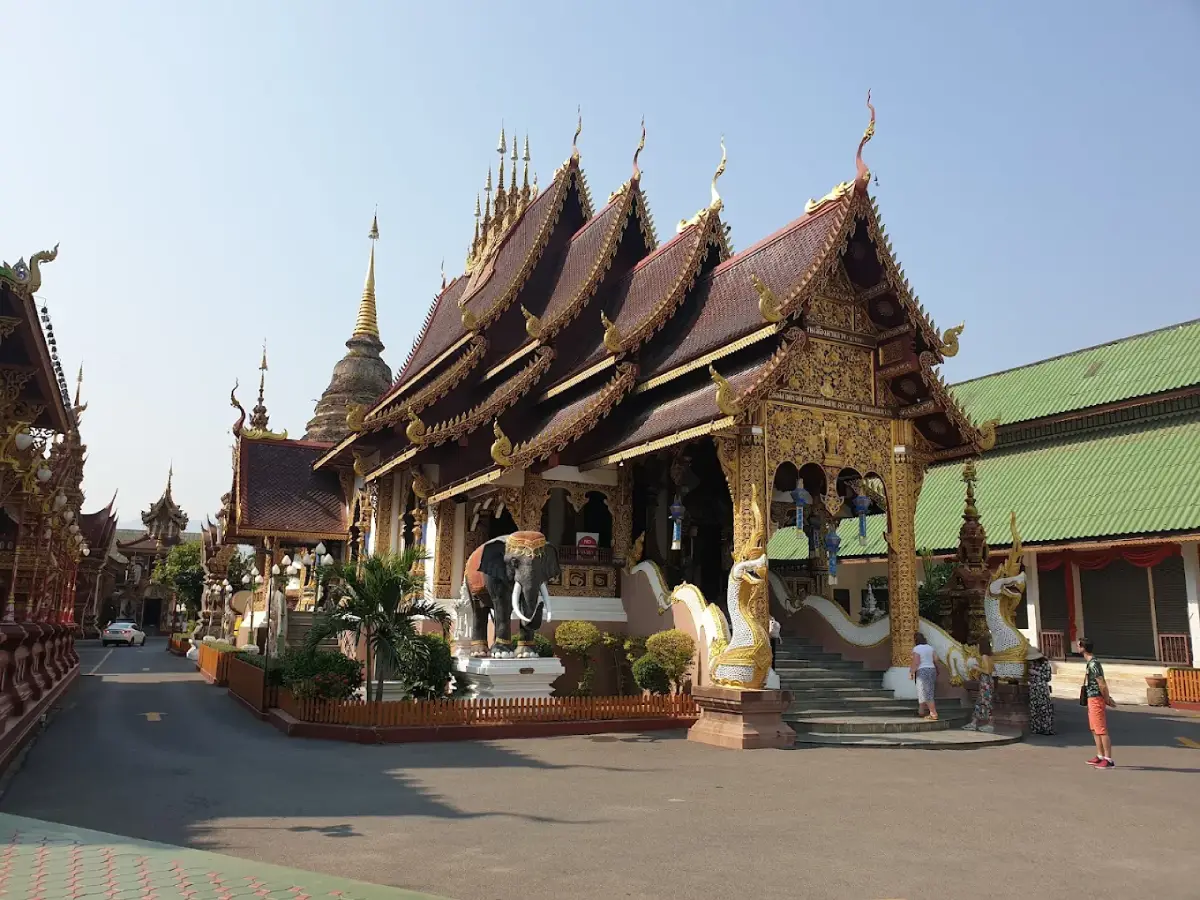
Wat Hua Khuang
Open Days: Daily
Opening Hours: 08.00 - 17.00
Wat Hua Khuang is a community Buddhist temple at 60 Moo 6, Ban Hua Khuang, Song Khwae Subdistrict, Doi Lo District, Chiang Mai Province. Affiliated with the Maha Nikaya tradition, the temple is closely connected with the history of a riverside Lanna community along the Ping River. Its significance extends beyond its vihara, chedi, monks' residences, and practical temple structures. The story of Wat Hua Khuang begins with a community open ground, or “khuang” in the Northern Thai language, which once stood beside a river landing used by timber merchants and people traveling by water.
Wat Hua Khuang is one of the Buddhist temples serving Song Khwae Subdistrict, where Buddhism and Lanna cultural traditions remain important parts of community life. Other temples in the subdistrict include Wat Lang Tham, Wat Thung O, Wat Song Khwae, Wat Pa Lan, and Wat Khong Khao. Their distribution among different villages reflects a traditional northern Thai settlement pattern in which the temple functions not only as a religious institution but also as a community landmark and gathering place.
The village now known as Ban Hua Khuang was formerly called Ban Tha Pi. The settlement developed close to the Ping River, where a broad open area lay beside a river landing. In Northern Thai usage, an open communal ground is called a “khuang.” Such spaces could serve as places for gathering, shared activities, and public use. The river landing at Ban Tha Pi was particularly important because the Ping River once served as a major transport route through northern Thailand. Timber merchants and travelers moving by boat regularly stopped at this riverside area.
The origin of Wat Hua Khuang is associated with an unnamed Buddhist monk who traveled to the village on a pilgrimage from Wat Saen Mueang Ma Luang in Chiang Mai city. Wat Saen Mueang Ma Luang is also known as Wat Hua Khuang. When the monk reached Ban Tha Pi and saw the open riverside ground, he considered the area suitable for a religious site. Local residents developed strong faith in the monk, and the community joined together to dedicate the riverside ground for the construction of a temple.
The name “Wat Hua Khuang” is traditionally explained in two related ways. First, the monk connected with the foundation of the temple had come from another temple known as Wat Hua Khuang in Chiang Mai city, so the familiar name was carried to the new monastery. Second, the temple stood on a khuang, or open ground, near the head of the village. The combination of the geographical position and the Lanna term for the communal open space created the name Hua Khuang, which eventually became associated with both the temple and the surrounding village.
The word “khuang” is important for understanding the cultural meaning of the site. In traditional Lanna communities, an open ground was more than unused space. It could be a place where residents met, organized activities, and shared public life. Wat Hua Khuang therefore represents a transformation of communal space: an open ground beside a river landing gradually became a Buddhist religious center. The temple name preserves the memory of the original landscape, transportation network, and village organization.
After the temple was established, monks and novices continued to reside at the site. Local historical records published by Song Khwae Municipality mention 5 December 1882 in the section describing official permission for the temple's establishment. Wat Hua Khuang therefore has a documented history stretching back more than a century and has developed alongside Ban Hua Khuang and the wider Song Khwae community.
Another local historical account describes the temple as having existed for roughly two centuries and mentions that the site was once abandoned before being revived by a monk who had traveled from Wat Hua Khuang in Chiang Mai city. These community traditions and administrative records together show that the temple's history contains several layers of local memory. Rather than reducing the story to a single founding episode, Wat Hua Khuang is best understood as a religious site that evolved over time through the relationship between monks, villagers, and the surrounding landscape.
Wat Hua Khuang belongs to the Maha Nikaya monastic order. The temple grounds cover approximately 1 rai, 1 ngan, and 86 square wah. Historical property descriptions record public-access land along several sides of the temple grounds, reinforcing the character of Wat Hua Khuang as a monastery embedded within a village rather than an isolated religious complex.
Confirmed structures within the temple grounds include a vihara, monks' residences, a chedi, and a water-supply tank. These elements illustrate the practical layout of a functioning rural Buddhist monastery. Wat Hua Khuang was not designed primarily as a tourist attraction. Its buildings serve religious, residential, and community purposes, giving visitors an opportunity to experience a living village temple rather than a monumental heritage complex.
The vihara is one of the central religious buildings and functions as a place for worship, merit-making, and communal Buddhist activities. Visitors should begin their visit respectfully in this area, taking time to observe the religious setting before moving through the rest of the grounds. In many northern Thai temples, the vihara plays an especially important role in everyday community Buddhism.
The temple's chedi is another confirmed sacred structure. Reliable information is not currently sufficient to state its construction date, exact architectural classification, or the nature of any relics associated with it. For this reason, no unsupported architectural description should be attached to the structure. Its presence nevertheless forms an important part of the temple's religious landscape alongside the vihara and monks' residences.
The monks' residences are working residential spaces rather than visitor facilities. Travelers should not enter these areas without permission and should keep noise to a minimum. Wat Hua Khuang continues to function as a religious site, so visitor behavior should be based on respect for monastic life rather than the expectations of a commercial attraction.
The temple's water-supply structure may appear less visually significant than the vihara or chedi, but it illustrates the practical side of a community monastery. Temples require everyday infrastructure for resident monks, religious events, community activities, and maintenance. Seeing these practical elements alongside sacred structures provides a more complete understanding of how rural Buddhist temples operate as living institutions.
One of the most significant aspects of Wat Hua Khuang's history is its relationship with the Ping River. The story of the riverside khuang and the landing used by timber merchants recalls a period when rivers were essential transportation corridors in northern Thailand. Before modern road networks became dominant, the Ping River connected communities, trade routes, and settlements. The location of the temple is therefore tied to the wider economic and social geography of the region.
Seen from this perspective, Wat Hua Khuang forms part of a broader cultural landscape along the Ping River. A river landing used by travelers developed into a communal ground, and that ground eventually became a religious site. The sequence reveals how geography, trade, settlement, and Buddhism could interact in a northern Thai village. Visitors interested in local history can therefore read the story of Ban Hua Khuang not only through buildings but also through the meaning of the place name itself.
The temple also has a historical naming connection with Wat Saen Mueang Ma Luang, also known as Wat Hua Khuang, in Chiang Mai city. The monk in the local foundation story came from that monastery. The name Hua Khuang is found at a number of temples across the former Lanna cultural region, often connected with communal grounds or urban open spaces. This broader pattern makes the Doi Lo temple especially interesting for travelers studying Lanna place names and settlement history.
In Ban Hua Khuang, the name of the temple and the name of the village have become closely intertwined. The earlier name Ban Tha Pi recalls the riverside settlement, while Hua Khuang records the open ground at the head of the village and the Buddhist institution that emerged there. Studying the village name and temple history together provides a clearer picture of local development than examining the temple buildings alone.
Song Khwae Municipality's historical record lists a number of former abbots associated with Wat Hua Khuang, including Khruba Ta Thawaro, Phra Kui, Phra Sunthon, Phra Ba Kham, Phra Athikan Buntha Yatikaro, and Phra Athikan Bunsi Chawanapanyo. The published sequence later records Phra Khru Worakitti Phimon from 1984 onward. Because no sufficiently recent source confirms the current abbot in 2026, this article does not present any historical name as the present abbot.
The role of Wat Hua Khuang in Ban Hua Khuang is best understood through the continuing relationship between the monastery and local residents. A temple survives not simply through architecture but through people who worship there, maintain the grounds, support monks, and use the site as part of community life. Song Khwae is a predominantly Buddhist subdistrict with strong Lanna cultural traditions, giving the temple an important place within the cultural structure of the area.
Lanna community life commonly involves merit-making, Buddhist holy days, offerings, and seasonal religious traditions. However, no sufficiently current source provides a verified annual schedule for specific kathin, pha pa, tan kuai salak, stupa-bathing, or temple fair events at Wat Hua Khuang. Travelers wishing to attend a particular ceremony should therefore confirm local arrangements before making a special trip.
For visitors, the strongest reason to explore Wat Hua Khuang is the opportunity to experience a community temple whose history is connected with river transportation and the Lanna concept of communal space. Travelers interested in local history can see how a single place name links geography, trade, Buddhism, and village identity. Those visiting for religious purposes can experience a quieter environment than the major tourist temples of central Chiang Mai.
A respectful visit should begin around the vihara and central religious area before continuing toward the chedi and the rest of the compound. Visitors should ask permission before photographing monks or entering residential zones. Shoulders and knees should be covered, noise should be kept low, and no religious structures should be climbed. If ceremonies are taking place, travelers should remain outside restricted spaces unless invited to participate.
Wat Hua Khuang is particularly suitable for travelers who want to see Chiang Mai beyond the Old City and major tourism corridors. Doi Lo District offers a rural setting where temples remain closely connected with villages, agriculture, local roads, and everyday community life. The experience is especially appropriate for cultural travelers, Lanna heritage enthusiasts, photographers of local life, and visitors who prefer slow travel.
The temple can serve as a starting point for a cultural route through Song Khwae and nearby Doi Lo. Wat Thung O is approximately 0.6 km away, while Wat Khanthawat, also known as Wat Thung Pui, is around 2.1 km away. Wiang Tha Kan Ancient City lies approximately 5.3 km from the temple, while Wat Mai Phatthana and Wat Pa Amphawan are each roughly 5.4 km away.
Combining Wat Hua Khuang with Wiang Tha Kan creates an especially rewarding historical route. Wiang Tha Kan preserves archaeological evidence from the Hariphunchai and Lanna periods and provides a wider historical framework for settlement in the Ping River plain. Beginning with the intimate village history of Wat Hua Khuang and continuing to an ancient urban site allows travelers to see different scales of northern Thai history within a relatively compact area.
Several small restaurants and cafés are available close to the temple, making it practical to plan a half-day or full-day route without returning to central Chiang Mai for meals. Nearby options include Suk Him Na Café, Jai Cha Coffee, Baan Nok Khok Na Restaurant & Café, Phupha Coffee Bar, Tree Coffee, and ice coffee, most within approximately 0.8 to 2 km of the temple.
Accommodation within Doi Lo District is more limited than in central Chiang Mai but includes several local choices. Nearby options include Pimprajan Homestay, Huan Janto Homestay, Fortune Hotel Chiang Mai, Green Tree Resort, Baan Rai Inn, and De Aerng Boutique Hotel. These properties range from approximately 1 km to 10 km from the temple and may be useful for travelers continuing toward Chom Thong, Doi Inthanon, or San Pa Tong.
Getting There is easiest by private car or rental car. From central Chiang Mai, travel south along the Chiang Mai-Hot route through Hang Dong and San Pa Tong toward Doi Lo District. Continue into Song Khwae Subdistrict and Ban Hua Khuang, Moo 6. The temple is located at number 60. Approximate coordinates are 18.5107835, 98.8525750. Using both the temple name and “Song Khwae, Doi Lo” in navigation is important because several temples elsewhere in northern Thailand are also named Wat Hua Khuang.
Drivers should allow additional time for local village roads after leaving the main highway. Wat Hua Khuang is embedded in a community rather than positioned beside a major tourist road. Daytime travel is generally easier for navigation and is consistent with the published visiting hours of 08.00 to 17.00.
Public transport can bring travelers toward San Pa Tong or Doi Lo, after which local transportation is needed to reach Song Khwae and Ban Hua Khuang. Because connections between village temples and nearby attractions are limited, private transportation is considerably more practical for anyone planning to visit several places in one day.
Morning and late afternoon are the most comfortable periods for visiting, particularly during the warmer months. Visitors should avoid interrupting monastic activities and should follow local instructions if a ceremony is taking place. Wat Hua Khuang is an active religious environment rather than a staged tourist site, and this authenticity is one of its main attractions.
No current official source provides a clearly published admission fee for Wat Hua Khuang. For that reason, this article does not state that admission is free or assign a visitor fee. Travelers should follow any signs at the temple and may make voluntary merit donations according to personal preference.
An older cultural database lists the telephone number 053-367880 in connection with the temple, but no sufficiently recent independent source confirms that the number remains the correct public contact in 2026. It is therefore not presented as a current temple telephone number. Travelers requiring advance arrangements for ceremonies or special access should contact Song Khwae Municipality for updated local information.
Wat Hua Khuang remains listed as a Maha Nikaya temple in Doi Lo District, and Song Khwae Municipality continues to include it among the six Buddhist temples of the subdistrict at Ban Hua Khuang, Moo 6. The temple therefore remains an active religious site in the administrative and community records, with no current indication that it has permanently closed.
Overall, Wat Hua Khuang is a temple whose significance comes from place, memory, and community. Its name grew from the geography of an open communal ground at the head of a village. Its foundation story connects rural Doi Lo with Wat Saen Mueang Ma Luang in Chiang Mai city. The Ping River links the temple with older systems of transportation and trade. Together, these layers make Wat Hua Khuang a useful place for understanding Lanna cultural geography as well as Buddhist community life.
Travelers seeking a deeper view of Chiang Mai beyond famous temples and crowded attractions may find Wat Hua Khuang particularly rewarding. The most meaningful way to experience the temple is not to rush through a checklist of sights but to observe the relationship between the vihara, chedi, village roads, and surrounding community while understanding why the word “khuang” remains embedded in the identity of the place.
From an open riverside ground used by timber merchants and travelers to a Buddhist monastery serving Ban Hua Khuang, the site illustrates how Lanna communities transformed everyday landscapes into places of religious and social meaning. A visit to Wat Hua Khuang can therefore combine merit-making, local history, village culture, and a wider journey through Doi Lo, San Pa Tong, and the southern part of Chiang Mai Province.
| Name | Wat Hua Khuang |
| Type | Community Buddhist Temple, Maha Nikaya Tradition |
| Location | Ban Hua Khuang, Moo 6, Song Khwae Subdistrict, Doi Lo District, Chiang Mai Province |
| Address | 60 Moo 6, Song Khwae, Doi Lo, Chiang Mai 50160, Thailand |
| Coordinates | 18.5107835, 98.8525750 |
| Former Village Name | Ban Tha Pi |
| Name Origin | Linked both to a monk from Wat Saen Mueang Ma Luang, also known as Wat Hua Khuang, and to the Northern Thai word “khuang,” meaning an open communal ground, located at the head of the village |
| History | The temple developed from a riverside open ground beside the Ping River that had been used as a stopping place by timber merchants and water travelers. Local villagers and a pilgrim monk from Wat Saen Mueang Ma Luang established a temple on the site. Local historical records mention 5 December 1882 in the account of official permission for the temple. |
| Temple Area | 1 rai, 1 ngan, 86 square wah |
| Main Structures | Vihara, monks' residences, chedi, and water-supply tank |
| Highlights | Riverside khuang origin, historical connection with Wat Saen Mueang Ma Luang, and long-standing role as the community temple of Ban Hua Khuang |
| Community Context | Song Khwae is a predominantly Buddhist community with a strong connection to Lanna cultural traditions |
| Open Days | Daily |
| Opening Hours | 08.00 - 17.00 |
| Current Status | Still listed as a Maha Nikaya temple in Song Khwae Subdistrict, Doi Lo District, and included in current local institutional records |
| Travel Information | Drive south from Chiang Mai along the Chiang Mai-Hot route toward Doi Lo, then continue to Song Khwae Subdistrict and Ban Hua Khuang, Moo 6. Private car or rental car is the most convenient option. |
| Nearby Tourist Attractions | 1. Wat Thung O, approximately 0.6 km 2. Wat Khanthawat (Thung Pui), approximately 2.1 km 3. Wiang Tha Kan, approximately 5.3 km 4. Wat Mai Phatthana, approximately 5.4 km 5. Wat Pa Amphawan, approximately 5.4 km |
| Nearby Restaurants And Cafés | 1. Suk Him Na Café, approximately 0.8 km 2. Jai Cha Coffee, approximately 1.1 km, Tel. 083-263-5142 3. Baan Nok Khok Na Restaurant & Café, approximately 1.4 km, Tel. 065-464-3993 4. Phupha Coffee Bar, approximately 1.4 km, Tel. 083-822-7403 5. Tree Coffee, approximately 1.8 km 6. ice coffee, approximately 2 km, Tel. 082-529-4681 |
| Nearby Accommodations | 1. Pimprajan Homestay, approximately 1 km, Tel. 090-885-1545 2. Huan Janto Homestay, approximately 1.2 km, Tel. 094-683-0659 3. Fortune Hotel Chiang Mai, approximately 2.3 km, Tel. 093-185-5435 4. Green Tree Resort, approximately 6.2 km 5. Baan Rai Inn, approximately 8.4 km, Tel. 081-783-1315 6. De Aerng Boutique Hotel, approximately 10.1 km, Tel. 061-316-0822 |
Frequently Asked Questions (FAQ)
Q: Where is Wat Hua Khuang in Doi Lo located?
A: Wat Hua Khuang is located at 60 Moo 6, Ban Hua Khuang, Song Khwae Subdistrict, Doi Lo District, Chiang Mai Province 50160. Approximate coordinates are 18.5107835, 98.8525750.
Q: What is the origin of the name Wat Hua Khuang?
A: The name is linked to a monk from Wat Saen Mueang Ma Luang, another temple known as Wat Hua Khuang, and to the Northern Thai word “khuang,” meaning an open communal ground. The original khuang was located near the head of the village.
Q: What is the history of Wat Hua Khuang?
A: The area was formerly part of Ban Tha Pi beside the Ping River, where an open ground and river landing were used by timber merchants and travelers. A pilgrim monk from Wat Saen Mueang Ma Luang gained the support of local villagers, who then established a temple on the site.
Q: What can visitors see at Wat Hua Khuang?
A: Confirmed structures include the vihara, monks' residences, chedi, and water-supply structure. The temple's most distinctive cultural feature is its historical connection with a riverside khuang and Lanna village life.
Q: What are the opening hours of Wat Hua Khuang?
A: The published visiting hours are 08.00 to 17.00 daily.
Q: Is there an admission fee for Wat Hua Khuang?
A: No current official admission fee is publicly confirmed. Visitors should follow any information displayed at the temple and may make voluntary merit donations according to personal preference.
Q: What attractions can be combined with Wat Hua Khuang?
A: Nearby options include Wat Thung O, Wat Khanthawat, Wiang Tha Kan, Wat Mai Phatthana, and Wat Pa Amphawan. Wiang Tha Kan is particularly suitable for travelers interested in Hariphunchai and Lanna history.
Q: What is the best way to reach Wat Hua Khuang?
A: Private car or rental car is the most convenient choice. From Chiang Mai, travel south along the Chiang Mai-Hot route through San Pa Tong toward Doi Lo, then continue to Song Khwae Subdistrict and Ban Hua Khuang. Include “Doi Lo” in navigation searches to avoid confusion with other temples named Wat Hua Khuang.
 Category: ●Places of Worship
 Group: ●Temple
Last Update : 2 DayAgo
 Last Update : 2 DayAgo
 Click to Access the Navigation Map GPS
 Muang Chiang Mai(121)Chom Thong(47)Mae Chaem(25)Chiang Dao(33)Doi Saket(68)Mae Taeng(85)Mae Rim(69)Samoeng(29)Fang(71)Mae Ai(59)Phrao(70)San Pa Tong(103)San Kamphaeng(66)San Sai(73)Hang Dong(73)Hot(32)Doi Tao(22)Omkoi(11)Saraphi(74)Wiang Haeng(15)Chai Prakan(28)Mae Wang(32)Mae On(22)Doi Lo(33)Galyani Vadhana(1)


