
lovethailand home >North Travel Attractions >Chiang Mai Travel Attractions >Doi Lo >Song Khwae > Wat Lang Tham
TL;DR: Wat Lang Tham is located at Ban Mae Khan, Moo 1, Song Khwae Subdistrict, Doi Lo District, Chiang Mai Province, open Daily, hours 08.00 - 17.00.
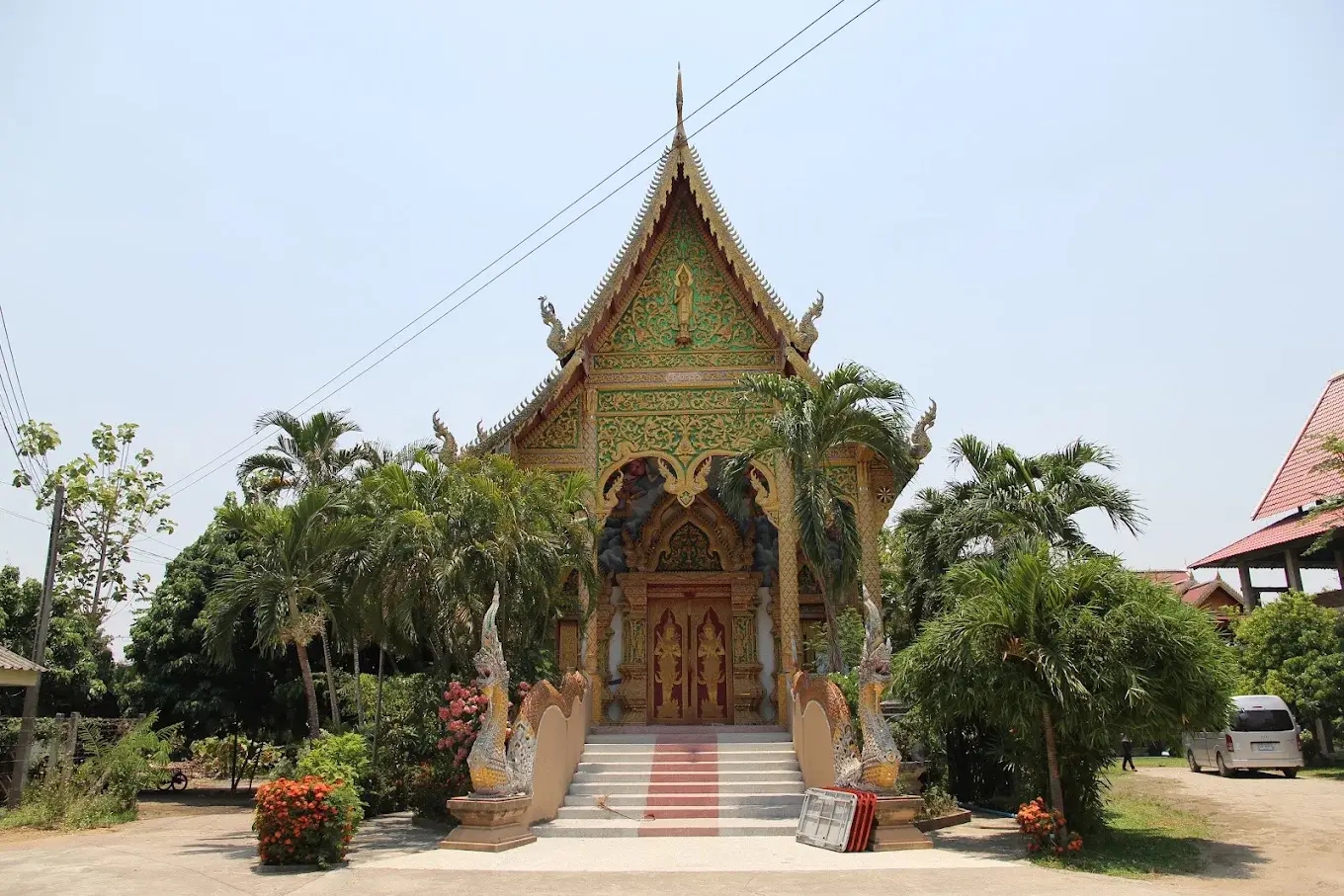
Wat Lang Tham
Open Days: Daily
Opening Hours: 08.00 - 17.00
Wat Lang Tham is a community Buddhist temple of the Maha Nikaya tradition located at 240 Moo 1, Ban Mae Khan, Song Khwae Subdistrict, Doi Lo District, Chiang Mai Province 50160. Established in 1938, the temple has a history closely connected with the religious, educational, and social life of the local community. Important structures and sacred objects include a vihara, a sermon hall, monks' residences, a bowl pavilion, a temple kitchen, a brass Buddha image in the Mara-Vijaya posture, a Phra Phuttha Chinnarat image, another Mara-Vijaya Buddha image, standing chief disciples, a chedi, and a traditional Lanna ceremonial drum.
Wat Lang Tham is particularly interesting not because it is a monumental tourist temple, but because its history reflects the close relationship between Buddhist temples, education, and rural communities in northern Thailand. The temple once served as a local school before the school was relocated and the temple entered a period of abandonment. In 1976, residents of the Mae Khan community worked together to restore the temple. This local revival makes Wat Lang Tham an important example of how a village temple can survive through community participation and religious devotion.
The main temple grounds cover 2 rai, 2 ngan, and 47 square wah. The registered temple property is surrounded by public-access land on all four sides. Wat Lang Tham also owns one additional monastic land plot measuring 2 ngan and 72 square wah. The eastern side of this additional land borders the Khan River, while the southern side adjoins a weir area and the western side borders a public route. The setting demonstrates the temple's close relationship with the surrounding settlement, local roads, and the water system of Ban Mae Khan.
Song Khwae Subdistrict is a predominantly Buddhist community in Doi Lo District where local life remains closely connected with Lanna cultural traditions. Temples continue to form an important part of the social landscape, functioning not only as religious sites but also as gathering places and community landmarks. Wat Lang Tham is located in Ban Mae Khan, Moo 1, and is one of the Buddhist temples in Song Khwae Subdistrict together with Wat Thung Tho, Wat Song Khwae, Wat Hua Khuang, Wat Pa Lan, and Wat Phra That Khong Khao.
Wat Lang Tham was founded in 1938. The name of its original founder is not recorded in the available historical account. During its early period, the temple served another important purpose by accommodating a school within the temple compound. This arrangement reflects the traditional role of Buddhist monasteries in rural Thailand, where temples historically functioned as places of worship, learning, and community organization before modern educational institutions became widely established.
The school was later moved to Santi Suk Subdistrict and became known as Ban Mae Khan School. After the school left the temple grounds, Wat Lang Tham eventually became abandoned. This period represents a major turning point in the temple's history, as a place that had once combined religious and educational functions temporarily lost its active role. However, the bond between the temple and the residents of Mae Khan did not disappear.
In 1976, villagers from the Mae Khan Lang Tham community joined together to renovate and re-establish the temple. Their collective effort restored Wat Lang Tham as a functioning Buddhist center. Phra Buntha from Wat Song Khwae was invited to become the first abbot after the restoration. The recorded succession continued with Phra Suthat as the second abbot, Phra Somphon as the third, Phra Athikan Duangkaeo Jiradhammo as the fourth, and Phra Athikan Srithai Pabhassaro as the fifth, recorded from 2003 onward.
This sequence—from the establishment of the temple in 1938, through its use as a school, its period of abandonment, and its community-led restoration in 1976—gives Wat Lang Tham a distinctive historical character. Unlike temples whose histories focus mainly on royal patronage or monumental architecture, Wat Lang Tham tells a local story shaped by the people of Ban Mae Khan themselves. Its survival demonstrates the continuing importance of Buddhist institutions in maintaining community identity.
The principal monastic buildings include the vihara, which serves as an important space for worship and Buddha images, a sermon hall used for religious and community activities, monks' residences, a bowl pavilion, and a temple kitchen. Together, these buildings reflect the practical organization of a rural Buddhist temple where spaces are required for monastic residence, religious ceremonies, communal gatherings, and merit-making activities.
Among the most important sacred objects is the brass principal Buddha image in the Mara-Vijaya posture. This posture, commonly seen in Thai Buddhist temples, represents the Buddha's victory over Mara before attaining enlightenment. Visitors may begin their visit by paying respect to the principal Buddha image before exploring other religious features within the temple compound.
Wat Lang Tham also houses a Phra Phuttha Chinnarat image, another Buddha image in the Mara-Vijaya posture, and standing images of the Buddha's chief disciples. These sacred figures add another layer of Buddhist artistic interest to the temple and demonstrate that Wat Lang Tham is more than simply a small village monastery. Its collection of devotional objects gives visitors an opportunity to observe forms of Buddhist imagery used in everyday religious practice in northern Thai communities.
A chedi is another important religious feature of Wat Lang Tham. Although reliable information about its construction date, architectural classification, or relics inside it is not available, its presence alongside the vihara and Buddha images contributes to the temple's traditional sacred landscape.
Another notable object is the temple's traditional Lanna ceremonial drum. Large drums have long been associated with Buddhist temples in northern Thailand and form part of the cultural environment of Lanna monasteries. At Wat Lang Tham, the drum provides a tangible connection between the temple and the wider cultural heritage of the Song Khwae community.
For travelers interested in local culture, Wat Lang Tham is best understood within the wider context of Song Khwae Subdistrict. Several temples are distributed among its villages, reflecting a traditional settlement pattern in which individual communities maintain their own Buddhist centers. Wat Lang Tham forms part of this network, while its 1976 restoration by local residents gives it a particularly strong community identity.
The temple name appears consistently in local temple records and map databases under the Thai name Wat Lang Tham and the English transliteration “Wat Lang Tham.” The temple is associated with Ban Mae Khan, Moo 1, and historical accounts of its restoration refer to the Mae Khan Lang Tham community. Travelers should include “Song Khwae, Doi Lo, Chiang Mai” when searching for the temple because other temples with similar names exist elsewhere in Thailand.
A visit can begin with paying respect to the principal Buddha image inside the religious area, followed by viewing the Phra Phuttha Chinnarat image, the Mara-Vijaya Buddha image, the standing chief disciples, the chedi, and the Lanna ceremonial drum. Visitors can then observe the temple's sermon hall and general compound. The experience is especially suitable for travelers interested in local temples, village history, Buddhism, and northern Thai cultural heritage rather than large-scale commercial attractions.
The atmosphere reflects the rural character of Doi Lo District and differs considerably from the major tourist temples of central Chiang Mai. Wat Lang Tham remains part of an active local community. Visitors should therefore dress respectfully, keep noise to a minimum, avoid entering monks' residential areas without permission, and ask before photographing monks or religious activities.
The temple's strongest connection with the community can be seen in its educational history. During its early years, the temple compound accommodated a local school, making the site both a religious and educational center. Even after the school moved away and the temple became abandoned, the community later returned to restore it. The 1976 reconstruction therefore represents more than the repair of buildings; it marks the recovery of a spiritual and social center for the people of Mae Khan.
Song Khwae remains strongly associated with Buddhism and Lanna cultural traditions. Local temples serve as places for merit-making, community gatherings, and religious observance. Although no sufficiently documented schedule for a specific annual festival at Wat Lang Tham is available, the temple clearly operates within the broader cultural environment of village Buddhism in Doi Lo District.
For travelers interested in local history, Wat Lang Tham offers a different type of cultural experience from Chiang Mai's famous monumental temples. Its importance lies in the story of ordinary villagers, local education, abandonment, and community restoration. This history helps visitors understand how rural Buddhist temples have remained central to northern Thai society and why local communities continue to invest effort in maintaining them.
Wat Lang Tham can also be included in a temple route around Song Khwae Subdistrict. Other temples in the same local area include Wat Thung Tho, Wat Phra That Khong Khao, Wat Song Khwae, Wat Hua Khuang, and Wat Pa Lan. Traveling by private car is the most practical way to connect these temples and explore the rural landscape of Doi Lo without returning to central Chiang Mai between stops.
Available grid-coordinate data indicates that Wat Thung Tho is the closest of these recorded temples to Wat Lang Tham, followed by Wat Phra That Khong Khao, Wat Song Khwae, Wat Hua Khuang, and Wat Pa Lan. This cluster provides a useful route for travelers who want to explore community temples rather than only the major tourist landmarks of Chiang Mai Province.
Getting There is easiest by private car or rental car. From central Chiang Mai, travel south toward Doi Lo District before continuing into Song Khwae Subdistrict and Ban Mae Khan, Moo 1. The destination address is 240 Moo 1. Searching for “Wat Lang Tham, Song Khwae, Doi Lo, Chiang Mai” is recommended to avoid confusion with temples of the same or similar name in other provinces.
First-time visitors should allow extra time for local roads within Song Khwae and follow navigation directions into the Mae Khan community. Vehicles should be parked without blocking temple or village access. Travelers wishing to photograph monks, residential monastic areas, or ceremonies should request permission first, as Wat Lang Tham remains a religious site rather than a purpose-built tourist attraction.
Published visiting hours are 08.00 to 17.00 daily. Morning and late afternoon are generally the most comfortable periods for visiting a rural temple. Anyone planning to attend a specific religious ceremony, make a special donation, or meet monks should check local arrangements in advance because activities may vary according to Buddhist holy days and community events.
Visitors interested in the history of northern Thai communities should pay particular attention to the temple's educational past, its restoration chronology, its religious buildings, and its Lanna ceremonial drum. These details turn a simple temple visit into an opportunity to understand the development of Ban Mae Khan itself, from the period when the temple served as a school to its renewed role as a Buddhist community center.
Wat Lang Tham is therefore especially suitable for cultural travelers, visitors interested in Lanna village temples, Buddhist heritage enthusiasts, and travelers who wish to explore beyond Chiang Mai's mainstream routes. Its significance does not depend on monumental scale. Instead, it comes from the long relationship between the temple, the residents of Ban Mae Khan, and the wider Song Khwae community.
From its establishment in 1938 to its role as a village school, its period of abandonment, and the community restoration of 1976, Wat Lang Tham represents the resilience of a rural Buddhist institution. Visitors encounter not only Buddha images, a chedi, a vihara, and a Lanna drum, but also the story of a community whose collective effort helped bring an abandoned temple back to life and preserve its place in Ban Mae Khan to the present day.
| Name | Wat Lang Tham |
| Type | Community Buddhist Temple, Maha Nikaya Tradition |
| Location | Ban Mae Khan, Moo 1, Song Khwae Subdistrict, Doi Lo District, Chiang Mai Province |
| Address | 240 Moo 1, Song Khwae, Doi Lo, Chiang Mai 50160, Thailand |
| Approximate Coordinates | 18.52451, 98.85581 |
| Established | 1938 |
| Historical Significance | Formerly accommodated a village school, later became abandoned, and was restored by residents of the Mae Khan Lang Tham community in 1976 |
| Temple Land | 2 rai, 2 ngan, 47 square wah |
| Additional Monastic Land | 1 plot measuring 2 ngan and 72 square wah |
| Main Structures | Vihara, sermon hall, monks' residences, bowl pavilion, and temple kitchen |
| Sacred Objects | Brass Mara-Vijaya principal Buddha image, Phra Phuttha Chinnarat image, Mara-Vijaya Buddha image, standing chief disciples, and chedi |
| Cultural Highlight | Traditional Lanna ceremonial drum and the temple's community-led restoration history |
| Recorded Abbots | 1. Phra Buntha 2. Phra Suthat 3. Phra Somphon 4. Phra Athikan Duangkaeo Jiradhammo 5. Phra Athikan Srithai Pabhassaro, recorded from 2003 onward |
| Open Days | Daily |
| Opening Hours | 08.00 - 17.00 |
| Travel Information | Private car or rental car is recommended. Travel south from Chiang Mai toward Doi Lo District, then continue to Song Khwae Subdistrict and Ban Mae Khan, Moo 1. |
| Current Status | Listed as an active Buddhist temple in Song Khwae Subdistrict, Doi Lo District |
| Nearby Tourist Attractions | 1. Wat Thung Tho, approximately 1 km 2. Wat Phra That Khong Khao, approximately 2 km 3. Wat Song Khwae, approximately 3 km 4. Wat Hua Khuang, approximately 4 km 5. Wat Pa Lan, approximately 5 km |
| Restaurants And Cafes In Doi Lo Area | 1. Jai Cha Coffee, Song Khwae 2. ice coffee, Song Khwae 3. Krua Doi Lo Restaurant, Doi Lo 4. DOK JIK Coffee Homemade, Doi Lo 5. PHANSA COFFEE, Doi Lo |
| Accommodations In Doi Lo Area | 1. De Aerng Boutique Hotel 2. Green Tree Resort 3. Bandin Resort 4. Chiang Mai Inthanon Golf and Natural Resort |
Frequently Asked Questions (FAQ)
Q: Where is Wat Lang Tham located?
A: Wat Lang Tham is located at 240 Moo 1, Ban Mae Khan, Song Khwae Subdistrict, Doi Lo District, Chiang Mai Province 50160.
Q: When was Wat Lang Tham established?
A: The temple was established in 1938. The name of its original founder is not recorded in the available temple history.
Q: Why did Wat Lang Tham become abandoned?
A: The temple once accommodated a local school. After the school moved to Santi Suk Subdistrict and became Ban Mae Khan School, the temple later entered a period of abandonment before local villagers restored it in 1976.
Q: What are the main things to see at Wat Lang Tham?
A: Important features include the brass principal Buddha image in the Mara-Vijaya posture, a Phra Phuttha Chinnarat image, standing chief disciples, the chedi, the vihara, and a traditional Lanna ceremonial drum.
Q: Why is Wat Lang Tham important to the Mae Khan community?
A: The temple once functioned as a local educational site, and after becoming abandoned it was restored collectively by residents of Mae Khan Lang Tham in 1976, restoring its role as a Buddhist community center.
Q: What are the opening hours of Wat Lang Tham?
A: Published visiting hours are 08.00 to 17.00 daily.
Q: Which nearby temples can be combined with a visit to Wat Lang Tham?
A: Visitors can continue to Wat Thung Tho, Wat Phra That Khong Khao, Wat Song Khwae, Wat Hua Khuang, and Wat Pa Lan within Song Khwae Subdistrict and the surrounding Doi Lo area.
 Category: ●Places of Worship
 Group: ●Temple
Last Update : 3 DayAgo
 Last Update : 3 DayAgo
 Click to Access the Navigation Map GPS
 Muang Chiang Mai(121)Chom Thong(47)Mae Chaem(25)Chiang Dao(33)Doi Saket(68)Mae Taeng(85)Mae Rim(69)Samoeng(29)Fang(71)Mae Ai(59)Phrao(70)San Pa Tong(103)San Kamphaeng(66)San Sai(73)Hang Dong(73)Hot(32)Doi Tao(22)Omkoi(11)Saraphi(74)Wiang Haeng(15)Chai Prakan(28)Mae Wang(32)Mae On(22)Doi Lo(33)Galyani Vadhana(1)


