
lovethailand home >North Travel Attractions >Chiang Mai Travel Attractions >Doi Lo >Yang Khram > Wat Si Daen Mueang
TL;DR: Wat Si Daen Mueang is located at Ban Si Daen Mueang, Moo 6, Yang Kram Subdistrict, Doi Lo District, Chiang Mai 50160, Thailand, open Daily, hours 08:00 - 17:00.
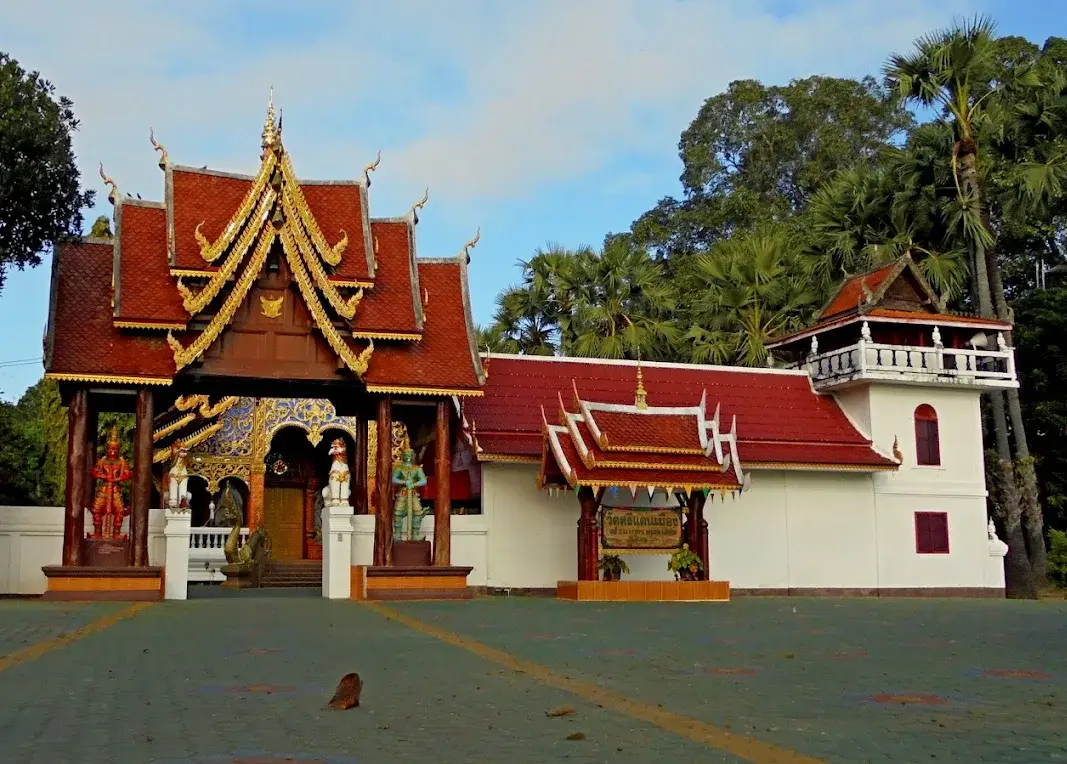
Wat Si Daen Mueang
Open Days: Daily
Opening Hours: 08:00 - 17:00
Wat Si Daen Mueang is a historic community Buddhist temple of the Maha Nikaya order located in Ban Si Daen Mueang, Moo 6, Yang Kram Subdistrict, Doi Lo District, Chiang Mai Province 50160. Its current temple code is 350240306. Local temple history traces the beginning of construction to 15 March 1849, while the official temple register records its formal establishment in 1884 and a royal Wisungkhamasima grant in 1916. The monastery developed from a forested site into a long-standing Buddhist center with monks' residences, a sala bat, viharn, ubosot, scripture library, and community facilities. Its earlier name was Wat Makantong Noi before it became known as Wat Si Daen Mueang.
The official name is Wat Si Daen Mueang. Older material occasionally contains the similar-looking form “Wat Si Don Mueang,” but the contemporary temple register, Ban Si Daen Mueang village name, and Sangha administration all use Si Daen Mueang. The temple is specifically identified by temple code 350240306 in Yang Kram, Doi Lo.
Two dates are important in understanding the temple's early history. Local history places the beginning of construction on 15 March 1849, when the location was still a broad and overgrown forest. The official national temple record, however, lists 1884 as the year of formal temple establishment. The two dates represent different stages: the beginning of the local religious community and the later formal institutional status of the monastery.
In the early period, local Buddhist residents considered the quiet forested location suitable for a monastery. They therefore invited Phra Khru Ya, then residing at Wat Makantong Luang, to help establish a religious community at the site.
After accepting the invitation, Phra Khru Ya agreed that the location was appropriate. Working with local supporters, he helped clear the site and establish the first monastic facilities. A monks' residence was constructed, followed by a sala bat and a viharn. When basic facilities were ready, the community formally invited him to reside there.
The early monastery became known as Wat Makantong Noi. The name was directly connected with Phra Khru Ya's former monastery, Wat Makantong Luang. Calling the new temple “Makantong Noi,” or the smaller Makantong temple, preserved a relationship with the religious lineage from which its first leading monk had come.
Phra Khru Ya remained at Wat Makantong Noi for 38 rains retreats. During this period the monastery became firmly connected with the surrounding community. Like many Lanna village temples, it served not only as a place of worship but also as a center of moral instruction, seasonal ceremonies, local cooperation, and social life.
After Phra Khru Ya passed away, Phra Khru In Chai succeeded him. His period of leadership was especially important because he transformed both the physical temple and its identity.
Phra Khru In Chai renamed the monastery Wat Si Daen Mueang. The new name was connected with the temple's position near an old administrative boundary between Chom Thong and San Pa Tong. In the modern landscape, the surrounding area is associated with the boundary between Doi Lo and Mae Wang. “Daen Mueang” therefore reflects a temple situated near the edge between territorial communities, while “Si” adds an auspicious meaning.
The renaming marked a shift from an identity tied to the first monk's former monastery to an identity rooted in the temple's own geography. The name became so firmly established that Ban Si Daen Mueang, Moo 6, now carries the same geographic identity.
During Phra Khru In Chai's tenure, the old viharn, monks' residences, and temple wall were restored. An ubosot was also constructed, giving the monastery a dedicated space for formal Sangha ceremonies.
The official temple record states that Wat Si Daen Mueang received its Wisungkhamasima in 1916. A Wisungkhamasima provides a formally recognized sacred boundary for ecclesiastical acts, particularly ordination. This marked an important stage in the monastery's institutional development.
Phra Khru In Chai served the monastery for 18 rains retreats before leadership passed to another generation. The temple continued to develop through successive abbots and acting abbots rather than remaining unchanged after its original foundation.
Phra Khru Chan Suwanno later served as acting abbot and undertook another period of restoration. He repaired an older monks' residence, constructed a sala bat, and built a Ho Trai, or Buddhist scripture library.
The presence of a scripture library is particularly important because it reflects the educational role of the monastery. Traditional northern Thai temples often preserved Buddhist texts and palm-leaf manuscripts in specialized structures, linking religious architecture with learning and the preservation of sacred knowledge.
Phra Khru Chan Suwanno remained at the temple for 49 rains retreats before leaving the monastic life. His unusually long association with Wat Si Daen Mueang made his period one of the longest recorded phases in the temple's transmitted history.
Phra Inkaeo Aggasudhammo then served as acting abbot for approximately five rains retreats before disrobing. He was followed by Phra Unruean Aggapanyo, who removed an aging viharn and constructed a new one.
This reconstruction demonstrates how Wat Si Daen Mueang continually adapted its physical structures to changing needs. A temple building that had served one generation eventually required replacement so that worship and community activities could continue safely.
Phra Unruean Aggapanyo remained for approximately eight rains retreats before disrobing. Phra Phet Cakkavaro then assumed responsibility, constructing another monks' residence and remaining at the monastery for approximately sixteen rains retreats.
The historical succession later includes Phra Athikan Bunchuai Pabhankaro. His name forms part of the recorded leadership history of Wat Si Daen Mueang and demonstrates the continued transmission of responsibility from one generation of monks to the next.
Wat Si Daen Mueang also developed a significant educational role for monks in the surrounding countryside. Biographical records of monks from nearby communities describe traveling to the temple to study Nak Tham Tri, the introductory level of formal monastic Dhamma education.
In an era when formal monastic schools were far less common than today, students sometimes walked several kilometers along rice-field embankments to study at Wat Si Daen Mueang. The temple therefore functioned as an educational center extending beyond Ban Si Daen Mueang itself.
The temple's Ho Trai and its role in monastic study reinforce each other historically. Together they show that the monastery was not merely a ceremonial center but also a place where Buddhist knowledge was stored, taught, and transmitted.
The temple's consecrated boundary was also used for ordination ceremonies involving monks from surrounding areas. In 1934, a monastic ordination associated with an important local meditation lineage took place within the temple's sacred boundary, demonstrating that its ubosot served a broader regional Sangha community.
Documented structures at Wat Si Daen Mueang include the viharn, ubosot, monks' residences, sala bat, Ho Trai, and temple wall. Their histories belong to different periods, reflecting repeated cycles of construction, restoration, and replacement.
The viharn is central to lay Buddhist worship. The first viharn dates to the early establishment period, later restoration took place under Phra Khru In Chai, and a replacement viharn was eventually built under Phra Unruean Aggapanyo.
The ubosot is particularly important because of the temple's 1916 Wisungkhamasima. Visitors should understand it not simply as an architectural landmark but as a sacred Sangha space used for formal ecclesiastical ceremonies.
The Ho Trai reflects the monastery's scholarly identity. Although a complete public catalogue of the texts historically stored there is not available, its recorded construction confirms the importance placed on Buddhist learning and the preservation of scripture.
The sala bat provided practical space for monastic and community religious activities. Its appearance in several phases of temple history demonstrates the importance of areas designed to connect monks with lay supporters.
Monks' residences were repeatedly built or restored as the community developed. These records offer a more complete picture of temple life because a functioning monastery requires not only sacred halls but also everyday residential and practical infrastructure.
Wat Si Daen Mueang remains part of the contemporary Yang Kram Sangha administrative area together with Wat Mai Phatthana, Wat Nong Lua, Wat Yang Kram, Wat Si Sai Mun, Wat Chetawan, Wat Don Chai, and Wat Ban Tham.
Contemporary Dhamma-education records also continue to show monks affiliated with Wat Si Daen Mueang. This creates a direct connection between the temple's historic educational importance and its continuing relationship with Buddhist study in the modern period.
Ban Si Daen Mueang lies within the agricultural landscape of Yang Kram. The surrounding area connects with Yang Kram village, Don Chai, Huai Nam Khao, Si Sai Mun, and communities toward Mae Wang. This geography helps explain why a name associated with territorial boundaries remained meaningful across changing administrative eras.
The monastery continues to function as a spiritual center for the local community. Buddhist holy days, merit-making ceremonies, funerals, Kathin, forest-robe offerings, and family religious events create occasions when residents gather at the temple.
Kathin is one of the most important annual periods for an active community monastery. Held after Buddhist Lent, it brings lay supporters together to offer robes and financial support to the resident Sangha. Exact dates change each year.
Forest-robe offerings can be organized at different times and often support restoration or community projects. These ceremonies illustrate the long-standing principle that the physical and religious life of a temple depends on cooperation between monks and lay supporters.
Major Buddhist days such as Makha Bucha, Visakha Bucha, Asalha Bucha, the beginning of Buddhist Lent, and the end of Lent also strengthen the temple's role as a community gathering place.
For visitors, Wat Si Daen Mueang is valuable not simply because it is old but because its development can be traced across many generations. Its story moves from a forest clearing in 1849 to Wat Makantong Noi, the renaming to Si Daen Mueang, the establishment of an ubosot, a scripture library, repeated viharn construction, and a continuing educational role.
A visit should begin with respectful worship in the areas open to the public. Visitors can then observe the viharn, ubosot, sala bat, Ho Trai, and overall monastic layout while remaining outside monks' private residential areas unless invited.
The atmosphere is best suited to travelers interested in living Lanna community temples rather than highly commercial tourist attractions. Early morning is a particularly good time for a quiet visit before continuing to other cultural sites in Yang Kram.
Visitors should dress modestly, cover shoulders and knees when entering religious buildings, remove shoes where required, speak quietly, and avoid intrusive photography during ceremonies.
General visiting hours are daily from 08:00 to 17:00. Access to individual buildings may depend on monastic activities taking place on the day.
Getting There from central Chiang Mai is straightforward by private vehicle. Follow Highway 108 south through Hang Dong and San Pa Tong into Doi Lo District, then continue into Yang Kram and Ban Si Daen Mueang, Moo 6. The approximate coordinates are 18.571689, 98.814436.
When using navigation, search specifically for “Wat Si Daen Mueang, Yang Kram, Doi Lo, Chiang Mai” to avoid confusion with similarly named temples elsewhere.
The Ganesha Himal Museum lies approximately 1.7 kilometers away and offers a contrasting cultural experience focused on Ganesha imagery, art, and religious symbolism.
Wat Si Sai Mun is another historic Yang Kram temple and can be combined with Wat Si Daen Mueang for travelers interested in comparing older village monasteries within the same subdistrict.
Wat Mai Phatthana is approximately 2.8 kilometers away and belongs to the same Yang Kram Sangha network, making it an easy additional stop.
Wat Yang Kram provides a useful historical contrast because it was formally established in 2002, while Wat Si Daen Mueang traces its local origins to the nineteenth century.
Wat Nong Lua can also be added to a longer Yang Kram temple itinerary. Travelers with more time can continue to Wat Don Chai, Wat Ban Tham, and Wat Chetawan.
Nearby food and café options include Lake Restaurant, approximately 3 kilometers away, Tel. 081-606-1426; Rin Coffee at Doi Lo, about 7 kilometers away, Tel. 089-953-8276; and Ta Ton Yon Coffee&Cafe, approximately 9.3 kilometers away, Tel. 052-000-566.
Other options include Hop Chafe Doi Lo, approximately 13.5 kilometers away, Tel. 086-190-2550, and DOK JIK coffee homemade, approximately 14.8 kilometers away, Tel. 080-945-3376.
Green Tree Resort is one of the closest accommodation options, approximately 1.8 kilometers from the temple, Tel. 063-383-3183. Pimprajan Homestay is approximately 7.2 kilometers away, Tel. 090-885-1545, while The Starly Night Cottage is approximately 7.5 kilometers away, Tel. 081-939-5610.
De Aerng Boutique Hotel is approximately 13.2 kilometers away, Tel. 061-316-0822, while Baan Rim Ping River Side Resort is approximately 16.6 kilometers away, Tel. 089-894-9172.
A half-day cultural route can begin at Wat Si Daen Mueang before continuing to the Ganesha Himal Museum, Wat Si Sai Mun, and Wat Mai Phatthana. A full-day route can also include Wat Yang Kram, Wat Nong Lua, Wat Don Chai, and Wat Ban Tham.
This itinerary reveals the chronological diversity of Buddhist institutions in Yang Kram. Wat Si Daen Mueang traces its community history to 1849, Wat Don Chai dates to the nineteenth century, while Wat Yang Kram represents a monastery formally established in the early twenty-first century.
Wat Si Daen Mueang is particularly valuable because its history includes not only a foundation story but also successive generations of monastic leadership, changing temple names, architectural restoration, education, and changing administrative geography.
The transformation from an overgrown forest into a monastery with residences, a sala bat, viharn, ubosot, and Ho Trai demonstrates the long-term cooperation between monks and village supporters.
The repeated reconstruction of temple buildings should be understood as part of this continuity rather than a loss of history. Active community monasteries must adapt their structures to changing needs while preserving their religious role.
For travelers interested in Chiang Mai beyond its famous city temples, Wat Si Daen Mueang provides an important example of how Lanna Buddhism developed at the village level through education, monastic networks, local geography, and community support.
Overall, Wat Si Daen Mueang grew from a Buddhist community established under Phra Khru Ya in 1849, first known as Wat Makantong Noi. Phra Khru In Chai later renamed it to reflect its position near a territorial boundary. Its official temple establishment is recorded in 1884, its Wisungkhamasima was granted in 1916, and successive monks continued developing its viharn, ubosot, residences, sala bat, and scripture library.
More than a century and a half after the first community began clearing the forested site, Wat Si Daen Mueang remains a living Maha Nikaya monastery. Its combination of local history, monastic education, religious architecture, and rural Lanna community life makes it a worthwhile cultural stop for travelers exploring Yang Kram and Doi Lo.
| Name | Wat Si Daen Mueang |
| Former Name | Wat Makantong Noi |
| Temple Type | Community Buddhist Temple, Maha Nikaya |
| Temple Code | 350240306 |
| Address | Ban Si Daen Mueang, Moo 6, Yang Kram Subdistrict, Doi Lo District, Chiang Mai 50160, Thailand |
| Coordinates | Approx. 18.571689, 98.814436 |
| Local Foundation History | Construction began on 15 March 1849 |
| Official Temple Establishment | 1884 (B.E. 2427) |
| Wisungkhamasima | 1916 (B.E. 2459) |
| Early Founding Figure | Phra Khru Ya and local Buddhist supporters |
| Former Name Origin | Wat Makantong Noi was named after Wat Makantong Luang, the former monastery of Phra Khru Ya |
| Current Name Origin | The name reflects the temple's historic position near an administrative boundary between local territories |
| Documented Structures | Viharn, ubosot, monks' residences, sala bat, Ho Trai scripture library, and temple wall |
| Important Monks In Temple History | Phra Khru Ya, Phra Khru In Chai, Phra Khru Chan Suwanno, Phra Inkaeo Aggasudhammo, Phra Unruean Aggapanyo, Phra Phet Cakkavaro, and Phra Athikan Bunchuai Pabhankaro |
| Educational Role | Historic center for monastic Dhamma study with continuing links to contemporary monastic education |
| Open Days | Daily |
| Opening Hours | 08:00 - 17:00 |
| Getting There | Take Highway 108 south from Chiang Mai through Hang Dong and San Pa Tong into Doi Lo, then continue to Ban Si Daen Mueang, Moo 6, Yang Kram. Search for “Wat Si Daen Mueang, Yang Kram, Doi Lo, Chiang Mai” or use the coordinates. |
| Current Status | Active Maha Nikaya temple in the Yang Kram Sangha administrative area |
| Nearby Tourist Attractions | 1. Ganesha Himal Museum, about 1.7 km, Tel. 053-024-287 2. Wat Si Sai Mun, about 2 km 3. Wat Mai Phatthana, about 2.8 km 4. Wat Yang Kram, about 4 km 5. Wat Nong Lua, about 4–5 km |
| Nearby Restaurants And Cafés | 1. Lake Restaurant, about 3 km, Tel. 081-606-1426 2. Rin Coffee at Doi Lo, about 7 km, Tel. 089-953-8276 3. Ta Ton Yon Coffee&Cafe, about 9.3 km, Tel. 052-000-566 4. Hop Chafe Doi Lo, about 13.5 km, Tel. 086-190-2550 5. DOK JIK coffee homemade, about 14.8 km, Tel. 080-945-3376 |
| Nearby Accommodations | 1. Green Tree Resort, about 1.8 km, Tel. 063-383-3183 2. Pimprajan Homestay, about 7.2 km, Tel. 090-885-1545 3. The Starly Night Cottage, about 7.5 km, Tel. 081-939-5610 4. De Aerng Boutique Hotel, about 13.2 km, Tel. 061-316-0822 5. Baan Rim Ping River Side Resort, about 16.6 km, Tel. 089-894-9172 |
Frequently Asked Questions (FAQ)
Q: Where is Wat Si Daen Mueang located?
A: Wat Si Daen Mueang is located in Ban Si Daen Mueang, Moo 6, Yang Kram Subdistrict, Doi Lo District, Chiang Mai 50160, at approximately 18.571689, 98.814436.
Q: When was Wat Si Daen Mueang founded?
A: Local temple history dates the beginning of construction to 15 March 1849, while the official temple register records formal establishment in 1884.
Q: What was the temple's original name?
A: The original name was Wat Makantong Noi, reflecting the connection with Wat Makantong Luang, where Phra Khru Ya had previously resided.
Q: Why was it renamed Wat Si Daen Mueang?
A: Phra Khru In Chai renamed the monastery to reflect its historic location near a boundary between local administrative territories.
Q: When did the temple receive its Wisungkhamasima?
A: Wat Si Daen Mueang received its royal consecrated boundary in 1916.
Q: What important structures are documented at the temple?
A: Documented structures include a viharn, ubosot, monks' residences, sala bat, Ho Trai scripture library, and temple wall.
Q: Why is Wat Si Daen Mueang important for Buddhist education?
A: The temple historically served as a local center for monastic Dhamma study and remains connected with contemporary monastic education.
Q: What nearby places can be visited after Wat Si Daen Mueang?
A: Nearby options include the Ganesha Himal Museum, Wat Si Sai Mun, Wat Mai Phatthana, Wat Yang Kram, and Wat Nong Lua.
 Category: ●Places of Worship
 Group: ●Temple
Last Update : 3 DayAgo
 Last Update : 3 DayAgo
 Click to Access the Navigation Map GPS
 Muang Chiang Mai(121)Chom Thong(47)Mae Chaem(25)Chiang Dao(33)Doi Saket(68)Mae Taeng(85)Mae Rim(69)Samoeng(29)Fang(71)Mae Ai(59)Phrao(70)San Pa Tong(103)San Kamphaeng(66)San Sai(73)Hang Dong(73)Hot(32)Doi Tao(22)Omkoi(11)Saraphi(74)Wiang Haeng(15)Chai Prakan(28)Mae Wang(32)Mae On(22)Doi Lo(33)Galyani Vadhana(1)


