
lovethailand home >North Travel Attractions >Chiang Mai Travel Attractions >Doi Lo >Doi Lo > Wat San Khayom
TL;DR: Wat San Khayom is located at 215 Ban Huai Thang, Moo 12, Doi Lo Subdistrict, Doi Lo District, Chiang Mai 50160, Thailand, open Daily, hours 08:00 - 17:00.

Wat San Khayom
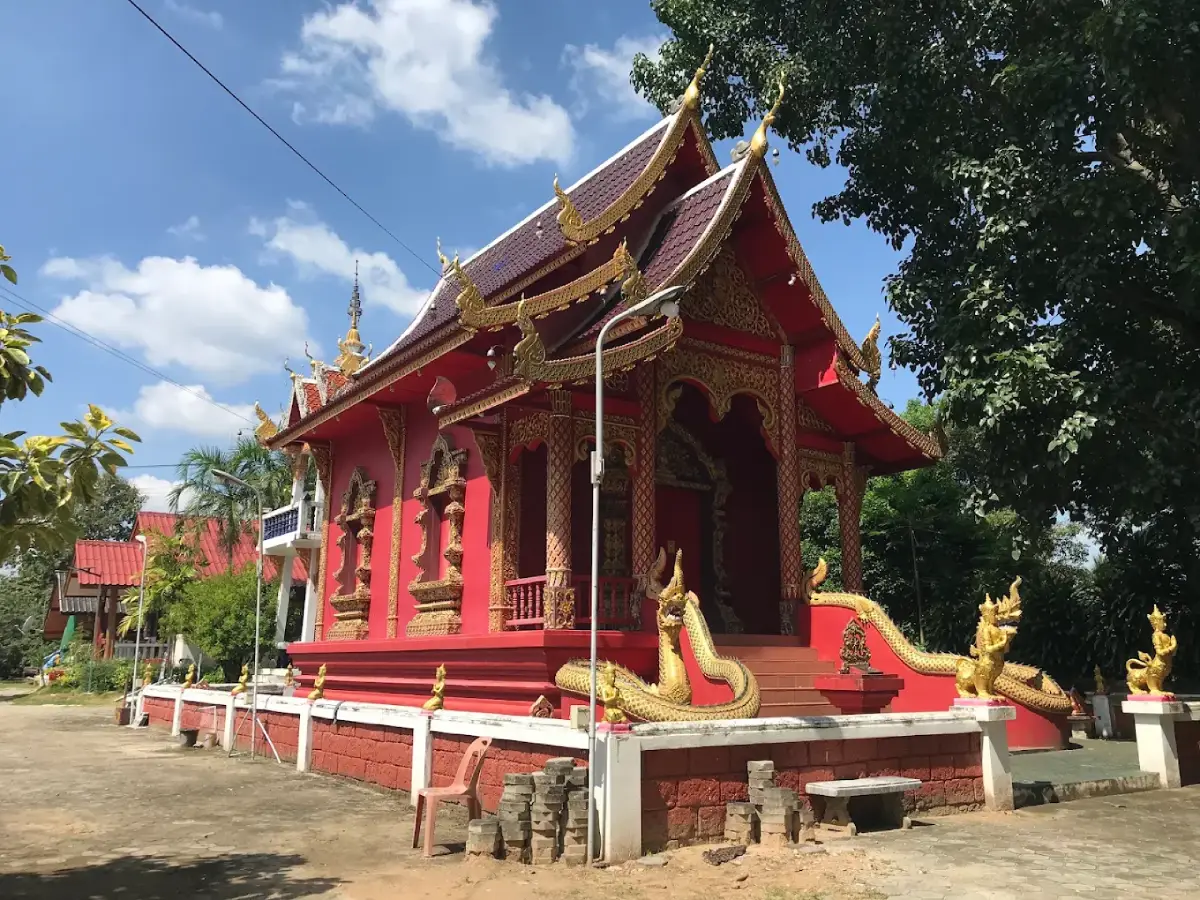
Open Days: Daily
Opening Hours: 08:00 - 17:00
Wat San Khayom is a community Buddhist temple of the Maha Nikaya order located at 215 Ban Huai Thang, Moo 12, Doi Lo Subdistrict, Doi Lo District, Chiang Mai Province 50160. The temple occupies approximately 8 rai and 13 square wah of land and remains an active Buddhist institution in the Doi Lo community. Its official temple code is 350240109, and a monk from Wat San Khayom still appears in Chiang Mai's monastic education records for 2025. The temple is particularly important for its oral history, which traces its origins back to around 1677, and for a sequence of three historical names: Wat Sai Mun, Wat Nang Liao, and finally Wat San Khayom. Its principal Buddha image, made of brick and stucco, and its old chedi are among the most important sacred objects preserved within the temple.
The significance of Wat San Khayom extends far beyond its age. Its history is closely intertwined with the development of communities around Doi Lo and the Ping River. In earlier times, the surrounding settlement was much smaller and the temple served Buddhist devotees from several neighboring communities. These included people from the area once known as San Chi Kung, now associated with Pak Thang Charoen, residents of the Sirimangkalajarn community, and villagers from Ban Wang Ku on the Lamphun side of the Ping River. The story therefore preserves evidence of a religious network that once extended beyond the boundaries of a single village or modern administrative district.
Two different chronological layers are important when understanding the history of Wat San Khayom. The first is local oral tradition, passed down through generations of village elders, which places the temple's early history around B.E. 2220, equivalent to 1677. No contemporary inscription or surviving document from that period has been identified. The second is the modern administrative record, which gives B.E. 2477, or 1934, as the temple's registration year. These dates do not necessarily refer to the same event. The earlier date belongs to community memory concerning the temple's origins, while the later date reflects its formal administrative history.
According to local tradition, the temple was originally called Wat Sai Mun. Approximately 50 years later, it became known as Wat Nang Liao. The exact year of that change is not preserved. After another long and undocumented period, the temple acquired the name Wat San Khayom, which it continues to use today. This sequence of three names is one of the most distinctive features of the temple's history because it records changing community identity across generations while preserving continuity of Buddhist worship at the same religious center.
There is not enough documentary evidence to explain precisely why each historical name changed. Rather than inventing an explanation, the names themselves should be preserved as part of the temple's oral heritage. Wat Sai Mun, Wat Nang Liao, and Wat San Khayom may eventually provide useful clues for future research into local settlement history, language, and community geography in Doi Lo.
The temple was once surrounded by a quiet rural settlement with only a small number of houses. A community called Ban San Khayom lay to the north, while the temple's religious supporters came from a wider area. This pattern reflects the traditional organization of rural Lanna Buddhism, in which a single temple could serve several settlements located within walking distance rather than functioning exclusively as the temple of one administrative village.
One important group mentioned in the oral history was the community of San Chi Kung, an area now known as Pak Thang Charoen. Other supporters came from Ban Sirimangkalajarn and Ban Wang Ku in Lamphun Province. These relationships demonstrate that the religious sphere of Wat San Khayom once crossed what are now provincial boundaries. Community connections were determined as much by geography, walking routes, kinship, and Buddhist devotion as by administrative divisions.
The story of Ban Wang Ku is especially revealing. Local memory describes a period when parts of the Ping River were shallow enough for villagers to cross on foot and travel to Wat San Khayom to make merit and support the temple. The river was therefore not simply a boundary. Depending on water conditions, it could form part of the everyday route connecting Buddhist communities on both sides.
As surrounding settlements grew and developed their own temples, the regional role of Wat San Khayom naturally changed. The temple became more closely associated with Ban Huai Thang and the present Doi Lo community. Nevertheless, the older oral tradition preserves evidence that Wat San Khayom once served a much broader network of Buddhist devotees than its current village address might suggest.
Ban Huai Thang remains officially designated as Moo 12 of Doi Lo Subdistrict, and Wat San Khayom continues to appear in contemporary Maha Nikaya temple registers under code 350240109. A 2025 monastic examination record also lists a monk affiliated with Wat San Khayom in Doi Lo, confirming that the temple remains part of the active Sangha system rather than surviving merely as a historic site.
The temple occupies approximately 8 rai and 13 square wah. Its northern and southern boundaries adjoin privately owned land, while other recorded boundaries include a public road and the Kham Pa irrigation channel. Older descriptions repeat the eastern direction for both features, so it is more accurate to preserve only the confirmed boundary elements rather than assigning an unverified compass direction.
The recorded monastic buildings at Wat San Khayom include a viharn, ubosot, sermon hall, and monks' residences. Important sacred objects include the principal brick-and-stucco Buddha image and a chedi. The available historical material does not establish exact construction dates or architectural periods for each structure, so they should be appreciated according to their documented religious functions rather than assigned an unsupported stylistic date.
The viharn is especially important because it houses the temple's old principal Buddha image. Made of brick and covered with stucco, the image is remembered locally for its graceful form and has long been the central object of devotion for temple supporters. The survival of the image within the viharn gives the building a significance that extends beyond architecture: it is the place where one of the temple's oldest and most meaningful religious traditions remains visible.
The ubosot serves the ecclesiastical functions of the Sangha. No sufficiently reliable record has been found giving its construction year, later rebuilding date, or precise architectural style. For this reason, its importance is best understood through its Buddhist function rather than through an unsupported attribution to a particular artistic period.
The sermon hall provides space for collective religious and community activities, while the monks' residences support the everyday life of the resident Sangha. Together, these structures demonstrate that Wat San Khayom is not simply a place where visitors come briefly to see an old Buddha image. It continues to function as a living monastery in which Buddhist worship, monastic life, and community activities coexist.
The chedi is another old sacred feature mentioned in the temple history. Its exact construction date, architectural period, and restoration history are not sufficiently documented. Visitors interested in local history should therefore treat the chedi as an important surviving component of the old temple complex without assigning it an age or contents that have not been established by evidence.
The most celebrated sacred object is the principal brick-and-stucco Buddha image inside the viharn. Local tradition remembers the Buddha image as being very old, although no exact construction year survives. It was particularly admired for the beauty of its proportions and became an important focus of worship for people in the wider Chiang Mai region.
Oral tradition recounts that approximately 300 years ago the Buddha image attracted large numbers of worshippers, both men and women. Villagers described the image as possessing a powerful sense of loving-kindness or compassionate charm. This language should be understood as an expression of religious devotion rather than as a claim of supernatural miracles. The temple's own traditional account does not record a specific miracle; instead, it emphasizes the emotional attraction and reverence inspired by the image.
Approximately a century ago, temple committee members reportedly altered portions of the Buddha image's facial appearance. The traditional explanation says the alteration was intended to make the image less visually striking than before. Because this account belongs to oral history and no detailed restoration record or early photograph has been established, it should be preserved as community memory without attempting to reconstruct the original facial form.
Today, the Buddha image remains enshrined in the viharn and is the most important object for visitors to pay respect to. For travelers interested in historic Buddhist imagery, its significance lies in the brick-and-stucco construction technique, its relationship to the history of Wat San Khayom, and generations of local devotion rather than in an unsupported attempt to assign an exact artistic period.
The principal Buddha image and the chedi reinforce the impression of Wat San Khayom as a religious site with deep historical roots. Written evidence for the earliest period is limited, but the continuity of the temple's former names, the stories of its supporting communities, memories of crossing the Ping River, and traditions surrounding the Buddha image show how the history of the temple has been preserved through collective memory.
Within the wider context of Lanna society, a village temple such as Wat San Khayom traditionally functioned as much more than a place for private prayer. It served as a center for merit-making, Buddhist teaching, Sangha activities, community gatherings, and spiritual support. In a settlement that once consisted of only a limited number of households, the temple would have provided one of the most important shared spaces for local residents.
The temple's historical connection with San Chi Kung, present-day Pak Thang Charoen, Ban Sirimangkalajarn, and Ban Wang Ku illustrates the broad network of faith that once supported it. People did not attend the temple merely because they lived in the same administrative village. They came because of religious ties and relationships among neighboring communities, even crossing the Ping River when conditions allowed.
As roads, local administration, and settlement patterns developed, neighboring villages established their own temples and the geographical role of Wat San Khayom became more localized. Yet the older stories remain valuable because they reveal the historical relationship between communities in Chiang Mai and Lamphun along the Ping River basin.
Wat San Khayom remains active in the contemporary monastic system. The Maha Nikaya temple register lists it under code 350240109, and a 2025 Nak Tham examination record includes Phra Chalermwut Santavaso as a monk affiliated with Wat San Khayom, Doi Lo. This recent record confirms the continued presence of a monastic community and the temple's connection with formal Buddhist education.
The most recent publicly available Chiang Mai provincial cultural information that identifies a temple community leader names Phra Athikan Chaeng Sutthijitto as the head of the Wat San Khayom community in 2022 and provides the contact number 089-223-2689. Because no newer public register clearly identifying the current abbot has been located, this name is best understood as the latest officially published temple leadership information rather than replaced with a name from another Wat San Khayom.
This distinction is important because several temples in northern Thailand share the name Wat San Khayom. Separate temples exist in San Pa Tong District, San Sai District, and Lamphun Province, each with different histories, abbots, and sacred objects. The temple covered here is specifically Wat San Khayom at Ban Huai Thang, Moo 12, Doi Lo Subdistrict, Doi Lo District, Chiang Mai, temple code 350240109.
What visitors should see begins with the viharn and the historic principal Buddha image. From there, visitors can view the chedi, ubosot, sermon hall, monks' residences, and the general temple grounds. Approaching the temple in this sequence allows travelers to appreciate both its old sacred objects and its continuing role as an active community monastery.
The principal Buddha image should be approached respectfully and should not be touched unnecessarily because it is an old sacred object belonging to the community. Visitors wishing to take photographs inside the viharn should observe any rules in place on the day of their visit. When monks are carrying out religious duties or local residents are making merit, visitors should avoid blocking the space and keep noise to a minimum.
Wat San Khayom is particularly suitable for travelers interested in local history, Lanna culture, traditional temples, and quiet cultural travel rather than commercial attractions. Its strongest feature is the opportunity to understand how one temple could once serve several villages and how generations of oral tradition can give surviving buildings and sacred objects a much deeper cultural meaning.
No sufficiently current public source has been found confirming a temple-specific annual festival with a fixed date. Buddhist holy days and major religious seasons naturally remain important to community temple life, but exact dates for Kathin, robe-offering events, or a temple-specific annual festival should be confirmed directly with the temple rather than assumed in advance.
The absence of a widely advertised annual festival does not reduce the temple's importance. The essential role of a community monastery lies in continuous religious life: merit-making, offerings to monks, Buddhist teaching, family ceremonies, and the everyday activities of the Sangha. Wat San Khayom therefore retains value as a functioning religious institution, not a site that becomes meaningful only during a large festival.
Getting There from Chiang Mai city is straightforward by private car or rental vehicle. Follow Highway 108, the Chiang Mai-Hot Road, south through Hang Dong and San Pa Tong into Doi Lo District. Continue into Doi Lo Subdistrict and Ban Huai Thang, Moo 12. The temple is located at approximately 18.47547, 98.81247. Private transport is especially convenient for travelers planning to combine several temples and attractions in Doi Lo during the same day.
Allow roughly an hour from central Chiang Mai depending on traffic. Because several temples share the name Wat San Khayom, navigation systems should be searched using the full name “Wat San Khayom, Ban Huai Thang, Doi Lo, Chiang Mai” or the coordinates rather than using the temple name alone.
Morning is a practical time to visit, especially for travelers who want to continue through Doi Lo afterward. From Wat San Khayom, a cultural route can connect Wat Phra That Doi Noi, Wat Mon Huai Kaeo, Wat Wang Kham Pom, Wat Phra That Doi Lo, and the Ganesha Himal Museum in Yang Kram. This creates a full-day itinerary combining old community temples, newer religious foundations, elevated temple landscapes, and a cultural museum.
Wat Phra That Doi Noi is one of the easiest nearby stops and provides a contrasting elevated setting. Combining it with Wat San Khayom allows visitors to experience different physical landscapes within Doi Lo while remaining within a relatively compact cultural route.
Wat Mon Huai Kaeo offers another useful contrast because its modern foundation history is well documented. Visiting Wat Mon Huai Kaeo and Wat San Khayom together gives travelers the opportunity to compare a twentieth-century community temple with a temple whose oral history stretches back several centuries.
Wat Wang Kham Pom adds another historical dimension through its close relationship with the Ping River and village settlement. This is especially meaningful because the oral history of Wat San Khayom also remembers devotees from Lamphun crossing the Ping River to support the temple.
Travelers interested in a non-temple cultural attraction can continue to the Ganesha Himal Museum in Yang Kram, Doi Lo District. The museum focuses on Ganesha-related art and cultural objects and can be combined easily with a temple route for travelers using private transportation.
Doi Lo has a growing selection of local restaurants and cafés suitable for a meal or rest stop after visiting the temple. Options include Suan Ahan Khrua Doi Lo, DOK JIK coffee homemade, PHANSA COFFEE, Rin Gi Coffee Bar, and Phupha Coffee Bar. Travelers should call ahead when possible because operating hours at small local businesses can change.
Accommodation is available both within Doi Lo and along connecting routes. Options include De Aerng Boutique Hotel, Baan Rim Ping River Side Resort, Green Tree Resort, The Starly Night Cottage, and Pimprajan Homestay. Staying in the district can be particularly convenient for travelers continuing to Chom Thong, Doi Inthanon, or Mae Wang National Park the following day.
A half-day cultural route can begin at Wat San Khayom in the morning, continue to Wat Phra That Doi Noi and Wat Mon Huai Kaeo, and finish with lunch in Doi Lo. With a full day, travelers can add Wat Wang Kham Pom, the Ganesha Himal Museum, or continue toward the natural attractions of Mae Wang. This approach allows visitors to understand Doi Lo as a cultural landscape rather than treating each temple as an isolated stop.
Visitors should remember that Wat San Khayom is a living community monastery rather than a museum. Dress modestly, remove shoes before entering buildings where required, keep voices low, do not climb on or touch the chedi or Buddha images, and ask permission before photographing monks or private community ceremonies.
For history-oriented travelers, Wat San Khayom is especially fascinating because several layers of time coexist here. The oldest layer is the oral tradition reaching back to 1677. Another layer is the succession of names from Wat Sai Mun to Wat Nang Liao and finally Wat San Khayom. The modern administrative layer begins with the recorded registration year of 1934 and continues through present-day Maha Nikaya temple registers.
The principal Buddha image also carries several layers of meaning. Physically, it is an old brick-and-stucco Buddha image inside the viharn. Religiously, it has been an object of devotion for generations. Within oral tradition, its beauty and sense of compassion once drew worshippers from a wide area. The value of this story does not depend on a miracle claim; it lies in demonstrating how strongly the local community has been attached to the image.
The viharn, ubosot, chedi, sermon hall, and monks' residences together create a complete religious environment in which worship, Sangha activities, community gatherings, and monastic life continue side by side. Understanding these buildings through their functions is more accurate than assigning architectural dates or styles that are not supported by the surviving records.
Culturally, Wat San Khayom also reveals the historical connection between Chiang Mai and Lamphun. Residents of Ban Wang Ku once crossed the Ping River to support the temple, illustrating a landscape in which religious networks, family connections, and walking routes could be more important than later provincial boundaries.
The temple's importance to Ban Huai Thang should therefore not be measured only by visitor numbers or online popularity. Wat San Khayom has served as a religious center, a repository of community memory, and a place of Buddhist continuity over generations. The old Buddha image, chedi, historical names, and stories of former temple supporters continue to connect the present community with its past.
For travelers searching for an old temple in Doi Lo with genuine local history, Wat San Khayom deserves attention. Its layers of oral history, sequence of historical names, old sacred objects, connections with communities on both sides of the Ping River, and continuing place in the contemporary Sangha make a visit much more than a simple temple stop.
From Wat Sai Mun to Wat Nang Liao and finally Wat San Khayom, changing names have not broken the continuity of the sacred site. Instead, they have added depth to its history. Combined with the brick-and-stucco Buddha image, old chedi, memories of multi-village patronage, and an active monastic presence today, Wat San Khayom remains a meaningful expression of Buddhist faith, Lanna community life, and the cultural history of Doi Lo.
| Name | Wat San Khayom |
| Temple Type | Community Buddhist Temple, Maha Nikaya |
| Temple Code | 350240109 |
| Address | 215 Ban Huai Thang, Moo 12, Doi Lo Subdistrict, Doi Lo District, Chiang Mai 50160, Thailand |
| Coordinates | 18.47547, 98.81247 |
| Temple Area | 8 rai and 13 square wah |
| Historical Origin | Local oral tradition traces the temple to around 1677, while the modern temple register records 1934 as its registration year. |
| Former Names | Wat Sai Mun, later Wat Nang Liao, before becoming Wat San Khayom |
| Main Structures | Viharn, ubosot, sermon hall, monks' residences, and chedi area |
| Important Sacred Objects | Historic brick-and-stucco principal Buddha image enshrined in the viharn and an old chedi |
| Highlights | Centuries of oral history, three historical temple names, an old brick-and-stucco Buddha image, and a former network of Buddhist supporters extending across communities in Chiang Mai and Lamphun |
| Historic Supporting Communities | Ban San Khayom, San Chi Kung or present-day Pak Thang Charoen, Ban Sirimangkalajarn, and Ban Wang Ku in Lamphun |
| Latest Publicly Listed Temple Leader | Phra Athikan Chaeng Sutthijitto, listed as head of the temple community in Chiang Mai provincial information for 2022 |
| Contact Number | 089-223-2689 |
| Open Days | Daily |
| Opening Hours | 08:00 - 17:00 |
| Travel Information | Take Highway 108 south from Chiang Mai through Hang Dong and San Pa Tong into Doi Lo, then continue to Ban Huai Thang, Moo 12. Search for “Wat San Khayom, Ban Huai Thang, Doi Lo” or use the coordinates to avoid similarly named temples elsewhere. |
| Current Status | Listed in the current Maha Nikaya temple register, with a monk affiliated with Wat San Khayom appearing in 2025 monastic education records. |
| Nearby Tourist Attractions | 1. Wat Phra That Doi Noi, about 2 km 2. Wat Mon Huai Kaeo, about 4 km 3. Wat Wang Kham Pom, about 6 km 4. Wat Phra That Doi Lo, about 6 km 5. Ganesha Himal Museum, Yang Kram, about 10 km |
| Nearby Restaurants And Cafés | 1. Suan Ahan Khrua Doi Lo, about 6 km, Tel. 081-026-4699 2. DOK JIK coffee homemade, about 8 km, Tel. 080-945-3376 3. PHANSA COFFEE, about 7 km, Tel. 099-272-9849 4. Rin Gi Coffee Bar, about 6 km, Tel. 092-797-9479 5. Phupha Coffee Bar, about 8 km, Tel. 083-822-7403 |
| Nearby Accommodations | 1. De Aerng Boutique Hotel, about 6 km, Tel. 061-316-0822 2. Baan Rim Ping River Side Resort, about 7 km, Tel. 089-894-9172 3. The Starly Night Cottage, about 8 km, Tel. 081-939-5610 4. Green Tree Resort, about 10 km, Tel. 063-383-3183 5. Pimprajan Homestay, about 10 km, Tel. 090-885-1545 |
Frequently Asked Questions (FAQ)
Q: Where is the Wat San Khayom covered in this article?
A: It is located at 215 Ban Huai Thang, Moo 12, Doi Lo Subdistrict, Doi Lo District, Chiang Mai, temple code 350240109. It should not be confused with other temples named Wat San Khayom in San Pa Tong, San Sai, or Lamphun.
Q: When was Wat San Khayom founded?
A: Local oral tradition traces the temple's history to around 1677, although no contemporary inscription from that period survives. The modern administrative temple record gives 1934 as the registration year.
Q: What former names did Wat San Khayom have?
A: The temple was originally remembered as Wat Sai Mun, later became Wat Nang Liao, and eventually acquired the present name Wat San Khayom.
Q: What is the most important sacred object to see at the temple?
A: The main sacred object is the historic principal Buddha image made of brick and stucco and enshrined inside the viharn. The temple also has an old chedi.
Q: What is the traditional story associated with the principal Buddha image?
A: Local tradition remembers the image as exceptionally beautiful and strongly associated with loving-kindness, attracting many worshippers in the past. The traditional history does not record a specific supernatural miracle.
Q: Is Wat San Khayom still an active temple?
A: Yes. It remains listed in the Maha Nikaya temple register, and a monk affiliated with Wat San Khayom in Doi Lo appears in Chiang Mai monastic education records for 2025.
Q: What nearby places can be combined with Wat San Khayom?
A: Useful nearby stops include Wat Phra That Doi Noi, Wat Mon Huai Kaeo, Wat Wang Kham Pom, Wat Phra That Doi Lo, and the Ganesha Himal Museum.
Q: How do I get to Wat San Khayom from Chiang Mai?
A: Follow Highway 108 south through Hang Dong and San Pa Tong into Doi Lo District, then continue to Ban Huai Thang, Moo 12. Use the full temple name or coordinates 18.47547, 98.81247 in your navigation system.
 Category: ●Places of Worship
 Group: ●Temple
Last Update : 3 DayAgo
 Last Update : 3 DayAgo
 Click to Access the Navigation Map GPS
 Muang Chiang Mai(121)Chom Thong(47)Mae Chaem(25)Chiang Dao(33)Doi Saket(68)Mae Taeng(85)Mae Rim(69)Samoeng(29)Fang(71)Mae Ai(59)Phrao(70)San Pa Tong(103)San Kamphaeng(66)San Sai(73)Hang Dong(73)Hot(32)Doi Tao(22)Omkoi(11)Saraphi(74)Wiang Haeng(15)Chai Prakan(28)Mae Wang(32)Mae On(22)Doi Lo(33)Galyani Vadhana(1)


