
lovethailand home >North Travel Attractions >Chiang Mai Travel Attractions >Fang >San Sai > Wat Si Bun Rueang (San Sai)
TL;DR: Wat Si Bun Rueang (San Sai) is located at Ban Song Khwae, Moo 7, Chotana Road, Tambon San Sai, Fang District, Chiang Mai Province, open Daily, hours 08.00 – 17.00.
Wat Si Bun Rueang (San Sai)
Open Days: Daily
Opening Hours: 08.00 – 17.00
Wat Si Bun Rueang (San Sai) in Fang District, Chiang Mai Province, is a historic community temple under the Maha Nikaya order. Located at 1 Moo 7, Ban Song Khwae, Chotana Road, Tambon San Sai, Fang District, Chiang Mai 50110, the temple was officially permitted as a Buddhist temple in 1925 and received its Wisungkham Sima in 1932. Today, it is led by Dr. Phra Khru Si Sitthiphimon Wisutthimethi and remains an important religious, educational, and meditation center for the San Sai community.
Wat Si Bun Rueang is not only a local temple for merit-making. It is one of the most meaningful Buddhist sites in San Sai because its history connects migration, village formation, ancient Buddha images, old brick remains, Lanna Buddhist architecture, monastic education, and meditation practice. Travelers who want to understand Fang District beyond nature attractions will find this temple especially valuable.
The temple stands in Ban Song Khwae, a community area of Tambon San Sai. The historical background of Wat Si Bun Rueang is connected with the older settlement known as Long Ngio Thao or Hong Ngio Thao in the Huai Ngu area. Over time, this area became part of present-day Tambon San Sai, Fang District. Because of this, Wat Si Bun Rueang is both a village temple and a cultural landmark that reflects the long development of Buddhist communities in northern Chiang Mai.
The modern history of the temple began in 1924, when Chao Athikan Nanta Nandatharo migrated from Wat Hua Khuang in Ban Song Khwae, Song Khwae Subdistrict, Chom Thong District, Chiang Mai, together with disciples and lay supporters. They established a monastery in the former Long Ngio Thao village area, which was then in the Huai Ngu region. The site was centrally located within the village and became a natural gathering place for the local Buddhist community.
During the early development of the temple, villagers cleared forested land and built simple monastic shelters. While digging in the area, they found many Buddha images of different postures, both small and large. More than ten baskets of Buddha images were reportedly collected, and some had inscriptions on their bases. Old brick remains and structures resembling ancient religious ruins were also found. These discoveries gave the temple strong historical and archaeological significance.
The temple was formally developed under the auspicious name Wat Si Bun Rueang. The land where Buddha images and ancient remains were found, together with the surrounding area, became the temple grounds. Construction began in a more organized form on 15 April 1925, which corresponded with a major Lanna New Year day. The temple was officially permitted as a temple in 1925 and later received its Wisungkham Sima in 1932, establishing its formal status for Buddhist monastic ceremonies.
The identity of Wat Si Bun Rueang is closely tied to Ban Song Khwae. The name Song Khwae was brought from the original community of the migrants from Chom Thong. In this sense, the temple preserves not only Buddhist faith but also the memory of migration, settlement, and community building. It became a spiritual foundation for people who had moved into the Fang area and created a new village life around Buddhism.
Today, the temple is supported by devotees from three main villages: Ban Song Khwae, Moo 7; Ban San Nong Khiao, Moo 13; and Ban Mai Nuea, Moo 14. This wider support base shows that Wat Si Bun Rueang is not simply a temple of one village. It is a shared religious center for several communities in Tambon San Sai and continues to bring people together through merit-making, ceremonies, education, and meditation practice.
The line of abbots at Wat Si Bun Rueang reflects the temple’s continuous development. The first abbot was Chao Athikan Nanta Nandatharo, who served from 1924 to 1936. He was followed by Chao Athikan Thip Yanawaro, Chao Athikan Inwan Panyatharo, Chao Athikan Wan Supharo, Phra Athikan Panya Phatthayanano, Chao Athikan Intha Khemaviro, and Phra Khru Thammathin Boontan Rattanasuwanno, a former ecclesiastical district leader of Fang. The current period is led by Dr. Phra Khru Si Sitthiphimon Wisutthimethi.
One of the most important structures at Wat Si Bun Rueang is its pagoda. Built between 1958 and 1959, the pagoda combines Pagan and Lanna influences and stands prominently within the Buddhist sanctuary area. It was later restored in 2002 by Phra Maha Aphisit Wisutthimethi. The pagoda is one of the temple’s key visual and spiritual landmarks.
The ubosot was built in 1953 and remains an important space for monastic ceremonies. An ubosot is central to the formal religious life of a temple because it is used for official Sangha acts. Together with the temple’s Wisungkham Sima, the ubosot confirms Wat Si Bun Rueang’s full religious function as an established Buddhist temple.
The main viharn is another highlight. The present Lanna-style viharn was built to replace an older deteriorated structure. Construction began in 1981 and was completed in 1987. Inside is a gilded replica of Phra Phuttha Chinnarat, serving as the principal Buddha image. The viharn features carved wooden doors depicting the Buddha’s victory over Mara, teak windows carved with stories of the Ten Great Birth Tales, and detailed decorative elements created through the devotion of the temple community.
The Sirikit Building is used for Phra Pariyatti Dhamma education in the general education section under Fang Dhamma Sueksa School. It has operated since 1992 and reflects the temple’s strong role in monastic education. Through this building and the school, Wat Si Bun Rueang supports monks and novices who study both Buddhist and general subjects.
The Kuti of Somdet Phra Maha Ratchamangalacharn was built to accommodate students, monks, novices, teachers, and visitors connected with temple education. The three-storey building includes novice residences, teacher rooms, a Buddha room, a reception room, and many bathrooms. It supports the daily life of the temple’s educational community.
The Thammathin Sai Than Sattha residence is a two-storey Lanna-style multipurpose building designed for lay practitioners observing precepts, visiting guests, and people attending meditation activities. With bedrooms and bathrooms for retreat participants, the building strengthens the temple’s role as a place for Buddhist practice, not only ritual worship.
The Thammathin Pariyatti Sueksa Building was constructed between August 2002 and July 2003. It is a two-storey educational building used for offices, a library, meeting rooms, a computer room, and classrooms. This building expanded the temple’s capacity for Buddhist education and helped make Wat Si Bun Rueang an important learning center in Fang District.
The Mondop Phra Upatchaya was built to enshrine the image of Luang Pho Phra Khru Thammathin Boontan Rattanasuwanno, a former abbot who contributed greatly to the temple’s development. It functions as a memorial space for paying respect to a senior monk whose work shaped the temple and the local Buddhist community.
Thamma Khosana Hall was started in January 2005 under Dr. Phra Khru Si Sitthiphimon Wisutthimethi and the temple community. Measuring about 20 meters wide and 52 meters long, the hall is used for youth morality camps in Fang, Mae Ai, Chai Prakan, Chiang Dao, and Wiang Haeng districts. It also serves as a monthly meditation venue for local Buddhist groups, showing the temple’s wider role in moral education.
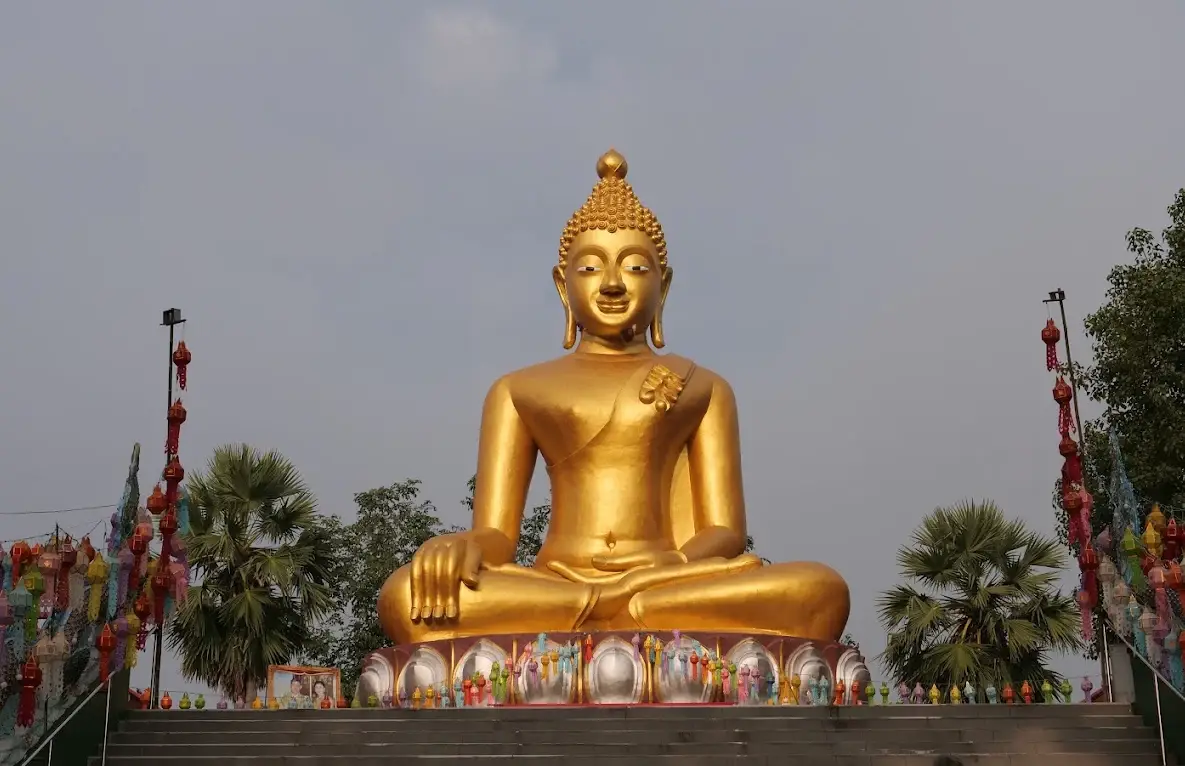
Somdet Phra Si Suwan Muni is a large Buddha image at the temple. The image has an 11-meter lap width and stands 24 meters high on a large base building. It is one of the temple’s major contemporary sacred images and an important point for visitors to pay respect. Its scale makes it one of the most visually memorable sacred objects at Wat Si Bun Rueang.
Wat Si Bun Rueang is also home to Chiang Mai Provincial Meditation Center No. 13, also known as the Phuttharaksa International Meditation Center. It began functioning as an international meditation center in 2009 and was recognized as a provincial meditation center in 2016. This gives the temple importance beyond the village level and connects it with formal Buddhist practice at the provincial level.
The temple is also associated with Fang Dhamma Sueksa School, a Phra Pariyatti Dhamma school in the general education section. Founded by Luang Pho Phra Khru Thammathin in 1992, the school provides education from lower to upper secondary levels for monks and novices in the Fang area. Through this role, Wat Si Bun Rueang contributes to both religious and social development.
For travelers, Wat Si Bun Rueang is especially interesting because it combines many layers of history in one place: ancient Buddha images, old brick remains, a renewed monastery, a Lanna viharn, an old ubosot, a Pagan-Lanna style pagoda, a large Buddha image, monastic education, and a provincial meditation center. It is suitable for visitors who want to understand a temple as a living institution rather than only a sightseeing stop.
Important points to visit include the pagoda, the ubosot, the Lanna-style viharn, the principal Buddha image, Somdet Phra Si Suwan Muni, the memorial mondop, and the meditation center. Visitors should dress modestly, speak quietly, avoid entering monks’ residences or school areas without permission, and respect ongoing religious or educational activities.
Major religious activities at the temple include the Kathin ceremony after Buddhist Lent, forest robe offerings, Buddhist holy day observances, meditation activities, and morality programs for young people. These activities show how the temple continues to function as a religious, educational, and social center for the San Sai community.
Getting There is straightforward by road. From Chiang Mai city, take Highway 107 through Mae Rim, Mae Taeng, Chiang Dao, and Chai Prakan toward Fang District. From Fang town, continue to Ban Song Khwae in Tambon San Sai along Chotana Road. The temple is convenient for travelers using a private car, rental car, or local transport from Fang town.
A practical itinerary is to visit Wat Si Bun Rueang in the morning, then continue to Wat Nantararam, Wat Si Thoi, or Wat Chedi Ngam. Travelers can also connect the route with Fang Hot Spring and Doi Pha Hom Pok National Park. This makes Wat Si Bun Rueang a useful cultural anchor for a wider Fang itinerary that includes temples, local food, accommodation, and nature.
Wat Si Bun Rueang is therefore one of the most meaningful temples to include in a Fang District trip. It preserves community history, Buddhist heritage, Lanna architecture, educational work, meditation practice, and the living faith of several villages in Tambon San Sai. For travelers interested in culture and Buddhism, the temple offers a deep and grounded view of northern Thai community life.
| Name | Wat Si Bun Rueang (San Sai) |
| Location | Ban Song Khwae, Moo 7, Chotana Road, Tambon San Sai, Fang District, Chiang Mai Province |
| Address | 1 Moo 7, Song Khwae, Chotana Road, Tambon San Sai, Fang District, Chiang Mai 50110, Thailand |
| Coordinates | 19.86926, 99.18471 |
| Temple Type | Community temple under the Maha Nikaya order |
| History | The monastery began in 1924, was formally built in 1925, was officially permitted as a temple in 1925, and received Wisungkham Sima in 1932 |
| Name Origin | The auspicious name Wat Si Bun Rueang was used after local devotees established the monastery on the former Long Ngio Thao or Hong Ngio Thao settlement area, where many Buddha images and ancient remains were found |
| Highlights | Ancient Buddha images, Pagan-Lanna style pagoda, old ubosot, Lanna viharn, gilded Phra Phuttha Chinnarat replica, Somdet Phra Si Suwan Muni, and Chiang Mai Provincial Meditation Center No. 13 |
| Distinctive Features | A Lanna community temple combining history, sacred objects, architecture, monastic education, and meditation practice in one compound |
| Travel Information | Travel from Chiang Mai to Fang via Highway 107, then continue to Ban Song Khwae in Tambon San Sai along Chotana Road. Suitable for private cars, rental cars, or local transport from Fang town |
| Current Status | Active community temple used for worship, merit-making, monastic education, meditation practice, and local Buddhist activities |
| Open Days | Daily |
| Opening Hours | 08.00 – 17.00 |
| Facilities | Thamma Khosana Hall, monastic education buildings, meditation areas, guest residences, temple courtyard, and religious activity spaces |
| Main Areas / Zones | Pagoda, ubosot, viharn, Sirikit Building, Kuti of Somdet Phra Maha Ratchamangalacharn, Thammathin Sai Than Sattha Residence, Thammathin Pariyatti Sueksa Building, Mondop Phra Upatchaya, Thamma Khosana Hall, Somdet Phra Si Suwan Muni, and Chiang Mai Provincial Meditation Center No. 13 |
| Abbot / Caretaker | Dr. Phra Khru Si Sitthiphimon Wisutthimethi |
| Main Contact Number | 053-457-127 |
| Related Religious Events | Kathin ceremony after Buddhist Lent, forest robe offerings, Buddhist holy day activities, meditation practice, and morality programs for youth |
| Nearby Tourist Attractions | 1. Wat Nantararam, about 2 km 2. Wat Si Thoi, about 3 km 3. Wat Chedi Ngam, about 6 km 4. Fang Hot Spring, about 12 km 5. Doi Pha Hom Pok National Park, about 14 km |
| Nearby Restaurants | 1. Khao Soi Parichat Fang, about 3 km, Tel. 053-451-164 2. PunThai Coffee Makro Fang, about 3 km, Tel. 062-197-0983 3. Oliang Roasted Duck Fang, about 4 km, Tel. 064-520-0241, 082-993-8124 4. Fang Cafe, about 5 km, Tel. 086-191-2101 5. Ban Rim Nam Garden Restaurant Fang, about 7 km, Tel. 053-382-174 |
| Nearby Accommodations | 1. Tangerine Ville Hotel, about 2 km, Tel. 053-452-114 2. Fang Modern Hotel, about 2 km, Tel. 086-439-1843 3. Khunyuw Place Fang, about 5 km, Tel. 053-453-319 4. Phumanee Lahu Home Hotel, about 6 km, Tel. 086-431-3564 5. Fang Villa Hotel, about 6 km, Tel. 086-451-7682, 053-452-448 |
Frequently Asked Questions (FAQ)
Q: Where is Wat Si Bun Rueang (San Sai) located?
A: Wat Si Bun Rueang is located at 1 Moo 7, Ban Song Khwae, Chotana Road, Tambon San Sai, Fang District, Chiang Mai 50110, Thailand.
Q: What is the history of Wat Si Bun Rueang?
A: The temple began as a monastery in 1924, was officially permitted as a temple in 1925, and received Wisungkham Sima in 1932. Its founding is connected with Chao Athikan Nanta Nandatharo and devotees who migrated from Chom Thong District.
Q: What are the main highlights of Wat Si Bun Rueang?
A: Key highlights include the Pagan-Lanna style pagoda, old ubosot, Lanna viharn, gilded Phra Phuttha Chinnarat replica, Somdet Phra Si Suwan Muni, and Chiang Mai Provincial Meditation Center No. 13.
Q: Who is the abbot of Wat Si Bun Rueang?
A: The abbot is Dr. Phra Khru Si Sitthiphimon Wisutthimethi.
Q: Is there a contact number for Wat Si Bun Rueang?
A: The main contact number is 053-457-127.
Q: What are the opening days and hours of Wat Si Bun Rueang?
A: The temple is open daily from 08.00 to 17.00.
Q: Who should visit Wat Si Bun Rueang?
A: The temple is suitable for cultural travelers, Buddhist visitors, history-focused travelers, and anyone interested in Lanna community temples, monastic education, and meditation centers in Fang District.
Q: What nearby places can be visited with Wat Si Bun Rueang?
A: Nearby places include Wat Nantararam, Wat Si Thoi, Wat Chedi Ngam, Fang Hot Spring, and Doi Pha Hom Pok National Park.
 Category: ●Places of Worship
 Group: ●Temple
Last Update : 3 DayAgo
 Last Update : 3 DayAgo
 Click to Access the Navigation Map GPS
Wat Si Bun Rueang (San Sai) Map
Recommend

 Muang Chiang Mai(121)Chom Thong(47)Mae Chaem(25)Chiang Dao(33)Doi Saket(68)Mae Taeng(85)Mae Rim(69)Samoeng(29)Fang(71)Mae Ai(59)Phrao(70)San Pa Tong(103)San Kamphaeng(66)San Sai(73)Hang Dong(74)Hot(32)Doi Tao(22)Omkoi(11)Saraphi(74)Wiang Haeng(15)Chai Prakan(28)Mae Wang(32)Mae On(22)Doi Lo(34)Galyani Vadhana(1)


