
lovethailand home >North Travel Attractions >Chiang Mai Travel Attractions >Fang >Wiang > Wat Muang Kham (Wiang)
TL;DR: Wat Muang Kham (Wiang) is located at Moo 13, Wiang Subdistrict, Fang District, Chiang Mai Province, open Daily, hours 08.00 – 17.00.

Wat Muang Kham (Wiang)
Open Days: Daily
Opening Hours: 08.00 – 17.00
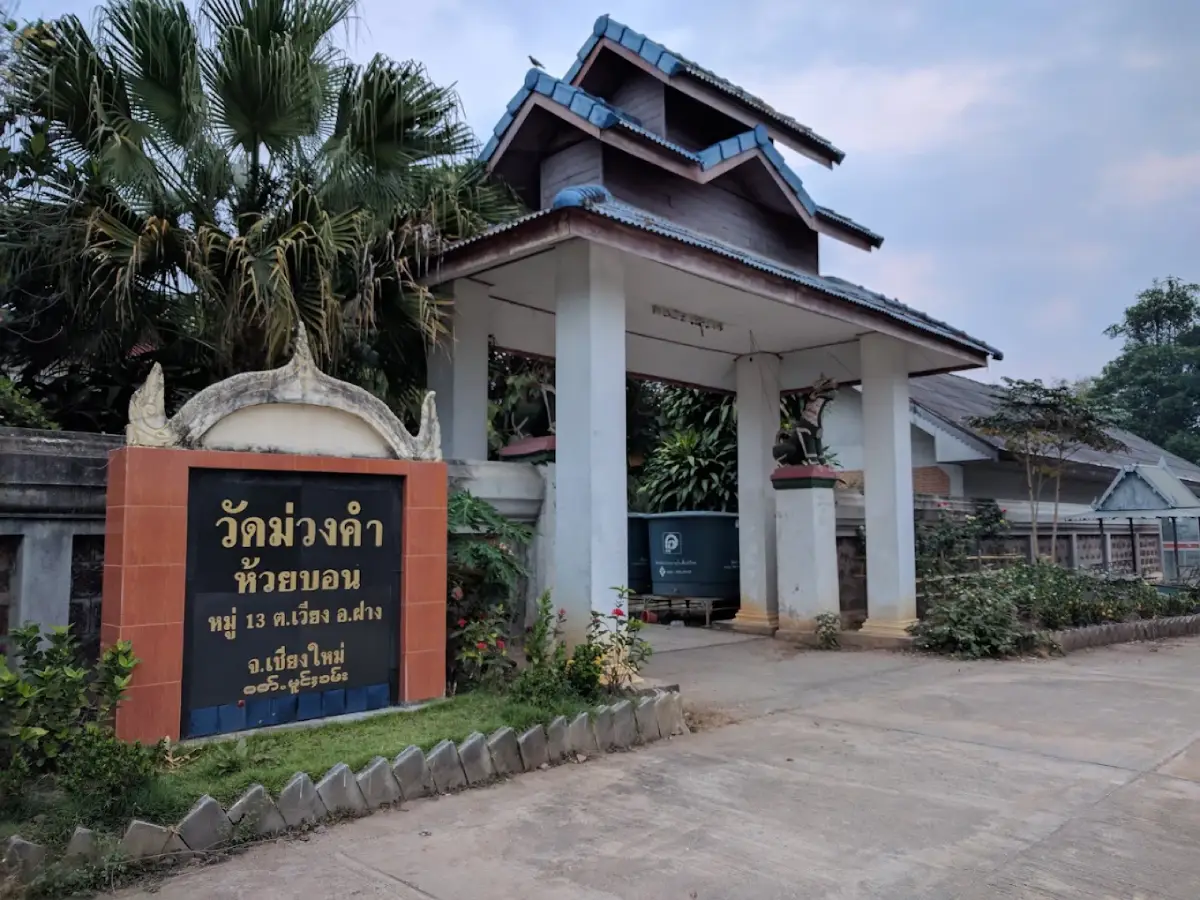
Wat Muang Kham (Wiang) is a private Buddhist temple under the Mahanikaya monastic order. It is located in Moo 13, Wiang Subdistrict, Fang District, Chiang Mai Province 50110. Local administrative documents also refer to the temple as Wat Muang Kham (Huai Bon), reflecting its connection with the Moo 13 community and the Huai Bon area of Wiang Subdistrict. The temple was officially established in 1937 and is identified with Phra Prachak Pannawaro as its abbot. Wat Muang Kham is therefore an active community temple with a clear Buddhist status and an ongoing role in local religious life.
Wat Muang Kham (Wiang) is suitable for travelers who want to visit a quiet local temple in Fang District and experience a simple community-based Buddhist atmosphere. It is not a large mainstream tourist attraction, but it has value as a village temple closely connected with local residents, local routes, and the natural landscape of Wiang Subdistrict. Because the temple is located in Moo 13, it can be combined with nearby nature-based attractions such as Tham Huai Bon, Ban Huai Bon Reservoir, Huai Hian Waterfall, and Fang Hot Spring.
The official establishment of the temple in 1937 is important for understanding its role in the community. Many local temples in northern Thailand developed from the faith of village residents who needed a place for merit-making, Buddhist ceremonies, and community gatherings. Wat Muang Kham grew as part of the Moo 13 community in Wiang Subdistrict. It became a place where villagers could make merit, join Buddhist holy day activities, listen to teachings, and preserve local religious traditions.
The name “Muang Kham” carries a gentle and auspicious meaning in northern Thai cultural context. The word “kham” is often associated with gold or something precious, while “muang” may relate to local place identity, vegetation, or community naming traditions. Although a detailed origin story for the name is not documented in the available public information, the name fits the style of many Lanna temple names that connect place identity, nature, and auspicious meaning.
The context of Wiang Subdistrict adds importance to Wat Muang Kham. Wiang is an area with many temples distributed across different village communities. Each temple functions as a local center of Buddhist practice and community identity. Wat Muang Kham serves this role for Moo 13. It is a religious landmark where the relationship between temple, village, and local life continues in a modest but meaningful way.
Phra Prachak Pannawaro is identified as the abbot of Wat Muang Kham in the temple information. In a community temple, the abbot’s role includes caring for the temple, supporting monks and novices, coordinating with villagers, organizing merit-making activities, and serving as a spiritual figure for the local community. Wat Muang Kham therefore reflects the close relationship between monks and villagers that remains central to Lanna Buddhist life.
The main appeal of Wat Muang Kham (Wiang) is its peaceful village-temple atmosphere. Visitors can stop here for merit-making, quiet reflection, and a respectful view of local Buddhist life. The temple is especially suitable for travelers who want to understand Fang beyond famous tourist sites. A village temple like this often shows the daily relationship between Buddhism and community more clearly than heavily promoted destinations.
The temple grounds support merit-making, chanting, Buddhist ceremonies, and community religious activities for residents of Moo 13. Visitors should dress respectfully, speak quietly, avoid disturbing monks or local worshippers, and keep the temple clean. Photography should be done with care, especially during religious activities. Wat Muang Kham is an active religious space, so visitors should approach it with mindfulness rather than treating it only as a photo stop.
Wat Muang Kham is connected with the regular Buddhist calendar and Lanna community traditions, including Makha Bucha Day, Visakha Bucha Day, Asalha Bucha Day, Buddhist Lent, the end of Buddhist Lent, Kathin, Pha Pa, Buddhist holy days, and village merit-making activities. These traditions help local residents maintain their relationship with the temple and pass Buddhist values from one generation to the next.
For travelers, Wat Muang Kham (Wiang) works well as part of a Wiang Subdistrict route on the Huai Bon side of Fang. A morning visit to the temple can be followed by Tham Huai Bon, Ban Huai Bon Reservoir, or Huai Hian Waterfall. Travelers interested in history can continue to the King Fang Udomsin and Queen Sam Phio Monument, Wat Phra Bat Udom, Wat Pannaram, or Wat Chedi Ngam closer to Fang town.
The travel route around Wat Muang Kham is appealing because it combines a local temple, village life, and natural attractions. Tham Huai Bon and Ban Huai Bon Reservoir are suitable for nature-based sightseeing. The King Fang Udomsin and Queen Sam Phio Monument is suitable for those interested in the history of Fang. Fang Hot Spring in Doi Pha Hom Pok National Park is a good place to end the day with a relaxing natural experience.
Getting There is easiest by private car or rental car. From Chiang Mai city, take Highway 107 toward Fang District, passing Mae Rim, Mae Taeng, Chiang Dao, and Chai Prakan before entering Fang. The distance from Chiang Mai city to Fang is roughly 150–160 km and usually takes about 2.5–3.5 hours depending on traffic and road conditions. Once in Fang, continue to Wiang Subdistrict and Moo 13 in the Huai Bon area, or search for Wat Muang Kham (Wiang) in a navigation app.
Travelers using public transport can take a Chiang Mai–Fang bus or van, then continue from Fang town by local transport, songthaew, or hired vehicle to Moo 13 of Wiang Subdistrict. A private vehicle is more convenient because the temple is best visited together with nearby nature attractions such as Tham Huai Bon, Ban Huai Bon Reservoir, Huai Hian Waterfall, and Fang Hot Spring.
The best time to visit Wat Muang Kham is in the morning from about 08.00 to 10.00 or later in the afternoon when the weather is milder. During the cool season, Fang District is pleasant for combining temple visits with natural attractions. During the rainy season, travelers should allow extra time and check road conditions, especially when continuing toward caves, waterfalls, reservoirs, or mountain areas.
Wat Muang Kham (Wiang) is best understood as a community temple of Moo 13 in Wiang Subdistrict. Its strongest verified details are its name, location, Mahanikaya affiliation, establishment year 1937, and abbot. When placed within the broader context of the Huai Bon area and Wiang Subdistrict, the temple becomes a meaningful stop for travelers who want to see the quieter side of Fang’s Buddhist and village life.
| Name | Wat Muang Kham (Wiang) |
| Location | Moo 13, Wiang Subdistrict, Fang District, Chiang Mai Province |
| Address | Moo 13, Wiang Subdistrict, Fang District, Chiang Mai 50110, Thailand |
| Highlights | A Mahanikaya community temple of Moo 13, Wiang Subdistrict, suitable for a peaceful local temple visit and a route connected with Huai Bon natural attractions |
| History | Officially established as a temple in 1937 and serving as a community Buddhist temple in Wiang Subdistrict |
| Affiliation | Private temple under the Mahanikaya monastic order |
| Name Origin | The name reflects local identity and an auspicious Lanna naming style, with “kham” commonly associated with gold or something precious |
| Distinctive Features | A quiet village temple suitable for merit-making, reflection, and community-based cultural travel in Fang District |
| Important Sacred Areas | Temple grounds used for merit-making, Buddhist ceremonies, chanting, and community religious activities of Moo 13 |
| Travel Information | From Chiang Mai city, take Highway 107 toward Fang District, then continue to Wiang Subdistrict and Moo 13 in the Huai Bon area. Private car or rental car is the most convenient option. |
| Current Status | Open as an active community temple in Wiang Subdistrict, Fang District, Chiang Mai Province |
| Open Days | Daily |
| Opening Hours | 08.00 – 17.00 |
| Abbot / Caretaker | Phra Prachak Pannawaro |
| Related Traditions | Buddhist holy days, Kathin, Pha Pa, Buddhist Lent, the end of Buddhist Lent, and merit-making activities of the Moo 13 community |
| Nearby Tourist Attractions | 1. Tham Huai Bon, about 2 km 2. Ban Huai Bon Reservoir, about 4 km 3. Huai Hian Waterfall, about 5 km 4. Fang Hot Spring, Doi Pha Hom Pok National Park, about 9 km 5. King Fang Udomsin and Queen Sam Phio Monument, about 11 km |
| Nearby Restaurants | 1. GREAT VIEW FANG, about 8 km, Tel. 062-048-4222 2. Ban Rim Nam Fang Restaurant, about 11 km, Tel. 053-382-174 3. Hong Nang Len Fang Chiang Mai, about 11 km, Tel. 083-201-8503, 095-134-6442 4. Add Line Shabu Fang, about 11 km, Tel. 061-127-3013 5. Fang Cafe, about 12 km, Tel. 087-301-6200 |
| Nearby Accommodations | 1. Fang Villa Hotel, about 11 km, Tel. 086-451-7682 2. Huen San Fang, about 11 km, Tel. 081-881-6430, 063-790-0666 3. Fang Modern Hotel, about 13 km, Tel. 086-439-1843 4. Fang Chayapa Hotel, about 13 km, Tel. 091-879-2664 5. Tangerine Ville Hotel, about 14 km, Tel. 053-452-114 |
Frequently Asked Questions (FAQ)
Q: Where is Wat Muang Kham (Wiang) located?
A: Wat Muang Kham (Wiang) is located in Moo 13, Wiang Subdistrict, Fang District, Chiang Mai Province 50110.
Q: What are the opening days and opening hours of Wat Muang Kham (Wiang)?
A: Wat Muang Kham (Wiang) is open daily from 08.00 to 17.00.
Q: What type of temple is Wat Muang Kham (Wiang)?
A: Wat Muang Kham (Wiang) is a private Buddhist temple under the Mahanikaya monastic order and serves the Moo 13 community in Wiang Subdistrict.
Q: What is the historical background of Wat Muang Kham (Wiang)?
A: The temple was officially established in 1937 and has continued to serve as a community Buddhist temple in Wiang Subdistrict.
Q: Who is the abbot of Wat Muang Kham (Wiang)?
A: Phra Prachak Pannawaro is identified as the abbot of Wat Muang Kham in the temple information.
Q: Who should visit Wat Muang Kham (Wiang)?
A: It is suitable for travelers who want a peaceful local temple visit and a route connected with Huai Bon natural attractions in Fang District.
Q: How can travelers get from Chiang Mai city to Wat Muang Kham (Wiang)?
A: Take Highway 107 from Chiang Mai city toward Fang District, then continue to Wiang Subdistrict and Moo 13 in the Huai Bon area.
Q: Which nearby places can be visited with Wat Muang Kham (Wiang)?
A: Nearby places include Tham Huai Bon, Ban Huai Bon Reservoir, Huai Hian Waterfall, Fang Hot Spring, and the King Fang Udomsin and Queen Sam Phio Monument.
 Category: ●Places of Worship
 Group: ●Temple
Last Update : 7 DayAgo
 Last Update : 7 DayAgo
 Click to Access the Navigation Map GPS
Wat Muang Kham (Wiang) Map
Recommend

 Muang Chiang Mai(121)Chom Thong(47)Mae Chaem(25)Chiang Dao(33)Doi Saket(68)Mae Taeng(85)Mae Rim(69)Samoeng(29)Fang(71)Mae Ai(59)Phrao(70)San Pa Tong(103)San Kamphaeng(66)San Sai(73)Hang Dong(73)Hot(32)Doi Tao(22)Omkoi(11)Saraphi(74)Wiang Haeng(15)Chai Prakan(28)Mae Wang(32)Mae On(22)Doi Lo(34)Galyani Vadhana(1)


