
lovethailand home >North Travel Attractions >Chiang Mai Travel Attractions >Fang >Wiang > Wat Pannaram
TL;DR: Wat Pannaram is located at Ban Ton Nun, Chet Yot Area, Moo 5, Wiang Subdistrict, Fang District, Chiang Mai Province, open Daily, hours 08.00 – 17.00.

Wat Pannaram
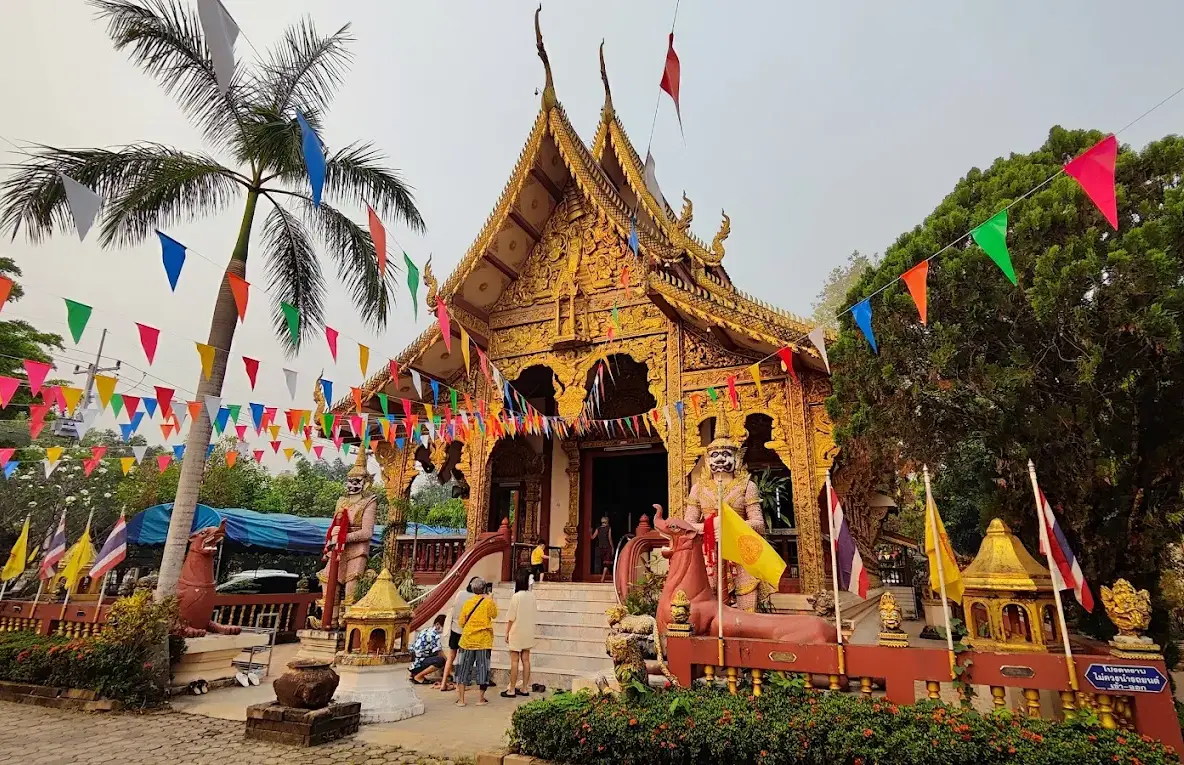
Open Days: Daily
Opening Hours: 08.00 – 17.00
Wat Pannaram, also widely known among local residents as Wat Ton Nun, is a private Buddhist temple under the Mahanikaya monastic order. It is located at 311 Moo 5, Ban Ton Nun, Chet Yot area, Wiang Subdistrict, Fang District, Chiang Mai Province. The temple is one of the historically meaningful religious sites in old Fang. Official records state that it was established as a temple in 1877 and received its Wisungkhamsima, or royal consecrated boundary, in 1955. Its older local history connects it with the former name “Wat Ta Saeng Noi,” making the temple an important site for understanding the Buddhist and community history of Fang.
Wat Pannaram is suitable for travelers who want to visit a quiet community temple with a strong historical background. Its significance does not lie only in being a place of merit-making for local residents. The temple is also associated with a local account of Phraya Ta Saeng Noi, an inscription on the base of the temple’s principal Buddha image referring to Chula Sakarat 958, and ancient religious structures such as Buddha images and a chedi. These elements give Wat Pannaram value as a place of faith, local history, and community memory.
The temple’s original name was Wat Ta Saeng Noi, named after Phraya Ta Saeng Noi, who is remembered in local history as the founder of the temple. He may have been an important nobleman or high-ranking official connected with the ruler of Chai Prakan, the old Fang polity. Building a temple with large Buddha images and a chedi in ancient times required manpower, wealth, and skilled craftsmanship. For this reason, Wat Pannaram should be understood as more than a small village temple. It is a cultural trace of an old settlement where Buddhism received strong local support.
The inscription referring to Chula Sakarat 958 is important for understanding the temple’s historical depth. This year corresponds approximately to 1596 CE, or 2139 BE, placing the temple’s older layer within the historical context of old Fang and Chai Prakan. Wat Pannaram therefore contains several layers of history: an ancient temple associated with the old city, a restored temple after the resettlement of Fang, and a formally registered temple in the modern ecclesiastical system.
When Chai Prakan became deserted, many temples in the area deteriorated because there were no settled communities to maintain them. The old Fang area became forested for more than a century before northern rulers connected with Chiang Mai encouraged people to resettle and rebuild the town. As people returned, old temples were restored and religious life resumed. Wat Ta Saeng Noi, the former name of Wat Pannaram, was revived, monks and novices lived there again, and the temple returned to its role as a Buddhist center for the local community.
Later, people from Mae Rim moved into the area and settled around Wat Ta Saeng Noi. As the village of Ton Nun developed around the temple, the temple became known as Wat Ton Nun. This name became deeply rooted in daily life because it was linked to the village and the identity of local residents. Even today, many people still recognize the temple by this traditional name.
In 1943, the Chiang Mai Sangha administration changed the temple’s name from Wat Ton Nun to Wat Pannaram in line with naming policies of that period. The new name became the official name, but many local residents continued to use the older name because of its deep connection with the village. For visitors, it is useful to know both names: Wat Pannaram is the official name, while Wat Ton Nun is the local name that reflects community memory.
The temple’s formal Buddhist status is clear. Wat Pannaram is a private temple under the Mahanikaya order. It was officially established in 1877 and received Wisungkhamsima on 1 January 1955. A Wisungkhamsima is a formally consecrated boundary used for important monastic ceremonies, including ordination. This confirms that Wat Pannaram has long functioned as a complete Buddhist temple for the local community, not only as an old religious site with historical stories.
Phra Khru Wisuttham Rak Suthammo is identified as the abbot of Wat Pannaram in the source information. In a community temple, the abbot plays an important role in maintaining religious practice, caring for temple property, organizing merit-making activities, and coordinating with local residents. Wat Pannaram therefore remains connected to the daily Buddhist life of Ban Ton Nun and Wiang Subdistrict.
The main points of interest at Wat Pannaram are its historical atmosphere and its connection with the old town of Fang. Visitors should pay attention to the Buddha image associated with the inscription and the chedi mentioned in the temple’s local history. These objects are important because they help explain why the temple is regarded as an ancient site and why it continues to carry meaning for people in the Ton Nun community.
Wat Pannaram is a place for respectful merit-making and quiet reflection. Travelers interested in Lanna temples and the history of Fang should walk through the temple grounds with care, because this is still an active religious site used by local residents. Modest clothing, quiet behavior, and respect for monks and worshippers are expected.
The temple’s community role is clear. Wat Pannaram serves as a village temple, a place for Buddhist ceremonies, a gathering space for local residents, and a public venue for civic activities such as local elections. This shows that the temple remains relevant in modern community life. It is not only an ancient temple but also a living social and religious space in Wiang Subdistrict.
Wat Pannaram is connected with Buddhist merit-making traditions throughout the year, including important Buddhist holy days, Buddhist Lent, the end of Buddhist Lent, Kathin, Pha Pa, and local community merit-making activities. Event details may change each year, so travelers who wish to attend a specific ceremony should check local announcements before visiting.
Getting There is easiest by private car or rental car. From Chiang Mai city, take Highway 107 toward Fang District, passing Mae Rim, Mae Taeng, Chiang Dao, and Chai Prakan before entering Fang town. The distance from Chiang Mai city to Fang is roughly 150–160 km and usually takes about 2.5–3.5 hours depending on traffic and road conditions. Once in Fang, continue to Wiang Subdistrict and the Ton Nun, Chet Yot area, or search for Wat Pannaram or Wat Ton Nun in a navigation app.
Travelers using public transport can take a Chiang Mai–Fang bus or van and continue from Fang town by local transport, songthaew, or hired vehicle. A private vehicle is more convenient for combining several nearby temples and attractions in one day, such as Wat Phra Bat Udom, Wat Chedi Ngam, Wat Chong Paen, the King Fang and Phra Nang Sam Phio Monument, and Fang Hot Spring.
A practical route is to visit Wat Pannaram in the morning, then continue to Wat Phra Bat Udom and the King Fang and Phra Nang Sam Phio Monument nearby. After that, travelers can visit Wat Chedi Ngam or Wat Chong Paen in Wiang Subdistrict. If there is more time in the afternoon, the route can be extended to Fang Hot Spring or Doi Pha Hom Pok National Park. This route combines temple visits, old Fang history, and northern Thai nature in one trip.
The best time to visit is in the morning between 08.00 and 10.00 or later in the afternoon when the weather is milder. During the cool season, Fang District is especially pleasant for temple visits and can be combined with trips to Doi Ang Khang, Doi Pha Hom Pok, or Fang Hot Spring. During the rainy season, travelers should allow extra time and check road conditions if continuing toward mountain areas.
Wat Pannaram is best understood as a historical community temple rather than a simple sightseeing stop. It combines an official temple history, an older local name, the story of Phraya Ta Saeng Noi, links with old Chai Prakan, the name change in 1943, and an ongoing role in Ban Ton Nun. Visitors who come here gain not only a temple visit, but also a deeper view of Fang’s local history and living Buddhist culture.
| Name | Wat Pannaram, also known as Wat Ton Nun |
| Location | Ban Ton Nun, Chet Yot Area, Moo 5, Wiang Subdistrict, Fang District, Chiang Mai Province |
| Address | 311 Moo 5, Ton Nun, Chet Yot, Wiang Subdistrict, Fang District, Chiang Mai 50110, Thailand |
| Highlights | An ancient community temple formerly known as Wat Ta Saeng Noi, linked with old Fang and Chai Prakan history |
| History | Officially established in 1877 and granted Wisungkhamsima on 1 January 1955; local history refers to an inscription dated Chula Sakarat 958 on the base of a Buddha image |
| Name Origin | Originally called Wat Ta Saeng Noi, later known as Wat Ton Nun after the village, and renamed Wat Pannaram in 1943 |
| Distinctive Features | A Mahanikaya community temple with deep local history and strong ties to Ban Ton Nun and Wiang Subdistrict |
| Important Sacred Objects | A Buddha image associated with the inscription and a chedi mentioned in local temple history as major ancient religious structures |
| Travel Information | From Chiang Mai city, take Highway 107 toward Fang District, then continue to Wiang Subdistrict and the Ton Nun, Chet Yot area. Private car is the most convenient option. |
| Current Status | Open as an active community temple in Wiang Subdistrict, Fang District, Chiang Mai Province |
| Open Days | Daily |
| Opening Hours | 08.00 – 17.00 |
| Abbot / Caretaker | Phra Khru Wisuttham Rak Suthammo |
| Main Contact Number | 053-452-722 |
| Related Traditions | Buddhist holy days, Kathin, Pha Pa, Buddhist Lent, and community merit-making activities of Ban Ton Nun |
| Nearby Tourist Attractions | 1. Wat Phra Bat Udom, about 2 km 2. King Fang and Phra Nang Sam Phio Monument, about 2 km 3. Wat Chedi Ngam, about 3 km 4. Wat Chong Paen, about 3 km 5. Fang Hot Spring, Doi Pha Hom Pok National Park, about 11 km |
| Nearby Restaurants | 1. Ban Rim Nam Fang Restaurant, about 2 km, Tel. 053-382-174 2. Hong Nang Len Fang Chiang Mai, about 2 km, Tel. 083-201-8503, 095-134-6442 3. Add Line Shabu Fang, about 3 km, Tel. 061-127-3013 4. Fang Cafe, about 4 km, Tel. 087-301-6200 5. GREAT VIEW FANG Branch, about 7 km, Tel. 062-048-4222 |
| Nearby Accommodations | 1. Huen San Fang, about 2 km, Tel. 081-881-6430, 063-790-0666 2. Fang Villa Hotel, about 3 km, Tel. 086-451-7682 3. Fang Modern Hotel, about 5 km, Tel. 086-439-1843 4. Fang Chayapa Hotel, about 5 km, Tel. 091-879-2664 5. Tangerine Ville Hotel, about 6 km, Tel. 053-452-114 |
Frequently Asked Questions (FAQ)
Q: Where is Wat Pannaram located?
A: Wat Pannaram is located at 311 Moo 5, Ban Ton Nun, Chet Yot, Wiang Subdistrict, Fang District, Chiang Mai Province 50110.
Q: What are the opening days and opening hours of Wat Pannaram?
A: Wat Pannaram is open daily from 08.00 to 17.00.
Q: Are Wat Pannaram and Wat Ton Nun the same temple?
A: Yes. Wat Pannaram is the official name, while Wat Ton Nun is the local name. The temple was also formerly known as Wat Ta Saeng Noi.
Q: How old is Wat Pannaram?
A: The temple was officially established in 1877, while local history refers to an inscription dated Chula Sakarat 958, giving the temple an older historical layer of more than 400 years.
Q: Who founded Wat Pannaram according to local history?
A: Local history attributes the foundation of the temple to Phraya Ta Saeng Noi, who was connected with old Chai Prakan or old Fang.
Q: What should visitors see at Wat Pannaram?
A: Visitors should pay attention to the Buddha image associated with the inscription, the chedi mentioned in local history, and the quiet atmosphere of this historic community temple.
Q: How can travelers get from Chiang Mai city to Wat Pannaram?
A: Take Highway 107 from Chiang Mai city toward Fang District, then continue to Wiang Subdistrict and the Ton Nun, Chet Yot area. Public transport to Fang is available, but local transport is needed for the final section.
Q: What nearby places can be visited with Wat Pannaram?
A: Nearby places include Wat Phra Bat Udom, the King Fang and Phra Nang Sam Phio Monument, Wat Chedi Ngam, Wat Chong Paen, and Fang Hot Spring.
 Category: ●Places of Worship
 Group: ●Temple
Last Update : 1 DayAgo
 Last Update : 1 DayAgo
 Click to Access the Navigation Map GPS
Wat Pannaram Map
Recommend

 Muang Chiang Mai(121)Chom Thong(47)Mae Chaem(25)Chiang Dao(33)Doi Saket(68)Mae Taeng(85)Mae Rim(69)Samoeng(29)Fang(71)Mae Ai(59)Phrao(70)San Pa Tong(105)San Kamphaeng(66)San Sai(73)Hang Dong(74)Hot(32)Doi Tao(22)Omkoi(11)Saraphi(74)Wiang Haeng(15)Chai Prakan(28)Mae Wang(32)Mae On(22)Doi Lo(34)Galyani Vadhana(1)


