
lovethailand home >North Travel Attractions >Chiang Mai Travel Attractions >Fang >Mae Kha > Wat Khayanusit
TL;DR: Wat Khayanusit is located at No. 7, Moo 1, Ban Mae Kha, Mae Kha Subdistrict, Fang District, Chiang Mai Province, open Daily, hours 08.00 - 17.00.

Wat Khayanusit
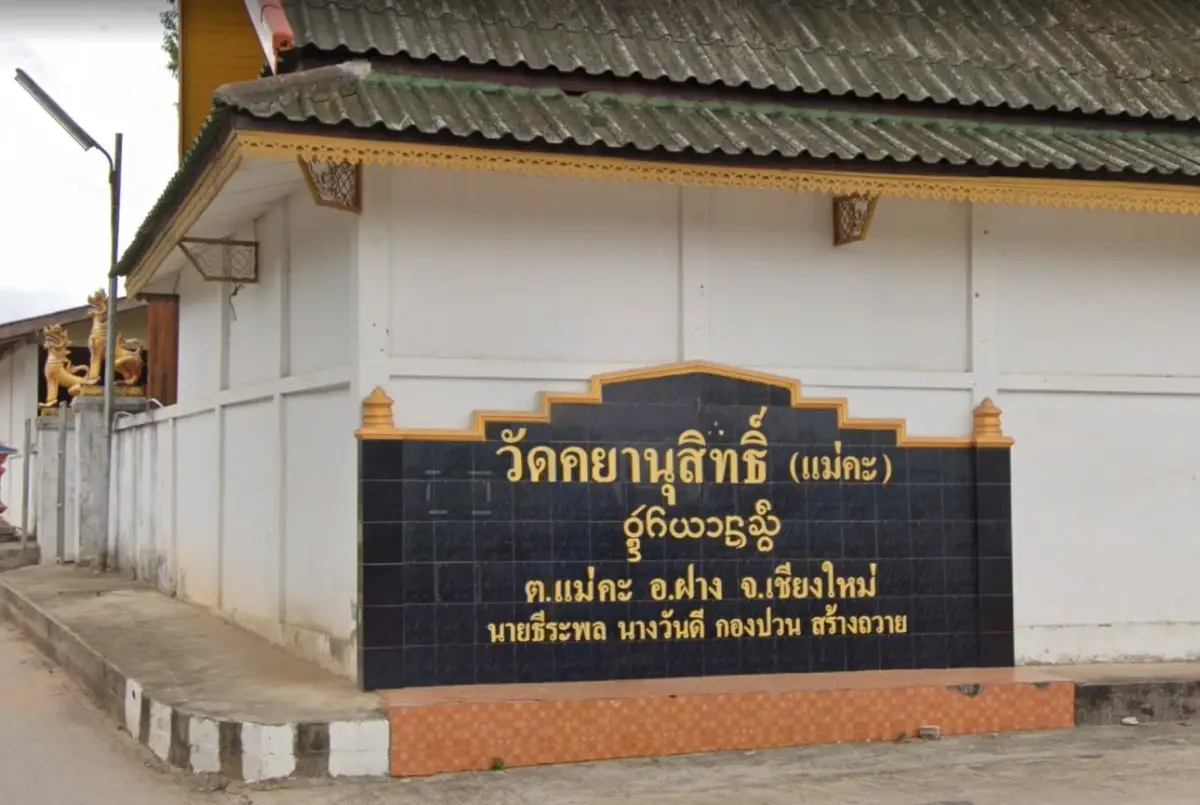
Open Days: Daily
Opening Hours: 08.00 - 17.00
Wat Khayanusit is located at No. 7, Moo 1, Ban Mae Kha, Mae Kha Subdistrict, Fang District, Chiang Mai Province. It is a local Buddhist temple under the Mahanikaya order and an important community temple for Ban Mae Kha. The temple was founded in 1920, with Pho Luang Noi Muen Tipsin leading the local community in establishing the temple. It received its royal consecrated boundary on April 28, 1980. With more than a century of history, Wat Khayanusit remains a meaningful spiritual center for the Mae Kha community.
Wat Khayanusit is valuable because it represents the relationship between Buddhism and village life in northern Thailand. It is not a large commercial tourist attraction. Its importance lies in its role as a community temple where local residents make merit, listen to sermons, join Buddhist ceremonies, and gather for village activities. For travelers who want to understand Fang District beyond mountain scenery and hot springs, this temple offers a quiet and authentic view of Mae Kha’s local Buddhist culture.
The temple name “Khayanusit” carries a formal Buddhist tone and a sense of auspiciousness. Publicly available sources do not provide a detailed origin story for the name, but the temple is commonly identified together with Mae Kha, showing its close connection with Ban Mae Kha in Moo 1. Like many village temples in northern Thailand, Wat Khayanusit grew from local faith and became a cultural and spiritual landmark for the surrounding community.
The temple’s founding in 1920 places Wat Khayanusit among the long-established community temples of Mae Kha. At that time, rural temples in northern Thailand were more than places for rituals. They served as moral learning spaces, community meeting places, centers of seasonal merit-making, and places where elders, families, and children gathered around Buddhist values. Wat Khayanusit has continued that role through changes in the local economy, transportation, and community structure.
The royal consecrated boundary granted on April 28, 1980 was a major milestone. In Thai Buddhism, a consecrated boundary is essential for formal monastic ceremonies. Its presence confirms the temple’s full religious status within the Sangha system and allows the temple to support important Buddhist rites. For a local village temple, this status reflects both religious maturity and continued community support.
The temple compound covers 2 rai, 2 ngan, and 16 square wah. The temple land is associated with Nor Sor 3 land document No. 1459, land plot No. 136. The northern boundary extends about 1 sen and 10 wa to a public road, and the eastern boundary extends about 3 sen and 5 wa to the village. The temple also has one plot of monastic land measuring 2 ngan. These land details show the temple’s physical foundation as a religious and community space in Ban Mae Kha.
Mae Kha village in Moo 1 is an important part of Mae Kha Subdistrict. The subdistrict has 15 villages and a landscape that includes hills, lowland areas, and local waterways such as Huai Khrai, Huai Mae Kha, and Huai Prasa. Mae Kha is also known for its petroleum history, agricultural areas, local beliefs, and cultural diversity. Wat Khayanusit therefore stands within a community landscape shaped by Buddhism, local livelihoods, natural resources, and northern Thai village culture.
Mae Kha Subdistrict’s local identity includes stories of Chao Pho Khomue Lek, the petroleum discovery area, serpent-like rock formations, and the cultural diversity of local ethnic communities. Within this context, Wat Khayanusit functions as a Buddhist anchor for the village. It provides a stable spiritual center in a community that has both traditional agricultural roots and modern local development connected with energy, roads, and public activities.
Important areas at Wat Khayanusit include the worship area, main religious space, temple grounds, ceremonial areas, and spaces used by monks for religious practice. Publicly verified details about specific structures such as the viharn, ubosot, chedi, bell tower, or sermon hall are limited, so those elements should not be described beyond what is supported. The temple’s status as a site with a royal consecrated boundary, however, confirms its role as a formal Buddhist religious space capable of supporting important monastic ceremonies.
The current abbot of Wat Khayanusit is Phra Athikan Suthat Chayanantho. In a community temple, the abbot’s role is central. He oversees temple activities, monks, religious ceremonies, temple maintenance, and the relationship between the temple and local residents. This leadership helps keep Wat Khayanusit active as both a religious site and a community space.
Wat Khayanusit continues to function as a public gathering place for Mae Kha. In 2026, the temple was used as the venue for a district-level activity on drug prevention and community participation, attended by local residents from Mae Kha Subdistrict. This shows that the temple remains active not only for Buddhist ceremonies but also as a shared civic space where local residents, community leaders, and government agencies can meet.
The temple’s religious life follows the Buddhist calendar and local Lanna traditions. Common activities include Buddhist holy days, food offerings to monks, sermons, candlelight ceremonies on major Buddhist festivals, Buddhist Lent, the end of Buddhist Lent, Kathin, Pha Pa, and community merit-making events. Kathin activities connected with the temple show the continuing relationship between lay supporters and the temple community.
In Lanna community life, a temple is more than a religious building. It is a shared space where elders make merit, families gather, children learn religious etiquette, and villagers maintain social ties. Wat Khayanusit reflects this function. It supports both religious continuity and social cohesion, giving Ban Mae Kha a stable center for Buddhist practice and community identity.
The main appeal of Wat Khayanusit is its authenticity as a long-standing village temple. Visitors should not expect a large tourist complex. Instead, the temple offers a calm atmosphere, a documented local history, and a close relationship with the Mae Kha community. It is suitable for respectful merit-making, quiet temple visits, and travelers who want to understand the cultural foundation of Fang District.
The area around Wat Khayanusit is also connected with the Northern Petroleum Development Center and the petroleum learning center in Mae Kha. Fang is known as the site of Thailand’s first crude oil discovery, and Mae Kha is part of that history. A visit to Wat Khayanusit can therefore be combined with local learning about petroleum history, village culture, and northern Thai Buddhism in one route.
Getting There from Chiang Mai city is straightforward but takes time. Travelers can take Highway 107 north toward Fang District, passing Mae Taeng, Chiang Dao, and Chai Prakan. From Fang, continue toward Mae Kha Subdistrict and Ban Mae Kha in Moo 1. Mae Kha is connected by Highway 109, which links the Fang area with Mae Suai District in Chiang Rai Province. When using a map application, search specifically for “Wat Khayanusit Mae Kha Fang Chiang Mai” to avoid confusion with similar temple names elsewhere.
From central Fang or Wiang Fang, Wat Khayanusit can be reached by private car, motorcycle, or local hired transport. Travelers coming from Chiang Rai or Mae Suai can also use the Fang-Mae Suai route to enter Mae Kha. The temple works well as a short cultural stop, especially for visitors planning to explore Mae Kha’s petroleum history, local temples, and nearby attractions in Fang District.
A short itinerary can combine Wat Khayanusit with the Northern Petroleum Development Center and nearby temples in Mae Kha, such as Wat Santi Wanaram, Wat Thep Nimit, Wat Chiang Yuen, Wat Ketukalong, and Wat Pong Sai Kham. A full-day route can continue to Fang Hot Springs, Doi Pha Hom Pok National Park, or the First Royal Factory Museum Fang. This creates a balanced route covering Buddhism, local culture, energy history, nature, and regional heritage.
The best time to visit Wat Khayanusit is in the morning or late afternoon, when the weather is more comfortable and the temple atmosphere is calm. Buddhist holy days and major festivals may bring more community activity, while ordinary weekdays are better for a quiet visit. Visitors should dress modestly, speak softly, respect monks and worshippers, and avoid touching sacred objects unnecessarily.
In summary, Wat Khayanusit is a local Mahanikaya temple in Ban Mae Kha, Moo 1, Mae Kha Subdistrict, Fang District, Chiang Mai. Founded in 1920 through the leadership of Pho Luang Noi Muen Tipsin and granted its royal consecrated boundary on April 28, 1980, the temple remains a spiritual center for the Mae Kha community. Its value lies in its documented history, community role, temple land foundation, and continuing function as both a Buddhist site and a local gathering place.
| Name | Wat Khayanusit |
| Location | No. 7, Moo 1, Ban Mae Kha, Mae Kha Subdistrict, Fang District, Chiang Mai Province |
| Address | 7 Moo 1, Ban Mae Kha, Mae Kha Subdistrict, Fang District, Chiang Mai 50110, Thailand |
| Type | Local Buddhist temple under the Mahanikaya order |
| Highlights | A long-established community temple of Ban Mae Kha, founded in 1920 and serving as a spiritual center for the local community |
| History | Founded in 1920, with Pho Luang Noi Muen Tipsin leading the local community in establishing the temple, and granted its royal consecrated boundary on April 28, 1980 |
| Temple Land | 2 rai, 2 ngan, 16 square wah, with Nor Sor 3 land document No. 1459, land plot No. 136, and one monastic land plot measuring 2 ngan |
| Important Boundaries | Northern boundary about 1 sen and 10 wa to a public road; eastern boundary about 3 sen and 5 wa to the village |
| Name Origin | The temple is commonly identified with Mae Kha, showing its close relationship with Ban Mae Kha in Moo 1 |
| Distinctive Features | A Lanna community temple that grew from local faith and continues to function as both a Buddhist site and a community gathering place |
| Main Areas / Sacred Spaces | Worship area, main religious space, temple grounds, ceremonial area, and monks’ religious practice areas |
| Traditions / Merit-Making | Buddhist holy days, major Buddhist festivals, Buddhist Lent, end of Buddhist Lent, Kathin, Pha Pa, and Mae Kha community merit-making activities |
| Community Role | A spiritual center for Ban Mae Kha, supporting Buddhist ceremonies, merit-making, and public community activities |
| Abbot / Caretaker | Phra Athikan Suthat Chayanantho |
| Contact Number | 099-962-0567 |
| Travel Information | From Chiang Mai city, take Highway 107 toward Fang District, then continue to Mae Kha Subdistrict. Mae Kha is connected by Highway 109 toward Mae Suai, Chiang Rai |
| Current Status | Open as a community Buddhist temple and religious site in Mae Kha, Fang District, Chiang Mai Province |
| Open Days | Daily |
| Opening Hours | 08.00 - 17.00 |
| Facilities | Temple grounds, worship area, ceremonial area, and parking area within the temple compound |
| Nearby Tourist Attractions | 1. Northern Petroleum Development Center / Petroleum Learning Center, about 2 km 2. Wat Santi Wanaram Mae Kha, about 4 km 3. Wat Thep Nimit Mae Kha, about 6 km 4. Wat Chiang Yuen Mae Kha, about 7 km 5. Wat Ketukalong Mae Kha, about 9 km 6. Wat Pong Sai Kham Mae Kha, about 10 km 7. Fang Hot Springs, about 22 km 8. Doi Pha Hom Pok National Park, about 28 km 9. First Royal Factory Museum Fang, about 32 km |
| Nearby Restaurants | 1. GREAT VIEW FANG Branch, about 4 km, Tel. 062-048-4222 2. Kafae Ban Lung Ma, about 6 km, Tel. 095-690-1751 3. Khrua Mae Khaning, about 8 km, Tel. 082-283-3832 4. Bamee Je Hua Fang Branch, about 11 km, Tel. 064-721-8851 5. Oliang Ped Yang Fang, about 11 km, Tel. 064-520-0241, 082-993-8124 |
| Nearby Accommodations | 1. Ban Mueang Nuea Resort, about 7 km, Tel. 081-663-2569, 084-674-2014 2. Fang Modern Hotel, about 12 km, Tel. 086-439-1843 3. Fang Villa Hotel, about 13 km, Tel. 087-576-0838 4. Ban Sathitphon Hotel, about 14 km 5. Huen San Fang Hotel, about 16 km |
Frequently Asked Questions (FAQ)
Q: Where is Wat Khayanusit located?
A: Wat Khayanusit is located at No. 7, Moo 1, Ban Mae Kha, Mae Kha Subdistrict, Fang District, Chiang Mai Province 50110, Thailand.
Q: When was Wat Khayanusit founded?
A: Wat Khayanusit was founded in 1920, with Pho Luang Noi Muen Tipsin leading the local community in establishing the temple.
Q: When did Wat Khayanusit receive its royal consecrated boundary?
A: The temple received its royal consecrated boundary on April 28, 1980.
Q: Who is the abbot of Wat Khayanusit?
A: The abbot is Phra Athikan Suthat Chayanantho.
Q: What is special about Wat Khayanusit?
A: It is a long-established community temple of Ban Mae Kha with more than a century of history, temple land, monastic land, and a continuing role as a Buddhist and community gathering place.
Q: What kind of travelers will enjoy Wat Khayanusit?
A: It is suitable for travelers who enjoy peaceful temple visits, merit-making, Lanna community culture, and local history in Fang District.
Q: How do travelers get to Wat Khayanusit from Chiang Mai city?
A: Travelers can take Highway 107 toward Fang District, then continue to Mae Kha Subdistrict and Ban Mae Kha in Moo 1. Searching for “Wat Khayanusit Mae Kha Fang Chiang Mai” helps identify the correct temple.
Q: What nearby places can be combined with Wat Khayanusit?
A: Nearby places include the Northern Petroleum Development Center, Wat Santi Wanaram, Wat Thep Nimit, Wat Chiang Yuen, Fang Hot Springs, Doi Pha Hom Pok National Park, and the First Royal Factory Museum Fang.
 Category: ●Places of Worship
 Group: ●Temple
Last Update : 2 DayAgo
 Last Update : 2 DayAgo
 Click to Access the Navigation Map GPS
 Muang Chiang Mai(121)Chom Thong(47)Mae Chaem(25)Chiang Dao(33)Doi Saket(68)Mae Taeng(85)Mae Rim(69)Samoeng(29)Fang(71)Mae Ai(59)Phrao(70)San Pa Tong(105)San Kamphaeng(66)San Sai(73)Hang Dong(74)Hot(32)Doi Tao(22)Omkoi(11)Saraphi(74)Wiang Haeng(15)Chai Prakan(28)Mae Wang(32)Mae On(22)Doi Lo(34)Galyani Vadhana(1)


