
lovethailand home >North Travel Attractions >Chiang Mai Travel Attractions >Fang >Mon Pin > Wat Prathummawas
TL;DR: Wat Prathummawas is located at 56 Moo 8, Ban Nong Bua, Mon Pin Subdistrict, Fang District, Chiang Mai Province, open Daily, hours 08.00 - 17.00.

Wat Prathummawas
Open Days: Daily
Opening Hours: 08.00 - 17.00
Wat Prathummawas, also known locally as Wat Nong Bua, is a local Buddhist temple located at 56 Moo 8, Ban Nong Bua, Mon Pin Subdistrict, Fang District, Chiang Mai Province. The temple belongs to the Maha Nikaya order and was officially established in 1897. It received its royal grant of Wisungkhamsima in 1996. The available temple information names Phra Khru Adun Thammasophit Chandasuwwanno as the abbot. Wat Prathummawas is important as an old community temple of Ban Nong Bua, with Lanna-style religious buildings, a teak-carved Lanna ordination hall, and a continuing role as a spiritual center of the local community.
Wat Prathummawas is located in Ban Nong Bua, Mon Pin Subdistrict, one of the important community areas of Fang District in northern Chiang Mai. Mon Pin is shaped by the Mae Mao water system, agricultural villages, community temples, local schools, and cultural-natural travel routes. The temple therefore functions not only as a place of worship, but also as part of the village landscape where Buddhism, education, water, and daily life are closely connected.
The formal name “Prathummawas” is associated with the lotus and a Buddhist monastery, while the local name “Wat Nong Bua” comes from Ban Nong Bua, the village where the temple stands. Together, the two names express both the religious identity of the temple and its direct relationship with the local community.
The temple was founded through the faith of Pho Nan Chai, who consulted with the villagers of Ban Nong Bua to establish a temple for the community. The villagers then invited Chao Khru Ba Kantha from Wat Phra Bat Udom to lead the construction. This origin story reflects the common pattern of Lanna village temples: a temple is created through the shared faith of monks, local leaders, elders, and households.
The official establishment of the temple in 1897 makes Wat Prathummawas one of the long-standing temples of Mon Pin. During that period, village temples in northern Thailand were central to community life. They were places for merit-making, moral learning, Dhamma listening, village meetings, and important life-cycle rituals. Wat Prathummawas continues this role as a living Buddhist center of Ban Nong Bua.
The royal grant of Wisungkhamsima in 1996 is another important milestone. In Thai Buddhism, Wisungkhamsima is the formally granted sacred boundary used for important monastic acts, including ordination and other Sangha ceremonies. This status confirms the temple’s capacity to support formal Buddhist functions and marks its development as a complete community temple.
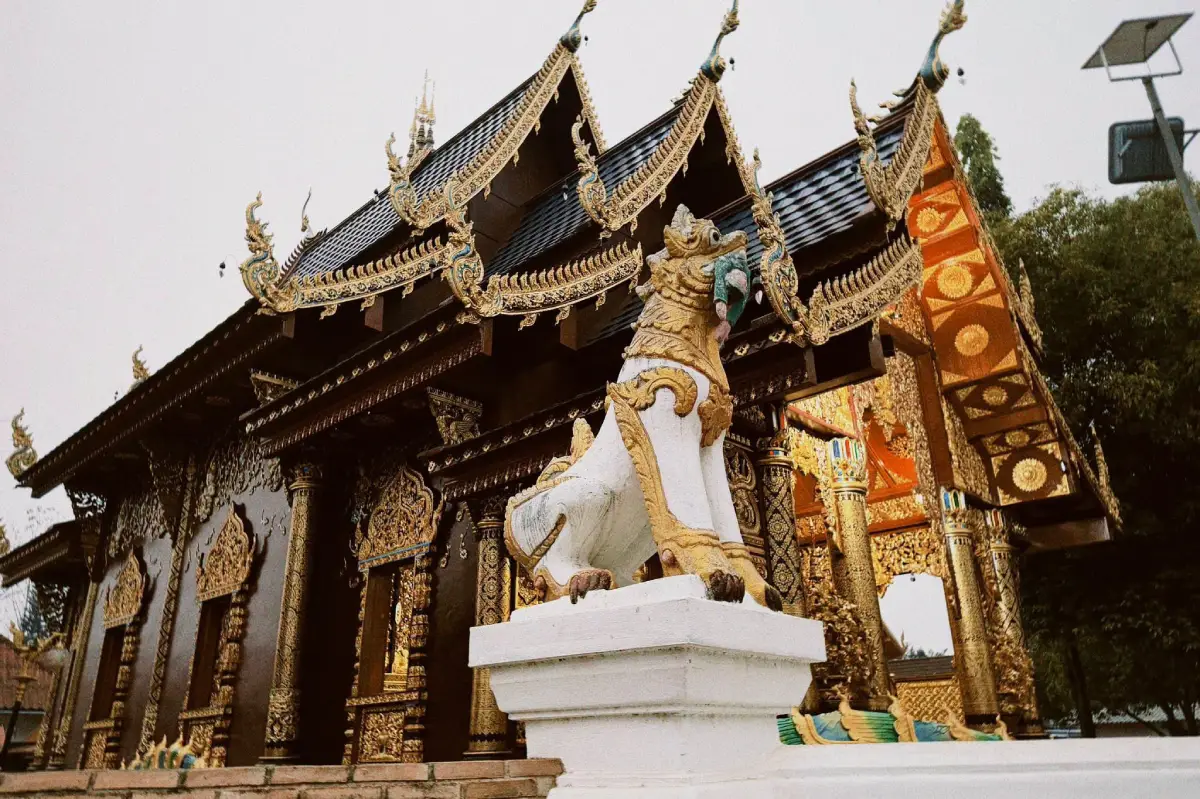
The main religious buildings of Wat Prathummawas include a viharn, a Lanna-style ordination hall carved with golden teak, a sala kan parian, and monks’ residences. The viharn serves as an important worship space. The sala kan parian supports Dhamma listening, merit-making, and community gatherings. The monks’ residences support the daily monastic life of the temple.
The Lanna-style ordination hall carved with golden teak is one of the most distinctive features of the temple. Teak has long been associated with northern Thai architecture because of its strength, warm texture, and cultural value. A teak-carved Lanna ordination hall gives Wat Prathummawas a strong sense of local identity and makes it especially meaningful for visitors interested in northern Thai Buddhist architecture.
The sacred objects inside the temple include various Buddha images. For a community temple, Buddha images are not only works of religious art. They are the focus of village faith, used in Buddhist holy day worship, annual merit-making, family ceremonies, and community religious life. Visitors should pay respect quietly and behave with modesty and care inside worship areas.
The temple boundary also shows its relationship with the surrounding community. One side of the temple area is connected with the Mae Mao stream, while other sides relate to public roads, local land, and nearby community institutions such as Ban Nong Bua School. This context shows that Wat Prathummawas is embedded in the village structure, not isolated from daily life.
The known line of abbots begins with Khru Ba Kantha, who played a leading role in the temple’s founding. Later abbots included Phra Inthachak, Phra Wutthima, Phra Kantha Khantharo, Phra Chai Si, Phra Mueang Kaeo Panyawaro, Phra Intha Thawaro, Phra Tip Khanthitharo, Phra Buntha Chandasuwwanno, and Phra Khru Adun Thammasophit. This succession shows the continuity of temple leadership across generations.
Phra Khru Adun Thammasophit Chandasuwwanno is named in available information as the abbot of Wat Prathummawas. In a community temple, an abbot’s role includes maintaining the temple, guiding religious practice, leading Buddhist ceremonies, and preserving the relationship between the temple and the village. This leadership helps the temple remain a calm and respectful place for merit-making and Dhamma learning.
Wat Prathummawas has also had an educational and community-training role. The temple has been associated with a Dhamma studies school, a Sunday Buddhist studies center, a subdistrict public training unit, and a village newspaper reading point. These functions show that the temple has served not only as a ritual space, but also as a place of learning, moral education, and community development.
The temple’s relationship with Ban Nong Bua School adds another important community dimension. In rural Thai communities, the relationship between home, temple, and school has long shaped local identity. Wat Prathummawas is part of this structure, helping support moral learning, temple etiquette, and community continuity for younger generations.
Mon Pin Subdistrict includes many villages, such as Ban Mae Mao Khi Lek, Ban Mae Mao Ton Tum, Ban Mon Pin, Ban Pa Hin, Ban Lan, Ban Hua Na, Ban Suan Cha, Ban Nong Bua, Ban Wiang Wai, Ban Muang Chum, Ban Doi Pa Kha, Ban Mon Pin Tai, and Ban Den Chai. This landscape includes local temples, waterways, agriculture, highland communities, and cultural attractions. Wat Prathummawas is one of the important religious points within this wider Mon Pin setting.
The main appeal of Wat Prathummawas for travelers is its combination of old temple history, Lanna religious architecture, and strong village identity. Visitors should observe the viharn, the Lanna-style teak-carved ordination hall, the sala kan parian, the monks’ residences, and the Buddha images. These features make the temple suitable for travelers interested in community temples, Lanna woodwork, and local history in Fang District.
Wat Prathummawas is best visited slowly and respectfully. It is not a large commercial tourist attraction. Its value lies in its long history, quiet atmosphere, village setting, and continuing religious role. Travelers should view it as a living sacred space used by local people, not simply as a photo stop.
Religious activities at Wat Prathummawas follow the rhythm of the Buddhist calendar and Lanna community life. These include Buddhist holy day merit-making, food offerings, Buddhist Lent, the end of Buddhist Lent, Kathin, forest-robe offerings, Salak Phat, the northern Thai New Year, and Yi Peng. The temple was also included in a 2024 Kathin merit-making program, showing that it remains active in community religious life.
Kathin is one of the most important annual Buddhist ceremonies after the rainy-season retreat. Laypeople offer robes and requisites to monks who have completed the rains retreat. In a community temple such as Wat Prathummawas, Kathin is not only a religious ceremony but also a social event that gathers villagers and supporters to maintain the temple and renew communal faith.
Getting There is most convenient by private car or rental car. From Chiang Mai city, take Highway 107 north toward Fang, passing Mae Rim, Mae Taeng, Chiang Dao, and Chai Prakan before entering Fang District. From there, continue toward Mon Pin Subdistrict and Ban Nong Bua, Moo 8. Travelers should allow enough time because Fang is far north of Chiang Mai city and the route includes long road sections.
Travelers staying in Fang District can visit Wat Prathummawas as part of a half-day or full-day Mon Pin cultural route. A good itinerary is to begin at Wat Prathummawas for worship and Lanna temple architecture, continue to Wat Phra That Chaloem Phrakiat or Phra That Wiang Wai for cultural learning and views over Fang, and then visit Mae Mao Hydropower Dam, Nam Ru, or Tha Nam Phae Piak for nature and water-based attractions.
Wat Phra That Chaloem Phrakiat is one of the most suitable nearby sites to combine with Wat Prathummawas. It includes Phra That Wiang Wai, religious structures, a Guanyin hall, a tribal museum, and viewpoint areas overlooking Fang. Combining the two temples creates a route that includes both an old village temple and a more developed cultural viewpoint site.
Mae Mao Hydropower Dam or Ban Lan Dam adds another layer to the route. The reservoir reflects the role of water in local agriculture, community use, and electricity generation. Since Wat Prathummawas is also part of the Mae Mao community landscape, combining the temple with the dam helps travelers understand how water shapes local life in Mon Pin.
Nam Ru and Tha Nam Phae Piak offer natural and riverside experiences in Mon Pin. They can be added after a temple visit for travelers who want a softer local route combining worship, community history, and natural relaxation.
Travelers interested in ethnic culture can extend the route to Ban Doi Pa Kha and the Lahu ethnic tourism service center. This helps show Mon Pin as a culturally layered subdistrict, where Lanna village temples, highland ethnic communities, agriculture, and water landscapes exist within the same travel area.
Visitors should dress modestly, speak quietly, avoid disturbing monks and local worshippers, and refrain from touching sacred objects or carved wooden details unnecessarily. Photography should be done respectfully, especially in ritual areas. Wat Prathummawas is an active community temple, so respectful behavior is essential.
The travel value of Wat Prathummawas comes from several layers. Religiously, it is a Maha Nikaya temple with a royal grant of Wisungkhamsima. Historically, it dates back to 1897. Architecturally, it includes a Lanna-style teak-carved ordination hall. Socially, it has served the Ban Nong Bua community through worship, education, and public training. For travel, it fits well into a Mon Pin cultural route that connects temples, water landscapes, and local communities.
In summary, Wat Prathummawas or Wat Nong Bua is an important old temple of Ban Nong Bua, Moo 8, Mon Pin Subdistrict, Fang District, Chiang Mai Province. Its establishment in 1897, royal grant of Wisungkhamsima in 1996, Lanna-style religious buildings, teak-carved ordination hall, community education role, and connection with Mon Pin’s cultural route make it a meaningful stop for travelers who want to understand Fang through local faith, village history, and Lanna Buddhist culture.
| Name | Wat Prathummawas / Wat Nong Bua |
| Location | 56 Moo 8, Ban Nong Bua, Mon Pin Subdistrict, Fang District, Chiang Mai Province |
| Address | 56 Moo 8, Nong Bua, Mon Pin Subdistrict, Fang District, Chiang Mai 50110 |
| Highlights | An old Maha Nikaya community temple of Ban Nong Bua, featuring Lanna-style religious buildings and a golden-teak-carved Lanna ordination hall |
| History | Founded in 1897 by Pho Nan Chai and the villagers of Ban Nong Bua, with Chao Khru Ba Kantha from Wat Phra Bat Udom invited to lead the construction; received its royal grant of Wisungkhamsima in 1996 |
| Name Origin | The formal name Prathummawas is associated with the lotus and a Buddhist monastery, while Wat Nong Bua is the local name connected with Ban Nong Bua |
| Distinctive Features | A long-established community temple with a viharn, Lanna-style ordination hall, sala kan parian, monks’ residences, and Buddha images used for worship |
| Travel Information | Accessible by private car or rental car via Highway 107 on the Chiang Mai–Fang route, then continue to Mon Pin Subdistrict and Ban Nong Bua, Moo 8 |
| Current Status | Active local Buddhist temple under the Maha Nikaya order in Mon Pin Subdistrict, Fang District, Chiang Mai Province |
| Open Days | Daily |
| Opening Hours | 08.00 - 17.00 |
| Abbot / Caretaker | Phra Khru Adun Thammasophit Chandasuwwanno |
| Religious Buildings | Viharn Lanna-Style Ordination Hall Carved With Golden Teak Sala Kan Parian Monks’ Residences |
| Important Sacred Objects | Various Buddha images within the temple |
| Community Role | Spiritual center of Ban Nong Bua, merit-making space, Kathin activity site, and a community Buddhist learning place |
| Related Traditions | Buddhist holy day merit-making, Buddhist Lent, end of Buddhist Lent, Kathin, forest-robe offerings, Salak Phat, northern Thai New Year, Yi Peng, and other community Buddhist activities |
| Nearby Tourist Attractions | 1. Wat Phra That Chaloem Phrakiat / Phra That Wiang Wai, about 6 km 2. Mae Mao Hydropower Dam / Ban Lan Dam, about 10 km 3. Nam Ru, Mon Pin Subdistrict, about 12 km 4. Tha Nam Phae Piak, Mon Pin Subdistrict, about 14 km 5. Lahu Ethnic Tourism Service Center, Ban Pa Kha, about 28 km |
| Nearby Restaurants | 1. Baan Fang Coffee, about 8 km, Tel. 082-385-4599, 080-958-7918 2. PunThai Coffee Fang 2, about 10 km, Tel. 062-593-0154 3. Kha Mu Krob Kai Yang San Ma Fueang, about 12 km, Tel. 081-882-5589, 081-467-3624 4. Fang Cafe, about 14 km, Tel. 086-191-2101 5. Say Mink Cafe, about 18 km, Tel. 099-634-9797 |
| Nearby Accommodations | 1. Mon Mueang Ngam Resort, about 6 km, Tel. 082-895-3433 2. Fang Modern Hotel, about 7 km 3. TonFang Hotel, about 7 km 4. Phumanee Lahu Home Hotel, about 10 km 5. Doi Pha Hom Pok National Park Guesthouse Area, about 20 km |
Frequently Asked Questions (FAQ)
Q: Where is Wat Prathummawas located?
A: Wat Prathummawas is located at 56 Moo 8, Ban Nong Bua, Mon Pin Subdistrict, Fang District, Chiang Mai Province 50110.
Q: What is another name for Wat Prathummawas?
A: Wat Prathummawas is also locally known as Wat Nong Bua because it is located in Ban Nong Bua.
Q: What is the historical importance of Wat Prathummawas?
A: Wat Prathummawas was founded in 1897 by Pho Nan Chai and the villagers of Ban Nong Bua, with Chao Khru Ba Kantha from Wat Phra Bat Udom invited to lead the construction. The temple received its royal grant of Wisungkhamsima in 1996.
Q: Who is the abbot of Wat Prathummawas?
A: The abbot named in the available temple information is Phra Khru Adun Thammasophit Chandasuwwanno.
Q: What should visitors see at Wat Prathummawas?
A: Visitors should see the viharn, the Lanna-style ordination hall carved with golden teak, the sala kan parian, the monks’ residences, and the Buddha images inside the temple.
Q: Who should visit Wat Prathummawas?
A: The temple is suitable for cultural travelers, temple visitors, Lanna architecture enthusiasts, local history travelers, and those interested in Mon Pin community routes.
Q: What nearby places can be combined with Wat Prathummawas?
A: Nearby places include Wat Phra That Chaloem Phrakiat, Mae Mao Hydropower Dam, Nam Ru, Tha Nam Phae Piak, and the Lahu ethnic tourism route at Ban Pa Kha.
 Category: ●Places of Worship
 Group: ●Temple
Last Update : 1 HourAgo
 Last Update : 1 HourAgo
 Click to Access the Navigation Map GPS
 Muang Chiang Mai(121)Chom Thong(47)Mae Chaem(25)Chiang Dao(33)Doi Saket(68)Mae Taeng(85)Mae Rim(69)Samoeng(29)Fang(71)Mae Ai(62)Phrao(70)San Pa Tong(105)San Kamphaeng(66)San Sai(73)Hang Dong(74)Hot(32)Doi Tao(22)Omkoi(11)Saraphi(74)Wiang Haeng(15)Chai Prakan(28)Mae Wang(32)Mae On(22)Doi Lo(34)Galyani Vadhana(1)


