
lovethailand home >North Travel Attractions >Chiang Mai Travel Attractions >Fang >Pong Nam Ron > Wat Pityaram
TL;DR: Wat Pityaram is located at Moo 6, Ban Piang Kok, Pong Nam Ron Subdistrict, Fang District, Chiang Mai Province.

Wat Pityaram
Operating day: Daily
Operating time: 08.00 - 17.00
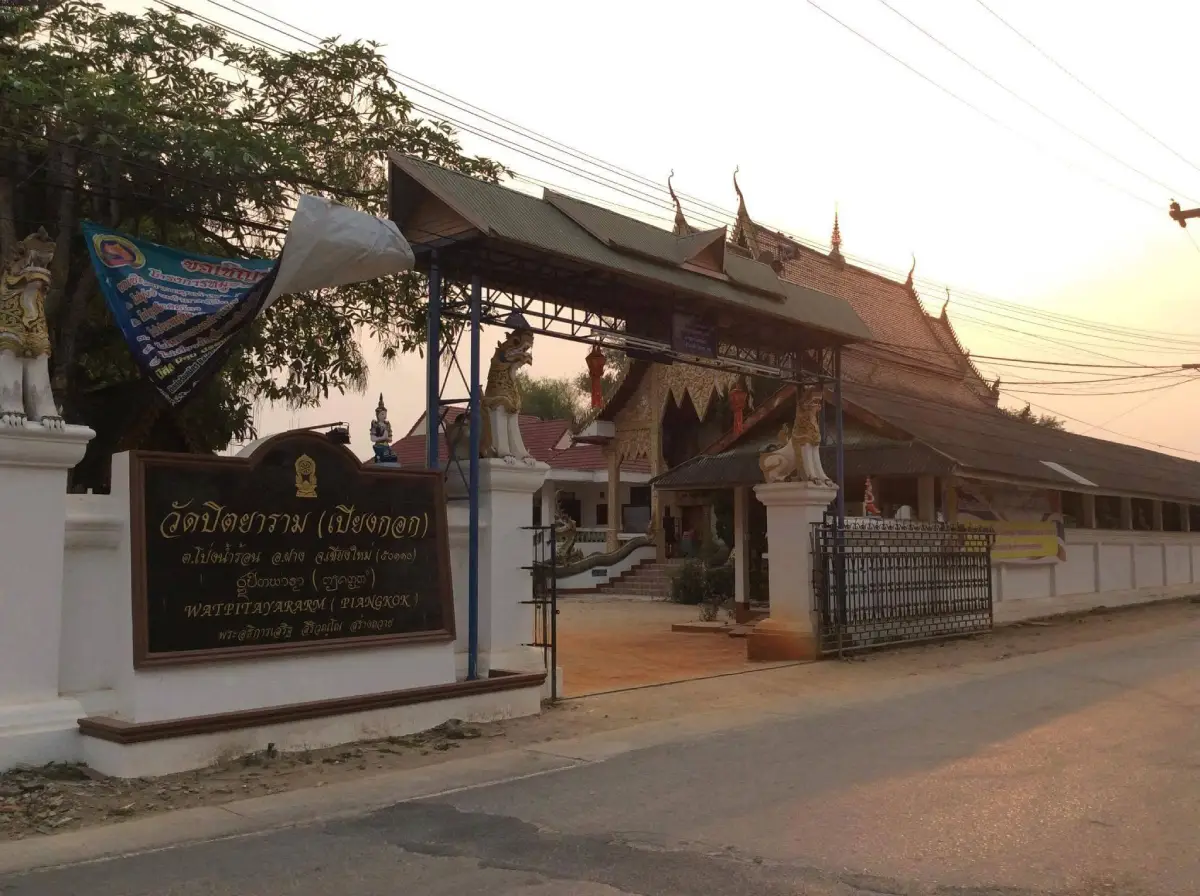
Wat Pityaram, also known locally as Wat Piang Kok, is a community Buddhist temple in Moo 6, Ban Piang Kok, Pong Nam Ron Subdistrict, Fang District, Chiang Mai Province. The temple belongs to the Maha Nikaya order and serves as an important religious and community center for Ban Piang Kok. Wat Pityaram was officially established as a temple in 1937 and received its royal grant of Wisungkhamsima in 1999. These milestones make it a long-standing religious site in northern Fang, with a clear role in Buddhist practice, local ceremonies, youth learning, and Lanna community life.
Wat Pityaram is located in Ban Piang Kok, Moo 6, one of the major villages of Pong Nam Ron Subdistrict. The village is part of a wider rural landscape shaped by agriculture, local wisdom, community networks, hot springs, streams, and mountain routes. For this reason, Wat Pityaram should be understood not only as a temple, but also as part of the cultural and social structure of Ban Piang Kok.
The formal name of the temple is Wat Pityaram, while the local name Wat Piang Kok comes from the village where it is located. This naming pattern is common in northern Thai communities, where a temple is closely identified with its village. The local name helps show that the temple belongs directly to the everyday life of Ban Piang Kok and is recognized by villagers as part of their community identity.
The temple’s establishment in 1937 places Wat Pityaram among the older community temples of the Pong Nam Ron area. Village temples of this period often functioned as centers of moral learning, merit-making, local ceremonies, and community organization. Wat Pityaram has continued this role by serving as a place where local people gather for Buddhist activities, annual observances, and village-based religious life.
The royal grant of Wisungkhamsima in 1999 is an important milestone in the temple’s development. In Thai Buddhism, Wisungkhamsima refers to a formally granted monastic boundary used for important Sangha acts, including ordination and other ceremonies that must be performed within a recognized sacred boundary. This status confirms the temple’s formal religious function and its capacity to support major Buddhist rites.
Pong Nam Ron Subdistrict has a distinctive identity within Fang District. It includes village communities, hot springs, forested mountain areas, streams, agricultural land, and several Buddhist temples. Wat Pityaram is part of this cultural and natural setting. Nearby places such as Fang Hot Springs, Doi Pha Hom Pok National Park, Huai Mae Jai, Wat Mathurawat, Wat Dhammikawat, and Wat Si Don Chai make the temple suitable for inclusion in a cultural and nature-based travel route.
Ban Piang Kok is also associated with local wisdom and community products, including local craft activity in the area. This context helps explain the role of Wat Pityaram more clearly. In Lanna communities, a temple is often supported by villagers, local leaders, occupational groups, and families who share responsibility for maintaining religious space. Wat Pityaram therefore represents both faith and community cooperation.
The temple has the character of a working village temple. Important areas and structures include the ordination hall, monks’ residences, a merit-making hall or alms-related hall, and Buddha images used for worship. These elements show the temple’s practical religious role: a place for monastic ceremonies, a residence for monks, a merit-making area for laypeople, and a sacred space for local worship.
The ordination hall and Wisungkhamsima boundary are especially important for understanding the temple’s religious status. Since the temple received its royal grant of Wisungkhamsima in 1999, it has a formal sacred boundary for important Sangha ceremonies. For visitors interested in Buddhist institutions, this detail shows that Wat Pityaram is more than a small village shrine; it is a recognized Buddhist temple with formal ceremonial capacity.
The monks’ residences show that the temple functions as a living religious site, while the hall areas support merit-making and community gatherings. Buddha images within the temple serve as places of worship for villagers and visitors. Even if the temple is not designed as a major tourist attraction, these features reflect the real religious life of a northern Thai village temple.
Wat Pityaram is also connected with early childhood and community learning through the early childhood training center within the temple context. This gives the temple an educational dimension in addition to its religious role. Children who grow up near a temple environment are introduced to community discipline, temple etiquette, Buddhist values, and respect for shared sacred space.
This educational role is important in rural northern Thailand. Temples often function as safe public spaces where villagers meet, children learn social behavior, and community activities take place. Wat Pityaram therefore serves not only adult worshippers, but also the broader social structure of Ban Piang Kok.
The temple functions as a spiritual center for the village. Local people come to make merit on Buddhist holy days, attend ceremonies, listen to Dhamma, and participate in seasonal Buddhist events. In a large rural village, the temple helps connect different groups of people and provides a shared space for religious and social continuity.
Local Buddhist and Lanna traditions associated with Pong Nam Ron include Songkran or the northern Thai New Year, Buddhist Lent candle offerings, Salak Phat merit-making, Yi Peng, Poi Luang, and other annual Buddhist observances. Even when a specific annual festival of Wat Pityaram is not separately documented, the temple’s role as a village temple means it remains connected with the religious calendar and community merit-making practices.
For travelers, Wat Pityaram’s main appeal is its authenticity as a local community temple. It is not a highly commercial tourist attraction. Visitors who are interested in Lanna culture, village temples, and the deeper local side of Fang District will find the temple meaningful. The best points to observe are the ordination hall, the temple grounds, the Buddha images, and the quiet atmosphere of Ban Piang Kok.
Visitors should dress modestly, speak quietly, avoid disturbing monks or local worshippers, and ask for permission before taking photos in ritual areas. The temple should be approached as a living sacred place rather than a quick photo stop. This respectful approach helps visitors understand how the temple continues to function within the village.
The temple is suitable for cultural travelers, temple visitors, local history enthusiasts, and those who want to explore Fang beyond its major natural attractions. Wat Pityaram helps complete the travel picture of Pong Nam Ron by adding a Buddhist community dimension to an area already known for hot springs, mountains, streams, and agriculture.
Getting There is most convenient by private car or rental car. From Chiang Mai city, take Highway 107 north toward Fang, passing Mae Rim, Mae Taeng, Chiang Dao, and Chai Prakan before entering Fang District. From there, continue toward Pong Nam Ron Subdistrict and Ban Piang Kok, Moo 6. The route is suitable for travelers planning to combine a community temple visit with Fang Hot Springs or Doi Pha Hom Pok National Park.
Travelers starting from Chiang Mai city should leave early because Fang is far north of the provincial capital and the route includes mountain sections. Those already staying in Fang or near Fang Hot Springs can visit Wat Pityaram as part of a half-day cultural route.
A practical itinerary is to begin at Wat Pityaram for worship and a local community temple visit, continue to Fang Hot Springs for a natural hot spring experience, and then visit Huai Mae Jai or nature areas within Doi Pha Hom Pok National Park. Travelers who want a stronger temple-focused route can also include Wat Mathurawat, Wat Dhammikawat, Wat Si Don Chai, or Phra That Si Maha Pho Taphotharam.
Fang Hot Springs is one of the most important nearby natural attractions. The hot springs are formed by geothermal energy and have mineral water throughout the year. The site is associated with the Doi Pha Hom Pok National Park area and can be combined easily with a visit to Wat Pityaram, creating a balanced route of religion, village life, and nature.
Doi Pha Hom Pok National Park is another important nearby destination. The park includes high mountain landscapes, forests, streams, and natural attractions characteristic of northern Fang. Visiting Wat Pityaram before continuing to the park gives travelers a broader understanding of Pong Nam Ron, combining sacred community space with natural heritage.
Pong Nam Ron Subdistrict has seven villages: Ban Nong Phanang, Ban Don, Ban Hua Fai, Ban Tha Hat, Ban Ton Phueng, Ban Piang Kok, and Ban Ton Phueng Tai. Wat Pityaram belongs to Ban Piang Kok, Moo 6, and therefore helps tell the story of one of the subdistrict’s key communities. The temple connects with local administration, agricultural life, and community cultural networks.
Wat Pityaram has value on several levels. Religiously, it is a Maha Nikaya temple with Wisungkhamsima. Historically, it dates back to its establishment in 1937. Socially, it serves Ban Piang Kok as a shared sacred and community space. For tourism, it connects well with the hot spring and national park route of Pong Nam Ron.
Compared with major tourist sites in Fang, Wat Pityaram may not stand out through grand architecture or large visitor crowds. Its strength is its authenticity as a village temple with a documented history and ongoing community role. It offers a quieter and more grounded way to understand Lanna Buddhism at the village level.
In summary, Wat Pityaram or Wat Piang Kok is a meaningful community temple in Pong Nam Ron Subdistrict, Fang District, Chiang Mai Province. Its establishment in 1937, royal grant of Wisungkhamsima in 1999, connection with Ban Piang Kok, and proximity to Fang Hot Springs and Doi Pha Hom Pok National Park make it a valuable stop for travelers who want to understand Fang through both culture and nature.
| Name | Wat Pityaram / Wat Piang Kok |
| Location | Moo 6, Ban Piang Kok, Pong Nam Ron Subdistrict, Fang District, Chiang Mai Province |
| Address | Ban Piang Kok, Moo 6, Pong Nam Ron Subdistrict, Fang District, Chiang Mai 50110 |
| Highlights | An old Maha Nikaya community temple of Ban Piang Kok, established in 1937 and serving as a spiritual center of Moo 6, Pong Nam Ron Subdistrict |
| History | Officially established as a temple in 1937 and received its royal grant of Wisungkhamsima in 1999 |
| Name Origin | Wat Pityaram is the formal temple name, while Wat Piang Kok is the local name connected with Ban Piang Kok, Moo 6 |
| Distinctive Features | A long-established village temple with an ordination hall, monks’ residences, merit-making hall areas, and Buddha images used for worship |
| Travel Information | Accessible by private car or rental car via Highway 107 on the Chiang Mai–Fang route, then continue to Pong Nam Ron Subdistrict and Ban Piang Kok, Moo 6 |
| Current Status | Active local Buddhist temple under the Maha Nikaya order in Pong Nam Ron Subdistrict, Fang District, Chiang Mai Province |
| Main Areas / Things To See | Ordination hall and Wisungkhamsima boundary Monks’ residences Merit-making hall area Buddha images within the temple Village temple atmosphere of Ban Piang Kok |
| Community Role | Spiritual center of Ban Piang Kok, merit-making space for villagers, and a temple site connected with early childhood community learning |
| Related Traditions | Community Buddhist events such as Buddhist holy days, Buddhist Lent candle offerings, Salak Phat merit-making, Yi Peng, and Poi Luang in the Pong Nam Ron cultural context |
| Local Information Contact | Pong Nam Ron Subdistrict Administrative Organization, Tel. 053-451234, 053-451213, 053-451595 |
| Nearby Tourist Attractions | 1. Fang Hot Springs, about 8 km 2. Doi Pha Hom Pok National Park, about 9 km 3. Huai Mae Jai, about 9 km 4. Wat Mathurawat / Wat Ton Phueng, about 10 km 5. Chiang Mai Agricultural Research and Development Center (Fang), about 12 km |
| Nearby Restaurants | 1. Say Mink Cafe, about 3 km, Tel. 099-634-9797 2. PunThai Coffee Fang 2, about 12 km, Tel. 062-593-0154 3. Baan Fang Coffee, about 14 km, Tel. 082-385-4599, 080-958-7918 4. Kha Mu Krob Kai Yang San Ma Fueang, about 16 km, Tel. 081-882-5589, 081-467-3624 5. Fang Cafe, about 18 km, Tel. 086-191-2101 |
| Nearby Accommodations | 1. Doi Pha Hom Pok National Park Guesthouse Area, about 9 km 2. SD Guest House, about 12 km, Tel. 081-784-8510 3. Fang Modern Hotel, about 20 km 4. Phumanee Lahu Home Hotel, about 22 km, Tel. 053-452-875 5. TonFang Hotel, about 22 km |
Frequently Asked Questions (FAQ)
Q: Where is Wat Pityaram located?
A: Wat Pityaram is located in Moo 6, Ban Piang Kok, Pong Nam Ron Subdistrict, Fang District, Chiang Mai Province.
Q: What is another name for Wat Pityaram?
A: Wat Pityaram is also locally known as Wat Piang Kok because it is located in Ban Piang Kok.
Q: What is the historical importance of Wat Pityaram?
A: Wat Pityaram was officially established as a temple in 1937 and received its royal grant of Wisungkhamsima in 1999.
Q: Which Buddhist order does Wat Pityaram belong to?
A: Wat Pityaram is a local Buddhist temple under the Maha Nikaya order.
Q: What should visitors see at Wat Pityaram?
A: Visitors should see the ordination hall, Wisungkhamsima boundary, monks’ residences, merit-making hall area, Buddha images, and the peaceful village temple atmosphere.
Q: Who should visit Wat Pityaram?
A: The temple is suitable for cultural travelers, temple visitors, local history enthusiasts, and travelers interested in the quieter community side of Fang District.
Q: What nearby places can be combined with Wat Pityaram?
A: Nearby places include Fang Hot Springs, Doi Pha Hom Pok National Park, Huai Mae Jai, Wat Mathurawat, and the Chiang Mai Agricultural Research and Development Center (Fang).
 Category: ●Places of Worship
 Group: ●Temple
Last Update : 21 HourAgo
 Last Update : 21 HourAgo
 Click to Access the Navigation Map GPS
 Muang Chiang Mai(121)Chom Thong(47)Mae Chaem(25)Chiang Dao(33)Doi Saket(68)Mae Taeng(85)Mae Rim(69)Samoeng(29)Fang(71)Mae Ai(62)Phrao(70)San Pa Tong(105)San Kamphaeng(66)San Sai(73)Hang Dong(74)Hot(32)Doi Tao(22)Omkoi(11)Saraphi(74)Wiang Haeng(15)Chai Prakan(28)Mae Wang(32)Mae On(22)Doi Lo(34)Galyani Vadhana(1)


