
lovethailand home >North Travel Attractions >Chiang Mai Travel Attractions >Doi Saket >San Pu Loei > Wat San Pu Loei Sali Wiang Kaew
TL;DR: Wat San Pu Loei Sali Wiang Kaew is located at Ban San Pu Loei, Moo 1, San Pu Loei Subdistrict, Doi Saket District, Chiang Mai Province, open Daily, hours 08.00 – 17.00.

Wat San Pu Loei Sali Wiang Kaew
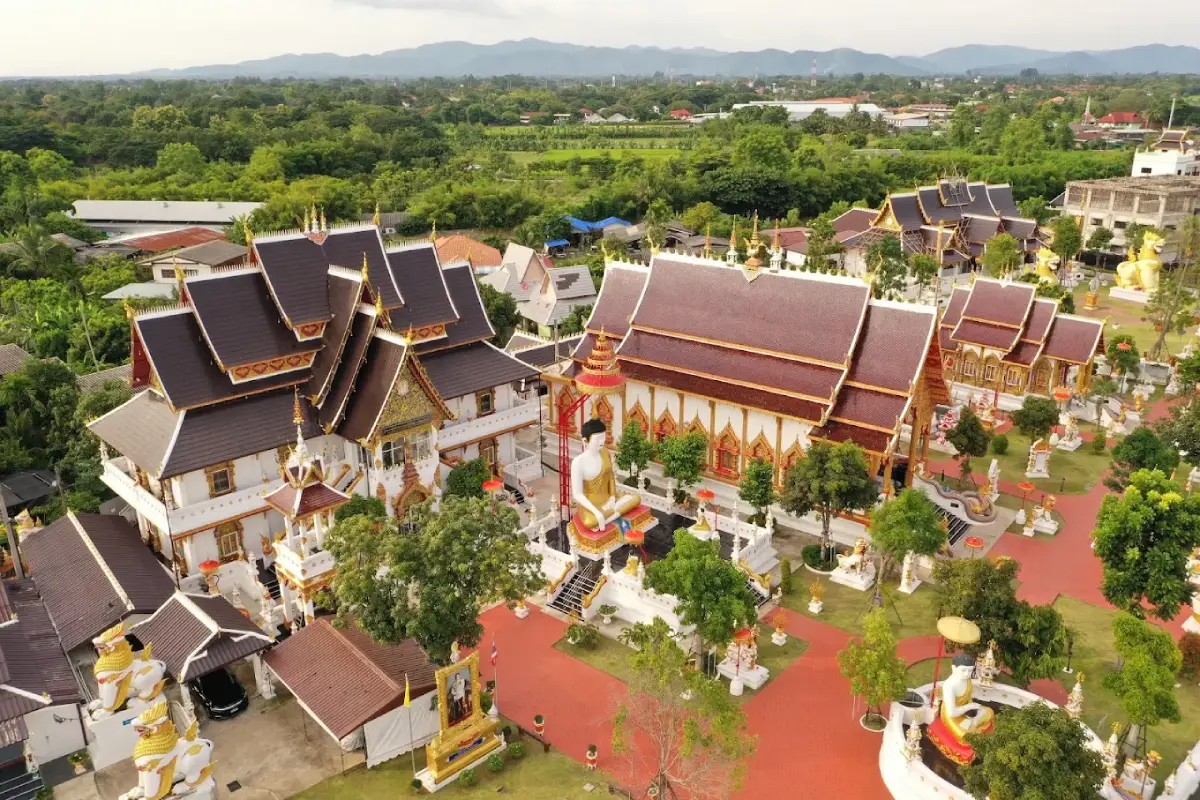
Open Days: Daily
Opening Hours: 08.00 – 17.00
Wat San Pu Loei Sali Wiang Kaew is located at No. 66, Ban San Pu Loei, Moo 1, San Pu Loei Subdistrict, Doi Saket District, Chiang Mai Province 50220. It is a local Buddhist temple under the Mahanikaya order. The temple was officially re-established in 1801 and received its royal consecrated boundary on 10 August 1948. The abbot is Phra Khru Palat Worakon Khemapanyo. Today, the temple is an important spiritual center of Ban San Pu Loei and a recognized meditation center in Chiang Mai Province.
The temple’s history is closely connected with the legend of Wiang Kaew and a Mon community in the area. Local tradition tells of King Po Mayungnguan, also known as Po Mayiwun, who ruled Wiang Kaew. When his mother became seriously ill, he made a vow before the Triple Gem that if she recovered, he would build a large Buddha image and a monastery as an offering to the Buddha, the Dhamma, and the Sangha. After his mother recovered, he built a great monastery and enshrined a principal Buddha image known as Phra Chao Tan Chai, or the “Wish-Fulfilling Buddha.”
The temple was formerly known as Wat Sali Wiang Kaew. This name reflects both the ancient town memory and the temple’s role as a sacred center of the community. Later, during times of war and political change, the temple fell into abandonment like many temples in Chiang Mai. It was restored in 1801 under the leadership of Phra Khru Ba Luang Thananchai and became known as Wat San Pu Loei. In 2013, the temple was officially renamed Wat San Pu Loei Sali Wiang Kaew.
The name “San Pu Loei” reflects the local landscape and village identity, while “Sali Wiang Kaew” preserves the older memory of Wiang Kaew and the temple’s sacred legacy. The full name therefore carries historical, religious, and community meaning. It identifies the temple as both the village temple of Ban San Pu Loei and a place that continues an older Buddhist story of faith and restoration.
The temple received its royal consecrated boundary on 10 August 1948. The boundary measures 40 meters wide and 70 meters long. In Thai Buddhist practice, a consecrated boundary is essential for formal monastic acts that must be performed within a properly defined sacred area. This confirms the temple’s religious status and allows it to support important Sangha ceremonies.
Wat San Pu Loei Sali Wiang Kaew is also recognized as Chiang Mai Provincial Meditation Center No. 19 by the Sangha Supreme Council. This role makes the temple more than a place for worship and merit-making. It is also a space for mindfulness practice, meditation, Dhamma learning, and inner cultivation. Visitors and devotees can therefore experience the temple as both a community temple and a place of Buddhist practice.
Phra Khru Palat Worakon Khemapanyo, widely known among devotees as Khru Ba Noi, serves as the abbot of Wat San Pu Loei Sali Wiang Kaew. As abbot, he oversees the temple grounds, religious activities, meditation programs, restoration work, community relations, and the temple’s role as a living spiritual center. His leadership helps maintain the temple’s calm atmosphere and continued religious activity.
Important areas within the temple include the great viharn, viharn, ubosot, worship areas for important Buddha images, meditation areas, temple courtyard, and spaces used for community activities. Important sacred objects and worship points include Phra Chao Tan Chai, Phra Phuttha Maha Si Muni or Phra Singh Luang, Phra Phuttha Maha Chak Kaew Mani, other important Buddha images, and the memorial monument of Khru Ba Siwichai.
Phra Chao Tan Chai is closely linked with the temple’s founding legend. The name “Tan Chai” expresses the idea of a blessing fulfilled swiftly through sincere faith. Visitors should begin by paying respect to this image before continuing to other sacred points inside the temple. This creates a meaningful connection with the temple’s origin story and local devotion.
Phra Phuttha Maha Si Muni, also called Phra Singh Luang, is one of the temple’s important contemporary sacred images. It is a brass Buddha image in the Mara Vijaya posture, lacquered and gilded, with a lap width of 30 inches. Its form reflects Chiang Saen-style Buddhist art and was modeled after Phra Singh Noi, a smaller Buddha image discovered beneath the base of the temple’s former viharn. The 2026 eye-opening and parasol-raising ceremony for this image strengthened its significance as a bridge between the temple’s ancient remains and present-day faith.
The memorial monument of Khru Ba Siwichai is another meaningful point within the temple. Khru Ba Siwichai is deeply respected across northern Thailand for his role in restoring Buddhist sites and strengthening Lanna Buddhist faith. His memorial at the temple adds a wider Lanna spiritual dimension to the temple’s local history.
The temple continues to host Buddhist activities, including Visakha Bucha events, chanting, meditation, monthly Dhamma practice activities, and annual merit-making ceremonies. These activities show that the temple is not only a historic place but also an active religious center where local people and visitors continue to practice, learn, and make merit.
Annual traditions connected with the temple and the San Pu Loei community include Buddhist holy day merit-making, offerings to monks, Buddhist Lent, Ok Phansa, Kathin ceremonies, forest robe offerings, Yi Peng, Tan Kuai Salak, Lanna New Year, elder water-pouring ceremonies, annual chedi or relic-related ceremonies, and meditation activities. These events allow villagers to support the temple, gather as a community, and pass Buddhist values to younger generations.
The temple serves the San Pu Loei community on several levels. Religiously, it is a place for worship, merit-making, sermons, and Buddhist ceremonies. Spiritually, it is a meditation center and a place for Dhamma practice. Culturally, it preserves the legend of Wiang Kaew, Lanna Buddhist identity, and local traditions. Socially, it remains a gathering point for villagers and devotees during important occasions.
The main appeal of Wat San Pu Loei Sali Wiang Kaew is its combination of long history, local legend, important Buddha images, meditation practice, and active community life. It is suitable for visitors who want a deeper temple experience rather than only a quick sightseeing stop. The temple rewards those who take time to walk calmly, learn its history, and pay respect at its main sacred points.
Important things to observe include Phra Chao Tan Chai, Phra Phuttha Maha Si Muni or Phra Singh Luang, Phra Phuttha Maha Chak Kaew Mani, the Khru Ba Siwichai memorial, the viharn, ubosot, meditation areas, temple courtyard, and the atmosphere of Ban San Pu Loei. Visitors should remain quiet and respectful, especially when meditation activities or religious ceremonies are taking place.
Travel to Wat San Pu Loei Sali Wiang Kaew is most convenient by private car, rental car, or local hired transport. From Chiang Mai city, use Highway 121 or the San Sai–Doi Saket route, then continue into Ban San Pu Loei, Moo 1. The temple is located at No. 66, San Pu Loei Subdistrict, Doi Saket District. A private vehicle makes it easier to combine the temple with nearby temples, markets, restaurants, and accommodation.
A practical route can begin at Wat San Pu Loei Sali Wiang Kaew for worship, meditation, and local history. From there, visitors can continue to Wat Don Chai or Wat Tha Rua, Wat Chet Tha Won Khup or Wat Pa Khui, Wat Chai Sathan or Wat Pa Sao Noi, Wat Chai Sathit or Wat Pa Sao Luang, and Tha Rua Market. For a broader cultural route, Bo Sang Umbrella Village and Chamcha Market can also be included.
Nearby dining options include local Thai restaurants, Isan restaurants, steak houses, and Tha Rua-area food stops. Useful choices include Lung Boon Thai Steak, Som Tam Kai Yang Khon Kaen Tha Rua, Tokyo Homemade Tha Rua, Im Aroi 1, and Khrua Ton Som at Wan Thong Tha Rua. These stops make the temple easy to include in a practical half-day food-and-temple route.
Nearby accommodation options include Enchanted Garden Bungalows, Ouychai Resort/Home Stay, C-Hill Camp & Resort, Baan Chai Thung Resort, and Tao Garden Health Spa & Resort. Travelers who want easy access to San Pu Loei may prefer accommodation near the main road, while those seeking a quieter atmosphere may choose lodging deeper in Doi Saket or Choeng Doi.
Visitors should follow normal Thai temple etiquette. Dress modestly, keep voices low, remove shoes where required, respect monks, meditators, and local worshippers, avoid disturbing ceremonies, and do not enter private monastic areas without permission. If visiting during a merit-making event or meditation activity, follow the temple’s space arrangements and help keep the temple clean.
In summary, Wat San Pu Loei Sali Wiang Kaew is a historic Mahanikaya community temple in Ban San Pu Loei, Moo 1, Doi Saket District, Chiang Mai. Its story is connected with Wat Sali Wiang Kaew, Wiang Kaew, King Po Mayungnguan, Phra Chao Tan Chai, the 1801 restoration, and its official renaming in 2013. Today, the temple is Chiang Mai Provincial Meditation Center No. 19, led by Phra Khru Palat Worakon Khemapanyo, and remains an important place for worship, meditation, Lanna Buddhist history, and local community life.
| Name | Wat San Pu Loei Sali Wiang Kaew |
| Former / Historical Names | Wat Sali Wiang Kaew, Wat San Pu Loei |
| Thai Name | วัดสันปูเลยสะหลีเวียงแก้ว |
| Location | Ban San Pu Loei, Moo 1, San Pu Loei Subdistrict, Doi Saket District, Chiang Mai Province |
| Address | No. 66, Moo 1, San Pu Loei Subdistrict, Doi Saket District, Chiang Mai 50220, Thailand |
| Temple Type | Local Buddhist temple under the Mahanikaya order and Chiang Mai Provincial Meditation Center No. 19 |
| History | Connected with the legend of Wat Sali Wiang Kaew and Wiang Kaew; restored and officially established as a temple on 1 October 1801 |
| Consecrated Boundary | Granted on 10 August 1948; the boundary measures 40 meters wide and 70 meters long |
| Official Renaming | Officially renamed Wat San Pu Loei Sali Wiang Kaew in 2013 |
| Abbot / Caretaker | Phra Khru Palat Worakon Khemapanyo |
| Main Contact Number | 053-689-894 |
| Important Buildings / Areas | Great viharn, viharn, ubosot, courtyard, Buddha image worship areas, meditation areas, and community activity spaces |
| Sacred Objects / Worship Points | Phra Chao Tan Chai, Phra Phuttha Maha Si Muni or Phra Singh Luang, Phra Phuttha Maha Chak Kaew Mani, important Buddha images, and Khru Ba Siwichai memorial |
| Highlights | Historic temple of Ban San Pu Loei with Wiang Kaew legend, important Buddha images, meditation center status, and active community Buddhist life |
| Community Role | A spiritual center for Ban San Pu Loei, supporting worship, sermons, meditation, merit-making, annual traditions, and community religious activities |
| Traditions / Merit-Making | Buddhist holy day merit-making, Visakha Bucha, Kathin ceremonies, forest robe offerings, Buddhist Lent, Ok Phansa, Yi Peng, Tan Kuai Salak, Lanna New Year, elder water-pouring ceremonies, annual chedi ceremonies, and monthly meditation activities |
| Travel Information | From Chiang Mai city, use Highway 121 or the San Sai–Doi Saket route, then continue into Ban San Pu Loei, Moo 1. Private car, rental car, or local hired transport is recommended. |
| Current Status | An active Buddhist temple and meditation center with official website, public news updates, meditation activities, and current Buddhist ceremonies |
| Open Days | Daily |
| Opening Hours | 08.00 – 17.00 |
| Nearby Tourist Attractions | 1. Tha Rua Market, about 2 km 2. Wat Don Chai or Wat Tha Rua, about 2 km 3. Wat Chet Tha Won Khup or Wat Pa Khui, about 3 km 4. Wat Chai Sathan or Wat Pa Sao Noi, about 3 km 5. Wat Chai Sathit or Wat Pa Sao Luang, about 4 km 6. Bo Sang Umbrella Village, about 5 km 7. Chamcha Market, about 5 km |
| Nearby Restaurants | 1. Lung Boon Thai Steak, about 2 km, Tel. 089-432-1775 2. Som Tam Kai Yang Khon Kaen Tha Rua, about 2 km, Tel. 093-172-1141 3. Tokyo Homemade Tha Rua, about 2 km, Tel. 082-635-2195 4. Im Aroi 1, about 3 km, Tel. 064-669-3547 5. Khrua Ton Som at Wan Thong Tha Rua, about 3 km |
| Nearby Accommodations | 1. Enchanted Garden Bungalows, about 2 km, Tel. 088-251-3121 2. Ouychai Resort/Home Stay, about 3 km, Tel. 098-074-1374 3. C-Hill Camp & Resort, about 4 km 4. Baan Chai Thung Resort, about 8 km, Tel. 098-014-3383 5. Tao Garden Health Spa & Resort, about 10 km, Tel. 084-028-0230 |
Frequently Asked Questions (FAQ)
Q: Where is Wat San Pu Loei Sali Wiang Kaew located?
A: Wat San Pu Loei Sali Wiang Kaew is located at No. 66, Ban San Pu Loei, Moo 1, San Pu Loei Subdistrict, Doi Saket District, Chiang Mai 50220.
Q: What was the former name of Wat San Pu Loei Sali Wiang Kaew?
A: The temple was formerly known as Wat Sali Wiang Kaew. It was later restored as Wat San Pu Loei and officially renamed Wat San Pu Loei Sali Wiang Kaew in 2013.
Q: What is historically important about Wat San Pu Loei Sali Wiang Kaew?
A: The temple is connected with the legend of King Po Mayungnguan, Wiang Kaew, and Phra Chao Tan Chai. It was restored and officially established in 1801 and received its royal consecrated boundary on 10 August 1948.
Q: Who is the abbot of Wat San Pu Loei Sali Wiang Kaew?
A: The abbot is Phra Khru Palat Worakon Khemapanyo.
Q: What are the important worship points inside the temple?
A: Important worship points include Phra Chao Tan Chai, Phra Phuttha Maha Si Muni or Phra Singh Luang, Phra Phuttha Maha Chak Kaew Mani, other important Buddha images, and the Khru Ba Siwichai memorial.
Q: Who should visit Wat San Pu Loei Sali Wiang Kaew?
A: The temple is suitable for visitors interested in worship, meditation, Wiang Kaew history, Lanna community temples, and temple routes in San Pu Loei.
Q: What nearby places can be visited with Wat San Pu Loei Sali Wiang Kaew?
A: Nearby places include Tha Rua Market, Wat Don Chai, Wat Chet Tha Won Khup, Wat Chai Sathan, Wat Chai Sathit, Bo Sang Umbrella Village, and Chamcha Market.
Q: What are the opening days and hours of Wat San Pu Loei Sali Wiang Kaew?
A: The temple is listed as open daily from 08.00 to 17.00.
 Category: ●Places of Worship
 Group: ●Temple
Last Update : 3 DayAgo
 Last Update : 3 DayAgo
 Click to Access the Navigation Map GPS
Wat San Pu Loei Sali Wiang Kaew Map
Recommend

 Muang Chiang Mai(121)Chom Thong(47)Mae Chaem(25)Chiang Dao(33)Doi Saket(68)Mae Taeng(85)Mae Rim(69)Samoeng(29)Fang(71)Mae Ai(62)Phrao(70)San Pa Tong(105)San Kamphaeng(66)San Sai(73)Hang Dong(74)Hot(32)Doi Tao(22)Omkoi(11)Saraphi(74)Wiang Haeng(15)Chai Prakan(28)Mae Wang(32)Mae On(22)Doi Lo(34)Galyani Vadhana(1)


