
lovethailand home >North Travel Attractions >Chiang Mai Travel Attractions >Doi Saket >San Pu Loei > Wat Don Chai (San Pu Loei)
TL;DR: Wat Don Chai (San Pu Loei) is located at Ban Tha Rua, Moo 7, San Pu Loei Subdistrict, Doi Saket District, Chiang Mai Province, open Daily, hours 08.00 – 17.00.

Wat Don Chai (San Pu Loei)
Open Days: Daily
Opening Hours: 08.00 – 17.00
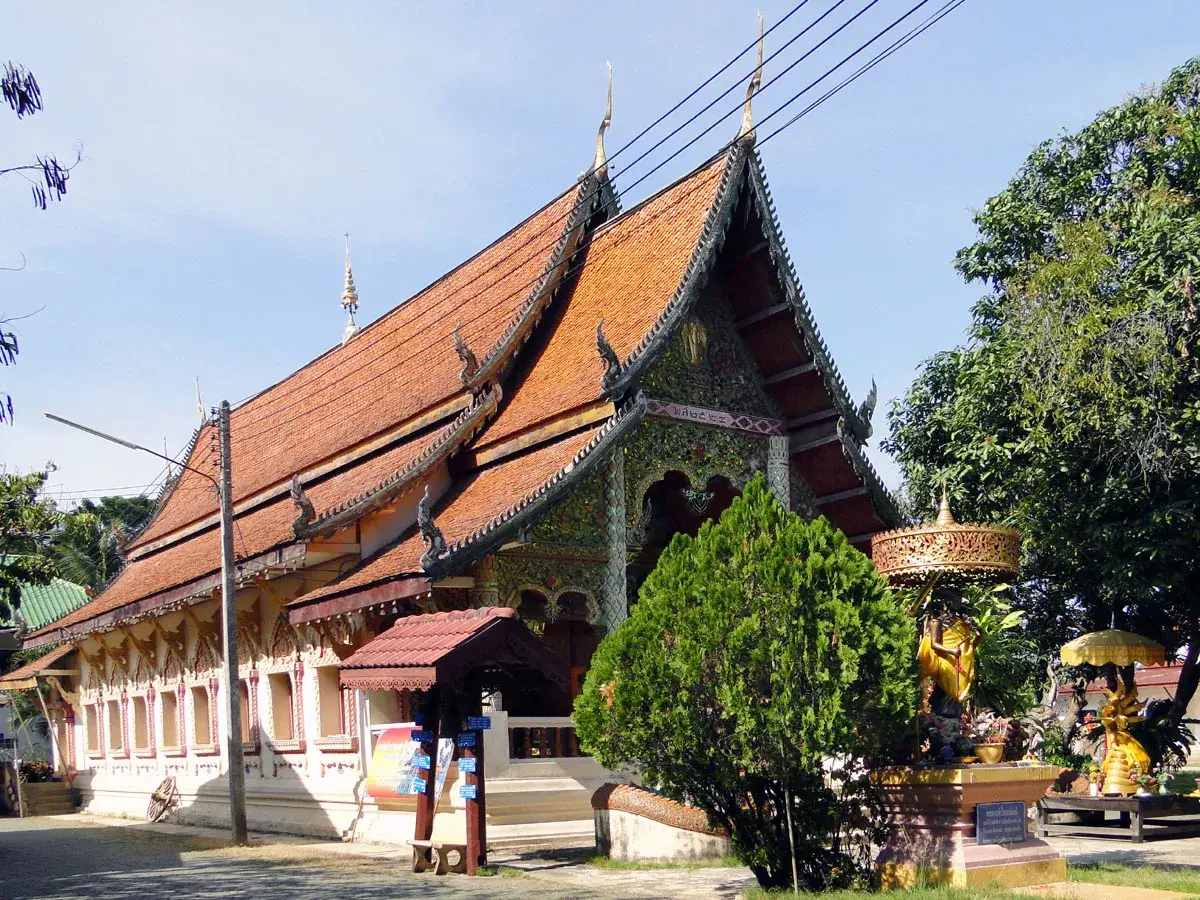
Wat Don Chai (San Pu Loei), also known locally as Wat Tha Rua, is located at No. 133, Ban Tha Rua, Moo 7, San Pu Loei Subdistrict, Doi Saket District, Chiang Mai Province. It is a local Buddhist temple under the Mahanikaya order and was officially established in 1826. The temple was formerly known as Wat Ta Hua and was founded by Phra Inthachak together with local devotees. Today, Wat Don Chai remains an important spiritual, educational, and cultural center of the Tha Rua community.
Ban Tha Rua is one of the key communities in San Pu Loei Subdistrict. The area connects Chiang Mai city, Doi Saket, San Sai, and San Kamphaeng through important local roads and the outer ring road. Around the temple are markets, restaurants, schools, homes, shops, and older community areas. Wat Don Chai is therefore not only an old temple but also a landmark that reflects the development of Tha Rua as a living community.
The name “Wat Don Chai” carries an auspicious meaning. “Don” refers to raised ground, while “Chai” means victory or success. Together, the name suggests a place of stable and auspicious faith. The local name Wat Tha Rua connects the temple directly with the village. These two names show both the temple’s formal religious identity and its everyday importance to local people.
The temple’s history dates back to 1826, making it one of the older community temples in San Pu Loei. In earlier times, a temple was more than a place for worship. It was a center for learning, morality, ceremonies, village meetings, and cultural continuity. Wat Don Chai developed within this traditional role and became a central institution of Ban Tha Rua.
The temple land covers 3 rai and 1 ngan, with land document S.K. 1 No. 145. Its northern boundary adjoins private rice fields, while the southern, eastern, and western sides adjoin canals. The temple also has three plots of monastic land totaling 8 rai, 1 ngan, and 62 square wah. This setting shows the temple’s close relationship with canals, rice fields, agriculture, and the older water-based landscape of San Pu Loei.
Important temple structures mentioned in historical records include the sermon hall, monks’ residences, and viharn. The sermon hall supports merit-making, sermons, and community gatherings. The monks’ residences support monastic life and daily religious practice. The viharn serves as an important worship space for devotees. Together, these structures reflect the basic working form of a Lanna village temple.
The history of Wat Don Chai is also reflected in its abbot lineage. Known abbots include Phra Inthachak, Phra Duang Kaew, Phra Inpan, Phra Inkaew Sopha, Phra Duang Kandhasilo, Phra Athikan Somboon Chattakayo, Chao Athikan Chanta Dhammavaddhano, and Phra Khru Sathaphon Thammaprachot. This continuity shows the long relationship between monastic leadership and the Tha Rua community.
The current abbot is Phra Khru Sathaphon Thammaprachot Panya Chotidhammo. He is also the ecclesiastical chief of San Pu Loei Zone 1 and is known for his role in Lanna language and literature, especially khaw ham, local poetic writing, and northern Thai script. This gives Wat Don Chai a deeper cultural dimension beyond its function as a place of worship.
Wat Don Chai has an important educational role. The temple opened a Dhamma study school in 1948 and a Sunday Buddhist study center in 1978. It also has a subdistrict training unit and a newspaper reading area. These functions show that the temple has long served as a place for Buddhist learning, moral education, and community knowledge.
The temple serves the community on several levels. Religiously, it is a place for worship, merit-making, sermons, offerings to monks, and Buddhist ceremonies. Educationally, it supports Dhamma learning and youth moral development. Culturally, it is connected with Lanna literature and local language traditions through the role of its abbot. Socially, it remains a gathering place for the Tha Rua community.
Ban Tha Rua today has both semi-urban and semi-rural characteristics. Roads, markets, shops, and new residential areas exist alongside older village patterns. Wat Don Chai helps preserve local identity amid this change. It remains a place where villagers return for merit-making, funerary rites, annual traditions, and community events.
Annual traditions connected with Wat Don Chai and the wider San Pu Loei community include Buddhist holy day merit-making, offerings to monks, Kathin ceremonies, forest robe offerings, Buddhist Lent, Ok Phansa, Yi Peng, Tan Kuai Salak, Lanna New Year, water-pouring ceremonies for elders, and other Buddhist calendar activities. These events keep the relationship between temple and community active from year to year.
The main appeal of Wat Don Chai is its identity as a historic community temple that remains active today. It has a long history from 1826, an older name, clearly recorded temple land, religious buildings, Dhamma education, a Sunday Buddhist study center, and an abbot associated with Lanna cultural knowledge. Visitors who are interested in local Buddhist life will find the temple more meaningful than a simple sightseeing stop.
Important things to observe include the temple grounds, viharn, sermon hall, monks’ residences, courtyard, and the atmosphere of Ban Tha Rua. The temple’s value lies in its active relationship with the village, the canals, the local roads, and the surrounding community. Visitors should take time to experience the temple quietly and respectfully.
Wat Don Chai is suitable for travelers interested in Lanna community temples, old temples in Doi Saket, San Pu Loei temple routes, Tha Rua community life, and Lanna language and literature. It is especially suitable for those who want to experience Chiang Mai through local village temples rather than only major tourist temples.
Travel to Wat Don Chai is most convenient by private car, rental car, or local hired transport. From Chiang Mai city, use Highway 121 or the San Sai–Doi Saket route, then continue into Ban Tha Rua, Moo 7, San Pu Loei. The temple can be searched as Wat Don Chai, Wat Tha Rua, or Wat Don Chai Tha Rua on map services.
A practical half-day route can begin at Wat Don Chai for worship and local history. From there, visitors can continue to Tha Rua Market, Wat Chet Tha Won Khup or Wat Pa Khui, Wat San Pu Loei Sali Wiang Kaeo, Wat Ku Man Mongkhon Chai, or Wat Chai Sathan. Those interested in crafts and creative markets can continue to Bo Sang Umbrella Village or Chamcha Market.
Nearby dining options include local Thai restaurants, Isan restaurants, steak houses, and Tha Rua food shops. Useful nearby choices include Lung Boon Thai Steak, Som Tam Kai Yang Khon Kaen Tha Rua, Tokyo Homemade Tha Rua, Khrua Ton Som at Wan Thong Tha Rua, and Som Tam Kai Yang Km.5 Tha Rua. These restaurants make the temple easy to include in a practical food-and-temple route.
Nearby accommodation options include Ouychai Resort/Home Stay, Cool Vintage Doisaket, Baan Chai Thung Resort, Villa Albizia, and Tao Garden Health Spa & Resort. Travelers who want easy access to San Pu Loei and Tha Rua may prefer accommodation near the main road, while those seeking a quieter atmosphere can choose places deeper in Doi Saket or Choeng Doi.
Visitors should follow normal Thai temple etiquette. Dress modestly, keep voices low, remove shoes where required, respect monks and local worshippers, avoid disturbing ceremonies, and do not enter private monastic areas without permission. If visiting during a local merit-making event, follow the temple’s space arrangements and help keep the temple clean.
In summary, Wat Don Chai (San Pu Loei), or Wat Tha Rua, is a historic Mahanikaya community temple in Ban Tha Rua, Moo 7, San Pu Loei Subdistrict, Doi Saket District, Chiang Mai. Established in 1826 by Phra Inthachak and local devotees, the temple has long served as a center of worship, education, community gathering, and Lanna cultural knowledge. It is a valuable stop for travelers who want to understand Doi Saket through living village temples and local Buddhist heritage.
| Name | Wat Don Chai (San Pu Loei) |
| Local Name | Wat Tha Rua / Wat Don Chai Tha Rua |
| Former Name | Wat Ta Hua |
| Thai Name | วัดดอนชัย (สันปูเลย) |
| Location | Ban Tha Rua, Moo 7, San Pu Loei Subdistrict, Doi Saket District, Chiang Mai Province |
| Address | No. 133, Ban Tha Rua, Moo 7, San Pu Loei Subdistrict, Doi Saket District, Chiang Mai 50220, Thailand |
| Coordinates | 18.80959, 99.06442 / Plus Code 7MCXR357+RQ |
| Temple Type | Local Buddhist temple under the Mahanikaya order |
| History | Officially established in 1826 by Phra Inthachak together with local devotees |
| Temple Land Area | 3 rai, 1 ngan; land document S.K. 1 No. 145 |
| Monastic Land | 3 plots totaling 8 rai, 1 ngan, 62 square wah |
| Boundaries | North adjoins private rice fields; south, east, and west adjoin canals |
| Abbot / Caretaker | Phra Khru Sathaphon Thammaprachot Panya Chotidhammo |
| Ecclesiastical And Cultural Role | Abbot of Wat Don Chai Tha Rua, ecclesiastical chief of San Pu Loei Zone 1, and a monk associated with Lanna language, khaw ham, and northern Thai script |
| Former Abbots In Temple Records | 1. Phra Inthachak 2. Phra Duang Kaew 3. Phra Inpan 4. Phra Inkaew Sopha 5. Phra Duang Kandhasilo 6. Phra Athikan Somboon Chattakayo 7. Chao Athikan Chanta Dhammavaddhano 8. Phra Khru Sathaphon Thammaprachot |
| Important Buildings | Sermon hall, monks’ residences, and viharn |
| Educational Role | Dhamma study school opened in 1948; Sunday Buddhist study center opened in 1978 |
| Distinctive Features | A historic Tha Rua community temple connected with Buddhism, education, morality, Lanna literature, and San Pu Loei cultural life |
| Community Role | A spiritual center of Ban Tha Rua, supporting worship, sermons, funerary rites, youth learning, and Lanna cultural continuity |
| Traditions / Merit-Making | Buddhist holy day merit-making, offerings to monks, Kathin ceremonies, forest robe offerings, Buddhist Lent, Ok Phansa, Yi Peng, Tan Kuai Salak, Lanna New Year, elder water-pouring ceremonies, and annual Buddhist activities in the San Pu Loei community context |
| Main Areas / Zones | Viharn, sermon hall, monks’ residences, temple courtyard, worship areas, community activity spaces, and Buddhist learning areas |
| Travel Information | From Chiang Mai city, use Highway 121 or the San Sai–Doi Saket route, then continue into Ban Tha Rua, Moo 7. Private car, rental car, or local hired transport is recommended. |
| Current Status | An active community Buddhist temple listed in temple references, maps, travel sources, local business sources, and current Buddhist activity reports |
| Open Days | Daily |
| Opening Hours | 08.00 – 17.00 |
| Main Contact Number | 053-887-132 |
| Nearby Tourist Attractions | 1. Tha Rua Market, about 1 km 2. Wat Chet Tha Won Khup or Wat Pa Khui, about 1 km 3. Wat San Pu Loei Sali Wiang Kaeo, about 3 km 4. Wat Ku Man Mongkhon Chai, about 4 km 5. Wat Chai Sathan or Wat Pa Sao Noi, about 5 km 6. Bo Sang Umbrella Village, about 5 km 7. Chamcha Market, about 5 km |
| Nearby Restaurants | 1. Lung Boon Thai Steak, about 1 km, Tel. 089-432-1775 2. Som Tam Kai Yang Khon Kaen Tha Rua, about 1 km, Tel. 093-172-1141 3. Tokyo Homemade Tha Rua, about 2 km, Tel. 082-635-2195 4. Khrua Ton Som at Wan Thong Tha Rua, about 2 km 5. Som Tam Kai Yang Km.5 Tha Rua, about 2 km, Tel. 094-986-9622 |
| Nearby Accommodations | 1. Ouychai Resort/Home Stay, about 2 km, Tel. 098-074-1374 2. Cool Vintage Doisaket, about 6 km 3. Baan Chai Thung Resort, about 8 km, Tel. 098-014-3383 4. Villa Albizia, about 9 km 5. Tao Garden Health Spa & Resort, about 10 km, Tel. 084-028-0230 |
Frequently Asked Questions (FAQ)
Q: Where is Wat Don Chai (San Pu Loei) located?
A: Wat Don Chai is located at No. 133, Ban Tha Rua, Moo 7, San Pu Loei Subdistrict, Doi Saket District, Chiang Mai Province.
Q: Does Wat Don Chai have another name?
A: Yes. It is locally known as Wat Tha Rua or Wat Don Chai Tha Rua, and its former name was Wat Ta Hua.
Q: What is historically important about Wat Don Chai?
A: The temple was officially established in 1826 by Phra Inthachak together with local devotees, making it a long-standing community temple of Ban Tha Rua and San Pu Loei.
Q: Who is the abbot of Wat Don Chai?
A: The abbot is Phra Khru Sathaphon Thammaprachot Panya Chotidhammo, who also serves as the ecclesiastical chief of San Pu Loei Zone 1.
Q: What important buildings are found at Wat Don Chai?
A: Important buildings mentioned in temple records include the sermon hall, monks’ residences, and viharn.
Q: What is the educational role of Wat Don Chai?
A: The temple opened a Dhamma study school in 1948 and a Sunday Buddhist study center in 1978, supporting Buddhist learning and moral education in the community.
Q: Who should visit Wat Don Chai?
A: The temple is suitable for travelers interested in Lanna community temples, old temples in Doi Saket, San Pu Loei temple routes, Tha Rua community life, and Lanna literature.
Q: What nearby places can be visited with Wat Don Chai?
A: Nearby places include Tha Rua Market, Wat Chet Tha Won Khup, Wat San Pu Loei Sali Wiang Kaeo, Wat Ku Man Mongkhon Chai, Wat Chai Sathan, Bo Sang Umbrella Village, and Chamcha Market.
 Category: ●Places of Worship
 Group: ●Temple
Last Update : 2 WeekAgo
 Last Update : 2 WeekAgo
 Click to Access the Navigation Map GPS
Wat Don Chai (San Pu Loei) Map
Recommend

 Muang Chiang Mai(121)Chom Thong(47)Mae Chaem(25)Chiang Dao(33)Doi Saket(68)Mae Taeng(85)Mae Rim(69)Samoeng(29)Fang(71)Mae Ai(59)Phrao(70)San Pa Tong(103)San Kamphaeng(66)San Sai(73)Hang Dong(73)Hot(32)Doi Tao(22)Omkoi(11)Saraphi(74)Wiang Haeng(15)Chai Prakan(28)Mae Wang(32)Mae On(22)Doi Lo(33)Galyani Vadhana(1)


