
lovethailand home >North Travel Attractions >Chiang Mai Travel Attractions >Doi Saket >Mae Pong > Wat Kanjanitayaram (Pa Phai Bo Thong)
TL;DR: Wat Kanjanitayaram (Pa Phai Bo Thong) is located at 111 Ban Huai Bo Thong, Moo 10, Mae Pong Subdistrict, Doi Saket District, Chiang Mai 50220, open Daily, hours 08.00 – 17.00.

Wat Kanjanitayaram (Pa Phai Bo Thong)
Open Days: Daily
Opening Hours: 08.00 – 17.00
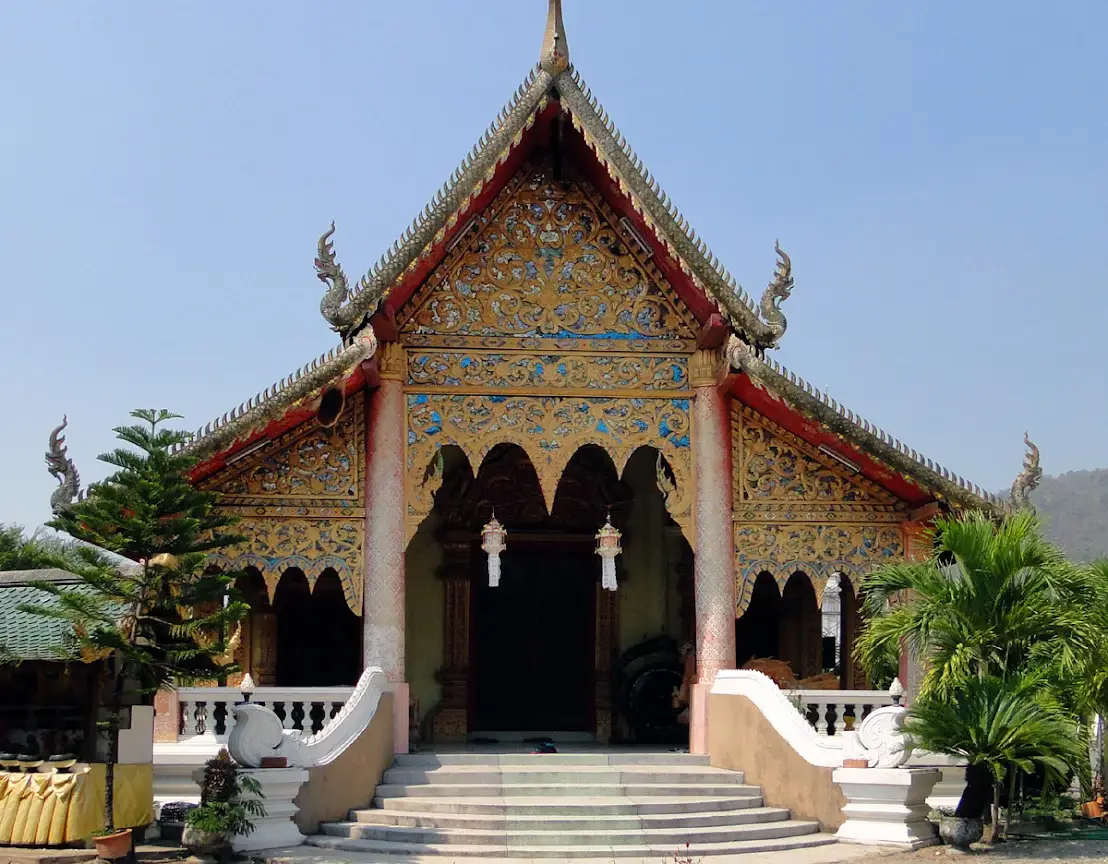
Wat Kanjanitayaram (Pa Phai Bo Thong) is a local Buddhist temple located at 111 Ban Huai Bo Thong, Moo 10, Mae Pong Subdistrict, Doi Saket District, Chiang Mai Province. It is a community temple under the Maha Nikaya tradition. The temple land covers 6 rai, 2 ngan, and 1 square wah, with title deed number 44587. Its boundary adjoins garden land to the north, a road to the south, a stream to the east, and paddy fields to the west. The temple was built in 1911 and is locally known as Wat Pa Phai. It was granted Wisung Kham Sima on 10 August 1948, with a consecrated boundary measuring 40 metres wide and 62 metres long. The temple is currently associated with Phra Khru Phutthithamrak, also known as Bunthen Buddharakkhito, as its abbot.
Wat Kanjanitayaram is closely connected with the history of Ban Huai Bo Thong. Before the community developed into the present village, the surrounding area was a dry dipterocarp forest with streams, water sources, and forest-edge farmland. Wat Pa Phai was an early religious centre of the area. As the community expanded and the temple was relocated to a site near the forest edge and the foothill landscape of Doi Pha Phueng, the temple became one of the anchors of local settlement. People began to call the area “Ban Wat,” meaning the temple village, before it later became known as Ban Huai Bo Thong.
The name Ban Huai Bo Thong is connected with local water sources. Community history explains that a small spring and stream supplied water to the village throughout the year. The water was described as having a yellowish tone, leading villagers to call the place Huai Bo Thong, or “the golden well stream.” This local background gives Wat Kanjanitayaram a deeper meaning. The temple is not only a place of worship, but also part of the community’s origin story, settlement pattern, and relationship with forest, water, and farmland.
With its founding year in 1911, Wat Kanjanitayaram has more than a century of history. The temple has grown together with Ban Huai Bo Thong and the older Pa Phai community. Its importance comes not only from its official temple status, but also from its continuing role as a spiritual centre, a place for Buddhist ceremonies, a community gathering space, and a source of moral education for people in Mae Pong Subdistrict.
The granting of Wisung Kham Sima on 10 August 1948 is one of the temple’s key religious facts. Wisung Kham Sima refers to the consecrated boundary used for formal monastic acts according to Buddhist discipline. At Wat Kanjanitayaram, this boundary measures 40 metres wide and 62 metres long. This confirms the temple’s role as a recognized Buddhist site for monastic ceremonies and important religious functions.
Wat Kanjanitayaram has several important structures and community facilities, including an ubosot, viharn, multipurpose hall, meditation hall, monks’ residences, bell tower, and temple reading area. These structures show that the temple functions beyond ordinary worship. It supports formal Buddhist ceremonies, lay merit-making, religious education, meditation practice, community gatherings, and everyday temple life.
The ubosot is central to formal Buddhist ceremonies, while the viharn serves as a place for worship, chanting, and merit-making. The multipurpose hall supports village activities and temple events. The meditation hall provides a quiet space for practice and reflection. Monks’ residences support the monastic community, the bell tower marks temple rhythms, and the reading area reflects the temple’s educational role within the village.
The temple’s known abbots include Phra Athikan Tui Punnaphako and Phra Khru Phutthithamrak, also known as Bunthen Buddharakkhito, who has been associated with the abbacy from 1976 to the present. Phra Khru Phutthithamrak is also documented in cultural records for his religious status and educational roles in the Doi Saket area, including involvement in school committee work and Buddhist examination activities. This gives the temple a strong dimension of both religion and community development.
Wat Kanjanitayaram also has a clear educational role. The Public Training Unit of Mae Pong Subdistrict began operating at the temple in 1976, and the Sunday Buddhist Study Centre began teaching in 1981. These institutions show that the temple is a place where children, youth, and local residents can learn Buddhist principles, moral conduct, and community values through structured religious education.
The temple remains active in annual Buddhist life. A nationwide Kathin project listing for 2025 records Wat Kanjanitayaram as a local temple with five resident monks and a Kathin ceremony after the end of Buddhist Lent. This confirms that the temple continues to support monastic residence, Buddhist ceremonies, and community merit-making.
Another example of the temple’s role in public Buddhist life is the candle-offering tradition before Buddhist Lent. An educational institution in Chiang Mai organized a candle-offering activity at Wat Kanjanitayaram (Pa Phai Bo Thong), showing how the temple connects monastic life, education, students, staff, and the preservation of Thai Buddhist traditions.
In the Lanna cultural context, a village temple such as Wat Kanjanitayaram is important throughout the year. Buddhist holy days, Buddhist Lent, the end of Buddhist Lent, Kathin offerings, robe-offering ceremonies, ancestral merit-making, and local Buddhist events all reinforce the relationship between monks and laypeople. These traditions help preserve faith, gratitude, social cooperation, and Buddhist values across generations.
The atmosphere of Wat Kanjanitayaram is calm, local, and community-based. The temple is not a crowded mass-tourism landmark. Its value lies in its authenticity as a living village temple. Visitors can come to pay respect to the Buddha, make merit, offer alms, or spend quiet time in the temple grounds while observing how local people use the temple in everyday religious life.
The temple’s setting adds another layer of interest. Ban Huai Bo Thong is surrounded by hills, forest, and water sources. The community is known as a quiet rural village with natural surroundings and a connection to community forest conservation. A visit to Wat Kanjanitayaram therefore also introduces visitors to the wider landscape of Mae Pong, where Buddhist culture, village history, and local ecology are closely linked.
Mae Pong Subdistrict is suitable for combining Buddhist travel with nature-based community travel. From Wat Kanjanitayaram, visitors can explore Ban Huai Bo Thong, nearby community forest areas, local water sources, Wat Doi Chom Chaeng, Wat Mae Pong, San Kamphaeng Hot Springs, and other attractions in Doi Saket. This makes the temple a useful starting point for a route that includes faith, local history, and natural scenery.
For a half-day visit, travellers can begin with Wat Kanjanitayaram, learn about the temple and Ban Huai Bo Thong, then continue to nearby village and nature sites in Mae Pong. With more time, the route can extend to Wat Phra That Doi Saket, San Kamphaeng Hot Springs, and other attractions in the eastern Chiang Mai area. This creates a balanced itinerary for visitors who want more than a quick temple stop.
Visitors should dress respectfully when entering Wat Kanjanitayaram. Clothing should be appropriate for a sacred place. Shoes should be removed before entering religious buildings, voices should be kept low, and private monastic areas should not be entered without permission. If ceremonies or community activities are taking place, visitors should give space to monks and local worshippers.
Getting There is easiest by private car, rental car, or local hired transport. From Chiang Mai city, travel toward Doi Saket or the San Kamphaeng–Mae Pong route, then continue to Ban Huai Bo Thong, Moo 10, Mae Pong Subdistrict. Visitors should search for “Wat Kanjanitayaram” or “Wat Kanjanitayaram Pa Phai Bo Thong” on a navigation map to reach the temple accurately.
The best time to visit Wat Kanjanitayaram is from morning to early afternoon. Morning is especially suitable for merit-making and alms offering, while daytime visits fit the temple’s normal opening hours. During Buddhist holy days, Buddhist Lent, Kathin season, or temple events, visitors should allow extra time for parking and local community activities.
Wat Kanjanitayaram is ideal for travellers who want to understand Chiang Mai at a community level. The temple has a clear history, documented land details, a consecrated boundary, known abbots, Buddhist education units, and important temple structures. It reflects not only faith, but also the educational, social, and cultural functions of a Lanna village temple.
In summary, Wat Kanjanitayaram (Pa Phai Bo Thong) is a Maha Nikaya community temple in Ban Huai Bo Thong, Mae Pong Subdistrict, Doi Saket District, Chiang Mai Province. It was built in 1911, granted Wisung Kham Sima on 10 August 1948, covers 6 rai, 2 ngan, and 1 square wah, and remains closely connected with the origin and development of Ban Huai Bo Thong. With its religious structures, Buddhist education role, and community identity, the temple is a meaningful stop for merit-making, cultural learning, and a deeper Doi Saket travel route.
| Name | Wat Kanjanitayaram (Pa Phai Bo Thong) |
| Local Name | Wat Pa Phai |
| Location | 111 Ban Huai Bo Thong, Moo 10, Mae Pong Subdistrict, Doi Saket District, Chiang Mai 50220 |
| Temple Type | Local Buddhist temple under the Maha Nikaya tradition |
| Land Area | 6 rai, 2 ngan, and 1 square wah |
| Title Deed | Title deed number 44587 |
| Land Boundary | North: garden land South: road East: stream West: paddy field |
| History | Built in 1911 and granted Wisung Kham Sima on 10 August 1948 |
| Wisung Kham Sima Boundary | 40 metres wide and 62 metres long |
| Abbot / Caretaker | Phra Khru Phutthithamrak (Bunthen Buddharakkhito) |
| Known Abbots | 1. Phra Athikan Tui Punnaphako 2. Phra Khru Phutthithamrak (Bunthen Buddharakkhito), from 1976 to present |
| Important Areas / Structures | Ubosot, viharn, multipurpose hall, meditation hall, monks’ residences, bell tower, and temple reading area |
| Educational Role | Mae Pong Subdistrict Public Training Unit opened in 1976 Sunday Buddhist Study Centre began teaching in 1981 |
| Highlights | Historic community temple of Ban Huai Bo Thong, connected with the former Wat Pa Phai, village settlement history, and Buddhist education |
| Travel Information | Travel from Chiang Mai city toward Doi Saket or the San Kamphaeng–Mae Pong route, then continue to Ban Huai Bo Thong, Moo 10, Mae Pong Subdistrict. Private car, rental car, or local hired transport is recommended. |
| Current Status | Open as an active community temple, with resident monks and listings in public travel, map, and Buddhist activity databases |
| Open Days | Daily |
| Opening Hours | 08.00 – 17.00 |
| Main Contact Number | Tel. 053-840-808 |
| Nearby Tourist Attractions | 1. Ban Huai Bo Thong Community Area, about 1 km 2. Wat Doi Chom Chaeng, about 5 km 3. San Kamphaeng Hot Springs, about 8 km 4. Wat Mae Pong, about 9 km 5. Huai Hong Khrai Royal Development Study Centre, about 10 km 6. Wat Phra That Doi Saket, about 12 km 7. Bo Sang Village, about 14 km |
| Nearby Restaurants | 1. Tara Restaurant at Papai Country Lodge, about 1 km, Tel. 081-882-7100 2. Village Green Cafe & Retreat, about 3 km, Tel. 087-656-9213 3. Peppercorns Restaurant, about 4 km, Tel. 087-460-0451 4. Ing Tarn Cafe, about 6 km, Tel. 064-564-8564 5. Huen Nom Ka Fae, about 7 km, Tel. 084-612-2477 6. Bee & Rose Cafe, about 7 km, Tel. 098-828-9143 |
| Nearby Accommodations | 1. Papai Country Lodge, about 1 km, Tel. 081-882-7100 2. Village Green Cafe & Retreat, about 3 km, Tel. 087-656-9213 3. Secret Garden Chiang Mai, about 9 km, Tel. 053-339-502 4. Ban Tung Residence, about 10 km, Tel. 065-669-8246 5. La Bonita Chiang Mai, about 12 km 6. Imagine Resort Chiang Mai, about 13 km |
Frequently Asked Questions (FAQ)
Q: Where is Wat Kanjanitayaram located?
A: Wat Kanjanitayaram is located at 111 Ban Huai Bo Thong, Moo 10, Mae Pong Subdistrict, Doi Saket District, Chiang Mai Province.
Q: What is the local name of Wat Kanjanitayaram?
A: Local people call Wat Kanjanitayaram “Wat Pa Phai,” and it is often referred to as Wat Kanjanitayaram (Pa Phai Bo Thong).
Q: What are the opening hours of Wat Kanjanitayaram?
A: Wat Kanjanitayaram is open daily from 08.00 to 17.00.
Q: When was Wat Kanjanitayaram built?
A: Wat Kanjanitayaram was built in 1911 and is closely connected with the history of Ban Huai Bo Thong.
Q: When did Wat Kanjanitayaram receive Wisung Kham Sima?
A: Wat Kanjanitayaram was granted Wisung Kham Sima on 10 August 1948, with a boundary measuring 40 metres wide and 62 metres long.
Q: Who is the abbot of Wat Kanjanitayaram?
A: The abbot of Wat Kanjanitayaram is Phra Khru Phutthithamrak, also known as Bunthen Buddharakkhito.
Q: What important structures are found at Wat Kanjanitayaram?
A: Important structures include an ubosot, viharn, multipurpose hall, meditation hall, monks’ residences, bell tower, and temple reading area.
Q: What nearby attractions can be combined with Wat Kanjanitayaram?
A: Nearby places include Ban Huai Bo Thong Community Area, Wat Doi Chom Chaeng, San Kamphaeng Hot Springs, Wat Mae Pong, Huai Hong Khrai Royal Development Study Centre, Wat Phra That Doi Saket, and Bo Sang Village.
 Category: ●Places of Worship
 Group: ●Temple
Last Update : 1 WeekAgo
 Last Update : 1 WeekAgo
 Click to Access the Navigation Map GPS
Wat Kanjanitayaram (Pa Phai Bo Thong) Map
Recommend

 Muang Chiang Mai(121)Chom Thong(47)Mae Chaem(25)Chiang Dao(33)Doi Saket(68)Mae Taeng(85)Mae Rim(69)Samoeng(29)Fang(71)Mae Ai(59)Phrao(70)San Pa Tong(103)San Kamphaeng(66)San Sai(73)Hang Dong(74)Hot(32)Doi Tao(22)Omkoi(11)Saraphi(74)Wiang Haeng(15)Chai Prakan(28)Mae Wang(32)Mae On(22)Doi Lo(34)Galyani Vadhana(1)


