
lovethailand home >North Travel Attractions >Chiang Mai Travel Attractions >Doi Saket >Talat Yai > Wat Phromchariyaram
TL;DR: Wat Phromchariyaram is located at Ban Mae Ka, Village No. 2, Talat Yai Subdistrict, Doi Saket District, Chiang Mai Province.

Wat Phromchariyaram
Operating day: Daily
Operating time: 08.00 - 17.00
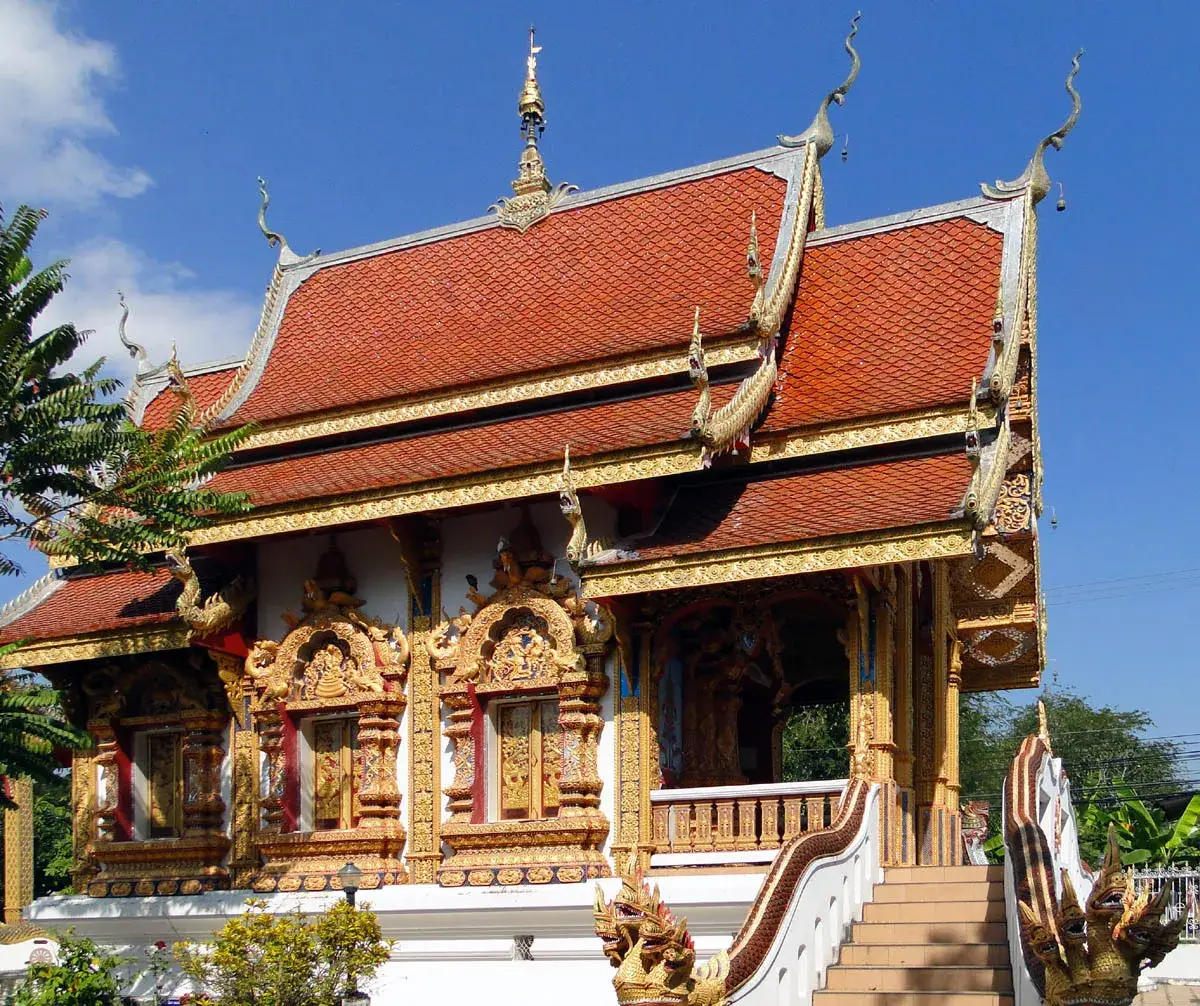
Wat Phromchariyaram is located in Village No. 2, Ban Mae Ka, Talat Yai Subdistrict, Doi Saket District, Chiang Mai Province. It is a local Buddhist temple under the Maha Nikaya order and an important community temple for Ban Mae Ka. The temple was officially permitted to be established in B.E. 2434 (1891) and received Wisungkhamsima in B.E. 2547 (2004). Its abbot is Phra Khru Chan Phrommathat Sirichanto. Wat Phromchariyaram serves as a place for worship, merit-making, Buddhist ceremonies, Dhamma listening, and community religious life in Talat Yai.
Ban Mae Ka is located in Talat Yai Subdistrict, Doi Saket District, Chiang Mai. The area is connected with the Doi Saket–Bo Sang–San Kamphaeng route and lies not far from Doi Saket town. Talat Yai is a lowland community area with agricultural surroundings, village roads, local trade, and connections to nearby craft and market communities. Wat Phromchariyaram therefore stands in a living community setting, not as a temple separated from village life.
The name “Phromchariyaram” has a strong Buddhist meaning. “Phromchariya” refers to noble conduct, disciplined living, and a life guided by Dhamma, while “aram” means a temple or peaceful religious dwelling. Together, the name suggests a temple dedicated to noble conduct and spiritual cultivation. This meaning fits the temple’s role as a place where villagers come to make merit, listen to Dhamma, and strengthen moral practice.
The temple’s official establishment in B.E. 2434 makes Wat Phromchariyaram an old community temple of Doi Saket. A temple with this length of history has usually served several generations through changes in farming, transport, trade, household life, and community organization. Its continued presence reflects the long relationship between Buddhism and village life in Mae Ka.
Wat Phromchariyaram received Wisungkhamsima in B.E. 2547. In Thai Buddhism, Wisungkhamsima is a sacred boundary used for formal monastic acts, especially those connected with the ubosot. Receiving Wisungkhamsima confirms the temple’s formal religious role and its ability to support important Buddhist ceremonies.
The abbot of Wat Phromchariyaram is Phra Khru Chan Phrommathat Sirichanto. In a community temple, the abbot plays an important role in maintaining the temple, leading ceremonies, teaching Dhamma, coordinating with villagers, and preserving the temple as a living spiritual center. A village temple remains active through the cooperation of monks and lay supporters.
As a Maha Nikaya community temple, Wat Phromchariyaram is closely connected with local residents. People support the temple through offerings, Buddhist holy day activities, food offerings, Kathin, robe offerings, family ceremonies, and participation in temple events. The temple is therefore both a religious place and a shared community space where village relationships are maintained.
Talat Yai has long been a community area with local trade and farming. The name of the subdistrict is connected with the idea of a large market community, and the area has been home to local people as well as groups who came through trade and travel. This wider cultural context gives Wat Phromchariyaram a strong local setting as a temple in a village connected with agriculture, roads, and community exchange.
The Doi Saket–Bo Sang–San Kamphaeng route gives Talat Yai an important position within eastern Chiang Mai. Ban Mae Ka is not an isolated village, but part of a wider network of communities connected by travel, trade, agriculture, and local craftsmanship. Wat Phromchariyaram therefore represents a village temple in a route-based community landscape.
The importance of Wat Phromchariyaram lies not only in its official dates but also in its role as a temple of Ban Mae Ka. Village temples are used for real community life. They support merit-making, Buddhist ceremonies, Kathin, robe offerings, family rituals, and village gatherings. Such temples help maintain social relationships and spiritual continuity in the community.
The atmosphere of Wat Phromchariyaram is suitable for travelers who want to worship quietly and understand a local community temple in Doi Saket. It is not a large commercial tourist attraction, and that is part of its value. Visitors can experience the local side of Buddhism in Chiang Mai through a temple that continues to serve its village.
Talat Yai includes several Mae Ka communities, including Mae Ka Nuea, Mae Ka Talat, and Mae Ka Tai. Wat Phromchariyaram, located in Village No. 2, Ban Mae Ka, is part of this wider Mae Ka cultural landscape. The temple should be understood within this network of homes, village roads, local markets, rice fields, and religious spaces that shape everyday life in the area.
Travelers interested in community temples in Doi Saket should consider Wat Phromchariyaram as a meaningful local stop. It may not be promoted as widely as major landmark temples, but it reflects how Buddhism continues at the village level. Its value lies in continuity, local faith, and the relationship between monks and villagers.
A visit to Wat Phromchariyaram can be combined with nearby places such as Wat Si Chayaram Mae Ka Nuea, Wat Phra That Doi Saket, Tweechol Botanical Garden, Bo Sang Village, and Mae Kuang Udom Thara Dam. This route allows travelers to see a mix of community temples, district-level religious landmarks, gardens, craft villages, and natural scenery.
Wat Si Chayaram Mae Ka Nuea is a nearby temple in the Talat Yai area and can be included with Wat Phromchariyaram to understand the local temple network of Mae Ka. Visiting both temples shows how different village temples serve different parts of the same wider community area.
Wat Phra That Doi Saket is a major religious landmark of Doi Saket and can be paired with Wat Phromchariyaram in the same trip. Together, they show two levels of Buddhist life: a quiet village temple and a well-known district temple. This gives visitors a fuller understanding of Buddhist life in Doi Saket.
Tweechol Botanical Garden and Mae Kuang Udom Thara Dam add nature and leisure to the route. After worshipping at local temples, visitors can continue to green spaces, gardens, reservoir scenery, and quiet viewpoints. This creates a balanced route of faith, community, and nature.
Bo Sang Village in San Kamphaeng District is also possible to combine with the route. It is known for paper umbrellas and Lanna handicrafts. A route that includes Wat Phromchariyaram and Bo Sang gives travelers a combination of Buddhist culture, village life, and northern Thai craft heritage.
Getting There is easiest by private car, rental car, or local transport. From Chiang Mai city, travel toward Doi Saket District, then continue into Talat Yai Subdistrict and Ban Mae Ka, Village No. 2. Visitors can use the name Wat Phromchariyaram, Ban Mae Ka, Talat Yai, Doi Saket, Chiang Mai for navigation.
Travelers without a private vehicle can take public or hired transport from Chiang Mai toward Doi Saket and then continue with local transport to Ban Mae Ka. This requires planning because village transport may not be frequent throughout the day. For travelers who want to visit several nearby places, hiring a car with a driver is usually more convenient.
The best time to visit is in the morning or late afternoon, when the weather is more comfortable and the temple atmosphere is calm. During the cool season or after the rainy season, Doi Saket and Talat Yai are especially pleasant for a combined temple, community, and nature route.
Visitors should dress politely, speak quietly, keep the temple grounds clean, and avoid entering monastic areas without permission. Photography should be done respectfully and should not disturb monks or local worshippers. Wat Phromchariyaram is a community temple, so respectful behavior toward monks, villagers, and sacred spaces is essential.
Overall, Wat Phromchariyaram is a Maha Nikaya community temple in Ban Mae Ka, Village No. 2, Talat Yai Subdistrict, Doi Saket District, Chiang Mai. Officially established in B.E. 2434, granted Wisungkhamsima in B.E. 2547, and led by Phra Khru Chan Phrommathat Sirichanto, the temple remains a meaningful place for worship, merit-making, and understanding local Buddhist life in Talat Yai.
| Name | Wat Phromchariyaram |
| Local Name | Wat Phromchariyaram Mae Ka / Wat Phromchariyaram Mae Ka Talat |
| Location | Ban Mae Ka, Village No. 2, Talat Yai Subdistrict, Doi Saket District, Chiang Mai Province |
| Address | Village No. 2, Ban Mae Ka, Talat Yai Subdistrict, Doi Saket District, Chiang Mai 50220, Thailand |
| Temple Type | Community Buddhist Temple Under The Maha Nikaya Order |
| Temple Code | 350051001 |
| History | Officially permitted to be established as a temple in B.E. 2434 (1891) and granted Wisungkhamsima in B.E. 2547 (2004) |
| Abbot / Caretaker | Phra Khru Chan Phrommathat Sirichanto |
| Community Context | Community temple of Ban Mae Ka, Village No. 2, Talat Yai Subdistrict, located in a lowland area connected with the Doi Saket–Bo Sang–San Kamphaeng route and local agricultural life |
| Highlights | Maha Nikaya community temple of Ban Mae Ka, serving as a place for worship, merit-making, Dhamma listening, and community Buddhist life |
| Distinctive Features | Village temple reflecting the relationship between Buddhism, Mae Ka community life, old trade routes, and the local way of life in Talat Yai |
| Travel Information | From Chiang Mai city, travel toward Doi Saket District, then continue into Talat Yai Subdistrict and Ban Mae Ka, Village No. 2. Best reached by private car, rental car, or local transport. |
| Current Status | Active Maha Nikaya community temple in Village No. 2, Ban Mae Ka, Talat Yai Subdistrict, Doi Saket District, Chiang Mai Province, appearing in current temple registry information |
| Nearby Tourist Attractions | 1. Wat Si Chayaram Mae Ka Nuea, about 2 km 2. Wat Phra That Doi Saket, about 8 km 3. Tweechol Botanical Garden, about 9 km 4. Bo Sang Village, San Kamphaeng District, about 10 km 5. Mae Kuang Udom Thara Dam, about 16 km |
| Nearby Restaurants | 1. Mae Ka Coffee Doi Saket, about 1 km 2. Four O'clock Spicy Salad Mae Ka Doi Saket, about 2 km 3. Jin Moo Kluea Doi Saket by Mae Anong, about 2 km, Tel. 094-709-2236 4. SAPATAD Doi Saket, about 7 km, Tel. 090-264-9601 5. The Lemontree Garden & Restaurant Doi Saket, about 14 km |
| Nearby Accommodations | 1. Him Doi House @ Doisaket, about 8 km 2. Lanna Inthan Hotel & Resort, about 9 km 3. Horizon Village & Resort, about 10 km 4. Baan Chai Thung Resort, about 12 km 5. Suwanna Tara Resort & Spa, about 13 km |
Frequently Asked Questions (FAQ)
Q: Where is Wat Phromchariyaram located?
A: Wat Phromchariyaram is located in Village No. 2, Ban Mae Ka, Talat Yai Subdistrict, Doi Saket District, Chiang Mai Province.
Q: When was Wat Phromchariyaram officially established?
A: Wat Phromchariyaram was officially permitted to be established as a temple in B.E. 2434 (1891).
Q: When did Wat Phromchariyaram receive Wisungkhamsima?
A: Wat Phromchariyaram received Wisungkhamsima in B.E. 2547 (2004).
Q: Who is the abbot of Wat Phromchariyaram?
A: The abbot of Wat Phromchariyaram is Phra Khru Chan Phrommathat Sirichanto.
Q: What type of temple is Wat Phromchariyaram?
A: Wat Phromchariyaram is a local Buddhist temple under the Maha Nikaya order.
Q: What is the main appeal of Wat Phromchariyaram?
A: Its main appeal is its role as a quiet community temple of Ban Mae Ka, suitable for worship, merit-making, Dhamma listening, and learning about village Buddhist life in Talat Yai.
Q: How can travelers get to Wat Phromchariyaram?
A: From Chiang Mai city, travel toward Doi Saket District, then continue into Talat Yai Subdistrict and Ban Mae Ka, Village No. 2.
Q: What nearby places can be visited with Wat Phromchariyaram?
A: Nearby places include Wat Si Chayaram Mae Ka Nuea, Wat Phra That Doi Saket, Tweechol Botanical Garden, Bo Sang Village, and Mae Kuang Udom Thara Dam.
 Category: ●Places of Worship
 Group: ●Temple
Last Update : 1 WeekAgo
 Last Update : 1 WeekAgo
 Click to Access the Navigation Map GPS
Wat Phromchariyaram Map
Recommend

 Muang Chiang Mai(121)Chom Thong(47)Mae Chaem(25)Chiang Dao(33)Doi Saket(68)Mae Taeng(85)Mae Rim(69)Samoeng(29)Fang(71)Mae Ai(59)Phrao(70)San Pa Tong(103)San Kamphaeng(66)San Sai(73)Hang Dong(74)Hot(32)Doi Tao(22)Omkoi(11)Saraphi(74)Wiang Haeng(15)Chai Prakan(28)Mae Wang(32)Mae On(22)Doi Lo(34)Galyani Vadhana(1)


