
lovethailand home >North Travel Attractions >Chiang Mai Travel Attractions >Doi Saket >Choeng Doi > Wat Rong Khi Lek
TL;DR: Wat Rong Khi Lek is located at Ban Rong Khi Lek, Village No. 7, Choeng Doi Subdistrict, Doi Saket District, Chiang Mai Province.
Wat Rong Khi Lek
Operating day: Daily
Operating time: 08.00 - 17.00
Wat Rong Khi Lek is located at No. 154, Ban Rong Khi Lek, Village No. 7, Choeng Doi Subdistrict, Doi Saket District, Chiang Mai Province. It is a local Buddhist temple under the Maha Nikaya order and one of the most culturally distinctive community temples in Doi Saket. The temple was founded in B.E. 2321 (1778) by local Shan, also known historically as Ngiao, and Thai Khuen villagers. This origin gives the temple a strong multicultural identity within the Lanna region.
Ban Rong Khi Lek is a village in Choeng Doi Subdistrict, an area known for old temples, community settlements, schools, local roads, agricultural surroundings, and cultural routes east of Chiang Mai city. Wat Rong Khi Lek stands within this living community landscape. It serves as a place for merit-making, Buddhist ceremonies, Dhamma learning, village communication, and the preservation of local art and culture.
The temple’s founding in B.E. 2321 gives it a long history in the Doi Saket area. It was not created by a single cultural group but by Shan and Thai Khuen communities, both of which have played important roles in the history of northern Thailand. This background helps explain why the temple contains strong Lanna, Shan, and local village elements in its architecture, murals, and cultural memory.
The temple land covers 5 rai, 2 ngan, and 92 square wah, with title deed No. 22585. This area supports the temple’s main religious and community functions, including monastic residences, worship areas, ceremonial halls, and the historic viharn. As a community temple, Wat Rong Khi Lek is not only a place for ritual but also a shared space for local residents.
The temple’s main structures include an ubosot, sermon hall, monks’ residences, multipurpose hall, and an old Lanna-style viharn. Each structure serves a different role. The ubosot supports formal monastic acts, the sermon hall supports Dhamma teaching and ceremonies, the monks’ residences support monastic life, and the multipurpose hall supports village activities. The old viharn is the temple’s most important artistic and historical highlight.
The old viharn was built in B.E. 2471 (1928). It is a Lanna-style structure that reflects local craftsmanship and village wisdom. The pediment includes carved teak wood decorated with colored glass. Inside, the roof structure and round teak columns show the quality of traditional northern Thai timber construction. The use of teak gives the viharn a strong sense of age, solidity, and sacred presence.
Inside the old viharn, visitors will find a large gilded stucco Buddha image in the Mara Vijaya posture as the principal Buddha image. Two smaller Buddha images are placed on each side. The Mara Vijaya posture symbolizes the Buddha’s victory over temptation and inner obstacles, making it a fitting focal point for worship and meditation within the viharn.
The viharn also contains a beautifully crafted teak busabok-style pulpit. A pulpit is important in northern Thai temples because it is used for preaching and Dhamma teaching. The teak pulpit at Wat Rong Khi Lek is therefore not merely a ceremonial object; it is a sign of the temple’s role as a place where Buddhist teachings have been delivered and preserved in the community.
The most remarkable feature of the viharn is its mural painting. The murals are painted with Chinese powdered pigments by Shan artists. They depict the Vessantara Jataka, Phra Malai’s journey to teach beings, and the local literary story Suwan Wong Hong Hin. These murals are valuable because they preserve religious teachings, moral imagination, and local literature within one sacred architectural space.
The Vessantara Jataka is one of the most important Buddhist stories in Thai and Lanna religious culture. It emphasizes generosity, sacrifice, and the perfection of giving. When shown on temple walls, the story becomes a visual Dhamma text. People entering the viharn can learn about generosity and moral strength through images rather than through written text alone.
The story of Phra Malai also plays an important moral role. Phra Malai is a revered monk in Buddhist storytelling who travels to hell and heaven, returning with teachings about karma, merit, and the consequences of human action. Murals of Phra Malai help viewers reflect on ethical conduct, the value of making merit, and the importance of avoiding harmful actions.
The inclusion of Suwan Wong Hong Hin gives the murals a strong local character. This story belongs to the world of local literature and oral tradition. Its presence in the viharn shows that the temple served not only as a religious space but also as a cultural archive where Buddhist stories and local narratives were preserved together.
The temple’s sacred objects include stucco Buddha images, an old pulpit, and small Buddha images. Together with the old viharn and murals, these objects make Wat Rong Khi Lek an important site for the study of local religious art. The temple is valuable not only for worshippers but also for people interested in Lanna architecture, Shan mural traditions, and village Buddhist culture.
Wat Rong Khi Lek received Wisungkhamsima on November 5, B.E. 2464 (1921). In Thai Buddhism, Wisungkhamsima is a designated sacred boundary for formal monastic acts, especially those connected with the ubosot. Receiving Wisungkhamsima confirms the temple’s formal religious role and its ability to support important monastic ceremonies.
The temple also has an educational role. Its Sunday Buddhist Study Center opened in B.E. 2521 (1978). This center reflects the traditional function of Thai temples as places of learning. It helps young people and local residents study Buddhist teachings, moral values, manners, and cultural practice. In this way, the temple supports both spiritual and educational development within the village.
Wat Rong Khi Lek also has a public library, a newspaper reading area for local residents, and a village announcement tower. These features show that the temple has served the community beyond ritual use. It has been a place for communication, reading, learning, and public information, strengthening the temple’s role as a community center.
The old viharn continues to be used by monks, novices, laymen, and laywomen for religious activities on Buddhist holy days and Sundays. This ongoing use is important because the viharn is not only an old building or an art object. It remains a living sacred space where art, faith, and community practice continue to meet.
Another important feature of the temple is Phra That Ket Kaeo Chulamani. It is a visually striking stupa decorated with colored glass, giving it a bright and sacred appearance. The stupa serves as another point of worship within the temple and adds to the temple’s spiritual character.
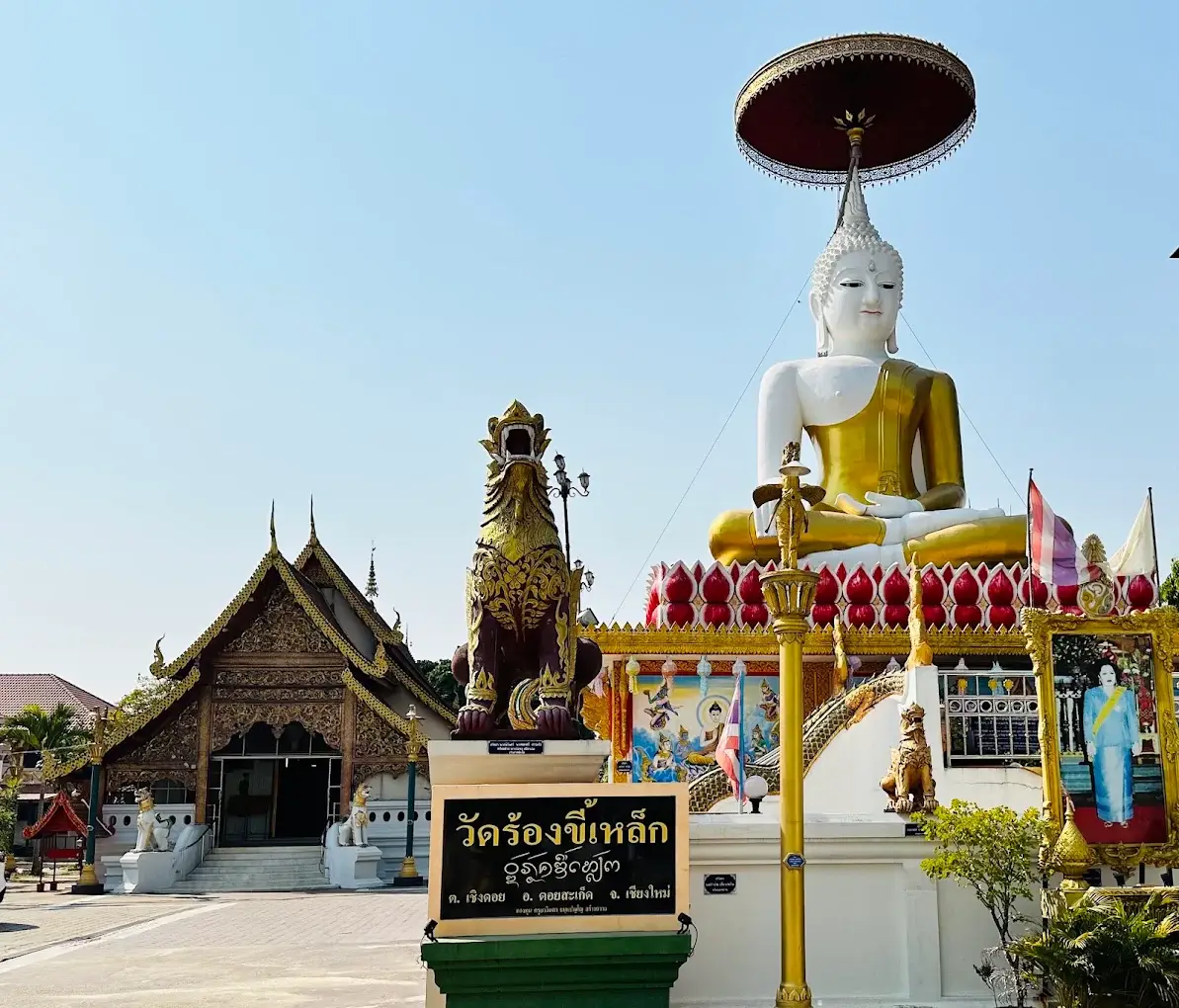
The temple also has a large white Phra Chao Than Jai image facing toward the temple entrance. Phra Chao Than Jai images are widely respected for their association with wishes, determination, and timely fulfillment. Its location makes it a welcoming sacred presence for visitors arriving at the temple.
The significance of Wat Rong Khi Lek lies in its many layers. It is an old community temple founded by Shan and Thai Khuen people, a Lanna architectural site, a place with rare Shan-style murals, a center of Buddhist education, and a village communication point. These layers make the temple one of the more culturally rich religious sites in Doi Saket.
For visitors, Wat Rong Khi Lek is suitable for worship, merit-making, and careful appreciation of local art. It is especially interesting for people who want to learn about Lanna architecture, Shan mural painting, Thai Khuen and Shan community history, and local Buddhist literature. The old viharn should be visited slowly and respectfully because its details are more meaningful when given time and attention.
Choeng Doi and Doi Saket contain several temples and cultural places that can be combined into a slow religious and cultural route. Wat Rong Khi Lek can be included as a major cultural stop because of its old viharn and murals. Nearby attractions, restaurants, and accommodations are arranged in the summary table below for convenient trip planning.
Getting There is easiest by private car, rental car, or local transport. From Chiang Mai city, travel toward Doi Saket District, then continue into Choeng Doi Subdistrict and Ban Rong Khi Lek, Village No. 7. The temple is located within a village community and is best visited with enough time to see the old viharn and murals respectfully.
Travelers without a private vehicle can take public or hired transport from Chiang Mai to Doi Saket and then continue with local transport into Ban Rong Khi Lek. This requires planning because village transport may not be frequent throughout the day. For travelers who want to visit several nearby places, hiring a car with a driver is usually more convenient.
The best time to visit is in the morning or late afternoon, when the weather is more comfortable and the temple atmosphere is calm. Visitors who wish to see the murals should choose a time with suitable natural light and should avoid using flash in any area where it may affect old paintings or disturb worshippers.
Visitors should dress politely, speak quietly, keep the temple grounds clean, and avoid entering monastic areas without permission. Photography should be done respectfully and should not disturb monks or local worshippers. Because Wat Rong Khi Lek contains an old viharn and valuable mural paintings, visitors should never touch the walls, painted surfaces, teak structures, or sacred objects.
Overall, Wat Rong Khi Lek is an old Maha Nikaya community temple in Ban Rong Khi Lek, Choeng Doi Subdistrict, Doi Saket District, Chiang Mai. Founded in B.E. 2321 by Shan and Thai Khuen villagers, granted Wisungkhamsima on November 5, B.E. 2464, and home to a 1928 Lanna-style viharn with Shan mural paintings, the temple is an important place for worship, merit-making, Lanna art, local literature, and community cultural learning.
| Name | Wat Rong Khi Lek |
| Location | Ban Rong Khi Lek, Village No. 7, Choeng Doi Subdistrict, Doi Saket District, Chiang Mai Province |
| Address | No. 154, Ban Rong Khi Lek, Village No. 7, Choeng Doi Subdistrict, Doi Saket District, Chiang Mai 50220, Thailand |
| Temple Type | Community Buddhist Temple Under The Maha Nikaya Order |
| History | Founded in B.E. 2321 (1778) by Shan and Thai Khuen villagers; granted Wisungkhamsima on November 5, B.E. 2464 (1921) |
| Temple Land | 5 rai, 2 ngan, and 92 square wah; title deed No. 22585 |
| Main Structures | Ubosot, sermon hall, monks’ residences, multipurpose hall, and old Lanna-style viharn |
| Old Viharn | Built in B.E. 2471 (1928), with carved teak pediment, colored glass decoration, roof structure, and round teak columns |
| Murals | Chinese powdered pigment murals by Shan artists, depicting the Vessantara Jataka, Phra Malai, and Suwan Wong Hong Hin |
| Sacred Objects | Stucco Buddha images, large gilded Mara Vijaya Buddha image, teak busabok pulpit, old pulpit, small Buddha images, Phra That Ket Kaeo Chulamani, and large white Phra Chao Than Jai image |
| Educational And Community Role | Sunday Buddhist Study Center opened in B.E. 2521 (1978), with a public library, newspaper reading area, and village announcement tower |
| Highlights | Old Lanna-style viharn, Shan mural paintings, Phra That Ket Kaeo Chulamani, and large white Phra Chao Than Jai image |
| Distinctive Features | Historic temple reflecting Shan, Thai Khuen, and Lanna cultural roots in Doi Saket |
| Travel Information | From Chiang Mai city, travel toward Doi Saket District, then continue into Choeng Doi Subdistrict and Ban Rong Khi Lek, Village No. 7. Best reached by private car, rental car, or local transport. |
| Current Status | Active Maha Nikaya community temple in Ban Rong Khi Lek, Choeng Doi Subdistrict, Doi Saket District, Chiang Mai Province |
| Nearby Tourist Attractions | 1. Wat Phra That Doi Saket, about 4 km 2. Wat Pho Thong Charoen, about 5 km 3. Wat Doi Ku, about 6 km 4. Tweechol Botanical Garden, about 9 km 5. Mae Kuang Udom Thara Dam, about 13 km |
| Nearby Restaurants | 1. Lat Na Pa Chuan Phon Doi Saket, about 3 km 2. Pla San Khuean, about 5 km, Tel. 053-865-559, 081-882-9481 3. The Lemontree Garden & Restaurant Doi Saket, about 7 km, Tel. 093-415-0544 4. Sorn's Cafe, Restaurant And Bar, about 8 km, Tel. 081-485-2801 5. G&M German Sausage Doi Saket, about 15 km |
| Nearby Accommodations | 1. Him Doi House @ Doisaket, about 4 km, Tel. 089-656-4959 2. Baan Chai Thung Resort, about 7 km 3. Suwanna Tara Resort & Spa, about 8 km, Tel. 053-291-937 4. Lanna Inthan Hotel & Resort, about 9 km 5. Horizon Village & Resort, about 9 km |
Frequently Asked Questions (FAQ)
Q: Where is Wat Rong Khi Lek located?
A: Wat Rong Khi Lek is located at No. 154, Ban Rong Khi Lek, Village No. 7, Choeng Doi Subdistrict, Doi Saket District, Chiang Mai Province.
Q: When was Wat Rong Khi Lek founded?
A: Wat Rong Khi Lek was founded in B.E. 2321 (1778) by Shan and Thai Khuen villagers.
Q: What is the main highlight of Wat Rong Khi Lek?
A: The main highlight is the old Lanna-style viharn built in B.E. 2471 (1928), with mural paintings by Shan artists.
Q: What stories are shown in the temple murals?
A: The murals depict the Vessantara Jataka, Phra Malai, and the local literary story Suwan Wong Hong Hin.
Q: When did Wat Rong Khi Lek receive Wisungkhamsima?
A: Wat Rong Khi Lek received Wisungkhamsima on November 5, B.E. 2464 (1921).
Q: What sacred objects are found at Wat Rong Khi Lek?
A: The temple has stucco Buddha images, a gilded Mara Vijaya Buddha image, a teak busabok pulpit, an old pulpit, small Buddha images, Phra That Ket Kaeo Chulamani, and a large white Phra Chao Than Jai image.
Q: What educational and community roles does Wat Rong Khi Lek have?
A: The temple has a Sunday Buddhist Study Center opened in B.E. 2521 (1978), a public library, a newspaper reading area, and a village announcement tower.
Q: How can travelers get to Wat Rong Khi Lek?
A: From Chiang Mai city, travel toward Doi Saket District, then continue into Choeng Doi Subdistrict and Ban Rong Khi Lek, Village No. 7. A private car, rental car, or local transport is recommended.
 Category: ●Places of Worship
 Group: ●Temple
Last Update : 2 WeekAgo
 Last Update : 2 WeekAgo
 Click to Access the Navigation Map GPS
Wat Rong Khi Lek Map
Recommend

 Muang Chiang Mai(121)Chom Thong(47)Mae Chaem(25)Chiang Dao(33)Doi Saket(68)Mae Taeng(85)Mae Rim(69)Samoeng(29)Fang(71)Mae Ai(59)Phrao(70)San Pa Tong(103)San Kamphaeng(66)San Sai(73)Hang Dong(73)Hot(32)Doi Tao(22)Omkoi(11)Saraphi(74)Wiang Haeng(15)Chai Prakan(28)Mae Wang(32)Mae On(22)Doi Lo(33)Galyani Vadhana(1)


