
lovethailand home >North Travel Attractions >Chiang Mai Travel Attractions >Doi Saket >Choeng Doi > Wat Doi Ku (Wat Phra That Doi Ku)
TL;DR: Wat Doi Ku (Wat Phra That Doi Ku) is located at Ban Mae Dok Daeng, Village No. 1, Choeng Doi Subdistrict, Doi Saket District, Chiang Mai Province. Highlights include Hilltop community temple of Ban Mae Dok Daeng with a sacred stupa as its spiritual center.
Wat Doi Ku (Wat Phra That Doi Ku)
Operating day: Daily
Operating time: 08.00 - 17.00
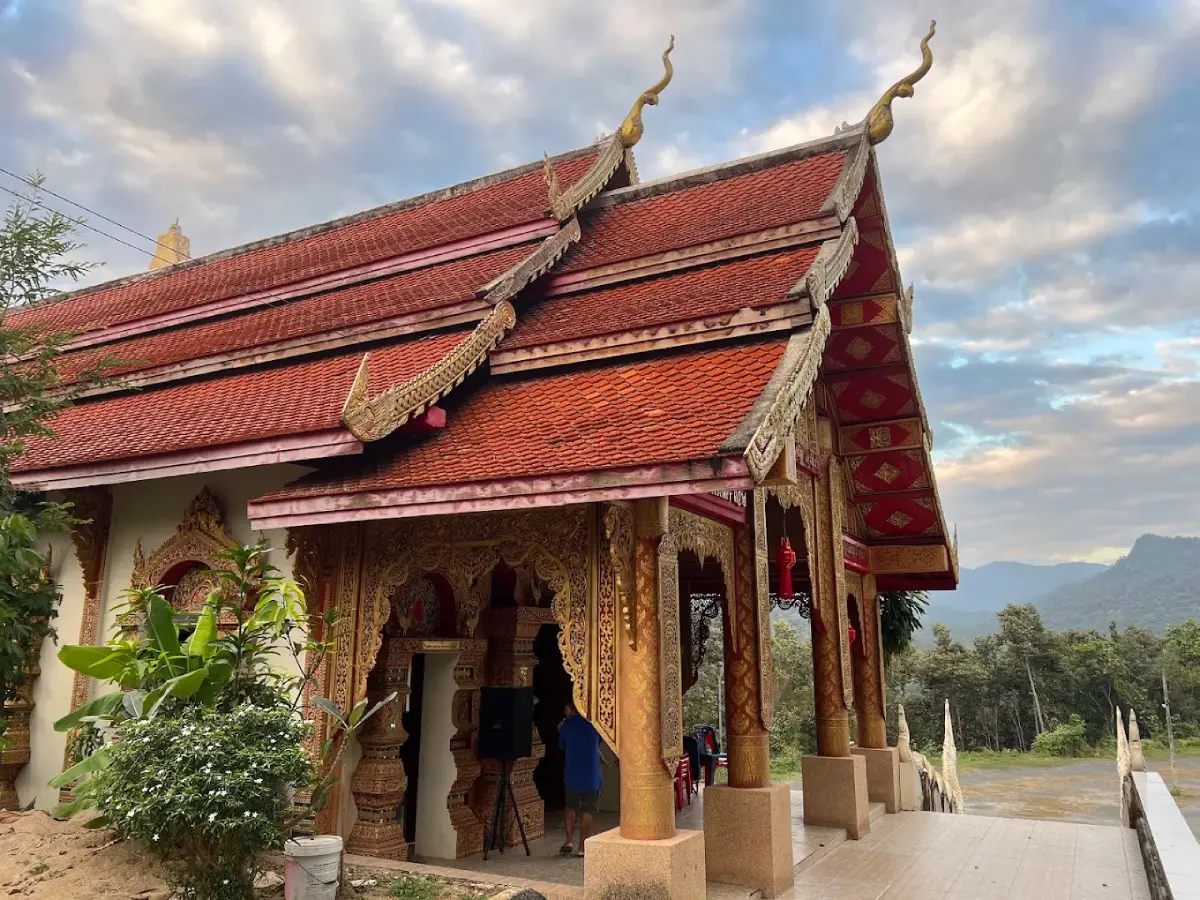
Wat Doi Ku, also known as Wat Phra That Doi Ku, is located in Village No. 1, Ban Mae Dok Daeng, Choeng Doi Subdistrict, Doi Saket District, Chiang Mai Province. It is a local Buddhist temple under the Maha Nikaya order and an important religious site for the Mae Dok Daeng community. The temple was officially permitted to be established in B.E. 2515 (1972), and its abbot is Phra Sirichai Paphassaro. Wat Doi Ku is best known as a hilltop temple with a sacred stupa as its spiritual center, offering a calm atmosphere for worship, merit-making, and quiet reflection.
Ban Mae Dok Daeng is a village in Choeng Doi Subdistrict, an area that connects Doi Saket town with local communities, rural roads, schools, temples, and natural routes east of Chiang Mai city. Wat Doi Ku stands within this community landscape. It serves as a place where local people make merit, attend Buddhist ceremonies, and maintain the spiritual life of the village.
The name “Doi Ku” reflects both geography and Buddhist meaning. In northern Thailand, “doi” means hill or mountain, while “ku” is often associated with a stupa, chedi, or sacred religious structure in Lanna culture. The name therefore suggests a temple on a hill with a stupa as its defining feature. This meaning helps visitors understand the character of the temple even before arriving: it is a place where elevation, sacred architecture, and devotion come together.
Wat Doi Ku is also known as Wat Phra That Doi Phu. The temple was formerly an abandoned temple before being officially restored as a temple with resident monks on January 10, B.E. 2515 (1972). This history gives the temple additional meaning. It is not only a community temple but also a restored sacred site, brought back into active Buddhist life through local faith and monastic continuity.
The temple land covers 20 rai. Its boundary is recorded as approximately 5 sen on the north and south sides and approximately 5 sen on the east and west sides. This area gives the temple enough space to support its stupa, viharn, monks’ residences, worship areas, and hilltop surroundings. Hill temples often feel different from lowland temples because visitors gradually move from the village environment into a quieter and more contemplative sacred space.
The most important sacred object at Wat Doi Ku is the Phra That Doi Ku stupa. The stupa is the spiritual focal point of the temple and the main reason many visitors come to pay respect. A hilltop stupa carries a strong sense of Buddhist symbolism. It invites worshippers to look upward, slow down, and focus their minds on reverence, merit, and inner calm.
The temple’s main structures include a viharn and monks’ residences. The viharn is used for worship and Buddhist ceremonies, while the monks’ residences support the monastic life of the temple. Together with the stupa, these structures give Wat Doi Ku the essential form of a working community temple. It can support both local religious life and visits from worshippers who come to pay respect to the stupa.
The temple’s history mentions Phra Khruba Siwichai and Phra Sing Nueng in connection with its sacred objects. Khruba Siwichai is one of the most respected monks in northern Thai Buddhist history, known for his role in restoring temples, building religious routes, and strengthening Buddhist communities across Lanna. This association gives Wat Doi Ku a deeper place within the religious memory of northern Thailand.
The temple’s known monastic leadership shows continuity after the restoration of the abandoned site. The recorded names include Phra Thongkham, Phra Inpan, Phra Prasit, Phra Khru Rattanabanyan, Phra Chan Hom Ratindharo, Phra Athikan Insom Mahawiro, Phra Song Siriwuttho, and Phra Athikan Manop Chinawiso. These names show that Wat Doi Ku developed through a continuing line of monastic care rather than remaining only a historical site.
As a Maha Nikaya community temple, Wat Doi Ku is closely connected with local residents. Temples of this kind are supported by laypeople through merit-making, offerings, ceremonies, and community participation. The temple’s value is not based on commercial tourism but on its role as a living religious space for Ban Mae Dok Daeng and the wider Choeng Doi area.
The abbot of Wat Doi Ku is Phra Sirichai Paphassaro. In a hilltop temple with a sacred stupa, the abbot’s role includes maintaining the temple grounds, caring for the stupa area, leading ceremonies, supporting Buddhist practice, and coordinating with local devotees. The ongoing care of the temple helps keep the site peaceful, orderly, and suitable for worship.
The charm of Wat Doi Ku lies in its quiet hilltop atmosphere. It is not a large commercial tourist attraction, and that is part of its appeal. Visitors can pay respect to the stupa, make merit, walk calmly around the temple grounds, and experience a simple Buddhist site connected with the local community. The temple is especially suitable for travelers who prefer peaceful places over crowded sightseeing spots.
Choeng Doi Subdistrict is an important area of Doi Saket District. It includes local temples, schools, residential communities, agricultural areas, and the main route between Chiang Mai city and Doi Saket. Wat Doi Ku is part of a wider local temple network that includes Wat Phra That Doi Saket, Wat Pho Thong Charoen, Wat Suk Kasem, Wat Rangsi Sutthawat, and other temples nearby. This makes the temple suitable for a short cultural route around Choeng Doi.
Wat Phra That Doi Saket is one of the most important nearby places to visit with Wat Doi Ku. It is a major hilltop temple of Doi Saket and a well-known landmark for worshippers and travelers. Visiting both temples allows travelers to see two different expressions of hilltop Buddhist devotion: a major district-level temple and a quieter community temple.
Mae Kuang Udom Thara Dam is another nearby destination that can be combined with Wat Doi Ku. The dam offers open scenery, water views, and a more natural atmosphere after a temple visit. A route that includes Wat Doi Ku, Wat Phra That Doi Saket, and Mae Kuang Udom Thara Dam gives travelers a balanced experience of worship, local culture, and nature.
Tweechol Botanical Garden is also a useful nearby stop, especially for families and travelers who enjoy green spaces. The garden includes plant collections, landscaped areas, animal zones, and leisure facilities. Combining Wat Doi Ku with Tweechol Botanical Garden creates a gentle itinerary that begins with worship and continues with relaxation in a natural setting.
Bo Sang Village in San Kamphaeng District can also be added to the route. It is known for handmade umbrellas and Lanna craft traditions. Travelers coming from Chiang Mai toward Doi Saket can combine temple visits with local craft culture, creating a route that includes Buddhism, hill landscapes, village life, and handmade heritage.
Getting There is easiest by private car, rental car, or local transport. From Chiang Mai city, take Highway 118 toward Doi Saket District, then continue into Choeng Doi Subdistrict and Ban Mae Dok Daeng, Village No. 1. Some parts of the route lead through local and hill roads, so careful driving is recommended, especially during rain, late afternoon, or when road surfaces are slippery.
Travelers without a private vehicle can take public transport or hired transport from Chiang Mai to Doi Saket, then continue with local transport into Choeng Doi and Ban Mae Dok Daeng. This option requires planning because village transport may not be frequent throughout the day. For travelers who want to visit multiple nearby places, hiring a car with a driver is usually more convenient.
The best time to visit is in the morning or late afternoon, when the weather is more comfortable and the temple atmosphere is calm. During the cool season or after the rainy season, Doi Saket is especially pleasant, with fresh air, green surroundings, and a quieter rural feel. Visitors should allow enough time for the route and avoid rushing through the temple grounds.
Visitors should dress politely, speak quietly, keep the temple grounds clean, and avoid entering monastic areas without permission. Photography should be done respectfully and should not disturb monks or other worshippers. Wat Doi Ku is a sacred community temple, so respectful behavior toward monks, villagers, and sacred spaces is essential.
Overall, Wat Doi Ku or Wat Phra That Doi Ku is a meaningful Maha Nikaya community temple of Ban Mae Dok Daeng in Choeng Doi Subdistrict, Doi Saket District, Chiang Mai. Restored from an abandoned temple and formally established in B.E. 2515, the temple is centered on its sacred stupa and remains a peaceful place for worship, merit-making, and quiet cultural travel. It is best visited together with Wat Phra That Doi Saket, Tweechol Botanical Garden, Mae Kuang Udom Thara Dam, Bo Sang Village, and other nearby attractions.
| Name | Wat Doi Ku |
| Other Names | Wat Phra That Doi Ku / Wat Phra That Doi Phu |
| Location | Ban Mae Dok Daeng, Village No. 1, Choeng Doi Subdistrict, Doi Saket District, Chiang Mai Province |
| Address | 34 Village No. 1, Choeng Doi Subdistrict, Doi Saket District, Chiang Mai 50220, Thailand |
| Temple Type | Community Buddhist Temple Under The Maha Nikaya Order |
| History | Formerly an abandoned temple, restored as a temple with resident monks on January 10, B.E. 2515 (1972) |
| Temple Land | 20 rai |
| Sacred Object | Phra That Doi Ku Stupa |
| Main Areas / Zones | Stupa area, viharn, monks’ residences, worship area, and hilltop temple grounds |
| Highlights | Hilltop community temple of Ban Mae Dok Daeng with a sacred stupa as its spiritual center |
| Distinctive Features | Peaceful Maha Nikaya hill temple, suitable for worship, merit-making, and a cultural route with Wat Phra That Doi Saket |
| Abbot / Caretaker | Phra Sirichai Paphassaro |
| Phone | 053-865-911 |
| Travel Information | From Chiang Mai city, take Highway 118 toward Doi Saket, then continue into Choeng Doi Subdistrict and Ban Mae Dok Daeng, Village No. 1. Best reached by private car, rental car, or local transport. |
| Current Status | Active Maha Nikaya community temple in Ban Mae Dok Daeng, Choeng Doi Subdistrict, Doi Saket District |
| Nearby Tourist Attractions | 1. Wat Phra That Doi Saket, about 3 km 2. Tweechol Botanical Garden, about 10 km 3. Mae Kuang Udom Thara Dam, about 12 km 4. Bo Sang Village, San Kamphaeng District, about 17 km 5. San Kamphaeng Hot Springs, about 28 km |
| Nearby Restaurants | 1. Lat Na Pa Chuan Phon Doi Saket, about 2 km, Tel. 083-475-3512, 085-864-6108 2. Pla San Khuean, about 4 km, Tel. 053-865-559, 081-882-9481 3. The Lemontree Garden & Restaurant Doi Saket, about 6 km, Tel. 093-415-0544 4. Sorn's Cafe, Restaurant And Bar, about 7 km, Tel. 053-291-162 5. G&M German Sausage Doi Saket, about 14 km, Tel. 053-840-531, 094-708-3737 |
| Nearby Accommodations | 1. Him Doi House @ Doisaket, about 3 km, Tel. 089-656-4959 2. Baan Chai Thung Resort, about 5 km, Tel. 089-058-0496, 053-495-892 3. Suwanna Tara Resort & Spa, about 7 km, Tel. 053-291-937 4. Lanna Inthan Hotel & Resort, about 8 km 5. Horizon Village & Resort, about 10 km, Tel. 053-292-381 |
Frequently Asked Questions (FAQ)
Q: Where is Wat Doi Ku located?
A: Wat Doi Ku is located in Ban Mae Dok Daeng, Village No. 1, Choeng Doi Subdistrict, Doi Saket District, Chiang Mai Province.
Q: What other names is Wat Doi Ku known by?
A: Wat Doi Ku is also known as Wat Phra That Doi Ku and Wat Phra That Doi Phu.
Q: When was Wat Doi Ku officially established?
A: The temple was formerly abandoned and was restored as a temple with resident monks on January 10, B.E. 2515 (1972).
Q: What is the highlight of Wat Doi Ku?
A: The main highlight is the Phra That Doi Ku stupa, the temple’s sacred focal point and a center of local faith.
Q: Who is the abbot of Wat Doi Ku?
A: The abbot of Wat Doi Ku is Phra Sirichai Paphassaro.
Q: How can travelers get to Wat Doi Ku?
A: From Chiang Mai city, take Highway 118 toward Doi Saket, then continue into Choeng Doi Subdistrict and Ban Mae Dok Daeng, Village No. 1. A private car, rental car, or local transport is recommended.
Q: What type of travelers should visit Wat Doi Ku?
A: The temple is suitable for travelers who want to worship, make merit, pay respect to a hilltop stupa, and visit a peaceful local temple away from crowded tourist routes.
Q: What nearby places can be visited with Wat Doi Ku?
A: Nearby places include Wat Phra That Doi Saket, Tweechol Botanical Garden, Mae Kuang Udom Thara Dam, Bo Sang Village, and San Kamphaeng Hot Springs.
 Category: ●Places of Worship
 Group: ●Temple
Last Update : 4 DayAgo
 Last Update : 4 DayAgo
 Click to Access the Navigation Map GPS
Wat Doi Ku (Wat Phra That Doi Ku) Map
Recommend

 Muang Chiang Mai(121)Chom Thong(47)Mae Chaem(25)Chiang Dao(33)Doi Saket(68)Mae Taeng(85)Mae Rim(69)Samoeng(29)Fang(71)Mae Ai(62)Phrao(70)San Pa Tong(105)San Kamphaeng(66)San Sai(73)Hang Dong(74)Hot(32)Doi Tao(22)Omkoi(11)Saraphi(74)Wiang Haeng(15)Chai Prakan(28)Mae Wang(32)Mae On(22)Doi Lo(34)Galyani Vadhana(1)


