
lovethailand home >North Travel Attractions >Chiang Mai Travel Attractions >Chai Prakan >Mae Tha Lop > Wat Pa Daeng (Mae Thalop)
TL;DR: Wat Pa Daeng (Mae Thalop) is located at Moo 2, Ban Pa Daeng, Mae Thalop Subdistrict, Chai Prakan District, Chiang Mai 50320, open Daily, hours 08.00 – 17.00.

Wat Pa Daeng (Mae Thalop)
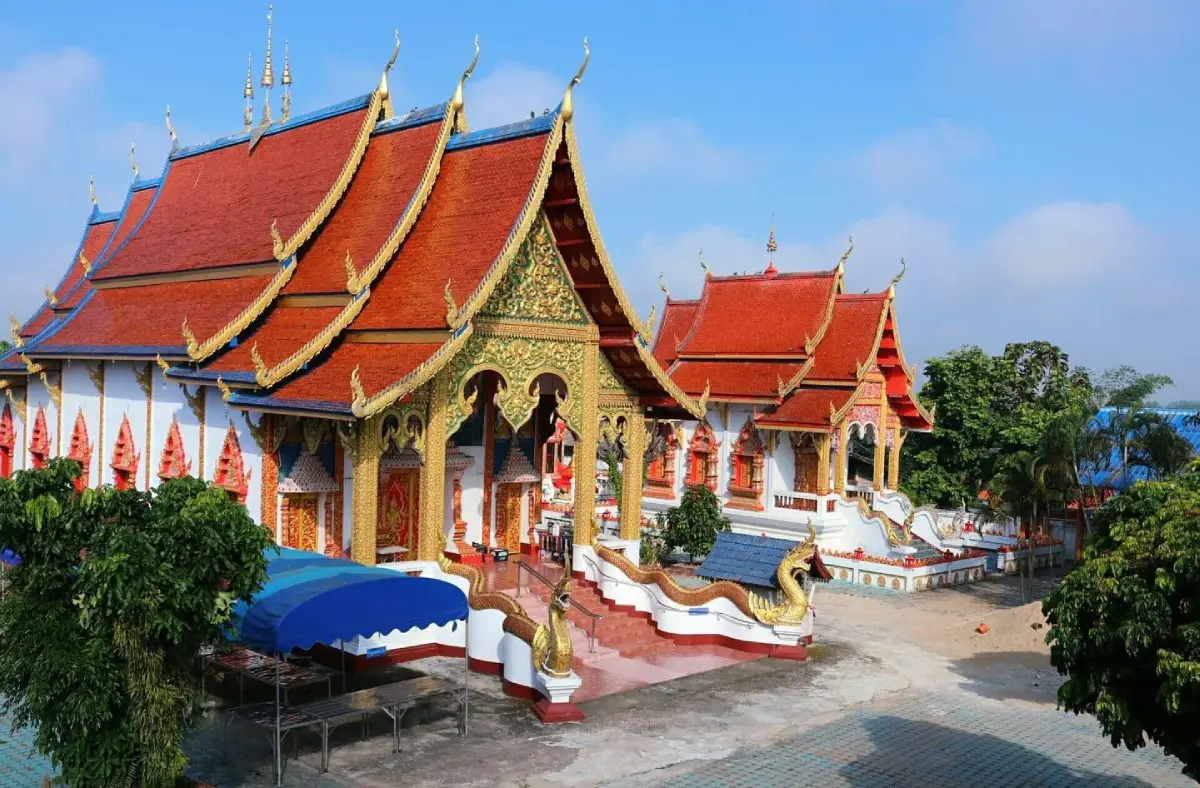
Open Days: Daily
Opening Hours: 08.00 – 17.00
Wat Pa Daeng (Mae Thalop), also recorded locally as Wat Pa Daeng Charoen Rat, is a community Buddhist temple in Moo 2, Ban Pa Daeng, Mae Thalop Subdistrict, Chai Prakan District, Chiang Mai Province. The temple belongs to the Mahanikaya order and has deep ties to the history of Ban Pa Daeng. It was officially permitted as a Buddhist temple in 1924 and received a royal Wisungkhamsima boundary in 1996. The temple remains an active religious and community space, with Phra Khru Supunyaphirat Abhipunyo serving as abbot.
What makes Wat Pa Daeng historically significant is that the present temple was not established on an empty piece of land. The site had previously been an abandoned temple. When villagers began restoring the area, remains of an old wall and viharn were still visible. The abandoned religious site was surrounded by a forest where red hardwood trees, teak, and padauk grew in large numbers. These details suggest that the sacred use of the site predates the temple's formal establishment in 1924, although the surviving public records do not assign a precise date to the earlier temple.
The forest landscape also helps explain the name Pa Daeng, which literally evokes a forest associated with redwood trees. Local records specifically mention the abundance of mai daeng, or red hardwood, together with teak and padauk around the temple site. The names of both Ban Pa Daeng and Wat Pa Daeng therefore preserve a connection with the former natural environment of the community. The temple's name is not merely an administrative label; it carries a memory of the landscape that once surrounded the settlement.
The revival of the abandoned temple was driven by local residents. Mr. Nueng Wandee and Mr. Kham Tejama worked together with Buddhist supporters from Ban Pa Daeng to clear the overgrown site and construct monastic facilities. The villagers then invited Phra Charoen and Phra Muen to reside at the temple. This episode is central to the identity of Wat Pa Daeng because the temple was restored through collective community effort rather than through a single royal or institutional project.
The year 1924 became an important milestone when Wat Pa Daeng was officially permitted as a Buddhist temple. By 2026, the temple had therefore existed for more than a century in its officially recognized form. The sacred history of the site, however, reaches further back because the remains of an earlier wall and viharn were already present when the villagers began clearing the abandoned temple grounds.
Wat Pa Daeng later received its royal Wisungkhamsima in 1996. In Thai Buddhism, a Wisungkhamsima defines a consecrated monastic boundary used for formal acts of the Sangha. The sequence of events therefore shows a clear development: an abandoned religious site was restored by villagers, monastic buildings were constructed, monks returned to reside there, the temple was formally established, and a consecrated boundary was later granted.
Wat Pa Daeng is located in Mae Thalop Subdistrict, a mountainous area on the eastern side of Chai Prakan District. The landscape contains forest, highland terrain, agricultural valleys, and a number of villages including Ban Mae Thalop, Ban Pa Daeng, Ban Pa Ngio, Ban Doi Lo, Ban Dong Chimphli, Ban Mai Phatthana, and Ban Huai Ton Tong. Mae Thalop is also culturally diverse, with Buddhist and Christian communities as well as highland groups including Lahu and Lisu residents.
Within this setting, Wat Pa Daeng serves the Buddhist community of Ban Pa Daeng and nearby settlements. It functions as a place for merit-making, observing Buddhist holy days, listening to teachings, and conducting community religious ceremonies. Like many rural temples in northern Thailand, its importance is inseparable from village life. The temple is part of the social structure of the community rather than an isolated monument.
The temple's continuing role is visible in recent community activities. In March 2026, the Mae Thalop Public Health and Medical Center under the Chiang Mai Provincial Administrative Organization used Wat Pa Daeng in Moo 2 as the venue for a traditional Thai medicine outreach program for local residents. Services included health checks and traditional treatments for people aged 40 and over. The event demonstrates that the temple continues to function as a shared public space as well as a religious institution.
Wat Pa Daeng School is also located in the same community and remains part of the educational system under Chiang Mai Primary Educational Service Area Office 3. The school provides education from early childhood and primary levels through lower secondary school. The continuing presence of the school bearing the temple's name illustrates the close relationship traditionally found among temples, education, and village life in rural northern Thailand.
From an architectural-history perspective, the clearest documented features of the original site are the remains of a wall and viharn that belonged to the abandoned temple. Local residents later constructed new monastic facilities when the site was revived. These details reveal at least two historical layers at Wat Pa Daeng: an earlier religious site that eventually became deserted, followed by the twentieth-century revival that led to the officially recognized temple established in 1924.
Visitors should therefore approach Wat Pa Daeng as a restored community temple with archaeological and historical memory rather than simply as a sightseeing temple with monumental architecture. Its main appeal is the story of the land, the forest, the villagers, and the collective restoration of an abandoned sacred place. Understanding this background adds far more meaning to a visit than simply photographing temple buildings.
The historical references to redwood, teak, and padauk also offer a glimpse into the former landscape of Mae Thalop. When the temple was revived, transportation in the area was still difficult. Clearing an abandoned site, constructing monastic facilities, and arranging for monks to live there required considerable cooperation from the village. The existence of the temple today is therefore the result of long-term religious commitment and community labor.
Travelers interested in Lanna community history can connect Wat Pa Daeng with other temples in Mae Thalop. Wat Pakkanthawas in Ban Mae Thalop has roots that extend back before the eighteenth century. Wat Phra That Chom Khiri is associated with restoration work supported by the celebrated Lanna monk Khruba Srivichai. Wat Chimphliwan developed as Ban Pa Ngio established its own village temple. Wat Pa Daeng, by contrast, represents the recovery and reuse of an abandoned sacred site. Visiting these temples together provides a broader picture of how Buddhist communities developed across Mae Thalop.
Wat Pa Daeng also belongs to a wider cultural environment where Buddhist and Northern Thai traditions remain important. Religious sites throughout Mae Thalop observe major Buddhist occasions such as Makha Bucha, Visakha Bucha, and Asalha Bucha. The subdistrict also maintains Northern Thai New Year traditions in April and Salak Phat merit-making traditions later in the year. These events reflect the strong relationship between temples, local craftsmanship, religious offerings, and village participation.
Kathin and robe-offering traditions are another important part of Buddhist community life in northern Thailand. Their basic purpose of supporting temples and monastic communities closely reflects the origins of Wat Pa Daeng itself, where villagers worked together to restore the land and provide facilities for monks. Community support is therefore not an additional aspect of the temple's history; it is the foundation on which the modern temple developed.
Phra Khru Supunyaphirat Abhipunyo is listed as the abbot of Wat Pa Daeng in publicly available temple information. At a village temple, the abbot is responsible not only for monastic administration but also for maintaining religious activities, caring for temple property, and coordinating with the surrounding community. The continued use of Wat Pa Daeng for public activities in 2026 shows that the temple remains integrated into everyday village life.
Travelers should spend enough time at Wat Pa Daeng to observe how the temple relates to the surrounding settlement. The nearby school, agricultural landscape, roads, houses, and neighboring temples are all part of the cultural setting. Rural Lanna temples are best understood as components of a living community rather than as isolated architectural attractions.
Mae Thalop is particularly suited to slow travel. Mountains and farmland separate its villages, and local roads reveal a landscape very different from central Chiang Mai. The cool season offers comfortable temperatures, while the rainy season brings a greener mountain environment. Drivers should take additional care during periods of heavy rain and on smaller roads connecting the villages.
A cultural temple route can begin at Wat Pa Daeng and continue to Wat Chimphliwan, Wat Pakkanthawas, Wat Phra That Chom Khiri, and Wat Doi Lo. Each site represents a different phase in local Buddhist history. Together they create a more complete understanding of settlement, religion, and community development in Mae Thalop than any single temple can provide.
After exploring Mae Thalop, travelers can continue to Doi Wiang Pha National Park for mountain scenery and nature, or travel toward Hinoki Land and Wat Tham Tab Tao along the wider Chai Prakan route. Combining village temples with natural attractions makes it possible to experience both the cultural and geographical character of northern Chiang Mai in one itinerary.
The Mae Thalop and Chai Prakan areas also have a growing selection of local restaurants, noodle shops, northern-style eateries, and cafés. Travelers can eat near Ban Pa Daeng or continue toward Si Dong Yen, Pong Tam, and the main Chai Prakan road corridor for a wider choice. Staying locally is also practical, as Chai Prakan has resorts, guest rooms, and homestays that make it easy to continue north toward Fang, Mae Ai, Doi Ang Khang, or Tha Ton the following day.
Getting There from Chiang Mai city is easiest by following Highway 107 north toward Chiang Dao, Fang, and Chai Prakan. From Chai Prakan, continue toward Mae Thalop Subdistrict and Ban Pa Daeng, Moo 2. A private car or rental car is the most practical option because Wat Pa Daeng lies within a rural community area where public transportation is limited. Having your own vehicle also makes it much easier to combine the temple with Wat Chimphliwan, Wat Pakkanthawas, Wat Phra That Chom Khiri, and other nearby sites.
Visitors should dress respectfully, remain quiet around active religious areas, and remember that Wat Pa Daeng is a functioning community temple rather than a commercial attraction. When ceremonies or local activities are taking place, avoid interrupting participants and ask permission before photographing monks or residents. Daytime is the most convenient period for visiting and continuing to other attractions in Mae Thalop.
Wat Pa Daeng is particularly rewarding for travelers interested in community temples, local history, and Lanna cultural landscapes. Its most important story begins with an abandoned temple where remnants of walls and a viharn stood among redwood, teak, and padauk trees. Mr. Nueng Wandee, Mr. Kham Tejama, and the villagers of Ban Pa Daeng cleared the site, rebuilt monastic facilities, and invited monks to reside there. From that community effort, the temple developed into an officially recognized Buddhist institution in 1924, received its Wisungkhamsima in 1996, and continues to serve Ban Pa Daeng as both a spiritual and communal space today.
| Name | Wat Pa Daeng (Mae Thalop) / Wat Pa Daeng Charoen Rat |
| Temple Type | Community Buddhist Temple, Mahanikaya Order |
| Location | Moo 2, Ban Pa Daeng, Mae Thalop Subdistrict, Chai Prakan District, Chiang Mai 50320 |
| Official Establishment | 1924 |
| Wisungkhamsima | Royal Wisungkhamsima granted in 1996 |
| History | The site was formerly an abandoned temple with remains of a wall and viharn. Mr. Nueng Wandee, Mr. Kham Tejama, and Ban Pa Daeng residents cleared the grounds, built monastic facilities, and invited Phra Charoen and Phra Muen to reside there before the temple was formally established in 1924. |
| Name Origin | The former landscape contained large numbers of red hardwood trees together with teak and padauk, linking the temple and village name to the area's original forest environment. |
| Historical Evidence | Remains of an old wall and viharn from the abandoned temple site |
| Abbot | Phra Khru Supunyaphirat Abhipunyo |
| Highlights | A century-old officially recognized community temple restored from an abandoned sacred site through the collective efforts of Ban Pa Daeng residents |
| Community Role | Buddhist worship, merit-making, village activities, and community public-service events |
| Local Cultural Context | Makha Bucha, Visakha Bucha, Asalha Bucha, Northern Thai New Year, and Salak Phat traditions in Mae Thalop |
| Current Status | Active community temple; public community activities were held at the temple in 2026 |
| Open Days | Daily |
| Opening Hours | 08.00 – 17.00 |
| Travel Information | Follow Highway 107 from Chiang Mai toward Chai Prakan, then continue to Mae Thalop Subdistrict and Ban Pa Daeng, Moo 2. Private car or rental car is the most convenient option. |
| Nearby Tourist Attractions | 1. Wat Chimphliwan, About 1 km 2. Wat Pakkanthawas, About 2 km 3. Wat Phra That Chom Khiri, About 3 km 4. Wat Doi Lo, About 4 km 5. Doi Wiang Pha National Park, About 8 km 6. Hinoki Land, About 15 km 7. Wat Tham Tab Tao, About 20 km |
| Nearby Restaurants | 1. Pa Daeng Larb Restaurant (Pa Noi), About 2 km, Tel. 081-027-9554 2. Larb Sala Pa Daeng, About 3 km, Tel. 088-412-8416 3. Unnamedcoffeeproject, About 7 km, Tel. 062-431-3239 4. Cafe' De Mamana, About 10 km, Tel. 099-435-4061, 090-435-4061 5. Teow Khwai “Por Sala”, About 10 km, Tel. 082-563-7712 6. Pizza & View Pang Chai Prakan, About 11 km, Tel. 082-198-8792 |
| Nearby Accommodations | 1. Baan Suan Khao Horm, About 5 km 2. Saimoonbury Resort, About 7 km, Tel. 053-870-410 3. Anton Place, About 9 km, Tel. 091-853-1586 4. Phrom Prathan Resort, About 9 km 5. Baan Suan Ngoon Sirisuk Rooms, About 11 km, Tel. 092-398-8884 6. Pang Kham Pom Homestay Chai Prakan, About 15 km, Tel. 084-170-7943 |
Frequently Asked Questions (FAQ)
Q: Where is Wat Pa Daeng in Mae Thalop located?
A: Wat Pa Daeng is in Moo 2, Ban Pa Daeng, Mae Thalop Subdistrict, Chai Prakan District, Chiang Mai Province 50320.
Q: When was Wat Pa Daeng established?
A: Wat Pa Daeng was officially permitted as a Buddhist temple in 1924, although the site had previously contained an older abandoned temple with remains of a wall and viharn.
Q: Why is the temple called Wat Pa Daeng?
A: Local history records that the area around the temple once contained many red hardwood trees, together with teak and padauk. The name is closely associated with this former forest landscape.
Q: Who restored the abandoned temple site?
A: Mr. Nueng Wandee, Mr. Kham Tejama, and residents of Ban Pa Daeng cleared the abandoned temple grounds, constructed monastic facilities, and invited Phra Charoen and Phra Muen to reside there.
Q: When did Wat Pa Daeng receive its Wisungkhamsima?
A: The temple received its royal Wisungkhamsima boundary in 1996.
Q: Who is the abbot of Wat Pa Daeng?
A: Public temple information lists Phra Khru Supunyaphirat Abhipunyo as the abbot.
Q: Is Wat Pa Daeng still active today?
A: Yes. The temple remains an active community religious site. In March 2026, a public traditional Thai medicine outreach program was held at Wat Pa Daeng in Moo 2.
Q: What other places can travelers visit near Wat Pa Daeng?
A: Nearby places include Wat Chimphliwan, Wat Pakkanthawas, Wat Phra That Chom Khiri, Wat Doi Lo, Doi Wiang Pha National Park, Hinoki Land, and Wat Tham Tab Tao.
 Category: ●Places of Worship
 Group: ●Temple
Last Update : 2 WeekAgo
 Last Update : 2 WeekAgo
 Click to Access the Navigation Map GPS
Wat Pa Daeng (Mae Thalop) Map
Recommend

 Muang Chiang Mai(121)Chom Thong(47)Mae Chaem(25)Chiang Dao(33)Doi Saket(68)Mae Taeng(85)Mae Rim(69)Samoeng(29)Fang(71)Mae Ai(59)Phrao(70)San Pa Tong(103)San Kamphaeng(66)San Sai(73)Hang Dong(73)Hot(32)Doi Tao(22)Omkoi(11)Saraphi(74)Wiang Haeng(15)Chai Prakan(28)Mae Wang(32)Mae On(22)Doi Lo(33)Galyani Vadhana(1)


