
lovethailand home >North Travel Attractions >Chiang Mai Travel Attractions >Chai Prakan >Pong Tam > Wat Supat Naram
TL;DR: Wat Supat Naram is located at Ban Tha, Moo 2, Pong Tam Subdistrict, Chai Prakan District, Chiang Mai 50320, Thailand, open Daily, hours 08.00 – 17.00.

Wat Supat Naram
Open Days: Daily
Opening Hours: 08.00 – 17.00
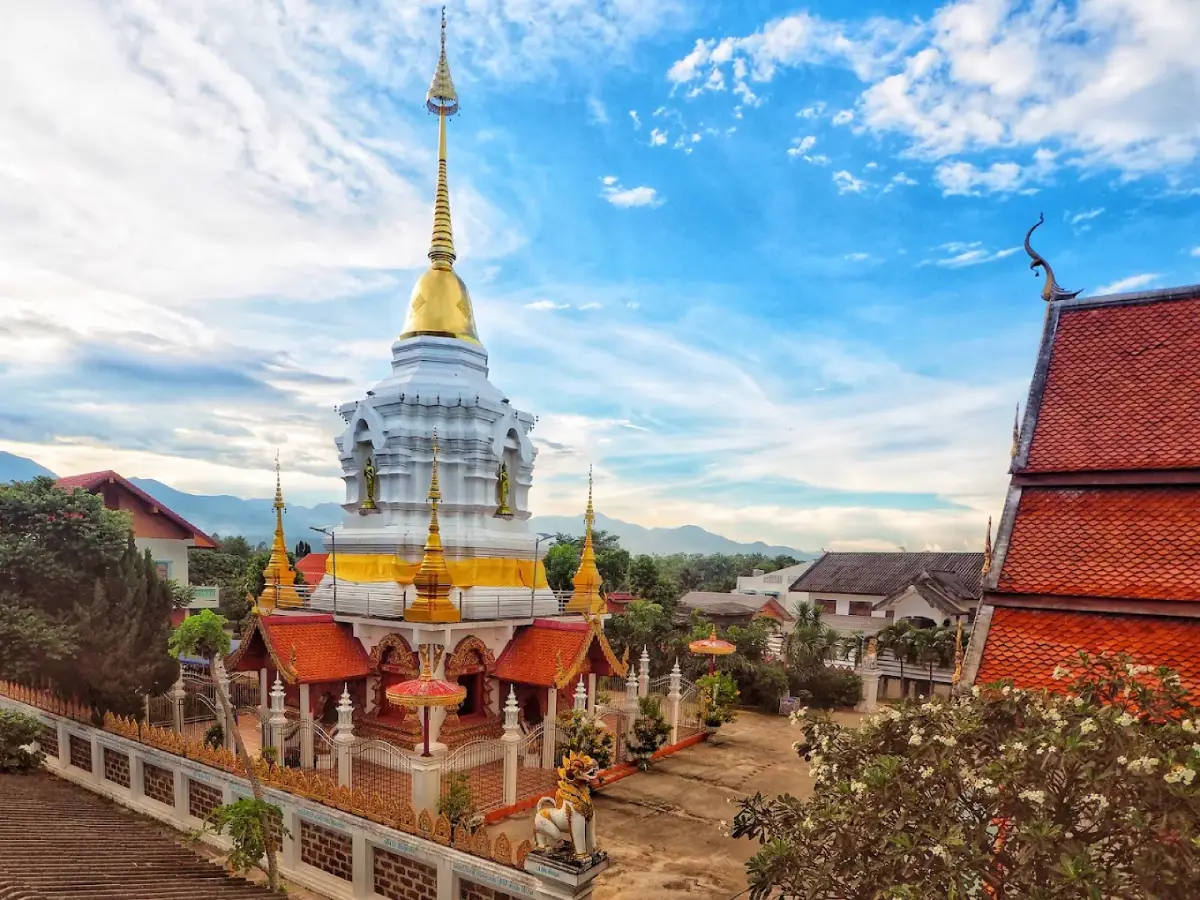
Wat Supat Naram, commonly known among local residents as Wat Ban Tha, is a historic community temple in Ban Tha, Moo 2, Pong Tam Subdistrict, Chai Prakan District, Chiang Mai Province. Affiliated with the Maha Nikaya order, the temple was established in 1922 on what had previously been public land. Two local figures, Pho Liang Intha and Luang Kam, played an important role in establishing the monastery, which was originally known as “Wat Muang Kham” before receiving its present name.
More than a century after its foundation, Wat Supat Naram remains an active Buddhist temple and a community institution. Recent local records continue to identify the temple as one of the Buddhist centres of Pong Tam Subdistrict. In November 2025, the temple was used for an official merit-making ceremony attended by Chai Prakan municipal representatives, while local planning documents published in 2026 continue to identify the temple and its facilities as important public spaces in Ban Tha.
The temple stands within Ban Tha, a community closely connected with Chotana Road and Highway 107, the main northbound route through Chai Prakan. Wat Ban Tha School is located in the same village and continues to operate as a local primary school. The close proximity of temple, school, homes and public transport reflects the traditional northern Thai pattern in which the monastery remains integrated into everyday village life.
Wat Supat Naram was founded in 1922, during a period when communities in northern Chiang Mai were still strongly organised around villages, agricultural livelihoods and Buddhist monasteries. The fact that the temple was established on public community land is significant. It reflects a collective need for a permanent religious centre where residents could make merit, listen to Buddhist teachings, hold ceremonies and gather for important community occasions.
The earliest recorded name of the temple was Wat Muang Kham. At a later stage it was renamed Wat Supat Naram, while local people continued to refer to it simply as Wat Ban Tha. This coexistence of formal and local names is common in northern Thailand, where a temple’s official ecclesiastical name may differ from the village name used in everyday speech.
Because Wat Supat Naram dates from 1922, it has now served Ban Tha for more than 100 years. The temple has witnessed major changes in Chai Prakan, including improved road access, the development of modern schools and local administration, and the transformation of Highway 107 into the principal transport corridor of northern Chiang Mai. Despite these changes, the temple remains a familiar landmark within the village.
The temple complex includes an ubosot, viharn, sermon hall, monks’ residences, chanting hall and multipurpose pavilion. Together these buildings support both the religious duties of the Sangha and the needs of local residents. The ubosot provides the sacred setting for formal monastic ceremonies, while the viharn serves as an important worship space for lay Buddhists.
The viharn is particularly noteworthy because it contains a principal Buddha image as well as mural paintings. Visitors interested in Buddhist art should spend time observing the interior rather than treating the temple as a brief photo stop. The murals add artistic and educational value to the worship space and contribute to the temple’s cultural character.
The principal Buddha image in the viharn remains a major focus of devotion for local worshippers. Wat Supat Naram also has a principal Buddha image inside the ubosot. The presence of principal images in both structures reflects the different functions of the two buildings: the ubosot is primarily associated with formal monastic ceremonies, while the viharn is more directly connected with everyday worship by the community.
Mural paintings are also recorded in one of the temple’s halls. These decorative religious works give Wat Supat Naram another layer of interest beyond the main Buddha images. They help transform community buildings into spaces that also communicate Buddhist stories, values and symbolism.
Phra Khru Phaibun Thamma Nitet has long been associated with Wat Supat Naram, and recent local administrative documents published in 2026 continue to list him as the temple’s abbot. A recent Chiang Mai Provincial Office of Buddhism record also includes his name among ecclesiastical monks receiving official support, reinforcing the temple’s continuing connection with the local Sangha administration.
Wat Supat Naram plays a role beyond daily worship. Local development documents identify both the meeting hall behind the temple and the pavilion in front of the viharn as spaces used for public activities in Moo 2. This illustrates the traditional community function of a Thai village temple: the monastery is both a sacred institution and a practical shared space.
The nearby Wat Ban Tha School further illustrates this relationship. The school serves children from early childhood through primary level and is located within the same Ban Tha community. Temple and school together form part of a long-standing social structure in which religious, educational and family life remain closely connected.
Wat Supat Naram is therefore best understood as a living community temple rather than as a large commercial tourist attraction. Its main value lies in more than a century of continuous use, its functioning Buddhist architecture and its continuing relationship with the residents of Ban Tha.
Local authorities also continue to recognise Buddhist temples as important centres of community development. Recent municipal budget documents include support for Wat Supat Naram alongside other temples in Chai Prakan, showing that the relationship between the monastery and local government remains active.
Important traditions in the wider Chai Prakan municipal area include Salak Phat merit-making, Poi Luang celebrations, Songkran, Buddhist Lent candle offerings and Loy Krathong. Temples throughout the district provide the religious and community settings in which such northern Thai traditions can continue to be transmitted between generations.
In November 2025, Wat Supat Naram hosted an official seven-day memorial merit-making ceremony involving Chai Prakan municipal representatives. The use of the temple for such an event confirms that its halls, worship areas and community spaces remain active and suitable for significant public religious ceremonies.
For visitors, the viharn and its mural paintings should be among the first features to see. The principal Buddha images in both the viharn and ubosot are also important devotional objects, while the sermon hall and shared community spaces help visitors understand how the temple operates as a functioning village institution.
A morning visit is suitable for merit-making and quiet worship, while later in the day visitors can spend more time looking at the temple buildings and murals. As Wat Supat Naram remains an active monastery, visitors should avoid disturbing monks, ceremonies or local residents using the temple grounds.
Appropriate clothing is expected. Shoulders and knees should be covered, and visitors should remove their shoes where required before entering worship buildings. Loud conversation and intrusive photography should be avoided, particularly while religious activities are taking place.
The history of the temple is also valuable for travelers interested in local settlement history. Wat Supat Naram began on public land through the efforts of Pho Liang Intha and Luang Kam and was first known as Wat Muang Kham. Its later development into the principal temple of Ban Tha reflects the way local Buddhist institutions emerged from community initiative.
The continued use of the name Wat Ban Tha is important in its own right. It preserves the direct relationship between the monastery and its village even though the official name is Wat Supat Naram. Formal and local names therefore coexist as two layers of the temple’s identity.
The temple is easily accessible from Chotana Road. Current public-transport information identifies stops at Wat Supat Naram, Wat Ban Tha School, Chai Prakan District Office and Mit Aran Market along the same transport corridor. This makes Wat Supat Naram more accessible than many rural temples located deep in mountain communities.
The temple is located at approximately 19.73747 latitude and 99.14270 longitude in Pong Tam Subdistrict. Travelers using navigation systems should search for “Wat Supat Naram, Chai Prakan” or “Wat Ban Tha, Chai Prakan” because several temples elsewhere in Thailand use similar names.
Wat Supat Naram can be combined with several other temples in the area, including Wat Pong Tam, Wat Mahingsawat, Wat Aranyawasi, Wat Pa Mai Daeng and Wat Tham Tap Tao. Visiting several temples provides a broader understanding of how individual villages within Chai Prakan developed their own Buddhist centres.
Wat Pong Tam, founded in 1918, is notable for the history of its relocation after a fire destroyed the original temple. Wat Mahingsawat, founded in 1917, preserves a Chiang Saen-style Buddha image and maintains a local sacred-relic bathing tradition. Together with Wat Supat Naram, these temples form a useful cultural route through Pong Tam Subdistrict.
Travelers who want to extend the route can continue to Wat Pa Mai Daeng or Wat Tham Tap Tao. Wat Tham Tap Tao is particularly interesting for its cave landscape, allowing travelers to combine Buddhist culture with natural surroundings.
Hinoki Land in Si Dong Yen Subdistrict offers a completely different type of attraction and can be combined with a temple route for a more varied day trip. This makes Chai Prakan suitable for travelers who want to mix local Buddhist heritage with contemporary attractions.
Food and coffee are available both in Ban Tha and along the main Chotana Road corridor. One nearby option is Unnamedcoffeeproject in Moo 2, Pong Tam, with the publicly listed telephone number +66 62 431 3239. Ros Nuea Chai Prakan is another current dining option in the district, with the telephone number +66 91 840 9200.
Accommodation is also available close to the main Chai Prakan community. Saimoonbury Resort is approximately 1.9 kilometres from Wat Supat Naram according to current hotel mapping data. Other accommodation in the district includes Chai Prakan Mansion, Antong Place, Ruen Thai Sunicha Resort, Baan Suan Khao Horm and Ban Suan Angun Sirisuk.
Getting There is straightforward by private car or rental vehicle. From Chiang Mai city, follow Highway 107, also known as Chotana Road, north through Mae Rim, Mae Taeng and Chiang Dao toward Chai Prakan District. Continue to Ban Tha, Moo 2, Pong Tam Subdistrict. Public transport also runs along the highway, with Wat Supat Naram and Wat Ban Tha School appearing as recognised stops on the route.
Wat Supat Naram is therefore a strong example of a traditional northern Thai community temple. It combines more than a century of history with a functioning ubosot, viharn, sermon hall, monks’ quarters, chanting hall and multipurpose pavilion, as well as principal Buddha images and mural paintings. More importantly, these structures remain part of everyday religious and community life.
For cultural travelers, the temple’s greatest strength is not monumental scale but continuity. The story begins with public village land, the efforts of Pho Liang Intha and Luang Kam, and the original name Wat Muang Kham. It continues through the adoption of the name Wat Supat Naram, the enduring local name Wat Ban Tha, and the temple’s present role in public religious and community activities.
A visit to Wat Supat Naram therefore offers a view of Chiang Mai beyond the famous temples of the old city. Here, travelers can see how Buddhism remains woven into village life through worship, education, local administration and community identity. Paying respect to the Buddha images, viewing the murals and continuing on to other temples in Pong Tam can provide a deeper understanding of Chai Prakan and living Lanna culture.
| Name | Wat Supat Naram |
| Local Name | Wat Ban Tha |
| Location | Ban Tha, Moo 2, Pong Tam Subdistrict, Chai Prakan District, Chiang Mai 50320, Thailand |
| Coordinates | Approximately 19.73747, 99.14270 |
| Buddhist Order | Maha Nikaya |
| Established | 1922 |
| Founders | Pho Liang Intha and Luang Kam |
| Former Name | Wat Muang Kham |
| Abbot | Phra Khru Phaibun Thamma Nitet |
| Main Structures | Ubosot, viharn, sermon hall, monks’ residences, chanting hall and multipurpose pavilion |
| Sacred Objects And Art | Principal Buddha images in the ubosot and viharn, with mural paintings in the viharn and hall |
| Community Role | Centre for merit-making, Buddhist ceremonies and community activities in Ban Tha |
| Current Status | Active Buddhist temple and community venue |
| Open Days | Daily |
| Opening Hours | 08.00 – 17.00 |
| Travel Information | Follow Highway 107 / Chotana Road north from Chiang Mai to Chai Prakan, then continue to Ban Tha, Moo 2. Private car, rental vehicle and public transport along the main highway are available. |
| Nearby Tourist Attractions | 1. Wat Pong Tam, Pong Tam Subdistrict 2. Wat Mahingsawat, Pong Tam Subdistrict 3. Wat Aranyawasi, Pong Tam Subdistrict 4. Wat Pa Mai Daeng, Tel. +66 53 457 907 5. Wat Tham Tap Tao 6. Hinoki Land |
| Nearby Restaurants And Cafés | 1. Unnamedcoffeeproject, Moo 2 Pong Tam, Tel. +66 62 431 3239 2. Ros Nuea Chai Prakan, Tel. +66 91 840 9200 3. Restaurant at Saimoonbury Resort, about 1.9 km 4. Restaurants and cafés along Chotana Road in central Chai Prakan 5. Food outlets around Mit Aran Market on the same transport corridor |
| Nearby Accommodations | 1. Saimoonbury Resort, about 1.9 km, Tel. +66 53 870 410 2. Chai Prakan Mansion, Tel. +66 53 457 911 3. Antong Place, Tel. +66 91 853 1586 4. Ruen Thai Sunicha Resort, Tel. +66 81 950 9278, +66 81 980 7936 5. Baan Suan Khao Horm, Tel. +66 52 011 497 6. Ban Suan Angun Sirisuk, Tel. +66 92 398 8884 |
Frequently Asked Questions (FAQ)
Q: Where is Wat Supat Naram located?
A: Wat Supat Naram is located in Ban Tha, Moo 2, Pong Tam Subdistrict, Chai Prakan District, Chiang Mai Province. Local residents commonly call it Wat Ban Tha.
Q: When was Wat Supat Naram established?
A: The temple was established in 1922 on land that had previously been public community land. Pho Liang Intha and Luang Kam played key roles in its foundation.
Q: What was the original name of Wat Supat Naram?
A: The temple was originally called Wat Muang Kham before being renamed Wat Supat Naram. Local residents continue to call it Wat Ban Tha.
Q: What can visitors see at Wat Supat Naram?
A: Important features include the ubosot, viharn, sermon hall, monks’ residences, chanting hall, multipurpose pavilion, principal Buddha images and mural paintings.
Q: Who is the abbot of Wat Supat Naram?
A: Recent local administrative records list Phra Khru Phaibun Thamma Nitet as the abbot of Wat Supat Naram.
Q: Is Wat Supat Naram still active?
A: Yes. The temple remains active for Buddhist worship and community activities, with recent public religious events recorded at the temple.
Q: What attractions can be combined with Wat Supat Naram?
A: Nearby options include Wat Pong Tam, Wat Mahingsawat, Wat Aranyawasi, Wat Pa Mai Daeng, Wat Tham Tap Tao and Hinoki Land.
Q: How do travelers get to Wat Supat Naram?
A: From Chiang Mai, follow Highway 107 or Chotana Road north toward Chai Prakan District and continue to Ban Tha, Moo 2, Pong Tam Subdistrict. Private car or rental vehicle is most convenient, while public transport also serves the Wat Supat Naram stop.
 Category: ●Places of Worship
 Group: ●Temple
Last Update : 6 DayAgo
 Last Update : 6 DayAgo
 Click to Access the Navigation Map GPS
 Muang Chiang Mai(121)Chom Thong(47)Mae Chaem(25)Chiang Dao(33)Doi Saket(68)Mae Taeng(85)Mae Rim(69)Samoeng(29)Fang(71)Mae Ai(59)Phrao(70)San Pa Tong(103)San Kamphaeng(66)San Sai(73)Hang Dong(73)Hot(32)Doi Tao(22)Omkoi(11)Saraphi(74)Wiang Haeng(15)Chai Prakan(28)Mae Wang(32)Mae On(22)Doi Lo(33)Galyani Vadhana(1)


