
lovethailand home >North Travel Attractions >Chiang Mai Travel Attractions >Chiang Dao >Thung Khao Phuang > Wat Huai Tin Tang (Wat Phra That Si Samrak)
TL;DR: Wat Huai Tin Tang (Wat Phra That Si Samrak) is located at Ban Huai Tin Tang, Moo 7, Thung Khao Phuang Subdistrict, Chiang Dao District, Chiang Mai Province, open Daily, hours 08.00 - 16.30.
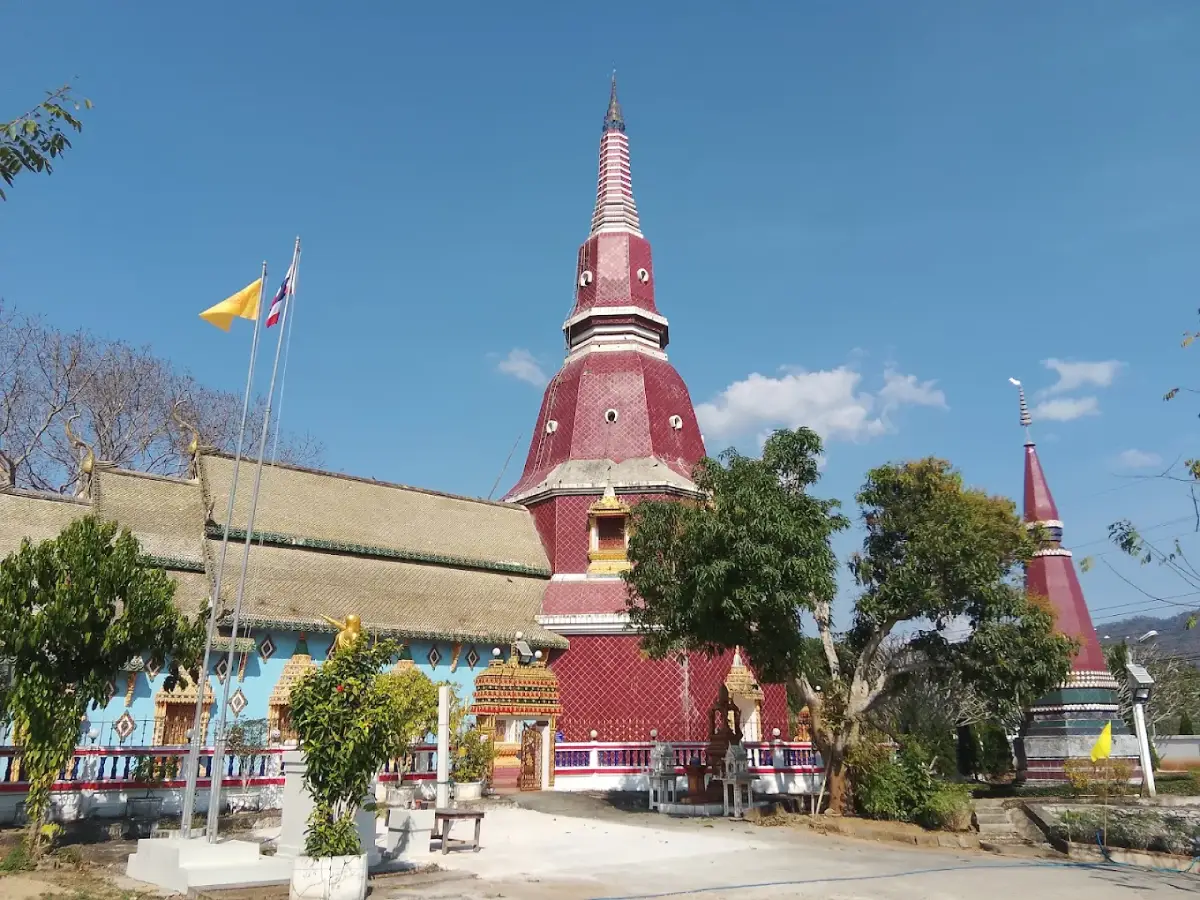
Wat Huai Tin Tang (Wat Phra That Si Samrak)
Open Days: Daily
Opening Hours: 08.00 - 16.30
Wat Huai Tin Tang, also known locally in tourism contexts as Wat Phra That Si Samrak, is located in Ban Huai Tin Tang, Moo 7, Thung Khao Phuang Subdistrict, Chiang Dao District, Chiang Mai Province. It is a local Buddhist temple under the Maha Nikaya order and an important spiritual landmark for the Ban Huai Tin Tang community. The temple is closely connected with local Buddhist faith, the story of Phra That Si Samrak, the historical memory of King Naresuan the Great, mural paintings related to military campaigns, and the rural landscape of northern Chiang Dao.
Wat Huai Tin Tang is a quiet community temple suitable for merit-making, paying respect to Phra That Si Samrak, learning about local history, and exploring the cultural side of Thung Khao Phuang. The temple was officially established in 1989 and received Wisungkhamsima in 2007. The current abbot is Phra Somchai Kantosobhano. Its main appeal lies in its role as a living village temple, its sacred stupa, its story linked to King Naresuan the Great, and its location on a route that can be combined with viewpoints, temples, Chiang Dao Cave, and other attractions in Chiang Dao District.
Ban Huai Tin Tang is a village in Thung Khao Phuang Subdistrict, a rural area of Chiang Dao where farmland, mountain views, local settlements, and Buddhist temples remain closely connected. The landscape around the temple gives visitors a different impression from well-known temples in Chiang Mai city. Wat Huai Tin Tang is not a large commercial tourist temple. It is a community temple where local people continue to use the site for worship, merit-making, ceremonies, and village religious life.
Within the wider context of Thung Khao Phuang, Wat Huai Tin Tang is recognized as a Buddhist cultural learning site. This makes the temple valuable not only for religious practice but also for understanding the social and cultural identity of the area. Temples in rural northern Thailand often serve as spiritual centers, gathering places, and memory keepers for the village. Wat Huai Tin Tang follows this pattern, connecting residents with Buddhism, local history, and the stories passed down in the community.
The temple was officially permitted to be established in 1989, during a period when the local community and religious infrastructure of Thung Khao Phuang were becoming more formally organized. Receiving official temple status allowed Wat Huai Tin Tang to function clearly within the Thai Sangha system and to support Buddhist activities for the community. In 2007, the temple received Wisungkhamsima, an important recognition that gives a temple an official boundary for formal monastic acts.
Wisungkhamsima is significant in Thai Buddhism because it defines the sacred boundary used for certain monastic ceremonies. For Wat Huai Tin Tang, receiving Wisungkhamsima marks the development of the temple from a village place of worship into a formally recognized Buddhist temple with a stronger institutional role. This milestone also shows the continuing faith and support of the Ban Huai Tin Tang community.
Wat Huai Tin Tang is also closely associated with the name Wat Phra That Si Samrak, which appears in local learning and travel sources. Phra That Si Samrak is the temple’s key sacred feature and gives the site a clear cultural and historical identity. For visitors, this name is important because it connects the temple with the stupa, local beliefs, and historical narratives that are promoted in the Thung Khao Phuang travel route.
The temple’s story is connected with King Naresuan the Great. Local accounts describe the site as part of the king’s route during a military campaign, with a tradition that Maha Thera Kanchong was ordered to establish the temple. This story gives Wat Huai Tin Tang a stronger historical character than many ordinary village temples and links the site to one of Thailand’s most important royal figures.
The area of the temple is also associated with old religious remains, sacred relic traditions, and later reconstruction. Stories connected with Phra That Si Samrak mention relics associated with Princess Suphankalaya and evidence of older structures such as laterite and brick remains. These elements give the temple a layered identity: part active community temple, part historical memory site, and part sacred place of worship.
Phra That Si Samrak is the main point of devotion for many visitors. It is connected with respect for King Naresuan the Great, King Ekathotsarot, and Princess Suphankalaya. The name “Si Samrak” carries a sense of reverence and protection, and the stupa functions as a symbolic focus for the temple’s faith and local identity.
Another important feature is the mural painting connected with the military journey of King Naresuan the Great. These murals help visitors understand the historical narrative of the temple in visual form. They are not merely decorative works. They act as a storytelling medium that links Buddhist space, local memory, and national history in one place.
Wat Huai Tin Tang remains a spiritual center for Ban Huai Tin Tang. In rural communities, temples often support merit-making, annual religious activities, Buddhist holy days, community gatherings, and the transmission of local tradition. The temple therefore functions as both a sacred site and a social institution. Visitors who understand this context will appreciate the temple more deeply than those who see it only as a sightseeing stop.
Phra Somchai Kantosobhano, the abbot of Wat Huai Tin Tang, plays an important role in maintaining the temple’s religious function and community presence. The presence of resident monks ensures that the temple continues to serve local people through worship, ceremonies, Buddhist teaching, and care for the sacred spaces within the temple grounds.
The atmosphere around Wat Huai Tin Tang is calm, rural, and natural. The village sits along a local route where visitors can still see agricultural landscapes, mountain surroundings, and the quieter side of Chiang Dao. A visit to this temple is best approached slowly. Instead of rushing for photographs, travelers should take time to pay respect, observe the stupa, read the history of the site, and understand how the temple fits into village life.
Visitors should dress respectfully, speak quietly, and behave with care around the stupa, murals, and monastic areas. As Wat Huai Tin Tang is an active religious site, travelers should avoid disturbing monks or local worshippers. Photography should be done politely, especially near sacred objects or during religious activities.
Getting There is most convenient by private car. From Chiang Dao District, take Highway 107 toward the Mueang Ngai junction, then turn onto Highway 1178 toward Thung Khao Phuang and Ban Huai Tin Tang. The distance from Chiang Dao District Office to the Ban Huai Tin Tang area is about 21 km. Daytime travel is recommended because the rural road, junctions, and village signs are easier to follow.
The temple can be included in a half-day cultural route through Thung Khao Phuang. Travelers can visit Wat Huai Tin Tang, the Thung Khao Phuang viewpoint, and Wat Phra That Doi Mon Ching in the same trip. With more time, the route can be extended toward Wat Phra Bat Roi Wua, Chiang Dao Cave, Wat Tham Pha Plong, Doi Luang Chiang Dao, and restaurants or accommodations in Chiang Dao town.
Wat Huai Tin Tang is suitable for travelers interested in community temples, local Buddhist culture, rural Lanna history, and quieter travel routes in Chiang Dao. The temple shows that Chiang Dao is not only about mountains and caves. It is also a district with living villages, sacred places, historical memories, and Buddhist landmarks that continue to shape local identity.
In conclusion, Wat Huai Tin Tang is a Maha Nikaya community temple with strong religious, historical, and cultural value. Its highlights include Phra That Si Samrak, the story of King Naresuan the Great, murals related to the royal military journey, and its continuing role as the spiritual center of Ban Huai Tin Tang. For travelers who want to understand Chiang Dao beyond its famous natural attractions, this temple is a meaningful stop on the cultural route through Thung Khao Phuang.
| Name | Wat Huai Tin Tang, also known as Wat Phra That Si Samrak |
| Location | Ban Huai Tin Tang, Moo 7, Thung Khao Phuang Subdistrict, Chiang Dao District, Chiang Mai Province |
| Address | Moo 7, Ban Huai Tin Tang, Thung Khao Phuang Subdistrict, Chiang Dao District, Chiang Mai 50170, Thailand |
| Coordinates | 19.5356, 98.9616 |
| Temple Type | Local Buddhist temple under the Maha Nikaya order |
| Highlights | Phra That Si Samrak, the story of King Naresuan the Great, mural paintings, and the quiet village atmosphere of Ban Huai Tin Tang |
| History | Officially established as a temple in 1989 and granted Wisungkhamsima in 2007 |
| Name Origin | The name comes from Ban Huai Tin Tang, while Wat Phra That Si Samrak is used in local cultural and travel contexts |
| Distinctive Features | A community temple combining Buddhist worship, local history, sacred stupa traditions, and the Thung Khao Phuang cultural route |
| Travel Information | From Chiang Dao District, take Highway 107 to the Mueang Ngai junction, then continue on Highway 1178 toward Ban Huai Tin Tang. The distance from Chiang Dao District Office is about 21 km. |
| Current Status | An active registered Buddhist temple and a Buddhist cultural learning site in Ban Huai Tin Tang |
| Open Days | Daily |
| Opening Hours | 08.00 - 16.30 |
| Main Areas / Zones | Phra That Si Samrak worship area, main Buddhist activity area, and viewpoint atmosphere around Ban Huai Tin Tang |
| Abbot / Caretaker | Phra Somchai Kantosobhano |
| Local Travel Contact | Thung Khao Phuang Municipality, Tel. 053-045120 |
| Nearby Tourist Attractions | 1. Thung Khao Phuang Viewpoint, about 1 km 2. Wat Phra That Doi Mon Ching, about 3 km 3. Wat Phra Bat Roi Wua, Ban Huai Pao, about 8 km 4. Doi Kham Fa, about 25 km 5. Chiang Dao Cave, about 24 km |
| Nearby Restaurants | 1. Sanae Doi Luang Chiang Dao, about 12 km, Tel. 081-111-7219 2. The Terrace, about 13 km 3. Doi Mek Coffee, about 20 km 4. Chiang Dao Nest 1 Restaurant, about 24 km, Tel. 053-456-612 5. The Cave Bar, about 24 km |
| Nearby Accommodations | 1. Azalea Village Wellness Resort & Residence, about 14 km, Tel. 053-456-168, 086-359-4244 2. Aurora Resort Chiangdao, about 14 km, Tel. 053-456-928 3. Malee's Nature Lovers Bungalows, about 24 km, Tel. 081-961-8387 4. Chiang Dao Hut, about 24 km 5. Chiang Dao Nest, about 24 km, Tel. 053-456-612 |
Frequently Asked Questions (FAQ)
Q: Where is Wat Huai Tin Tang located?
A: Wat Huai Tin Tang is located in Ban Huai Tin Tang, Moo 7, Thung Khao Phuang Subdistrict, Chiang Dao District, Chiang Mai Province.
Q: Is Wat Huai Tin Tang the same place as Wat Phra That Si Samrak?
A: Local learning and travel sources refer to Wat Phra That Si Samrak together with Wat Huai Tin Tang, located in Ban Huai Tin Tang, Moo 7.
Q: Why is Wat Huai Tin Tang important?
A: The temple is important as a Maha Nikaya community temple with Phra That Si Samrak, a story linked to King Naresuan the Great, and murals related to the royal military journey.
Q: Who is the abbot of Wat Huai Tin Tang?
A: The abbot is Phra Somchai Kantosobhano.
Q: What are the opening hours of Wat Huai Tin Tang?
A: The temple is open daily from 08.00 to 16.30.
Q: How can travelers get to Wat Huai Tin Tang?
A: From Chiang Dao District, take Highway 107 to the Mueang Ngai junction, then continue on Highway 1178 toward Ban Huai Tin Tang in Thung Khao Phuang Subdistrict.
Q: What nearby places can be visited with Wat Huai Tin Tang?
A: Nearby places include Thung Khao Phuang Viewpoint, Wat Phra That Doi Mon Ching, Wat Phra Bat Roi Wua, Chiang Dao Cave, and other cultural routes in Chiang Dao.
 Category: ●Places of Worship
 Group: ●Temple
Last Update : 1 DayAgo
 Last Update : 1 DayAgo
 Click to Access the Navigation Map GPS
Wat Huai Tin Tang (Wat Phra That Si Samrak) Map
Recommend

 Muang Chiang Mai(121)Chom Thong(47)Mae Chaem(25)Chiang Dao(33)Doi Saket(68)Mae Taeng(85)Mae Rim(69)Samoeng(29)Fang(71)Mae Ai(62)Phrao(70)San Pa Tong(105)San Kamphaeng(66)San Sai(73)Hang Dong(74)Hot(32)Doi Tao(22)Omkoi(11)Saraphi(74)Wiang Haeng(15)Chai Prakan(28)Mae Wang(32)Mae On(22)Doi Lo(34)Galyani Vadhana(1)


