
lovethailand home >North Travel Attractions >Chiang Mai Travel Attractions >Chom Thong >Ban Luang > Wat Mueang Klang
TL;DR: Wat Mueang Klang is located at Moo 11, Ban Mueang Klang, Chom Thong–Inthanon Road, Ban Luang Subdistrict, Chom Thong District, Chiang Mai Province, open Daily, hours 08.00 - 17.00.
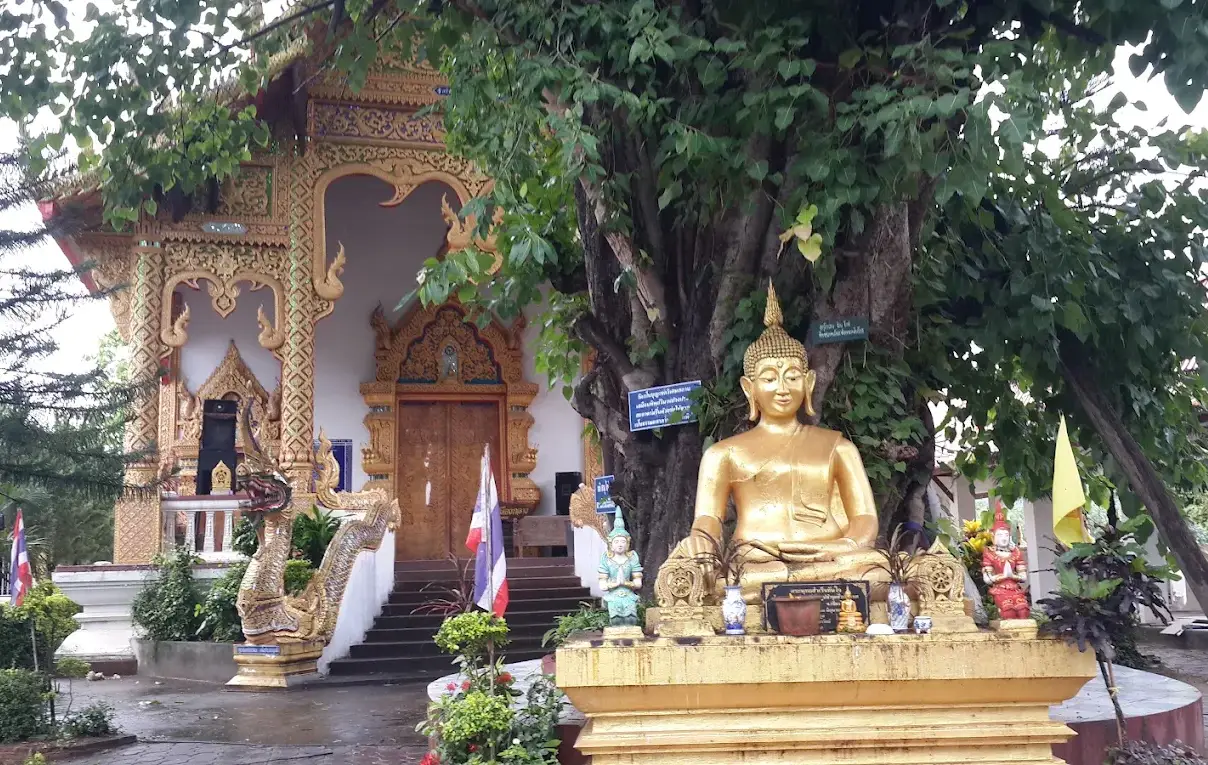
Wat Mueang Klang
Open Days: Daily
Opening Hours: 08.00 - 17.00
Wat Mueang Klang is located in Moo 11, Chom Thong–Inthanon Road, Ban Luang Subdistrict, Chom Thong District, Chiang Mai Province, postal code 50160. It is a community Buddhist temple under the Mahanikaya order and covers about 10 rai. The temple was founded in 1657 on the former palace compound of Princess Thorom, a daughter of Phraya Rawi. Before her passing, she asked the villagers to build a temple at this place, and the community later established the temple known today as Wat Mueang Klang.
Wat Mueang Klang is more than a village temple. Its name, history, and location connect it with the memory of an old settlement in Ban Luang. The name “Mueang Klang” suggests a central town or a place once regarded as important within the local landscape. For travelers interested in northern Thai culture, the temple offers a meaningful view of how local history, Buddhist faith, and community memory are preserved through a living temple.
Ban Luang Subdistrict is one of the important cultural areas of Chom Thong District. It contains old community temples, major Buddhist sites, agricultural communities, Mae Klang Waterfall, and the route toward Doi Inthanon. Wat Mueang Klang, located in Moo 11, is part of this wider religious landscape. A visit here helps travelers understand that Chom Thong is not only about famous temples or mountain attractions, but also about smaller community temples that preserve local stories and village identity.
The temple’s origin is closely connected with Princess Thorom and the old palace compound. Local tradition says that before her passing, she asked the villagers to build a temple on this site. The villagers later followed her wish and established Wat Mueang Klang. This story gives the temple a strong cultural meaning because it shows how a religious site can grow from memory, respect, and community devotion.
Wat Mueang Klang was founded in 1657, making it one of the older community temples in the Chom Thong area. Its long history shows that Ban Luang has maintained Buddhist faith and community religious life for many generations. Even though detailed early records of many village temples are limited, the continued role of Wat Mueang Klang reflects the strength of local devotion and the importance of temples in northern Thai village life.
The temple received royal Wisungkhamsima on 2 August 1946. Wisungkhamsima is the consecrated boundary granted for important monastic acts according to Buddhist discipline. This confirms the temple’s formal religious status and its ability to support proper Sangha ceremonies. For a community temple, receiving Wisungkhamsima is an important marker of religious completeness.
As a Mahanikaya community temple, Wat Mueang Klang is closely tied to local people. Community temples in northern Thailand often serve as centers for merit-making, sermons, Buddhist ceremonies, funerals, seasonal festivals, education, public meetings, and community activities. Wat Mueang Klang therefore functions not only as a place of worship, but also as a shared space for Ban Mueang Klang and nearby communities.
The temple’s main structures include the ubosot, sermon hall, and monks’ quarters. Its sacred objects include Buddha images and a chedi. These features allow the temple to support both monastic and community functions. The ubosot is central to Sangha ceremonies, the sermon hall supports merit-making and gatherings, the monks’ quarters support monastic residence, and the Buddha images and chedi serve as devotional focal points for villagers and visitors.
The Buddha images inside Wat Mueang Klang are important not only as religious art, but also as objects of daily devotion. Villagers and visitors come to pay respect, make merit, and reflect on Buddhist teachings. The chedi also gives the temple a strong spiritual center, symbolizing faith, remembrance, and continuity. Together, these sacred features make the temple a living place of worship rather than a simple historical site.
Wat Mueang Klang also has an educational and social role. The temple has been associated with Dhamma and Pali education, an early childhood center within the temple, a public training unit for the subdistrict, and the use of temple space for community meetings. These roles reflect the wider function of Lanna temples, where religion, education, social development, and community organization often come together.
The presence of Dhamma and Pali education is especially meaningful because these subjects form the foundation of monastic learning. At the same time, the temple’s role in early childhood and public training shows that its influence extends beyond monks to laypeople, families, children, and the wider community. Wat Mueang Klang is therefore best understood as both a religious site and a community institution.
The atmosphere of Wat Mueang Klang is quiet and local. Visitors should not expect a large commercial tourist attraction. Instead, the temple is best approached as an old community temple with a specific local story, active religious use, and a calm village setting. Travelers who appreciate slow cultural travel will find this temple valuable because it reveals a less crowded and more grounded side of Chom Thong.
Wat Mueang Klang can be included in a Ban Luang temple route. Nearby sites include Wat Phra That Si Chom Thong Worawihan, Wat Phrabat, Wat Phra Koet, Wat Nam Lat, Wat Nam Tok Mae Klang, and Wat Nam Tong. Such a route allows visitors to see the diversity of Buddhist sites in the same district, from major sacred temples to local village temples with unique histories and community functions.
Religious traditions connected with Wat Mueang Klang include Buddhist holy-day merit-making, food offerings to monks, sermons, Kathin, robe-offering ceremonies, memorial merit-making, Buddhist festival days, and community activities. These events keep the temple active as a social and spiritual center. They also allow villagers to support the temple, maintain buildings, dedicate merit, and strengthen community bonds.
For cultural travelers, Wat Mueang Klang is valuable because it combines several important elements: an old founding date, a story connected with Princess Thorom, Mahanikaya temple status, royal Wisungkhamsima, key temple structures, sacred objects, and an educational role in the community. These details make the temple suitable for a deeper travel route rather than a short sightseeing stop.
Getting There is most convenient by private car. From Chiang Mai city, take Highway 108, the Chiang Mai–Hot route, toward Chom Thong District. From Chom Thong, continue into Ban Luang Subdistrict and Moo 11, Ban Mueang Klang, via local roads. Travelers without a private car can take a bus to Chom Thong and then arrange local transport. A private vehicle is recommended for visitors who want to combine the temple with Wat Phra That Si Chom Thong, Mae Klang Waterfall, or the Doi Inthanon route.
The temple is open daily from 08.00 to 17.00. The best time to visit is in the morning or afternoon, when the weather is more comfortable. Visitors should dress modestly, speak quietly, avoid disturbing monks or villagers, and avoid entering monks’ private areas without permission. If a merit-making event or ceremony is taking place, follow local guidance and respect the religious atmosphere.
Wat Mueang Klang is suitable for travelers interested in old temples, local history, village Buddhism, and cultural routes in Chom Thong. It gives visitors a chance to see a community temple that has carried local memory for centuries and continues to function as a Buddhist and social center for Ban Luang.
In summary, Wat Mueang Klang is an old Mahanikaya community temple in Moo 11, Ban Luang Subdistrict, Chom Thong District, Chiang Mai Province. It was founded in 1657 on the former palace compound of Princess Thorom and received royal Wisungkhamsima on 2 August 1946. The temple includes the ubosot, sermon hall, monks’ quarters, Buddha images, and a chedi, and has long served religious, educational, and community roles. It is a meaningful stop for travelers who want to understand the cultural depth of Ban Luang and Chom Thong.
| Name | Wat Mueang Klang |
| Location | Moo 11, Ban Mueang Klang, Chom Thong–Inthanon Road, Ban Luang Subdistrict, Chom Thong District, Chiang Mai Province |
| Address | Moo 11, Ban Luang Subdistrict, Chom Thong District, Chiang Mai 50160, Thailand |
| Temple Type | Community Buddhist temple under the Mahanikaya order |
| Area | 10 rai |
| History | Founded in 1657 on the former palace compound of Princess Thorom and granted royal Wisungkhamsima on 2 August 1946. |
| Abbot | Phra Athikan Sawat Thawaro |
| Highlights | An old community temple connected with Princess Thorom, Phraya Rawi, and the former local palace compound of Ban Mueang Klang. |
| Sacred Objects / Key Features | Buddha images and a chedi within the temple grounds. |
| Main Areas And Buildings | Ubosot, sermon hall, monks’ quarters, Buddha image area, chedi area, and community activity spaces. |
| Name Origin | The name “Mueang Klang” is connected with the old palace area and the local memory of Ban Mueang Klang in Ban Luang Subdistrict. |
| Community Role | A community temple used for Buddhist ceremonies, merit-making, public training, education, and village activities. |
| Related Traditions | Buddhist holy-day merit-making, food offerings, sermons, Kathin, robe-offering ceremonies, memorial merit-making, Buddhist festival days, and Ban Luang community activities. |
| Travel Information | From Chiang Mai city, take Highway 108 toward Chom Thong, then continue into Ban Luang Subdistrict and Moo 11, Ban Mueang Klang. Private car is the most convenient option. |
| Current Status | The temple continues to appear in Mahanikaya temple listings and religious-site information for Ban Luang Subdistrict, Chom Thong District, Chiang Mai Province. |
| Open Days | Daily |
| Opening Hours | 08.00 - 17.00 |
| Nearby Tourist Attractions | 1. Wat Phra That Si Chom Thong Worawihan, about 7 km, Tel. 053-342184 2. Wat Phrabat, about 8 km 3. Wat Phra Koet, about 9 km 4. Mae Klang Waterfall, about 12 km 5. Doi Inthanon National Park, about 30 km |
| Nearby Restaurants | 1. Khon Mueang Chom Thong, about 7 km, Tel. 081-8858851 2. Food Center near Wat Phra That, about 7 km, Tel. 090-7588224 3. Krua Fueang Fa, about 8 km, Tel. 053-341274, 086-1825031 4. Pa Oi Krua Rim Than, about 18 km 5. Ban Hom Doi Inthanon Restaurant, about 20 km |
| Nearby Accommodations | 1. Chom Thong Boutique House, about 8 km, Tel. 081-5829889 2. Smile Place Chom Thong, about 9 km, Tel. 065-7538313 3. Touch Star Resort Doi Inthanon, about 12 km, Tel. 092-4194142, 097-4491415, 053-033594 4. Suan Sook Homestay Resort, about 12 km 5. Rim Na Ban Phak, about 28 km |
Frequently Asked Questions (FAQ)
Q: Where is Wat Mueang Klang located?
A: Wat Mueang Klang is located in Moo 11, Ban Mueang Klang, Ban Luang Subdistrict, Chom Thong District, Chiang Mai Province, Thailand.
Q: What are the opening days and hours of Wat Mueang Klang?
A: Wat Mueang Klang is open daily from 08.00 to 17.00.
Q: What is the historical importance of Wat Mueang Klang?
A: Wat Mueang Klang was founded in 1657 on the former palace compound of Princess Thorom and later received royal Wisungkhamsima on 2 August 1946.
Q: Who is associated with the origin story of Wat Mueang Klang?
A: The temple’s origin story is associated with Princess Thorom, a daughter of Phraya Rawi, who asked the villagers to build a temple at this site.
Q: What important buildings and sacred objects are inside Wat Mueang Klang?
A: Important features include the ubosot, sermon hall, monks’ quarters, Buddha images, and a chedi.
Q: Who is the abbot of Wat Mueang Klang?
A: The abbot of Wat Mueang Klang is Phra Athikan Sawat Thawaro.
Q: How can visitors get to Wat Mueang Klang?
A: From Chiang Mai city, take Highway 108 toward Chom Thong, then continue into Ban Luang Subdistrict and Moo 11, Ban Mueang Klang. A private car is the most convenient option.
Q: What nearby places can be combined with a visit to Wat Mueang Klang?
A: Visitors can combine the trip with Wat Phra That Si Chom Thong Worawihan, Wat Phrabat, Wat Phra Koet, Mae Klang Waterfall, and the Doi Inthanon route.
 Category: ●Places of Worship
 Group: ●Temple
Last Update : 2 DayAgo
 Last Update : 2 DayAgo
 Click to Access the Navigation Map GPS
 Muang Chiang Mai(121)Chom Thong(47)Mae Chaem(25)Chiang Dao(33)Doi Saket(68)Mae Taeng(85)Mae Rim(69)Samoeng(29)Fang(71)Mae Ai(62)Phrao(70)San Pa Tong(105)San Kamphaeng(66)San Sai(73)Hang Dong(74)Hot(32)Doi Tao(22)Omkoi(11)Saraphi(74)Wiang Haeng(15)Chai Prakan(28)Mae Wang(32)Mae On(22)Doi Lo(34)Galyani Vadhana(1)


