
lovethailand home >North Travel Attractions >Chiang Mai Travel Attractions >Chom Thong >Ban Luang > Wat Nam Tong
TL;DR: Wat Nam Tong is located at Moo 10, Ban Mae Hoi, Ban Luang Subdistrict, Chom Thong District, Chiang Mai Province.

Wat Nam Tong
Operating day: Daily
Operating time: 08.00 - 17.00
Wat Nam Tong is located in Moo 10, Ban Mae Hoi, Ban Luang Subdistrict, Chom Thong District, Chiang Mai Province. It is a community Buddhist temple under the Mahanikaya order and an important religious site near Mae Klang Waterfall and the foothill route to Doi Inthanon. The temple was officially permitted to be established on the 28th day of the month in 2000, according to the source information provided. Today, it continues to appear in temple listings for Ban Luang Subdistrict, Chom Thong District, Chiang Mai Province.
Wat Nam Tong is more than a small village temple. It has a layered story that includes an old temple site, a long period of abandonment, later restoration, Sunday Buddhist education, public training activities, Lanna-style temple architecture, and a chedi built through local devotion. Its location in Ban Mae Hoi, close to Mae Klang Waterfall and the Doi Inthanon route, makes it a meaningful stop for travelers who want to combine nature, Buddhist culture, and local community life in one route.
Temple listing data identifies Wat Nam Tong as a Mahanikaya temple in Moo 10, Ban Mae Hoi, Ban Luang Subdistrict, Chom Thong District, Chiang Mai Province. Local travel information describes the temple as being near Mae Klang Waterfall and as one of the attractive Lanna-style temples in Chom Thong. This makes the temple useful not only for worship, but also for understanding the cultural landscape around Doi Inthanon’s foothill communities.
The name “Wat Nam Tong” comes from a stream on the western side of the temple. The stream originates from the Doi Inthanon highlands and flows forcefully against the temple-side bank. This natural feature gave rise to the name “Nam Tong.” The name therefore preserves the temple’s relationship with water, mountain geography, and the natural environment of Ban Mae Hoi.
The temple’s background is linked with stories that go back to the era of Queen Chamathewi. The present site is said to have once been associated with a military camp of Aravi city or Mueang Kang. The old temple was formerly known as Wat Aranyawat before it fell into abandonment. Around 1932, as more people settled in the area, the temple was restored. This local history gives Wat Nam Tong a deeper cultural identity than a newly built community temple.
During the restoration period, Luang Pu Tue Achalathammo is mentioned as having stayed at the temple. Later, in 1934, Luang Pho Sut also stayed there. At that time, the area was still forested, difficult for villagers to access, and affected by malaria. In 1935, temple activity moved to the new location that is now Wat Nam Tok Mae Klang. After that, the old Wat Nam Tong site remained abandoned for a long period before being revived in more recent times by Phra Baidika Boonrat Ratanawanno.
The restoration by Phra Baidika Boonrat Ratanawanno is central to the modern story of Wat Nam Tong. Through his efforts, the temple became beautiful, clean, orderly, and peaceful again. The revival shows how a temple can return to life through monastic dedication and community faith. Wat Nam Tong is therefore significant not only because of its old stories, but also because of the renewed role it plays in Ban Mae Hoi today.
The viharn of Wat Nam Tong is known for its adapted Lanna style. Its doors are decorated with gold-lined celestial worship figures, creating a refined northern Thai artistic atmosphere. Inside the viharn, the main sacred image is Luang Pho Yai. This makes the viharn both an artistic space and a devotional center for villagers and visitors.
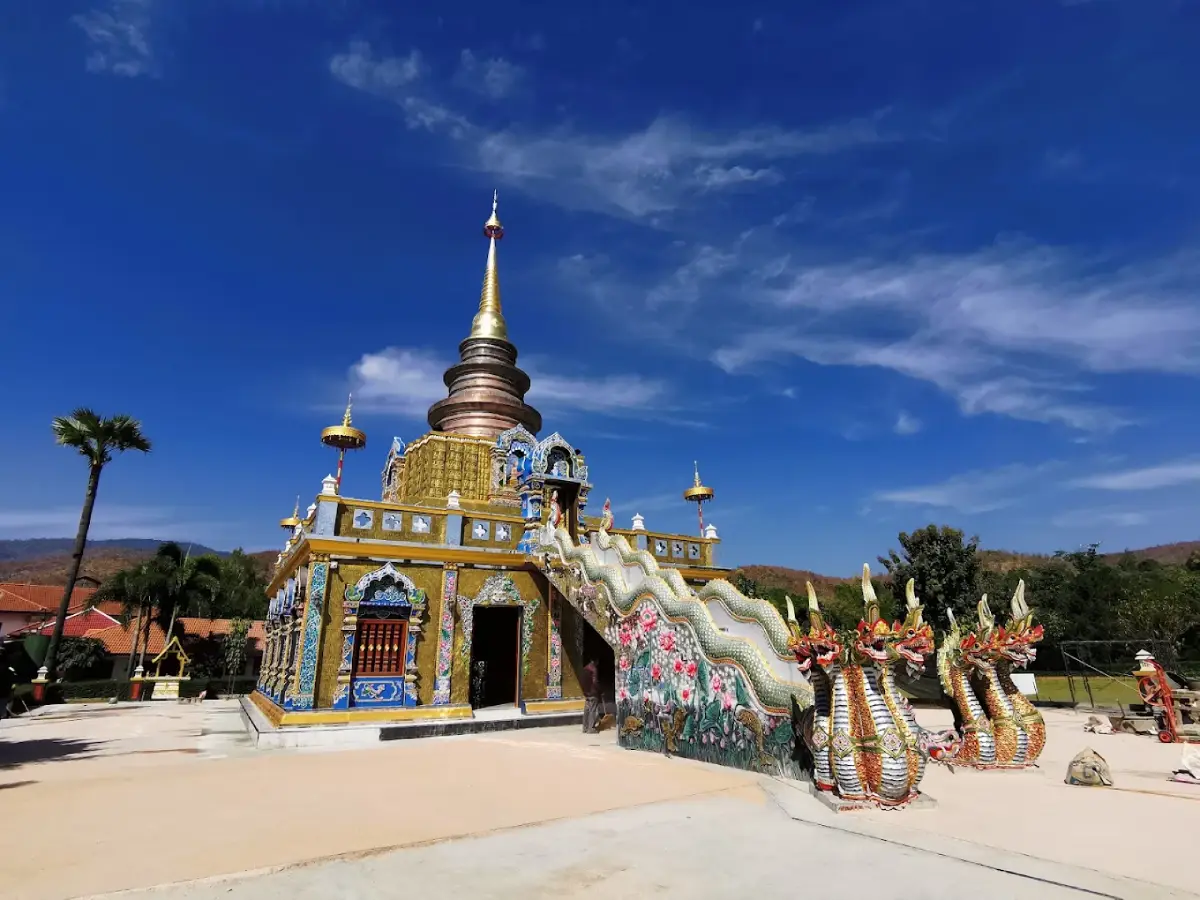
Another important landmark is Phra That Chedi Siriwatthana Nam Tong. The chedi is a two-storey structure. Its foundation stone was laid on 16 November 2013, with Phra Thammamangkhalachan, adviser to the Region 7 Sangha and abbot of Wat Phra That Si Chom Thong Worawihan, presiding over the ceremony. The chedi later became one of the temple’s most important religious features.
The upper part of the chedi enshrines Buddha relics, while the lower part preserves old Buddha images and old blue-and-white ceramics collected by the abbot. These elements make the chedi not only a sacred structure, but also a place of learning and preservation. The temple also has a hall for paying respect to former teachers and revered masters, adding another devotional space for visitors.
Wat Nam Tong received the “Wat Ngam Ta Pracha Chuen Chai” or 5S temple development award from the Chiang Mai Sangha in 2009. The 5S idea promotes order, convenience, cleanliness, standardization, and discipline within temple spaces. In this context, the award reflects the temple’s effort to become a clean, organized, and spiritually suitable place for the community.
The Sunday Buddhist Education Center at Wat Nam Tong is one of the temple’s most important community roles. The center began operating in 2010, with Phra Baidika Boonrat Ratanawanno serving as its director. It has a committee of six appointed members and five teachers or instructors. The center has had an average of around 30 students per academic year, showing that the temple supports youth education as well as religious practice.
The center teaches Dhamma studies at the elementary, intermediate, and advanced levels. It also offers cultural subjects such as traditional music, Mong Seing drumming, handicrafts, banana-leaf work, and folk sports. This combination allows students to learn Buddhist principles together with local Lanna culture. The temple therefore acts as a bridge between religion, local wisdom, and community identity.
Students from the Sunday Buddhist Education Center take part in many temple and community activities. These include Buddhist holy days, important royal commemorative days, and community events. Through this participation, students do not only learn Dhamma in a classroom; they also learn how to support the temple, respect tradition, and take part in public community life.
Wat Nam Tong also functions as a public training unit for Ban Luang Subdistrict. This role reflects the traditional Thai relationship between home, temple, and school. The temple supports moral learning, cultural activities, youth development, and community participation. For that reason, Wat Nam Tong should be understood as both a religious site and an educational community space.
The temple’s natural setting is another major attraction. Wat Nam Tong is surrounded by forested hills and a calm, clean, shaded atmosphere. The temple feels suitable for worship, reflection, and slow travel. Visitors passing toward Mae Klang Waterfall or Doi Inthanon can use Wat Nam Tong as a peaceful cultural stop that adds spiritual depth to a nature-focused trip.
Religious and community activities associated with Wat Nam Tong include Buddhist holy-day merit-making, important Buddhist festivals, Kathin, robe-offering ceremonies, Sunday Buddhist education, public training activities, and community events in Ban Luang. These activities keep the relationship between monks, youth, families, and villagers active throughout the year.
Getting There is most convenient by private car. From Chiang Mai city, take Highway 108 toward Chom Thong District, then continue into Ban Luang Subdistrict and Ban Mae Hoi. The temple is located near Mae Klang Waterfall and the foothill route toward Doi Inthanon. Travelers without private transport can take a bus from Chiang Mai to Chom Thong, then arrange local transport. Planning ahead is recommended because the temple is in a foothill village area rather than on a high-frequency city transport route.
A visit to Wat Nam Tong can be combined with Mae Klang Waterfall, Wat Nam Tok Mae Klang, Wat Phra That Si Chom Thong Worawihan, Wachirathan Waterfall, and Doi Inthanon National Park. This route gives travelers a more complete view of Chom Thong: not only waterfalls and mountains, but also a restored community temple, Buddhist education, Lanna art, and village life in Ban Mae Hoi.
Visitors should dress modestly, speak quietly, and avoid disturbing monks, students, or villagers using the temple. Do not enter monks’ private areas without permission. If Sunday Buddhist classes or community activities are taking place, visitors should respect the learning environment and follow local guidance.
The strength of Wat Nam Tong as a cultural travel destination is its range of stories. It has an old temple background, revival by Phra Baidika Boonrat Ratanawanno, Lanna-style architecture, Luang Pho Yai, Phra That Chedi Siriwatthana Nam Tong, Buddha relics, old Buddha images, preserved ceramics, a teachers’ memorial hall, a 5S temple development award, and a Sunday Buddhist Education Center. These details make the temple suitable for a deep cultural article rather than a short listing.
No publicly verified information confirms a fixed admission fee for general visitors. Travelers may visit respectfully and make merit according to their faith. A verified main telephone number for the temple was not found in reliable public sources. Visitors who want to join a specific activity, religious event, or Sunday Buddhist class should ask locally in Ban Mae Hoi or contact the temple community before traveling.
In summary, Wat Nam Tong is a Mahanikaya community temple in Ban Mae Hoi, Ban Luang Subdistrict, Chom Thong District, Chiang Mai Province. It was officially permitted to be established as a temple in 2000. Its importance lies in its old temple story, restoration, adapted Lanna viharn, Luang Pho Yai, Phra That Chedi Siriwatthana Nam Tong, Sunday Buddhist Education Center, and community training role. It is a meaningful stop for travelers who want to experience the cultural and spiritual side of the Doi Inthanon foothill route.
| Name | Wat Nam Tong |
| Location | Moo 10, Ban Mae Hoi, Ban Luang Subdistrict, Chom Thong District, Chiang Mai Province |
| Address | Moo 10, Ban Mae Hoi, Ban Luang Subdistrict, Chom Thong District, Chiang Mai 50160, Thailand |
| Coordinates | 18.48700, 98.66561 |
| Temple Type | Community Buddhist temple under the Mahanikaya order |
| History | Officially permitted to be established as a temple on the 28th day of the month in 2000. The site is connected with the old Wat Aranyawat story and later restoration. |
| Abbot / Key Temple Figure | Phra Baidika Boonrat Ratanawanno |
| Highlights | A Ban Mae Hoi community temple near Mae Klang Waterfall, known for its adapted Lanna viharn, Luang Pho Yai, Phra That Chedi Siriwatthana Nam Tong, and Sunday Buddhist Education Center. |
| Sacred Objects / Key Features | Luang Pho Yai, Phra That Chedi Siriwatthana Nam Tong, Buddha relics, old Buddha images, old blue-and-white ceramics, and teachers’ memorial hall. |
| Main Areas | Viharn, Phra That Chedi Siriwatthana Nam Tong, Buddha relic area, old Buddha image and ceramic collection area, teachers’ memorial hall, and Sunday Buddhist Education Center area. |
| Name Origin | The name comes from a stream west of the temple. The stream originates from Doi Inthanon and flows forcefully against the temple-side bank. |
| Community Role | Sunday Buddhist Education Center, public training unit for Ban Luang Subdistrict, and youth/community activity space for Ban Mae Hoi. |
| Sunday Buddhist Education Center | Opened in 2010. The center has six committee members, five teachers/instructors, and around 30 students per academic year. It teaches Dhamma studies and cultural subjects such as traditional music, Mong Seing drumming, banana-leaf work, handicrafts, and folk sports. |
| Related Traditions | Buddhist holy-day merit-making, Buddhist festivals, Kathin, robe-offering ceremonies, royal commemorative activities, and local community events. |
| Travel Information | From Chiang Mai city, take Highway 108 toward Chom Thong, then continue into Ban Luang Subdistrict and Ban Mae Hoi. Private car is the most convenient option. |
| Current Status | The temple continues to appear in Mahanikaya temple listings for Ban Luang Subdistrict, Chom Thong District, Chiang Mai Province, and in public travel/religious-site information. |
| Open Days | No publicly verified information available |
| Opening Hours | No publicly verified information available |
| Nearby Tourist Attractions | 1. Mae Klang Waterfall, about 2 km 2. Wat Nam Tok Mae Klang, about 2 km 3. Wat Phra That Si Chom Thong Worawihan, about 10 km, Tel. 053-342184 4. Wachirathan Waterfall, about 14 km 5. Doi Inthanon National Park, about 29 km |
| Nearby Restaurants | 1. Food Center near Wat Phra That, about 10 km, Tel. 090-7588224 2. Khon Mueang Chom Thong, about 10 km, Tel. 081-8858851 3. Krua Fueang Fa, about 11 km, Tel. 053-341274, 086-1825031 4. Pa Oi Krua Rim Than, about 17 km, Tel. 053-286760 5. Ban Hom Doi Inthanon Restaurant, about 19 km, Tel. 053-361381 |
| Nearby Accommodations | 1. Touch Star Resort Doi Inthanon, about 3 km, Tel. 092-4194142, 097-4491415, 053-033594 2. Suan Sook Homestay Resort, about 7 km 3. Chom Thong Boutique House, about 11 km, Tel. 081-5829889 4. Smile Place Chom Thong, about 12 km, Tel. 065-7538313 5. Rim Na Ban Phak, about 26 km, Tel. 096-6536521 |
Frequently Asked Questions (FAQ)
Q: Where is Wat Nam Tong located?
A: Wat Nam Tong is located in Moo 10, Ban Mae Hoi, Ban Luang Subdistrict, Chom Thong District, Chiang Mai Province, Thailand.
Q: What type of temple is Wat Nam Tong?
A: Wat Nam Tong is a community Buddhist temple under the Mahanikaya order and was officially permitted to be established as a temple in 2000.
Q: What is the origin of the name Wat Nam Tong?
A: The name comes from a stream west of the temple. The stream originates from Doi Inthanon and flows forcefully against the temple-side bank.
Q: What are the highlights of Wat Nam Tong?
A: Highlights include the adapted Lanna viharn, Luang Pho Yai, Phra That Chedi Siriwatthana Nam Tong, Buddha relics, old Buddha images, old ceramics, and the teachers’ memorial hall.
Q: What does the Sunday Buddhist Education Center at Wat Nam Tong teach?
A: The center teaches Dhamma studies and cultural subjects such as traditional music, Mong Seing drumming, banana-leaf work, handicrafts, and folk sports.
Q: What are the opening days and hours of Wat Nam Tong?
A: No publicly verified opening days or opening hours were found. Visitors should go during daylight hours and respect the temple environment.
Q: How can visitors get to Wat Nam Tong?
A: From Chiang Mai city, take Highway 108 toward Chom Thong, then continue into Ban Luang Subdistrict and Ban Mae Hoi. The temple is near Mae Klang Waterfall and the Doi Inthanon foothill route.
Q: What nearby places can be combined with a visit to Wat Nam Tong?
A: Visitors can combine the trip with Mae Klang Waterfall, Wat Nam Tok Mae Klang, Wat Phra That Si Chom Thong Worawihan, Wachirathan Waterfall, and Doi Inthanon National Park.
 Category: ●Places of Worship
 Group: ●Temple
Last Update : 2 WeekAgo
 Last Update : 2 WeekAgo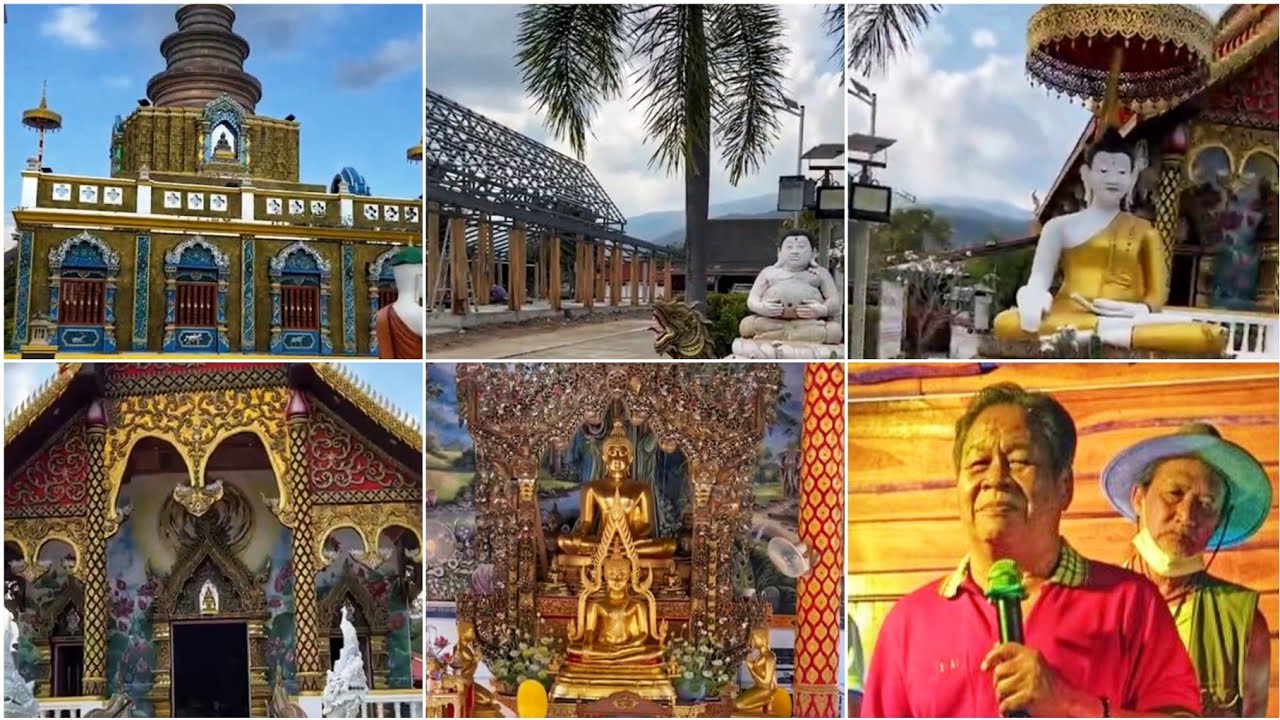
 Click to Access the Navigation Map GPS
Wat Nam Tong Map
Recommend

 Muang Chiang Mai(121)Chom Thong(47)Mae Chaem(25)Chiang Dao(33)Doi Saket(68)Mae Taeng(85)Mae Rim(69)Samoeng(29)Fang(71)Mae Ai(59)Phrao(70)San Pa Tong(103)San Kamphaeng(66)San Sai(73)Hang Dong(73)Hot(32)Doi Tao(22)Omkoi(11)Saraphi(74)Wiang Haeng(15)Chai Prakan(28)Mae Wang(32)Mae On(22)Doi Lo(34)Galyani Vadhana(1)


