
lovethailand home >North Travel Attractions >Chiang Mai Travel Attractions >Chom Thong >Khuang Pao > Wat Huai Tong Sak
TL;DR: Wat Huai Tong Sak is located at Ban Mai Ang Rak, Moo 15, Khuang Pao Subdistrict, Chom Thong District, Chiang Mai Province, open Daily, hours 08.00 – 17.00.
Wat Huai Tong Sak
Open Days: Daily
Opening Hours: 08.00 – 17.00
Wat Huai Tong Sak is located at 34 Ban Mai Ang Rak, Moo 15, Chom Thong-Inthanon Road, Khuang Pao Subdistrict, Chom Thong District, Chiang Mai 50160. It is a Mahanikaya local Buddhist temple with an active role in Khuang Pao Subdistrict and the Chom Thong-Doi Inthanon travel corridor. The temple’s historical background is connected with Ban Huai Tong Sak and the Mae Klang Waterfall road, while current local records identify its address in Ban Mai Ang Rak, Moo 15. This makes the temple both a local religious center and a convenient spiritual stop for travelers heading toward Doi Inthanon.
Wat Huai Tong Sak is suitable for visitors who want to explore a quieter side of Chiang Mai’s Buddhist culture. It is not a large tourist temple designed around grand architecture. Its value lies in its active monastic community, meditation halls, merit-making areas, large visitor facilities, and continuing Buddhist activities. The temple remains a living community temple where monks reside, lay supporters make merit, and Buddhist events are held throughout the year.
The temple received permission for construction on 4 October 1979, with Nai Sawaeng Pintaya as the person who applied for permission and helped establish the temple. The Ministry of Education later announced the formal establishment of the temple on 28 November 1988. At the time of the application, the temple land was recorded as 18 rai, 1 ngan, and 50 square wah. Current local records now list several temple land plots under Treasury Department state property, reflecting the temple’s ongoing administrative development.
Older records state that Wat Huai Tong Sak was originally located at Ban Huai Tong Sak on the Mae Klang Waterfall road, Moo 6, Khuang Pao Subdistrict, Chom Thong District. The old temple land was recorded as 21 rai, with the eastern side bordering the Mae Klang Waterfall road. Its early structures included a sermon hall and monks’ residence, and its sacred object was a Buddha image in the blessing posture. This older record preserves the temple’s original connection with Ban Huai Tong Sak and the route toward Mae Klang Waterfall.
The name Wat Huai Tong Sak reflects local geography and community memory. “Huai” refers to a small stream or watercourse, while “Tong Sak” is the local place name associated with the area. The name therefore preserves a connection between the temple, water, settlement, and the rural landscape of Khuang Pao. Many northern Thai temple names are closely connected with streams, villages, fields, and forests, and Wat Huai Tong Sak follows that pattern.
Wat Huai Tong Sak is a Mahanikaya temple and is listed among the temples of Khuang Pao Subdistrict, alongside Wat Mongkhon Waree, Wat Khamaet, Wat Tha Sala, Wat Wang Din, Wat Mai San Tueng, Wat Lanna Yanasangwararam, and Wat Khuang Pao Nuea. This network of temples shows that Wat Huai Tong Sak is part of a wider religious and community landscape in Chom Thong District.
The temple is located near the Chom Thong-Inthanon road, one of the key routes for travelers heading from Chom Thong toward Doi Inthanon National Park, Mae Klang Waterfall, and other natural attractions. This location makes Wat Huai Tong Sak a convenient stop for merit-making, worship, meditation, or a quiet rest before continuing into the mountain route.
Current land information lists several important plots, including one plot of 26 rai and 705 square wah, another plot of 1 rai and 84 square wah, and another plot of 7 rai and 225 square wah. These lands are recorded as Treasury Department state property. The northern boundary touches private land, the southern boundary touches a public road, the eastern boundary touches the Chom Thong-Inthanon road, and the western boundary touches private land.
Wat Huai Tong Sak has not yet received Wisungkhamsima because the temple record states that it does not yet have an ordination hall. This is important for understanding the temple’s role. Without an ordination hall and consecrated boundary, the temple’s primary functions are merit-making, Dhamma activities, meditation practice, Buddhist events, community gatherings, and religious education rather than formal Sangha acts conducted in an ordination hall.
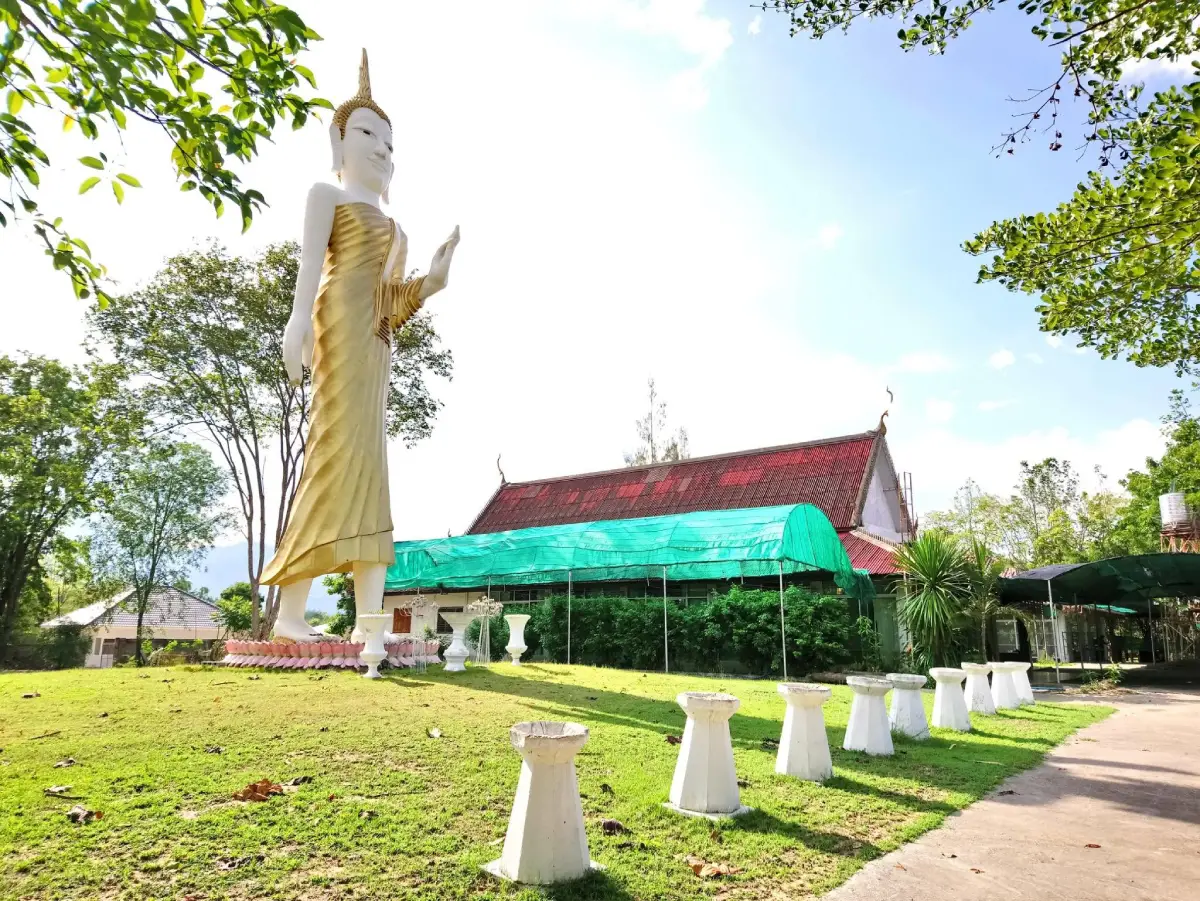
The temple’s key sacred object is a standing Buddha image measuring 1.2 meters wide and 12 meters high. The standing posture gives the image a strong visual presence and makes it one of the most recognizable devotional features of the temple. Older records also mention a Buddha image in the blessing posture, showing that the temple has long maintained sacred images for worship and merit-making.
The main facilities of Wat Huai Tong Sak include monks’ residences, a large meditation hall, a smaller meditation hall or food-offering hall, a donation hall, a large restroom building, additional monks’ residences, and the abbot’s residence. These structures show that the temple is equipped for Buddhist practice, community merit-making, and religious events with many participants.
The first monks’ residence is a reinforced concrete building measuring 3 meters wide and 18 meters long, built in 2019, and containing six rooms. This structure supports resident monks and helps organize monastic life within the temple. A temple with several resident monks requires suitable living areas so that monastic discipline, privacy, and daily practice can be maintained properly.
The large meditation hall measures 10 meters wide and 20 meters long and is a reinforced concrete building. It supports meditation, Dhamma listening, group practice, and Buddhist activities. This hall is one of the temple’s important functional spaces because Wat Huai Tong Sak has a history of Dhamma outreach and practice-oriented activities.
The smaller meditation hall, also used as a food-offering hall, measures 8 meters wide and 16 meters long. It supports smaller activities, food preparation, merit-making, and temple events. Food-offering spaces are essential in local temples because merit-making events often involve cooperation among monks, lay supporters, families, and village volunteers.
The donation hall measures 4 meters wide and 12 meters long and was built in 2015. It provides a designated area for merit-making and offerings. In Thai Buddhist culture, offering and generosity are central practices that connect the temple with the lay community. This hall reflects the temple’s continuing role as a place where faith, generosity, and community support come together.
The restroom building is a notable facility. Built in 2013, it measures 3 meters wide and 20 meters long and includes 15 women’s rooms, 15 men’s rooms, and 2 accessible rooms, for a total of 32 restrooms. This makes the temple well equipped to support large merit-making events, Kathin ceremonies, meditation activities, and gatherings with many participants.
The abbot’s residence measures 3 meters wide and 6 meters long and is a reinforced concrete building. The temple record also lists several additional monks’ residences. Although full dimensions are not recorded for every building, the presence of multiple residential structures shows that the temple has developed its monastic area to support resident monks and ongoing religious work.
Basic utilities include Provincial Waterworks Authority water supply, Provincial Electricity Authority electricity, and 3BB Wi-Fi. These utilities make the temple capable of supporting modern Buddhist activities, sound systems, communication, community events, and large ceremonies while still maintaining its religious character.
The abbot of Wat Huai Tong Sak is Phra Khru Wapi Woramanit Akkamanawo. The 2023 local temple record lists nine monks, two novices, one lay steward, and one lay ritual assistant. A 2025 Kathin record also lists nine resident monks. The number of resident monks confirms that the temple remains an active monastic center rather than a purely historical site.
Wat Huai Tong Sak has a strong record of Buddhist outreach. Earlier records describe a community radio station operated by the temple to spread Dhamma through FM 98.75 MHz. Later broadcast licensing data also lists Wat Huai Tong Sak in connection with a Dhamma radio service. This gives the temple a broader role in Buddhist communication and community learning beyond ordinary merit-making activities.
The temple has hosted many Buddhist activities, including Kathin ceremonies, large merit-making events, meditation-related activities, and alms-giving ceremonies. A 2025 Kathin record lists a Kathin ceremony in October 2025 and records nine resident monks. This shows that Wat Huai Tong Sak continues to function as a current religious activity site for Buddhists in Chiang Mai and nearby provinces.
Khuang Pao Subdistrict lies in the northern part of Chom Thong District. Its landscape includes foothill plains, agricultural land, irrigation channels, Highway 108, and roads leading toward Doi Inthanon. Wat Huai Tong Sak is located within this setting, connecting village life, agriculture, Buddhist practice, and travel routes to major natural attractions.
Visitors should approach the temple respectfully. Modest clothing, quiet speech, and careful behavior are important. Visitors should not enter monks’ residential areas without permission, and shoes should be removed before entering religious buildings. Photography should be done in a way that does not disturb monks, novices, worshippers, or ongoing temple activities.
Key places to observe include the standing Buddha image, large meditation hall, smaller meditation hall or food-offering hall, donation hall, monks’ residences, abbot’s residence, and merit-making areas. The temple is best appreciated as a living Buddhist community space rather than a quick photo stop.
Getting There is convenient by private car, rental car, motorbike, or local transport. From Chiang Mai city, take Highway 108 south toward Chom Thong, then connect to the Chom Thong-Inthanon road. The temple is located at 34 Ban Mai Ang Rak, Moo 15, Khuang Pao Subdistrict. For navigation, search for “Wat Huai Tong Sak, Khuang Pao, Chom Thong” and check that the destination is on the Chom Thong-Inthanon road.
The navigation coordinates listed in a public business directory are approximately 18.45376, 98.67381. Travelers should still check the destination before departure because some older sources refer to Ban Huai Tong Sak or Moo 6, while current local records identify the temple address as Ban Mai Ang Rak, Moo 15.
Wat Huai Tong Sak can be combined with Wat Lanna Yanasangwararam, Wat Wang Din, Wat Tha Sala, Wat Mongkhon Waree, Wat Phrathat Si Chom Thong Worawihan, Mae Klang Waterfall, and Doi Inthanon National Park. A half-day route can focus on temples around Khuang Pao and Chom Thong, while a full-day route can continue toward Doi Inthanon.
In summary, Wat Huai Tong Sak is a Mahanikaya community temple with strong religious and local value. Its highlights include formal establishment in 1988, the leadership of Phra Khru Wapi Woramanit Akkamanawo, nine resident monks, a standing Buddha image, meditation halls, food-offering and donation spaces, large restroom facilities, and Dhamma outreach through temple activities and community media. It is a meaningful stop for travelers who want to understand Chiang Mai through active village temples near the Doi Inthanon route.
| Name | Wat Huai Tong Sak |
| Location | Ban Mai Ang Rak, Moo 15, Khuang Pao Subdistrict, Chom Thong District, Chiang Mai Province |
| Address | 34 Ban Mai Ang Rak, Moo 15, Chom Thong-Inthanon Road, Khuang Pao Subdistrict, Chom Thong District, Chiang Mai 50160, Thailand |
| Coordinates | 18.45376, 98.67381 |
| Highlights | Mahanikaya community temple near the Chom Thong-Inthanon route, with a standing Buddha image, meditation halls, food-offering hall, donation hall, large restroom facilities, resident monks, and an active role in Buddhist outreach |
| History | Permission for construction was granted on 4 October 1979, and the Ministry of Education formally established the temple on 28 November 1988. Nai Sawaeng Pintaya applied for permission and helped establish the temple |
| Sect | Mahanikaya |
| Wisungkhamsima | The temple has not yet received Wisungkhamsima because the temple record states that it does not yet have an ordination hall |
| Temple Land | Current local records list several plots of temple land: 26 rai and 705 square wah, 1 rai and 84 square wah, and 7 rai and 225 square wah, recorded as Treasury Department state property |
| Distinctive Features | An active community temple with meditation halls and large facilities for Buddhist ceremonies, merit-making, and Dhamma activities near the Doi Inthanon travel route |
| Travel Information | From Chiang Mai city, take Highway 108 south toward Chom Thong, then continue to the Chom Thong-Inthanon road. The temple is in Ban Mai Ang Rak, Moo 15, Khuang Pao Subdistrict |
| Current Status | Open as a community temple for worship, merit-making, meditation practice, and Buddhist activities according to temple schedules |
| Open Days | Daily |
| Opening Hours | 08.00 – 17.00 |
| Facilities | Monks’ residences, large meditation hall, smaller meditation hall or food-offering hall, donation hall, 32 restrooms, abbot’s residence, Provincial Waterworks Authority water supply, Provincial Electricity Authority electricity, and 3BB Wi-Fi |
| Main Areas / Zones | Standing Buddha image, large meditation hall, smaller meditation hall, food-offering hall, donation hall, monks’ residences, abbot’s residence, restrooms, and community merit-making areas |
| Buddha Images / Sacred Objects | Standing Buddha image measuring 1.2 meters wide and 12 meters high; older records also mention a Buddha image in the blessing posture |
| Abbot / Key Figure | Phra Khru Wapi Woramanit Akkamanawo, abbot of Wat Huai Tong Sak |
| Monks And Novices | The 2023 local record and 2025 Kathin record list 9 monks; the 2023 record also lists 2 novices, 1 lay steward, and 1 lay ritual assistant |
| Main Contact Number | 062-405-7072 |
| Nearby Tourist Attractions | 1. Wat Lanna Yanasangwararam, about 1 km 2. Wat Wang Din, about 4 km 3. Wat Tha Sala, about 5 km 4. Wat Mongkhon Waree, about 6 km 5. Wat Phrathat Si Chom Thong Worawihan, about 8 km 6. Mae Klang Waterfall, about 16 km 7. Doi Inthanon National Park, about 18 km |
| Nearby Restaurants | 1. Kuai Tiao Aphai, about 6 km, Tel. 053-341-996 2. Pao Male Makro Chom Thong, about 6 km, Tel. 098-282-1040 3. Khon Mueang Chom Thong, about 8 km, Tel. 081-885-8851 4. Khao Soi Kalong, about 9 km, Tel. 087-189-2619 5. Krua Koban, about 10 km, Tel. 089-559-9329, 080-124-3393, 080-501-3622 6. Phing Phukao, about 11 km, Tel. 089-556-4854 |
| Nearby Accommodations | 1. The Farmer Farm Stay & Cafe, about 2 km, Tel. 064-801-7389 2. B-tel Chomthong Chiang Mai, about 3 km, Tel. 098-759-2003 3. Huan Khwan Khao, about 6 km, Tel. 084-687-0025, 081-602-0221 4. Chom Thong Boutique House, about 7 km, Tel. 081-582-9889 5. Bansuan Inthanon Resort, about 11 km, Tel. 086-429-1642 |
Frequently Asked Questions (FAQ)
Q: Where is Wat Huai Tong Sak located?
A: Wat Huai Tong Sak is located at 34 Ban Mai Ang Rak, Moo 15, Chom Thong-Inthanon Road, Khuang Pao Subdistrict, Chom Thong District, Chiang Mai 50160.
Q: What are the opening days and hours of Wat Huai Tong Sak?
A: Wat Huai Tong Sak is open daily from 08.00 to 17.00.
Q: When was Wat Huai Tong Sak established?
A: Permission for construction was granted on 4 October 1979, and the temple was formally established by the Ministry of Education on 28 November 1988.
Q: Which Buddhist sect does Wat Huai Tong Sak belong to?
A: Wat Huai Tong Sak is a Mahanikaya local Buddhist temple.
Q: Has Wat Huai Tong Sak received Wisungkhamsima?
A: The temple has not yet received Wisungkhamsima because the temple record states that it does not yet have an ordination hall.
Q: What are the main features inside Wat Huai Tong Sak?
A: The temple includes a standing Buddha image, large meditation hall, smaller meditation hall, food-offering hall, donation hall, monks’ residences, abbot’s residence, and large restroom facilities.
Q: Who is the abbot of Wat Huai Tong Sak?
A: The abbot of Wat Huai Tong Sak is Phra Khru Wapi Woramanit Akkamanawo.
Q: What nearby places can be visited with Wat Huai Tong Sak?
A: Nearby places include Wat Lanna Yanasangwararam, Wat Wang Din, Wat Tha Sala, Wat Mongkhon Waree, Wat Phrathat Si Chom Thong Worawihan, Mae Klang Waterfall, and Doi Inthanon National Park.
 Category: ●Places of Worship
 Group: ●Temple
Last Update : 1 DayAgo
 Last Update : 1 DayAgo
 Click to Access the Navigation Map GPS
 Muang Chiang Mai(121)Chom Thong(47)Mae Chaem(25)Chiang Dao(33)Doi Saket(68)Mae Taeng(85)Mae Rim(69)Samoeng(29)Fang(71)Mae Ai(62)Phrao(70)San Pa Tong(105)San Kamphaeng(66)San Sai(73)Hang Dong(74)Hot(32)Doi Tao(22)Omkoi(11)Saraphi(74)Wiang Haeng(15)Chai Prakan(28)Mae Wang(32)Mae On(22)Doi Lo(34)Galyani Vadhana(1)


