
lovethailand home >North Travel Attractions >Chiang Mai Travel Attractions >Chom Thong >Khuang Pao > Wat Mongkhon Waree
TL;DR: Wat Mongkhon Waree is located at Ban Nong Hai, Moo 1, Khuang Pao Subdistrict, Chom Thong District, Chiang Mai Province, open Daily, hours 08.00 – 17.00.
Wat Mongkhon Waree
Open Days: Daily
Opening Hours: 08.00 – 17.00
Wat Mongkhon Waree is located at 73 Moo 1, Ban Nong Hai, Chiang Mai-Hot Road, Khuang Pao Subdistrict, Chom Thong District, Chiang Mai Province. It is a Mahanikaya local Buddhist temple that plays an important role in the religious and community life of Ban Nong Hai. The temple was established in 1935 and began as a forest monastic site around 1936, when Nai Kantha Luang Khana, the village headman at the time, and local supporters cleared the forest and built temporary monastic structures.
Wat Mongkhon Waree is not a large tourist temple in the old city of Chiang Mai. Its value lies in its role as a community temple that grew from local faith, village cooperation, and long-term Buddhist practice. The name combines “Mongkhon,” meaning auspiciousness, and “Waree,” meaning water, giving the temple a name associated with blessing, coolness, and well-being. For visitors who want to understand Chiang Mai through local temples rather than only famous landmarks, Wat Mongkhon Waree is a meaningful stop in Chom Thong District.
The temple stands beside Highway 108, the Chiang Mai-Hot route, one of the main roads connecting Chiang Mai city with Chom Thong, Hot, Doi Inthanon, Mae Klang Waterfall, and other southern Chiang Mai destinations. This makes the temple convenient for travelers who want to stop for merit-making or a quiet temple visit while traveling toward Chom Thong or Doi Inthanon.
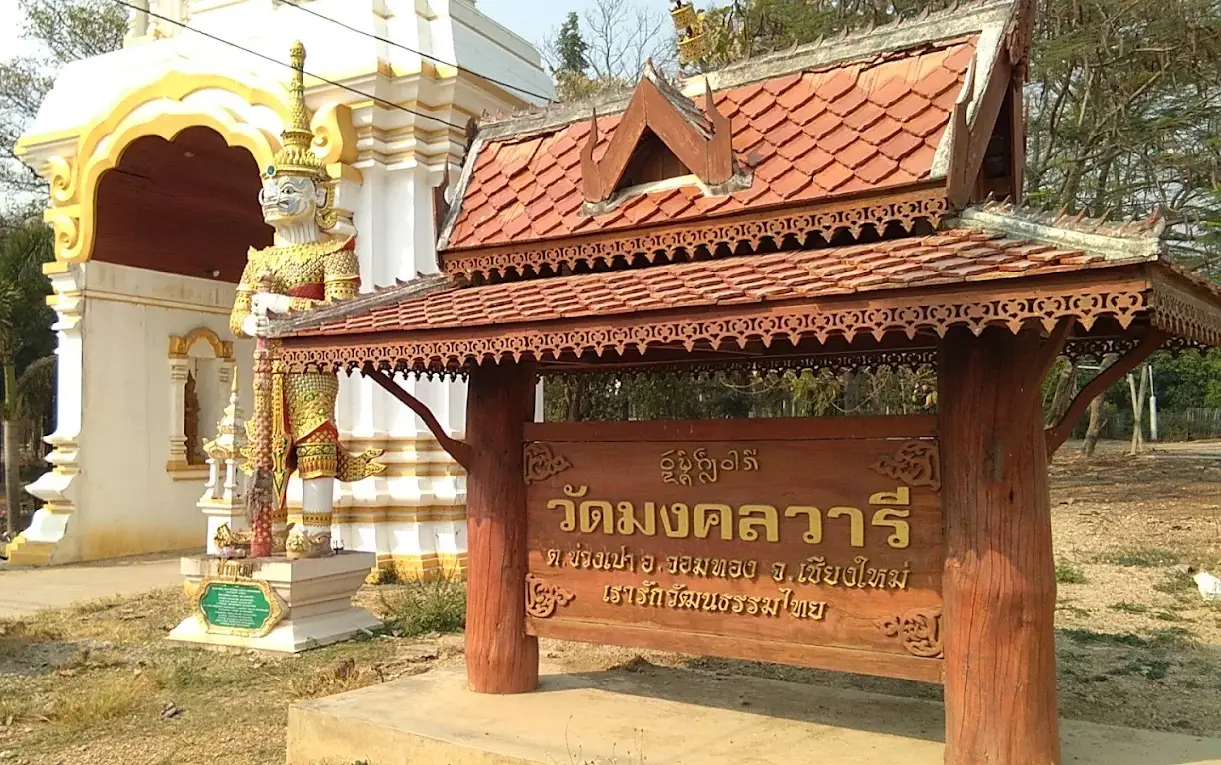
One of the temple’s visible landmarks is its entrance arch, together with guardian giant statues near the roadside. The temple is also used as a local landmark for the route toward Doi Tok, a natural site in Ban Nong Hai known for unusual landforms, rock formations, and canyon-like scenery. This makes Wat Mongkhon Waree not only a religious place but also a point of reference in the local landscape of Khuang Pao Subdistrict.
The temple’s history reflects the collective effort of local people. When the area was still forested, villagers helped clear the land and create temporary structures so monks could stay and perform religious duties. Over time, the site developed into a proper Buddhist temple serving Ban Nong Hai. Wat Mongkhon Waree therefore represents a typical but important pattern in northern Thai community history: a temple emerging from faith, land, labor, and shared village responsibility.
The temple land covers 10 rai, 1 ngan, and 50 square wah. Its northern boundary touches the Chiang Mai-Hot road, the southern boundary touches the Nong Hai-Huai Nam Dip road, the eastern boundary touches a public road and a local access route, and the western boundary touches an irrigation canal and nearby private activity areas. This location shows how closely the temple is woven into the daily geography of the community.
Wat Mongkhon Waree received its royal grant of Wisungkhamsima on 16 July 1994. The consecrated boundary measures 25 meters wide and 35 meters long. In Thai Buddhist practice, Wisungkhamsima is the formally consecrated area used for important Sangha acts, especially those performed in the ordination hall. This gives the temple’s ordination hall a specific monastic and religious significance.
The temple has been led by several abbots across its history, including early monks remembered in temple records and later leaders such as Phra Athikan Inta Kosalo, Phra Athikan Anan Ananto, Phra Khru Mongkhon Thammakon, and Phra Athikan Wut Prabhaso. Phra Khru Mongkhon Thammakon played an important role as abbot from 1974 to 2007. The present phase of the temple is associated with Phra Athikan Wut Prabhaso, who is listed as the abbot in the local temple record.
Important sacred objects inside the temple include the principal Buddha image in the ordination hall, a Phra Phuttha Sihing image in the Mara-subduing posture, created in 2022, and the principal Buddha image in the Phra Phuttha Mongkhon Maha Lap building, also known as Phra Chao Than Chai, created in 2013. These images are central points of worship for villagers and visitors who come to make merit, pray, and pay respect.
The temple’s main structures include the abbot’s residence, kitchen, alms hall, restrooms, bell tower, white Lanna-style chedi, Dhamma Sangwet building, ordination hall, Phra Phuttha Mongkhon Maha Lap building, merit-making hall, and an area described in the local record as the old-town zone. These structures show that Wat Mongkhon Waree is equipped for both everyday monastic life and community religious activities.
The ordination hall was built in 2022 as a reinforced concrete structure measuring 25 meters by 35 meters. It is the most important structure for formal monastic ceremonies and is also a primary worship space for visitors. The principal Buddha image inside the hall gives the building its devotional focus. Visitors should dress respectfully, remove shoes before entering, and maintain quiet behavior inside the hall.
The white Lanna-style chedi, built in 2013, is one of the temple’s most distinctive visual features. It gives the temple a clear northern Thai Buddhist identity and serves as an important sacred structure within the temple grounds. Its white form creates a calm and clean visual atmosphere that matches the temple’s name and local religious character.
The Phra Phuttha Mongkhon Maha Lap building houses Phra Chao Than Chai, a Buddha image associated in northern Thai belief with blessing, success, and timely fulfillment. Visitors often pay respect to such images for auspiciousness and encouragement in daily life. This building is therefore one of the temple’s important devotional areas.
The bell tower, built in 2007, reflects the traditional rhythm of temple life. Although modern communication has changed how temple activities are announced, the bell tower remains a symbolic part of Thai Buddhist temple culture. It reminds visitors of the way temples historically marked time, ceremonies, and community gatherings.
The temple’s kitchen and alms hall support merit-making activities, food preparation, and community gatherings. These areas are essential in a village temple because religious events often depend on cooperation among monks, lay supporters, and local families. Wat Mongkhon Waree therefore continues to function as a practical community center as well as a place of worship.
The Dhamma Sangwet building, built in 1992, supports religious and community ceremonies. The temple record states that Wat Mongkhon Waree does not have a crematorium within its temple land, so this building functions as an area for merit-making and ceremonial support rather than an on-site cremation facility.
The temple is supported by groundwater, temple water supply, and electricity from the Provincial Electricity Authority. Multiple restroom buildings help accommodate visitors during merit-making events and community ceremonies. These facilities are important for a village temple that regularly receives local residents during religious occasions.
Wat Mongkhon Waree also has an educational history. Temple records state that a Dhamma study school was opened in 1957. This reflects the traditional role of northern Thai temples as places of learning, especially for monks, novices, and local residents interested in Buddhist teachings.
Khuang Pao Subdistrict is located north of Chom Thong town, about 4 kilometers from the district center and about 55 kilometers south of Chiang Mai city along Highway 108. The area is a foothill plain where agriculture, village life, roads, and temples are closely connected. Wat Mongkhon Waree’s position in this landscape makes it part of the cultural and religious network of Chom Thong District.
For visitors, Wat Mongkhon Waree is best experienced as a living village temple. Important points to observe include the entrance arch, guardian giant statues, the ordination hall, the Phra Phuttha Mongkhon Maha Lap building, Phra Chao Than Chai, the white Lanna-style chedi, bell tower, and community halls. The temple’s charm lies in its local authenticity and continuing role in village religious life.
Wat Mongkhon Waree can be included in a cultural route through Chom Thong District. It pairs well with Wat Khuang Pao Nuea, Wat Khamaet, Chom Thong town, Wat Phrathat Si Chom Thong Worawihan, Mae Klang Waterfall, and Doi Inthanon National Park. Such a route gives travelers a broader understanding of Chom Thong as both a religious and natural travel area.
Getting There is convenient by private car, rental car, motorbike, or local transport. From Chiang Mai city, take Highway 108 south toward Chom Thong. Pass San Pa Tong and Doi Lo, then continue into Khuang Pao Subdistrict. The temple is located in Ban Nong Hai beside the Chiang Mai-Hot road, before reaching Chom Thong town. For navigation, search for Wat Mongkhon Waree, Ban Nong Hai, Chom Thong.
The best time to visit is in the morning or late afternoon. The temple is open daily from 08.00 to 17.00. Visitors who plan to join special temple events or merit-making ceremonies should contact the temple in advance to confirm schedules and appropriate conduct.
Visitors should dress modestly, speak quietly, remove shoes before entering religious buildings, and avoid entering monastic areas without permission. Since Wat Mongkhon Waree is an active community temple, respectful behavior is essential for a meaningful visit.
In summary, Wat Mongkhon Waree is a Mahanikaya community temple in Ban Nong Hai with historical, religious, and local cultural value. Established from a forest monastic site in the 1930s, granted Wisungkhamsima in 1994, and still serving local residents today, the temple is a worthwhile stop for travelers seeking a quieter and more authentic temple experience in Chom Thong District.
| Name | Wat Mongkhon Waree |
| Location | Ban Nong Hai, Moo 1, Khuang Pao Subdistrict, Chom Thong District, Chiang Mai Province |
| Address | 73 Moo 1, Chiang Mai-Hot Road, Khuang Pao Subdistrict, Chom Thong District, Chiang Mai 50160, Thailand |
| Highlights | Community temple of Ban Nong Hai with an entrance arch, guardian giant statues, Phra Phuttha Sihing image, Phra Chao Than Chai, Phra Phuttha Mongkhon Maha Lap building, and white Lanna-style chedi |
| History | Established in 1935 and developed from a forest monastic site around 1936 by the village headman Nai Kantha Luang Khana and local supporters |
| Sect | Mahanikaya |
| Wisungkhamsima | Granted on 16 July 1994; the consecrated boundary measures 25 meters wide and 35 meters long |
| Temple Land | 10 rai, 1 ngan, 50 square wah |
| Distinctive Features | A living community temple along Highway 108 with Lanna Buddhist elements and facilities supporting worship, merit-making, and village religious activities |
| Travel Information | From Chiang Mai city, take Highway 108 south toward Chom Thong. The temple is in Ban Nong Hai, Khuang Pao Subdistrict, before Chom Thong town |
| Current Status | Open for worship, merit-making, and community temple visits |
| Open Days | Daily |
| Opening Hours | 08.00 – 17.00 |
| Facilities | Ordination hall, abbot’s residence, kitchen, alms hall, restrooms, bell tower, Dhamma Sangwet building, Phra Phuttha Mongkhon Maha Lap building, merit-making hall, groundwater, temple water supply, and provincial electricity |
| Main Areas / Zones | Ordination hall, white Lanna-style chedi, Phra Phuttha Mongkhon Maha Lap building, alms hall, Dhamma Sangwet building, merit-making hall, bell tower, kitchen, and old-town zone |
| Buddha Images / Sacred Objects | Principal Buddha image in the ordination hall, Phra Phuttha Sihing in the Mara-subduing posture, created in 2022, and Phra Chao Than Chai in the Phra Phuttha Mongkhon Maha Lap building, created in 2013 |
| Abbot / Key Figures | Phra Athikan Wut Prabhaso, abbot of Wat Mongkhon Waree; Phra Khru Mongkhon Thammakon was an important former abbot from 1974 to 2007 |
| Main Contact Numbers | 053-369-653, 082-192-0185 |
| Nearby Tourist Attractions | 1. Doi Tok, Ban Nong Hai, about 2 km 2. Wat Khuang Pao Nuea, about 2 km 3. Chom Thong Market And Town Area, about 5 km 4. Wat Phrathat Si Chom Thong Worawihan, about 6 km 5. Mae Klang Waterfall, about 15 km 6. Doi Inthanon National Park, about 17 km |
| Nearby Restaurants | 1. Kuai Tiao Aphai, about 5 km, Tel. 053-341-996 2. Pao Male Makro Chom Thong, about 4 km, Tel. 098-282-1040 3. Khon Mueang Chom Thong, about 6 km, Tel. 081-885-8851 4. Khao Soi Kalong, about 7 km, Tel. 089-983-9922 5. Krua Koban, about 8 km 6. Phing Phukao, about 9 km, Tel. 089-556-4854 |
| Nearby Accommodations | 1. The Farmer Farm Stay & Cafe, about 3 km, Tel. 064-801-7389 2. Huan Khwan Khao, about 5 km, Tel. 084-687-0025, 081-602-0221 3. B-tel Chom Thong Resort Chiang Mai, about 5 km, Tel. 098-759-2003 4. Bansuan Inthanon Resort, about 7 km, Tel. 086-429-1642 5. Baan Lom Joy, about 8 km |
Frequently Asked Questions (FAQ)
Q: Where is Wat Mongkhon Waree located?
A: Wat Mongkhon Waree is located at 73 Moo 1, Ban Nong Hai, Chiang Mai-Hot Road, Khuang Pao Subdistrict, Chom Thong District, Chiang Mai 50160.
Q: What are the opening days and hours of Wat Mongkhon Waree?
A: Wat Mongkhon Waree is open daily from 08.00 to 17.00.
Q: When was Wat Mongkhon Waree established?
A: The temple was established in 1935 and began as a forest monastic site around 1936 through the support of local villagers.
Q: What are the main sacred objects inside Wat Mongkhon Waree?
A: Important sacred objects include the Phra Phuttha Sihing image in the ordination hall and Phra Chao Than Chai in the Phra Phuttha Mongkhon Maha Lap building.
Q: When did Wat Mongkhon Waree receive Wisungkhamsima?
A: Wat Mongkhon Waree received Wisungkhamsima on 16 July 1994, with a consecrated boundary measuring 25 meters wide and 35 meters long.
Q: Who is the abbot of Wat Mongkhon Waree?
A: The abbot of Wat Mongkhon Waree is Phra Athikan Wut Prabhaso. Phra Khru Mongkhon Thammakon was an important former abbot from 1974 to 2007.
Q: How can travelers get to Wat Mongkhon Waree?
A: From Chiang Mai city, take Highway 108 south toward Chom Thong. The temple is located beside the Chiang Mai-Hot road in Ban Nong Hai, Khuang Pao Subdistrict.
Q: What nearby places can be visited with Wat Mongkhon Waree?
A: Nearby places include Doi Tok, Wat Khuang Pao Nuea, Chom Thong Market, Wat Phrathat Si Chom Thong Worawihan, Mae Klang Waterfall, and Doi Inthanon National Park.
 Category: ●Places of Worship
 Group: ●Temple
Last Update : 2 DayAgo
 Last Update : 2 DayAgo
 Click to Access the Navigation Map GPS
Wat Mongkhon Waree Map
Recommend

 Muang Chiang Mai(121)Chom Thong(47)Mae Chaem(25)Chiang Dao(33)Doi Saket(68)Mae Taeng(85)Mae Rim(69)Samoeng(29)Fang(71)Mae Ai(62)Phrao(70)San Pa Tong(105)San Kamphaeng(66)San Sai(73)Hang Dong(74)Hot(32)Doi Tao(22)Omkoi(11)Saraphi(74)Wiang Haeng(15)Chai Prakan(28)Mae Wang(32)Mae On(22)Doi Lo(34)Galyani Vadhana(1)


