
lovethailand home >North Travel Attractions >Chiang Mai Travel Attractions >Chom Thong >Khuang Pao > Wat Khamaet
TL;DR: Wat Khamaet is located at Ban Huai Nam Dip, Moo 2, Khuang Pao Subdistrict, Chom Thong District, Chiang Mai Province, open Daily, hours 08.00 – 17.00.

Wat Khamaet
Open Days: Daily
Opening Hours: 08.00 – 17.00
Wat Khamaet is located at 209 Ban Huai Nam Dip, Chiang Mai-Hot Road, Moo 2, Khuang Pao Subdistrict, Chom Thong District, Chiang Mai Province. It is a Mahanikaya local Buddhist temple with a meaningful history tied to the Ping River, temple relocation, village faith, and the development of Chom Thong’s community landscape. Although it is not a large mass-tourism temple, Wat Khamaet is important as a living community temple that still supports monks, novices, local religious activities, and merit-making for residents around Ban Huai Nam Dip.
Wat Khamaet is suitable for travelers who want to explore a deeper and quieter side of Chiang Mai’s temple culture. The temple stands along the Chiang Mai-Hot route, a major road connecting Chiang Mai city with Chom Thong, Hot, and the Doi Inthanon travel corridor. This makes it a convenient cultural stop for visitors heading toward Wat Phrathat Si Chom Thong Worawihan, Mae Klang Waterfall, Doi Inthanon National Park, or other destinations in southern Chiang Mai.
The temple’s history begins with a local account that the original temple once stood on the bank of the Ping River. It was built by Phraya Khamae, and the temple name was taken from the name of its founder. Later, the temple became abandoned. In 1917, Phra Ta Mek Surin restored the temple and rebuilt its religious structures, allowing it to return to active use as a Buddhist temple. This gives Wat Khamaet a story of revival rather than a simple, uninterrupted history.
A major turning point came when the construction of Bhumibol Dam caused the old temple area to be flooded every year. Phra Kaeo Khemaviro therefore relocated the temple to its present site. The Ministry of Education officially approved the relocation on 9 June 1956. This history makes Wat Khamaet a strong example of how a Buddhist temple can move with the changing landscape while continuing to preserve its spiritual and community role.
Wat Khamaet received its royal grant of Wisungkhamsima on 10 July 1984. The consecrated boundary measures 14 meters wide and 29 meters long. In Thai Buddhist monastic practice, Wisungkhamsima is the consecrated area used for formal Sangha acts, especially ceremonies held in the ordination hall. This means the temple’s ordination hall is not simply a building; it is the legally and religiously defined space for important monastic rites.
The current temple land covers 8 rai, 3 ngan, and 74 square wah. Its northern boundary touches private land, the southern boundary touches Chiang Mai-Hot Road, the eastern boundary touches a public road, and the western boundary touches private land. The southern side of the temple area is next to Ban Huai Nam Dip School. This setting places Wat Khamaet directly within the life of the local community, close to a school, a main road, and village activity.
The temple also has four plots of monastic land totaling 17 rai, 1 ngan, and 81 square wah. Such land is part of the long-term religious and administrative foundation of the temple. It helps support the temple’s continuity and shows that Wat Khamaet is more than a small roadside shrine; it is an established community temple with formal land records, monastic property, and ongoing institutional function.
Inside the temple are several important Buddha images. The principal Buddha image in the ordination hall is in the meditation posture, with a lap width of 59 inches and a height of 80 inches, created in 1989. The principal Buddha image in the sermon hall is also in the meditation posture, with a lap width of 90 inches and a height of 50 inches, created in 2002. The Buddha image in the Phra Hall, also called Sala Panya, was created in 1987. The Buddha image in the chedi area was created in 2015, and another Buddha image is enshrined in the abbot’s residence, created in 1957.
The presence of several Buddha images across different areas of the temple gives visitors more than one point for worship and reflection. The Buddha image in the ordination hall is connected with formal monastic ceremonies. The Buddha image in the sermon hall supports community merit-making and Dhamma activities. The Buddha images in the Phra Hall, chedi area, and abbot’s residence show how sacred images are integrated throughout the temple’s daily religious life.
The temple’s main structures include the abbot’s residence, monks’ residence, novices’ residence, restrooms behind the ordination hall, restrooms behind the sermon hall, a storage hall, dining hall, kitchen, sermon hall, ordination hall, and a Lanna-style chedi in front of the temple. These buildings show that Wat Khamaet is an active community temple equipped for monastic residence, merit-making, ceremonies, community gatherings, and support for local Buddhist activities.
The abbot’s residence is a reinforced concrete building measuring 6.50 meters by 8 meters, built in 1991. The monks’ residence measures 6 meters by 21 meters and was built in 2020. The novices’ residence measures 3.50 meters by 8 meters and was built in 1995. These structures show the temple’s continuing development across different periods and its ongoing role as a residence for monks and novices.
The sermon hall is a reinforced concrete building measuring 12.5 meters by 32 meters, built in 2002. It serves as an important gathering space for merit-making, listening to Dhamma, community ceremonies, and religious events. The ordination hall measures 9 meters by 24.5 meters and was built in 1989. As the main space for formal Sangha acts, the ordination hall should be treated with special respect by all visitors.
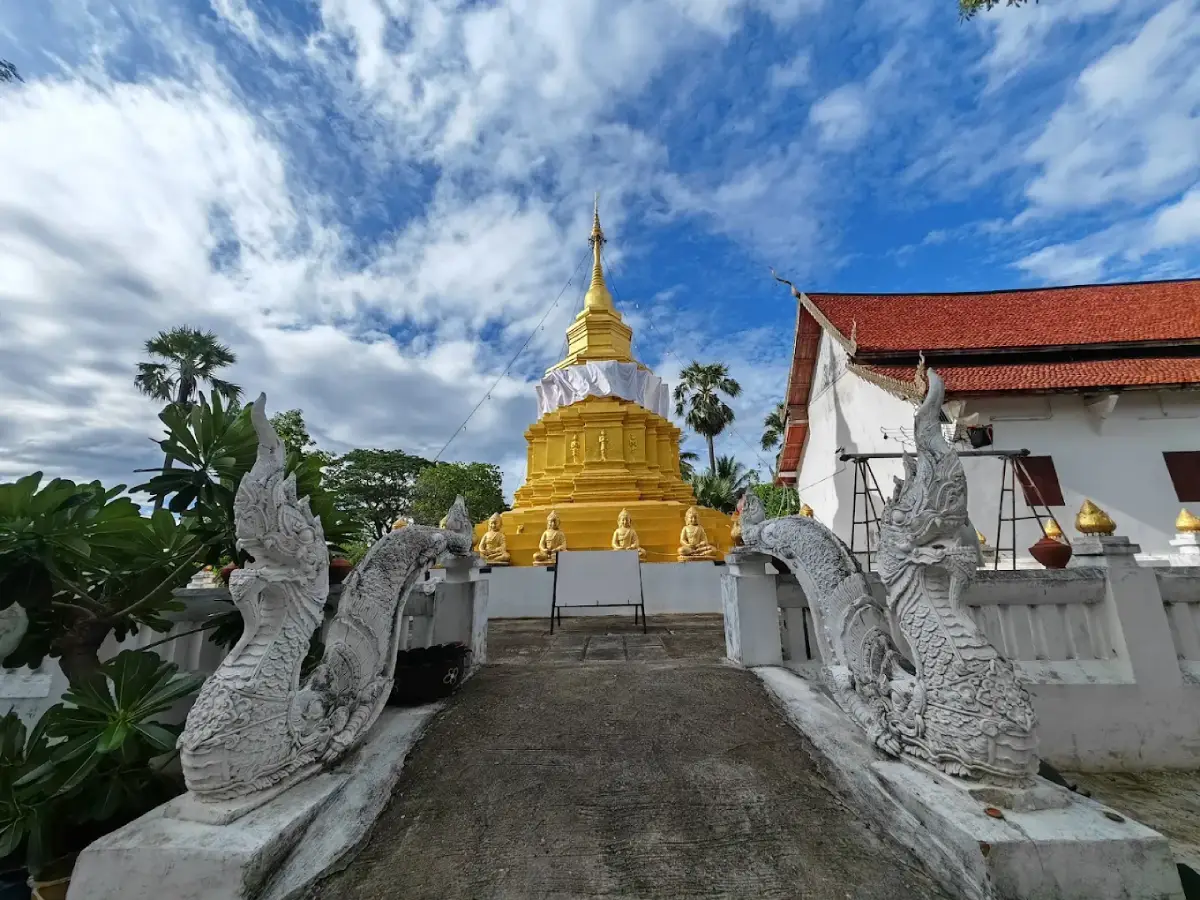
The Lanna-style chedi at the front of the temple measures 10 meters by 10 meters and was built in 2015. It gives the temple a clear northern Thai religious identity and provides a visual focus when entering the temple grounds. Visitors interested in local Buddhist architecture should take time to observe the chedi respectfully, as it helps express the temple’s connection with Lanna religious culture.
Wat Khamaet has basic utilities that support its present-day use, including groundwater, electricity from the Provincial Electricity Authority, and wireless internet from 3BB. The restrooms behind the ordination hall include women’s, men’s, and monks’ rooms, while the restrooms behind the sermon hall include separate women’s and men’s facilities. These facilities make the temple more convenient for merit-making events and community gatherings.
A crematorium is located to the north of the temple outside the temple boundary. This shows that Wat Khamaet continues to support important life-cycle rituals for the community. Like many village temples in northern Thailand, its role extends from everyday worship to ordination, merit-making, funerals, and ceremonies connected with the lives of local residents.
The temple’s known line of abbots includes Phra Ta Mek Surin, Phra Bunpan Mek Surin, Phra Kaeo Khemaviro, Phra Ma, Phra Jai, Phra Pokorn Pannavaro, Phra Bunlue Narintho, and Phra Somphon Chandrangsi. The current abbot is Phra Khru Wimon Chanthrangsri Chantharangsi, who has been associated with the temple from 1974 onward. A 2025 Kathin record also lists Phra Khru Wimon Chanthrangsri as the abbot of Wat Khamaet and records six resident monks for the Kathin season.
Temple records from 2023 list five monks and four novices. The record also lists one temple steward and one lay ritual assistant, showing that the temple is supported by both monastic and lay community members. This cooperation is typical of living village temples, where monks, novices, lay stewards, donors, and local residents all help maintain the temple’s religious and social functions.
Wat Khamaet also has an educational history. The temple record states that a Pali and Dhamma study school was opened in 1976. This reflects the traditional role of temples in northern Thailand as places of learning, especially for monks, novices, and young people connected with the community. For this reason, Wat Khamaet should be understood not only as a worship site but also as part of the educational and cultural fabric of Ban Huai Nam Dip.
Khuang Pao Subdistrict lies north of Chom Thong town, about 4 kilometers from the district center and about 55 kilometers south of Chiang Mai city along Highway 108. Its landscape is a foothill plain about 300-400 meters above sea level, with agricultural land, local canals, and the Ping River forming part of the wider local geography. Wat Khamaet’s position in this landscape makes it part of an active rural and roadside community rather than an isolated religious site.
For travelers, the main value of visiting Wat Khamaet is the chance to see a real community temple with a layered history. Its story includes an original riverbank site, abandonment, restoration in 1917, relocation due to flooding after the construction of Bhumibol Dam, formal recognition through Wisungkhamsima in 1984, and continuing use by monks, novices, and villagers today. This makes the temple meaningful for visitors interested in local history, Buddhist culture, and the relationship between temples and changing landscapes.
Wat Khamaet can be included in a cultural route through Chom Thong District. It pairs well with Wat Khuang Pao Nuea, Wat Phrathat Si Chom Thong Worawihan, Chom Thong town, Mae Klang Waterfall, Doi Inthanon National Park, and Wachirathan Waterfall. This route combines village temples, major pilgrimage sites, local markets, and natural attractions, giving travelers a more complete view of southern Chiang Mai.
Getting There is straightforward by private car, rental car, motorbike, or local transport. From Chiang Mai city, take Highway 108 south toward Chom Thong. Continue through San Pa Tong and Doi Lo toward Khuang Pao Subdistrict. The temple is located in Ban Huai Nam Dip, Moo 2, along the Chiang Mai-Hot route. For navigation, search for Wat Khamaet, Ban Huai Nam Dip, Chom Thong, or use the address 209 Moo 2, Khuang Pao Subdistrict, Chom Thong District, Chiang Mai 50160.
The approximate navigation coordinates are 18.45183, 98.71778, based on the Ban Huai Nam Dip location and map references showing Wat Khamaet in this area. Travelers should confirm the location before departure because Khuang Pao Subdistrict includes both Wat Khamaet and Wat Khamaet Kao, as well as other temples with similar local names. Including “Ban Huai Nam Dip” when searching helps reduce confusion.
The best time to visit is in the morning or late afternoon. The temple is open daily from 08.00 to 17.00. Visitors who wish to join special events, Kathin ceremonies, or community religious activities should contact the temple in advance at 087-192-3966 to confirm schedules and appropriate conduct.
Visitors should dress modestly, speak quietly, remove shoes before entering religious buildings, avoid disturbing monks and novices, and refrain from entering monastic residential areas without permission. Wat Khamaet is an active community temple, and respectful behavior is essential for a meaningful visit.
In summary, Wat Khamaet is a Mahanikaya community temple with strong historical and cultural value in Chom Thong District. Its highlights include the story of Phraya Khamae, the restoration in 1917, relocation from the Ping River area due to flooding, Wisungkhamsima granted in 1984, multiple Buddha images, a Lanna-style chedi, and its continuing role in Ban Huai Nam Dip. For travelers who want to understand Chiang Mai beyond famous landmarks, Wat Khamaet offers a grounded and meaningful look at a living village temple.
| Name | Wat Khamaet |
| Location | Ban Huai Nam Dip, Moo 2, Khuang Pao Subdistrict, Chom Thong District, Chiang Mai Province |
| Address | 209 Ban Huai Nam Dip, Chiang Mai-Hot Road, Moo 2, Khuang Pao Subdistrict, Chom Thong District, Chiang Mai 50160, Thailand |
| Coordinates | 18.45183, 98.71778 |
| Highlights | Mahanikaya community temple in Ban Huai Nam Dip; associated with Phraya Khamae, restored in 1917, relocated from the Ping River area due to flooding, with an ordination hall, sermon hall, Lanna-style chedi, and several Buddha images |
| History | Originally located on the Ping River bank and built by Phraya Khamae; later abandoned, restored by Phra Ta Mek Surin in 1917, and relocated to the current site after annual flooding affected the old temple area |
| Sect | Mahanikaya |
| Wisungkhamsima | Granted on 10 July 1984; the consecrated boundary measures 14 meters wide and 29 meters long |
| Temple Land | 8 rai, 3 ngan, 74 square wah, with four additional plots of monastic land totaling 17 rai, 1 ngan, and 81 square wah |
| Distinctive Features | A living community temple along the Chiang Mai-Hot route with relocation history, multiple Buddha images, a Lanna-style chedi, and complete temple facilities for monks, novices, and local merit-making |
| Travel Information | From Chiang Mai city, take Highway 108 south toward Chom Thong. The temple is in Ban Huai Nam Dip, Moo 2, Khuang Pao Subdistrict, along the Chiang Mai-Hot route |
| Current Status | Open for worship, merit-making, temple visits, and religious activities according to temple schedules |
| Open Days | Daily |
| Opening Hours | 08.00 – 17.00 |
| Facilities | Ordination hall, sermon hall, abbot’s residence, monks’ residence, novices’ residence, dining hall, kitchen, storage hall, restrooms, groundwater, provincial electricity, and 3BB wireless internet |
| Main Areas / Zones | Ordination hall, sermon hall, Phra Hall or Sala Panya, Lanna-style front chedi, monks’ residences, novices’ residence, kitchen, dining hall, and merit-making areas |
| Buddha Images / Sacred Objects | Principal Buddha image in the ordination hall, created in 1989; principal Buddha image in the sermon hall, created in 2002; Buddha image in Sala Panya, created in 1987; Buddha image in the chedi area, created in 2015; and Buddha image in the abbot’s residence, created in 1957 |
| Abbot / Key Figure | Phra Khru Wimon Chanthrangsri Chantharangsi, abbot of Wat Khamaet |
| Monks And Novices | 2023 temple record lists 5 monks and 4 novices; a 2025 Kathin record lists 6 resident monks |
| Main Contact Number | 087-192-3966 |
| Nearby Tourist Attractions | 1. Wat Khuang Pao Nuea, about 4 km 2. Chom Thong Market And Town Area, about 6 km 3. Wat Phrathat Si Chom Thong Worawihan, about 7 km 4. Wat Khuang Pao Tai, about 10 km 5. Mae Klang Waterfall, about 16 km 6. Doi Inthanon National Park, about 18 km 7. Wachirathan Waterfall, about 28 km |
| Nearby Restaurants | 1. Kuai Tiao Aphai, about 5 km, Tel. 053-341-996 2. Pao Male Makro Chom Thong, about 6 km, Tel. 098-282-1040 3. Khon Mueang Chom Thong, about 7 km, Tel. 081-885-8851 4. Khao Soi Kalong, about 8 km, Tel. 089-983-9922 5. Krua Koban, about 8 km, Tel. 089-559-9329, 080-124-3393, 080-501-3622 6. Phing Phukao, about 9 km, Tel. 089-556-4854 |
| Nearby Accommodations | 1. The Farmer Farm Stay & Cafe, about 5 km, Tel. 064-801-7389 2. Huan Khwan Khao, about 6 km, Tel. 084-687-0025, 081-602-0221 3. B-tel Chomthong Chiang Mai, about 7 km, Tel. 098-759-2003 4. Baan Lom Joy, about 8 km, Tel. 089-632-2592 5. Bansuan Inthanon Resort, about 10 km, Tel. 086-429-1642 |
Frequently Asked Questions (FAQ)
Q: Where is Wat Khamaet located?
A: Wat Khamaet is located at 209 Ban Huai Nam Dip, Chiang Mai-Hot Road, Moo 2, Khuang Pao Subdistrict, Chom Thong District, Chiang Mai 50160.
Q: What are the opening days and hours of Wat Khamaet?
A: Wat Khamaet is open daily from 08.00 to 17.00.
Q: What is the historical importance of Wat Khamaet?
A: The temple was originally located on the Ping River bank, built by Phraya Khamae, later abandoned, restored in 1917, and moved to its current site after the old area was affected by repeated flooding.
Q: When did Wat Khamaet receive Wisungkhamsima?
A: Wat Khamaet received Wisungkhamsima on 10 July 1984, with a consecrated boundary measuring 14 meters wide and 29 meters long.
Q: What are the main features inside Wat Khamaet?
A: The temple includes an ordination hall, sermon hall, Sala Panya, Lanna-style front chedi, monks’ residences, novices’ residence, several Buddha images, and community merit-making areas.
Q: Who is the abbot of Wat Khamaet?
A: The abbot of Wat Khamaet is Phra Khru Wimon Chanthrangsri Chantharangsi.
Q: How can travelers get to Wat Khamaet?
A: From Chiang Mai city, take Highway 108 south toward Chom Thong. The temple is located in Ban Huai Nam Dip, Moo 2, Khuang Pao Subdistrict, along the Chiang Mai-Hot route.
Q: What nearby places can be visited with Wat Khamaet?
A: Nearby places include Wat Khuang Pao Nuea, Chom Thong Market, Wat Phrathat Si Chom Thong Worawihan, Wat Khuang Pao Tai, Mae Klang Waterfall, Doi Inthanon National Park, and Wachirathan Waterfall.
 Category: ●Places of Worship
 Group: ●Temple
Last Update : 2 WeekAgo
 Last Update : 2 WeekAgo
 Click to Access the Navigation Map GPS
 Muang Chiang Mai(121)Chom Thong(47)Mae Chaem(25)Chiang Dao(33)Doi Saket(68)Mae Taeng(85)Mae Rim(69)Samoeng(29)Fang(71)Mae Ai(59)Phrao(70)San Pa Tong(103)San Kamphaeng(66)San Sai(73)Hang Dong(73)Hot(32)Doi Tao(22)Omkoi(11)Saraphi(74)Wiang Haeng(15)Chai Prakan(28)Mae Wang(32)Mae On(22)Doi Lo(34)Galyani Vadhana(1)


