
lovethailand home >North Travel Attractions >Chiang Mai Travel Attractions >Muang Chiang Mai >Nong Hoi > Wat Sao Hin
TL;DR: Wat Sao Hin is located at Ban Sao Hin, Moo 3, Nong Hoi Subdistrict, Mueang Chiang Mai District, Chiang Mai Province, open Daily, hours 08.00 – 17.00.

Wat Sao Hin
Open Days: Daily
Opening Hours: 08.00 – 17.00
Wat Sao Hin in Nong Hoi Subdistrict, Mueang Chiang Mai District, Chiang Mai Province, is one of the historically meaningful temples connected with the Wiang Kum Kam cultural landscape. The temple is notable for its stone-pillar legend, Lanna architecture, a replica stone-pillar pavilion, an old viharn, a Burmese-influenced chedi, a Lanna-style ordination hall, and murals depicting the 13 chapters of the Vessantara Jataka. For travelers who want to understand Chiang Mai beyond the old city walls, Wat Sao Hin offers a deep view of local belief, Buddhist art, and the historical memory of an ancient city by the Ping River.
Wat Sao Hin is located at 98 Moo 3, Om Mueang Road, Nong Hoi Subdistrict, Mueang Chiang Mai District, Chiang Mai 50000. The temple stands in the Ban Sao Hin community, not far from the historical area of Wiang Kum Kam. Its location connects it with the old landscape of waterways, lowlands, and ancient settlements south of central Chiang Mai. Travelers can reach the temple from Mahidol Road or Chiang Mai-Lamphun Road, making it suitable for a half-day cultural route together with Wiang Kum Kam, Wat Chedi Liam, Wat Chang Kham, Wat E-Kang, and Wat San Pa Liang.
The exact founder and original construction date of Wat Sao Hin are not clearly recorded. However, local historical sources and archaeological references associate the temple with the Wiang Kum Kam period and the Mangrai dynasty. Some accounts suggest that the temple was built around the same period as Wiang Kum Kam, between 1284 and 1558 CE, while another temple record gives 1376 CE as its construction year. The temple was formerly known as Wat Phan Lao Sao Hin, a name that reinforces its close connection with the stone-pillar belief that became the temple’s defining identity.
Wiang Kum Kam was an important early urban center linked to King Mangrai and the development of Chiang Mai. Wat Sao Hin stands within this broader historical landscape. The temple’s location, its elevated religious buildings, and its association with the stone pillar all reflect a landscape shaped by water, settlement, and Buddhist faith. A visit to Wat Sao Hin therefore helps travelers understand Chiang Mai from another perspective: not only as a walled old city, but also as a region of earlier riverside settlements and sacred communities.
The temple’s most distinctive belief centers on the sao hin, or stone pillar. Local tradition says that the original stone pillar lies beneath the Buddha image base inside the old viharn. The belief is connected with the idea of a sacred city pillar or Indakhil-like stone pillar that brings stability, peace, and prosperity to the city. It is also said that when Wiang Kum Kam declined, the reappearance of the stone pillar and public veneration of it would help the ancient city regain prosperity. This gives Wat Sao Hin a symbolic role far beyond its physical size.
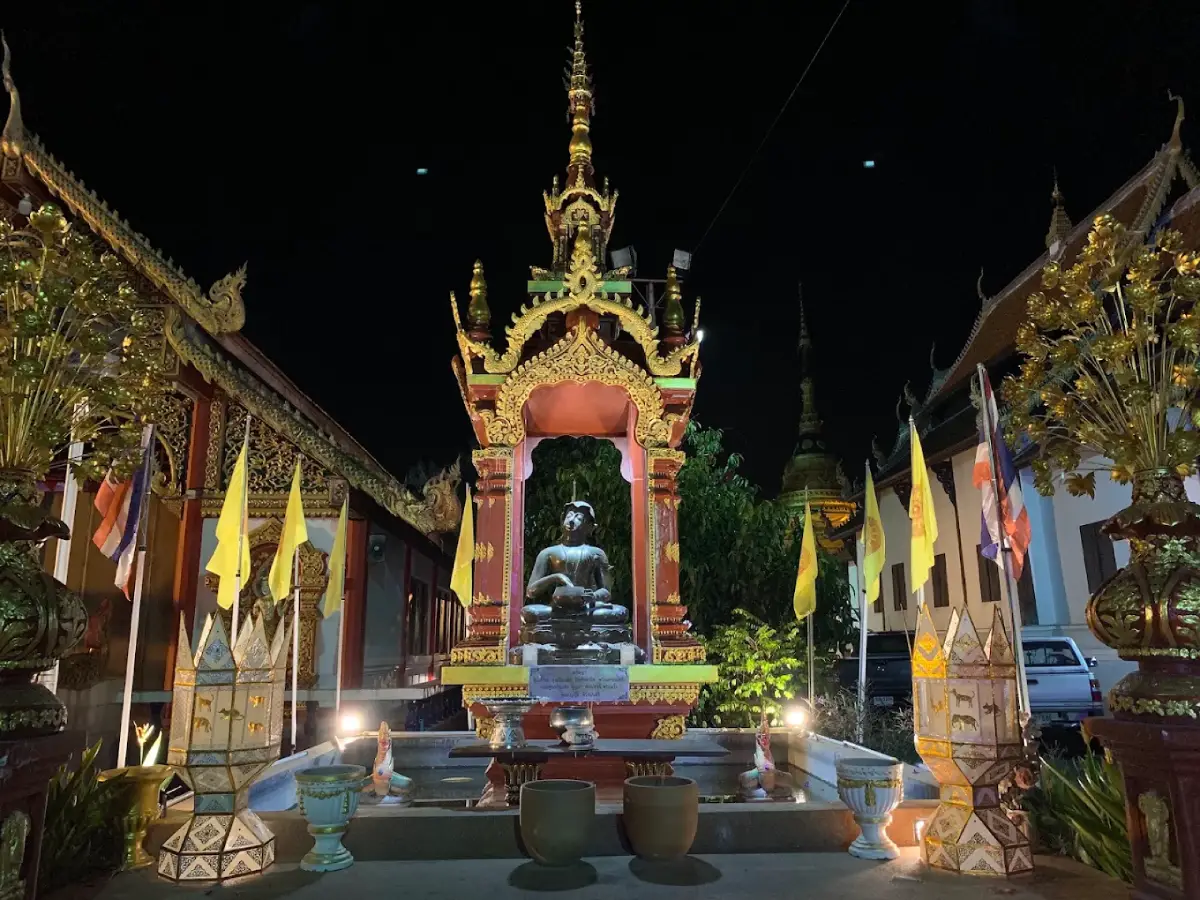
The Replica Stone-Pillar Pavilion is one of the most important structures in the temple. It was built as a place of worship for visitors who come to pay respect to the stone-pillar belief. The building is a Lanna-style cruciform pavilion with a three-tiered roof, ornate gable decoration, floral stucco patterns, colorful glass inlay, and a golden nine-tiered umbrella. The western stairway is decorated with stucco work in the form of makara and naga figures, giving the pavilion a sacred and ceremonial presence.
Inside the pavilion stands a replica stone pillar made of white sandstone. It is octagonal, about 30 centimeters wide and 199 centimeters high, with a lotus-bud finial. Around the main stone pillar are eight white sandstone Buddha images representing the days of birth. Four smaller octagonal attendant pillars are also placed around the central pillar. This arrangement makes the pavilion a key devotional point for visitors and a clear visual expression of the temple’s name and identity.
The old viharn of Wat Sao Hin is another major highlight. It stands on the western side of the temple near Wat Sao Hin School. The building is a modest brick-and-plaster Lanna structure raised on a high base, a feature that reflects the area’s historical relationship with flooding and lowland conditions. Its wooden gable is decorated with carved panels and traditional motifs, showing the craftsmanship of earlier artisans.
The most unusual feature of the viharn is its stairway. Instead of the naga staircase commonly found at many northern Thai temples, the stairway takes the form of a hatsadiling bird, a mythical creature associated with Buddhist and Himavanta traditions. Some visitors may first mistake it for a hen, but the form is more symbolic and unusual than that. The use of this figure demonstrates the creative freedom of local craftsmen and gives the viharn a distinctive identity not commonly found in other temples.
Inside the viharn are 11 Buddha images. The original bronze and stone images were stolen, and the temple later created stucco Buddha images to replace them. This reflects a challenge faced by many old temples: the loss of valuable sacred objects over time. Yet it also shows the temple community’s effort to restore the religious function of the viharn and preserve it as a living place of worship.
The viharn also contains murals depicting the 13 chapters of the Vessantara Jataka. These murals are especially valuable because their style is associated with central Thai craftsmanship from around the reigns of King Rama III to King Rama IV. The paintings provide insight into Buddhist storytelling, moral teaching, artistic exchange between central Thailand and Lanna, and historical visual culture. For travelers interested in Thai art, the viharn is one of the most important parts of Wat Sao Hin.
The main chedi stands behind the viharn. It is believed to have been built over an earlier structure. The chedi is made of brick and plaster in a Burmese-influenced style, set on four receding tiers of indented bases. The lowest tier has lion figures at the four corners, while the upper tiers include narasingha figures and floral motifs. On the northern side is a niche containing a Burmese-style Buddha image. The bell-shaped body is decorated with stucco giant figures and colorful glass floral patterns, and the top is crowned by a golden seven-tiered umbrella.
The chedi reveals the artistic interaction between Lanna and Burmese Buddhist traditions. The use of lion figures, narasingha motifs, glass decoration, guardian figures, and a multi-tiered umbrella reflects northern Thailand’s long history of cultural contact. Visitors should walk around the chedi slowly to observe its layered base and decorative details, as these elements express both artistic beauty and religious symbolism.
The ordination hall stands north of the replica stone-pillar pavilion. It is a Lanna-style structure and is associated with King Sam Fang Kaen, the eighth king of the Mangrai dynasty. Its key features include a high circumambulatory base, distinctive naga forms, a wooden gable decorated with floral carvings, guardian deva stucco figures at the entrance, and two lion figures at the front. The ordination hall strengthens the temple’s identity as a historical Buddhist site linked with the Mangrai lineage.
Wat Sao Hin is a Mahanikaya Buddhist temple with a temple land area of about 14 rai and 2 ngan. The temple includes religious buildings and community spaces such as an ordination hall, monks’ residences, viharn, chedi, principal Buddha images, a school on temple land, and activity areas for local residents. This means Wat Sao Hin functions not only as a historical destination but also as a living temple serving the Ban Sao Hin and Nong Hoi communities.
The atmosphere of Wat Sao Hin is calm and community-based. It is not a heavily commercialized tourist temple. Its value lies in the combination of legend, history, art, and living Buddhist practice. Visitors will find many layers of meaning in a compact temple area: the stone-pillar belief, the unusual hatsadiling stairway, the Vessantara murals, the Burmese-style chedi, and the Lanna ordination hall. Each feature contributes to a deeper understanding of Chiang Mai’s religious and artistic heritage.
For travelers interested in Wiang Kum Kam, Wat Sao Hin should be included in the route. It helps connect archaeological remains with active temples that still serve local communities. A route that includes Wat Sao Hin, Wiang Kum Kam, Wat Chedi Liam, Wat Chang Kham, Wat E-Kang, and Wat San Pa Liang gives visitors a clearer view of ancient settlement, Buddhist architecture, and the continuing relationship between old sacred spaces and modern neighborhoods.
For travelers interested in Buddhist art, Wat Sao Hin offers rich details in several styles. The viharn shows local Lanna creativity. The replica stone-pillar pavilion displays stucco and glass decoration. The chedi shows Burmese influence. The murals inside the viharn show central Thai craftsmanship. This combination makes the temple a strong study site for anyone interested in northern Thai Buddhist art and cultural exchange.
For worshippers, Wat Sao Hin offers peaceful places to pay respect to the principal Buddha images, the replica stone pillar, the birthday Buddha images around the pillar, and the chedi. The stone-pillar belief gives the temple a devotional meaning connected with stability, prosperity, and civic well-being. Visitors who come for merit-making can experience a quiet and respectful atmosphere away from the busiest parts of Chiang Mai.
Getting There is straightforward from central Chiang Mai. From Mahidol Road, enter Mahidol Soi 4 and continue for about 500 meters; the temple will be on the left. From Chiang Mai-Lamphun Road, enter Ban Sao Hin Soi 6 opposite Mae Ping Police Station, continue for about 700 meters, and proceed toward Ban Sao Hin Soi 15 and the temple area. For navigation, use the coordinates 18.753759, 99.003021.
Travelers without a private vehicle can use a local red truck, taxi, or ride-hailing service. The destination should be stated clearly as Wat Sao Hin, Ban Sao Hin, Nong Hoi Subdistrict, Mueang Chiang Mai District, near Wiang Kum Kam. This is important because there are several temples named Wat Sao Hin in Thailand. Using both the temple name and the Nong Hoi location helps avoid confusion.
The best time to visit is in the morning or late afternoon when the weather is more comfortable and the light is suitable for photographing the temple buildings. Visitors should dress respectfully, speak quietly, avoid touching murals or old architectural details, and respect monks and local worshippers. If photographing inside the viharn or near the murals, visitors should check temple signs and avoid using flash.
A visit to Wat Sao Hin can take 30 minutes to one hour for general sightseeing and merit-making. Travelers who want to study the architecture, murals, and historical details should allow more time. A good walking order is the replica stone-pillar pavilion, the old viharn, the murals, the chedi, and the ordination hall. This order helps visitors understand the stone-pillar belief first, then connect it with the temple’s art and historical setting.
Compared with Chiang Mai’s famous old-city temples, Wat Sao Hin is quieter and more local. It is best for travelers who appreciate historical depth, religious art, and community temples that still function in daily life. Its charm comes from layers of history rather than grand scale: the stone-pillar legend, Wiang Kum Kam connection, unusual architecture, murals, chedi, and living community context.
In summary, Wat Sao Hin is an important temple in Nong Hoi for travelers who want to explore Chiang Mai beyond the usual tourist route. The temple combines Wiang Kum Kam history, the sacred stone-pillar belief, Lanna architecture, Burmese-style chedi art, Vessantara Jataka murals, and an ordination hall associated with the Mangrai dynasty. It is a meaningful destination for cultural travelers, Buddhist art enthusiasts, and visitors who want to understand the historical depth of Chiang Mai’s southern communities.
| Name | Wat Sao Hin |
| Location | Ban Sao Hin, Moo 3, Nong Hoi Subdistrict, Mueang Chiang Mai District, Chiang Mai Province |
| Address | 98 Moo 3, Om Mueang Road, Nong Hoi Subdistrict, Mueang Chiang Mai District, Chiang Mai 50000, Thailand |
| Coordinates | 18.753759, 99.003021 |
| Highlights | Replica Stone-Pillar Pavilion, old viharn, hatsadiling stairway, Vessantara Jataka murals, Burmese-style chedi, and Lanna ordination hall |
| History | Associated with Wiang Kum Kam and the Mangrai dynasty; believed to have been built during the Wiang Kum Kam period between 1284 and 1558 CE, with another temple record listing 1376 CE as its construction year |
| Name Origin | Linked with the sacred stone-pillar belief; tradition says the original stone pillar lies beneath the Buddha image base inside the old viharn |
| Distinctive Features | Historic temple near Wiang Kum Kam with Lanna architecture, Burmese artistic influence, central Thai mural style, and a unique stone-pillar legend |
| Travel Information | From Mahidol Road, enter Mahidol Soi 4 for about 500 meters. From Chiang Mai-Lamphun Road, enter Ban Sao Hin Soi 6 for about 700 meters toward Ban Sao Hin Soi 15 and the temple area |
| Current Status | Open daily for worship, merit-making, and cultural visits |
| Open Days | Daily |
| Opening Hours | 08.00 – 17.00 |
| Facilities | Worship areas, merit-making space, temple grounds, a school on temple land, and community activity areas |
| Main Areas / Zones | Replica Stone-Pillar Pavilion, old viharn, chedi, ordination hall, monks’ residences, Wat Sao Hin School, and religious activity areas |
| Main Contact Number | 053-817-129 |
| Nearby Tourist Attractions | 1. Wiang Kum Kam, about 2 km 2. Wat E-Kang, Wiang Kum Kam, about 1 km 3. Wat Chedi Liam, about 2 km 4. Wat Chang Kham, Wiang Kum Kam, about 2 km 5. Wat San Pa Liang, about 2 km |
| Nearby Restaurants | 1. 1027COFFEE, about 1 km, Tel. 090-905-9593 2. Happy Noodle Upgrade Chiang Mai 4, about 1 km, Tel. 081-964-8253 3. Poonsri Nong Hoi, about 1 km, Tel. 098-936-4928, 062-693-5999 4. Mala Hea Hod Ban Sao Hin Soi 11, about 1 km, Tel. 064-971-7500 5. Chaew Hon Nong Hoi Restaurant, about 2 km, Tel. 053-141-197, 097-946-4969 |
| Nearby Accommodations | 1. The Adventure Hotel, about 3 km, Tel. 053-802-444 2. De Wiang Kum Kam, about 3 km, Tel. 094-471-0117 3. Wiang Kum Kam Resort, about 4 km, Tel. 097-949-4227 4. La Mai Hotel Chiang Mai, about 4 km, Tel. 053-140-822 5. B2 Mahidol Boutique & Budget Hotel, about 5 km, Tel. 052-009-161, 088-263-2897 |
Frequently Asked Questions (FAQ)
Q: Where is Wat Sao Hin located?
A: Wat Sao Hin is located at 98 Moo 3, Om Mueang Road, Nong Hoi Subdistrict, Mueang Chiang Mai District, Chiang Mai 50000.
Q: What are the opening days and hours of Wat Sao Hin?
A: Wat Sao Hin is open daily from 08.00 to 17.00.
Q: Why is Wat Sao Hin important?
A: Wat Sao Hin is an old temple near Wiang Kum Kam with a sacred stone-pillar belief, Lanna architecture, Burmese-style chedi art, and important Vessantara Jataka murals.
Q: What is special about the Replica Stone-Pillar Pavilion?
A: The pavilion houses a white sandstone octagonal replica stone pillar measuring about 199 centimeters high, surrounded by eight birthday Buddha images.
Q: What makes the old viharn of Wat Sao Hin distinctive?
A: The viharn is known for its unusual hatsadiling bird stairway, 11 Buddha images, and murals depicting the 13 chapters of the Vessantara Jataka.
Q: How is Wat Sao Hin connected with Wiang Kum Kam?
A: The temple stands within the historical landscape of Wiang Kum Kam and is believed to have been built around the same period as the ancient city.
Q: How can travelers get to Wat Sao Hin?
A: From Mahidol Road, enter Mahidol Soi 4 for about 500 meters. From Chiang Mai-Lamphun Road, enter Ban Sao Hin Soi 6 for about 700 meters, or use the coordinates 18.753759, 99.003021.
Q: What nearby places can be visited with Wat Sao Hin?
A: Nearby places include Wiang Kum Kam, Wat E-Kang, Wat Chedi Liam, Wat Chang Kham, and Wat San Pa Liang.
 Category: ●Places of Worship
 Group: ●Temple
Last Update : 1 WeekAgo
 Last Update : 1 WeekAgo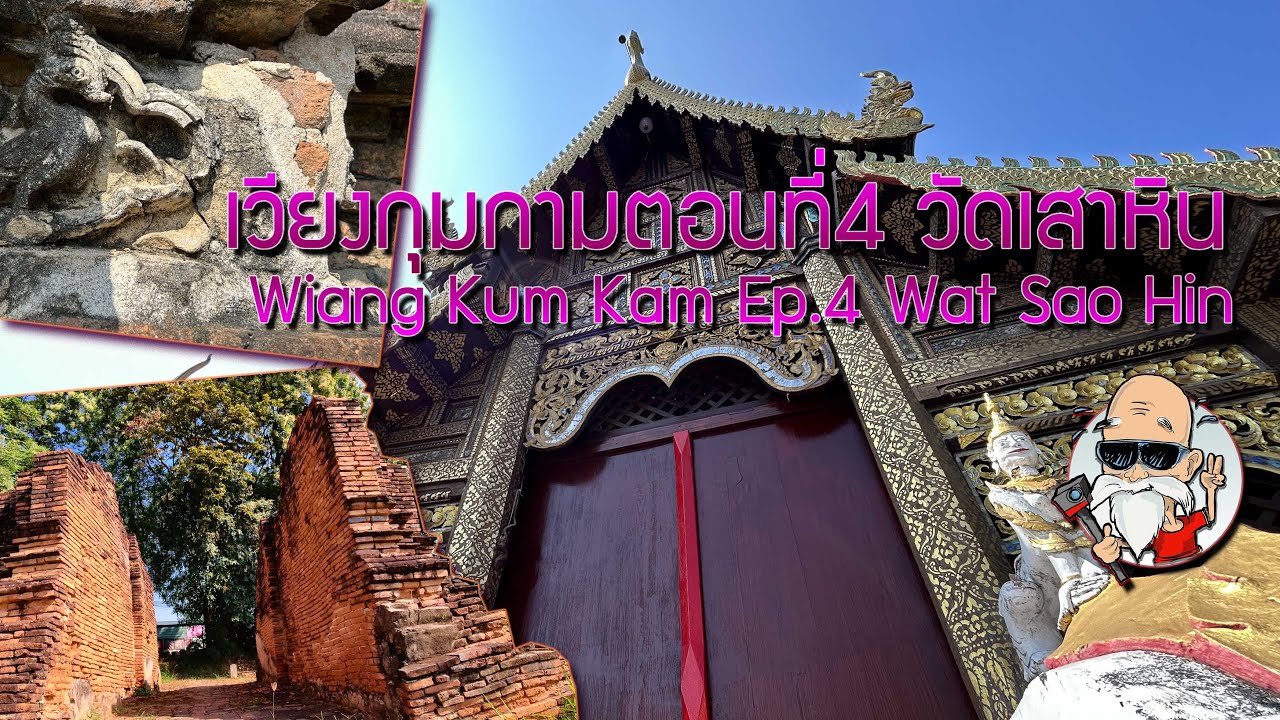
 Click to Access the Navigation Map GPS
Wat Sao Hin Map
Recommend

 Muang Chiang Mai(121)Chom Thong(47)Mae Chaem(25)Chiang Dao(33)Doi Saket(68)Mae Taeng(85)Mae Rim(69)Samoeng(29)Fang(71)Mae Ai(59)Phrao(70)San Pa Tong(103)San Kamphaeng(66)San Sai(73)Hang Dong(74)Hot(32)Doi Tao(22)Omkoi(11)Saraphi(74)Wiang Haeng(15)Chai Prakan(28)Mae Wang(32)Mae On(22)Doi Lo(34)Galyani Vadhana(1)


