
lovethailand home >North Travel Attractions >Chiang Mai Travel Attractions >Muang Chiang Mai >Nong Hoi > Wat San Pa Liang
TL;DR: Wat San Pa Liang is located at Moo 4, Nong Hoi Subdistrict, Mueang Chiang Mai District, Chiang Mai Province, open Daily, hours 08.00 – 17.00.

Wat San Pa Liang
Open Days: Daily
Opening Hours: 08.00 – 17.00
Wat San Pa Liang in Nong Hoi Subdistrict, Mueang Chiang Mai District, Chiang Mai Province, is a local Buddhist temple with a distinctive history, Lanna-style religious architecture, an old scripture hall, the Maha Ratchamongkhon Chedi, and an educational area known as a natural library. Located at 35 Chiang Mai-Lamphun Road, Moo 4, Nong Hoi, the temple covers 2 rai, 3 ngan, and 69 square wah. It is a meaningful place for travelers who want to explore a quieter side of Chiang Mai, learn about a local temple community, and see how a meditation retreat in a wooded area developed into a spiritual center for nearby residents.
Wat San Pa Liang is not a mass-tourism temple built around crowds or large-scale attractions. Its value comes from community memory, Buddhist practice, and the preservation of local Lanna identity. The temple’s origin is connected with Khru Ba Thamthi, a monk who traveled in search of a secluded and peaceful place for meditation. When he reached this area, which was once a dense and tranquil forest, he found it suitable for Dhamma practice and set up his umbrella tent to stay and meditate. Local residents later came to make merit, listen to sermons, and develop faith in his practice. They then built a monk’s residence for him and invited him to establish a temple as a spiritual center for the community.
The temple was originally called Wat Sam Por Liang because three large por trees once stood in a row on a ridge in the temple area. This original name preserved the natural setting of the place before it became a full temple. Over time, the name changed to Wat San Por Liang and eventually became Wat San Pa Liang, the name used today. The name is therefore not just a label; it is a cultural trace of old trees, fields, wooded land, and the early formation of the Nong Hoi community.
Although some sources describe the temple as having been established around 1992, the scripture hall inside the temple is much older. The temple’s scripture hall, or ho tham, was built in 1928 by Khru Ba Chao Phra Khru Suwat Warakhun together with local supporters from Ban San Pa Liang. It was created to preserve Buddhist scriptures, palm-leaf manuscripts, folded paper manuscripts, and old religious documents. This makes the scripture hall one of the most important parts of the temple because it reflects the temple’s earlier role as a place of learning for monks and the surrounding community.
The scripture hall of Wat San Pa Liang is important from religious, artistic, and local historical perspectives. Its architecture follows a Lanna vernacular style. In the past, the exterior walls were decorated with water-mixed powder-paint murals that reflected local Buddhist beliefs and artistic taste. However, the temple stands in a low-lying area that was repeatedly affected by flooding. Sediment and sand accumulated around the building, moisture damaged the old paintings, and wooden components deteriorated over time. These conditions caused the original murals and building materials to suffer serious damage.
In 1993, Phra Khru Sathit Sutaphon Sumangkhalo, together with the Sangha of Nong Hoi Subdistrict and local supporters, initiated a restoration of the scripture hall. The restoration preserved the original structure and the essential Lanna architectural character as carefully as possible. Instead of replacing the old building with a completely new structure, the project restored its historic identity. The damaged exterior paintings were reinterpreted as stucco reliefs covered with lacquer and gold leaf, allowing the visual character of the former artwork to survive in a more durable form.
The gilded stucco work gives the scripture hall a strong artistic identity. The decorative details on the exterior, along with the gable, roof ornaments, and Lanna-style elements, turn the building into more than a storage place for manuscripts. It becomes a visual expression of faith, preservation, and community participation. Visitors should spend time observing this structure carefully, as it is the most culturally significant feature of the temple.
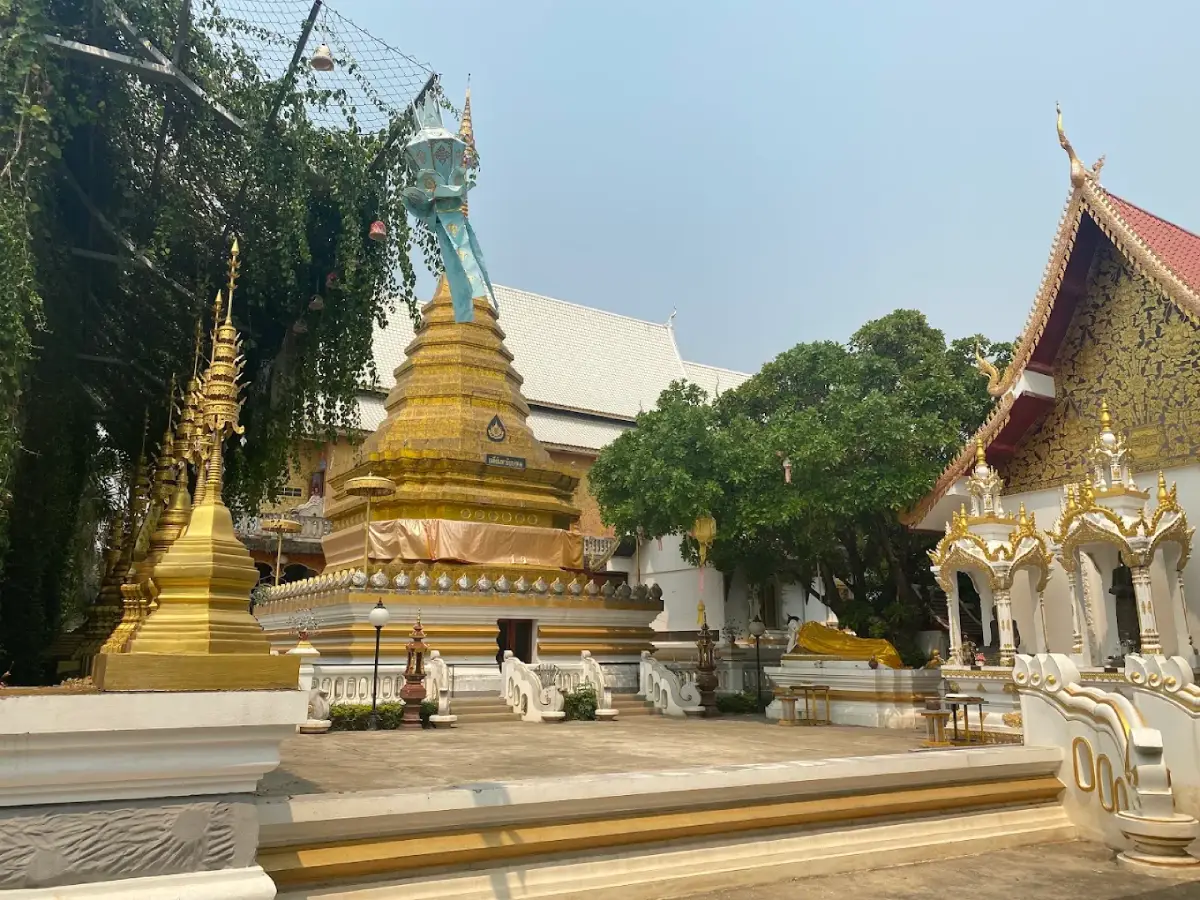
Another major religious landmark inside Wat San Pa Liang is the Maha Ratchamongkhon Chedi. The chedi was built in 1996 by monks, novices, and local supporters who jointly donated funds for its construction. Designed in a Lanna architectural style, it has a base width of 18 sok and a height of 49 sok. Its exterior is covered in gold tones, and relics of the Buddha and arahants are enshrined at the top. The chedi serves as a sacred focal point for worshippers and as an important symbol of Buddhist devotion within the temple.
The Maha Ratchamongkhon Chedi also gives the temple a strong ritual identity. Visitors can pay respect, make merit, and contemplate the teachings of Buddhism in a peaceful community setting. The golden chedi stands as a graceful presence within the temple grounds and forms the center of an annual local tradition: the bathing ceremony of the Maha Ratchamongkhon Chedi relics. This ceremony brings together the temple, Nong Hoi Municipality, local residents, cultural groups, students, monks, and community organizations.
The annual relic-bathing tradition at Wat San Pa Liang reflects the strength of the Nong Hoi community. The event includes offerings of a ceremonial cloth to the chedi, flower-bowl offerings, and a procession carrying sacred water, relic offerings, and cloth toward the temple. The procession includes Lanna-style ceremonial objects, dancers, drums, monks, novices, local residents, schools, and municipal teams. This tradition shows that the temple is not only a place of daily worship but also a living cultural stage where Buddhist devotion and local identity continue to be renewed.
Wat San Pa Liang is also known for its educational park, often described as a natural library. This area is designed for self-directed learning. Visitors and local residents can study materials on their own, borrow items, and return them to their original place. The concept emphasizes shared responsibility rather than formal library service. This makes the temple a community-based learning space as well as a religious site.
The natural library gives Wat San Pa Liang an educational role that extends beyond monks and regular temple-goers. Children, local residents, and interested visitors can use the space to learn independently. The absence of a full-time librarian is part of its philosophy: everyone who uses the space is expected to help care for it. This makes the temple a rare example of a Buddhist community space that combines faith, learning, and civic responsibility.
The overall atmosphere of Wat San Pa Liang is calm, shaded, and local. Visitors will see a temple that still functions in everyday religious life, with worship areas, a viharn, an ordination hall, the scripture hall, the chedi, a bell tower, and community activity spaces. It is not designed as a commercial attraction. Its appeal lies in the way it has grown from local faith and continues to serve people in the area.
A visit to Wat San Pa Liang is best approached slowly. Important points to observe include the restored scripture hall, the Maha Ratchamongkhon Chedi, the educational park, and the calm layout of the temple grounds. The temple is modest in size, but its layered history gives it depth. It is suitable for travelers who prefer cultural detail, local stories, and living Buddhist traditions over quick photo stops.
For visitors interested in Lanna art, the scripture hall is the heart of the temple. It shows how a local community preserved an old religious building while adapting materials for long-term durability. The change from powder-paint murals to gilded stucco reliefs demonstrates a practical approach to conservation in a living temple, where beauty, durability, and faith must coexist.
For visitors interested in local customs, the best time to experience the temple’s community life is during the relic-bathing tradition of the Maha Ratchamongkhon Chedi. During this period, the temple becomes especially lively. Visitors can observe how local people, cultural groups, and public organizations work together to continue a Lanna Buddhist tradition centered on reverence, merit-making, and community participation.
Getting There is convenient by private car, rental car, motorbike, or local ride-hailing service. The temple is located on Chiang Mai-Lamphun Road in Nong Hoi Subdistrict. From central Chiang Mai, visitors can approach the area via Mahidol Road, Chiang Mai-Lamphun Road, or local Nong Hoi routes. For accurate navigation, search for Wat San Pa Liang, Nong Hoi, Mueang Chiang Mai, or use the coordinates 18.75422, 99.01864.
Travelers using local transport should clearly specify that the destination is Wat San Pa Liang in Nong Hoi Subdistrict, Mueang Chiang Mai District. The correct address is 35 Chiang Mai-Lamphun Road, Nong Hoi, Mueang Chiang Mai, Chiang Mai 50000. Using both the temple name and coordinates helps avoid confusion with other places that may have similar names.
The best time to visit is in the morning or late afternoon, when the weather is more comfortable and the light is suitable for photographing the temple architecture. Visitors should dress respectfully, speak quietly, and avoid disturbing monks or local worshippers. If taking photographs inside buildings or around the scripture hall, check temple signs and respect sacred areas at all times.
Wat San Pa Liang can be combined with nearby places such as Suan Sukkhaphap Ban Chaiyaphruek, Wat E-Kang, Wat Chedi Liam, Wiang Kum Kam, and Nong Hoi Market. This route gives travelers a broader view of eastern Chiang Mai beyond the old city. It is suitable for a half-day cultural trip focused on local temples, historical neighborhoods, community life, and Lanna Buddhist heritage.
In summary, Wat San Pa Liang is a valuable Chiang Mai temple for travelers interested in faith, community history, Lanna art, and informal learning spaces. Its most important features are the origin story connected with Khru Ba Thamthi, the former name Wat Sam Por Liang, the scripture hall built in 1928, its restoration in 1993, the Maha Ratchamongkhon Chedi built in 1996, and the annual relic-bathing tradition. For travelers who want to understand Chiang Mai beyond the usual landmarks, Wat San Pa Liang is a meaningful stop in Nong Hoi.
| Name | Wat San Pa Liang |
| Location | Moo 4, Nong Hoi Subdistrict, Mueang Chiang Mai District, Chiang Mai Province |
| Address | 35 Chiang Mai-Lamphun Road, Nong Hoi Subdistrict, Mueang Chiang Mai District, Chiang Mai 50000, Thailand |
| Coordinates | 18.75422, 99.01864 |
| Highlights | Lanna-style scripture hall, Maha Ratchamongkhon Chedi, educational park, and an origin story connected with Khru Ba Thamthi’s meditation retreat |
| History | The temple grew from a meditation site of Khru Ba Thamthi. Its scripture hall was built in 1928, restored in 1993, and the Maha Ratchamongkhon Chedi was built in 1996 |
| Name Origin | Originally called Wat Sam Por Liang because three large por trees stood in a row on a ridge; the name later changed to Wat San Por Liang and then Wat San Pa Liang |
| Distinctive Features | A compact community temple with an old scripture hall, golden chedi, viharn, ordination hall, bell tower, and community learning area |
| Travel Information | Accessible via Chiang Mai-Lamphun Road in Nong Hoi; suitable for private car, rental car, motorbike, or local ride-hailing service |
| Current Status | Open daily for worship, merit-making, and visits |
| Open Days | Daily |
| Opening Hours | 08.00 – 17.00 |
| Facilities | Worship areas, merit-making space, temple grounds, educational park, and community activity areas |
| Main Areas / Zones | Scripture hall, viharn, ordination hall, bell tower, Maha Ratchamongkhon Chedi, educational park, and religious activity areas |
| Abbot / Key Figure | Phra Khru Sathit Sutaphon Sumangkhalo played an important role in the restoration of the temple’s scripture hall |
| Main Contact Number | 053-802-194 |
| Nearby Tourist Attractions | 1. Suan Sukkhaphap Ban Chaiyaphruek, about 0.1 km 2. Wat E-Kang, Wiang Kum Kam, about 2 km 3. Wat Chedi Liam, about 3 km 4. Wiang Kum Kam, about 3 km 5. Nong Hoi Market, about 3 km |
| Nearby Restaurants | 1. Soupthong Tom Lueat Mu Nong Hoi, about 1 km, Tel. 064-648-1629, 085-146-4624 2. Chaew Hon Nong Hoi Restaurant, about 1 km, Tel. 053-141-197, 097-946-4969 3. NONNI Dimsum Nong Hoi, about 2 km, Tel. 084-176-2913 4. Khao Soi Jai Kaew, about 3 km, Tel. 090-332-4989, 081-289-5327 5. Supattra A La Carte Nong Hoi, about 3 km, Tel. 082-081-6091 |
| Nearby Accommodations | 1. B2 Mahidol Boutique & Budget Hotel, about 1 km, Tel. 1328, 052-009-161 2. The Adventure Hotel, about 2 km, Tel. 053-802-444 3. La Mai Hotel Chiang Mai, about 3 km, Tel. 053-140-822 4. De Wiang Kum Kam, about 4 km, Tel. 094-471-0117 5. Wiang Kum Kam Resort, about 5 km, Tel. 097-949-4227 |
Frequently Asked Questions (FAQ)
Q: Where is Wat San Pa Liang located?
A: Wat San Pa Liang is located at 35 Chiang Mai-Lamphun Road, Nong Hoi Subdistrict, Mueang Chiang Mai District, Chiang Mai 50000.
Q: What are the opening days and hours of Wat San Pa Liang?
A: Wat San Pa Liang is open daily from 08.00 to 17.00.
Q: What is Wat San Pa Liang known for?
A: The temple is known for its Lanna-style scripture hall, Maha Ratchamongkhon Chedi, educational park, and origin story connected with Khru Ba Thamthi.
Q: What was Wat San Pa Liang originally called?
A: It was originally called Wat Sam Por Liang because three large por trees once stood in a row on a ridge in the temple area.
Q: Why is the scripture hall important?
A: The scripture hall was built in 1928 to preserve Buddhist scriptures, palm-leaf manuscripts, folded paper manuscripts, and old religious documents.
Q: Does Wat San Pa Liang have an annual tradition?
A: Yes. The temple has the relic-bathing tradition of the Maha Ratchamongkhon Chedi, with offerings, flower-bowl worship, and a Lanna-style procession.
Q: How can travelers get to Wat San Pa Liang?
A: Travelers can use Chiang Mai-Lamphun Road in Nong Hoi or navigate directly to the coordinates 18.75422, 99.01864.
Q: What nearby places can be visited with Wat San Pa Liang?
A: Nearby places include Suan Sukkhaphap Ban Chaiyaphruek, Wat E-Kang, Wat Chedi Liam, Wiang Kum Kam, and Nong Hoi Market.
 Category: ●Places of Worship
 Group: ●Temple
Last Update : 4 DayAgo
 Last Update : 4 DayAgo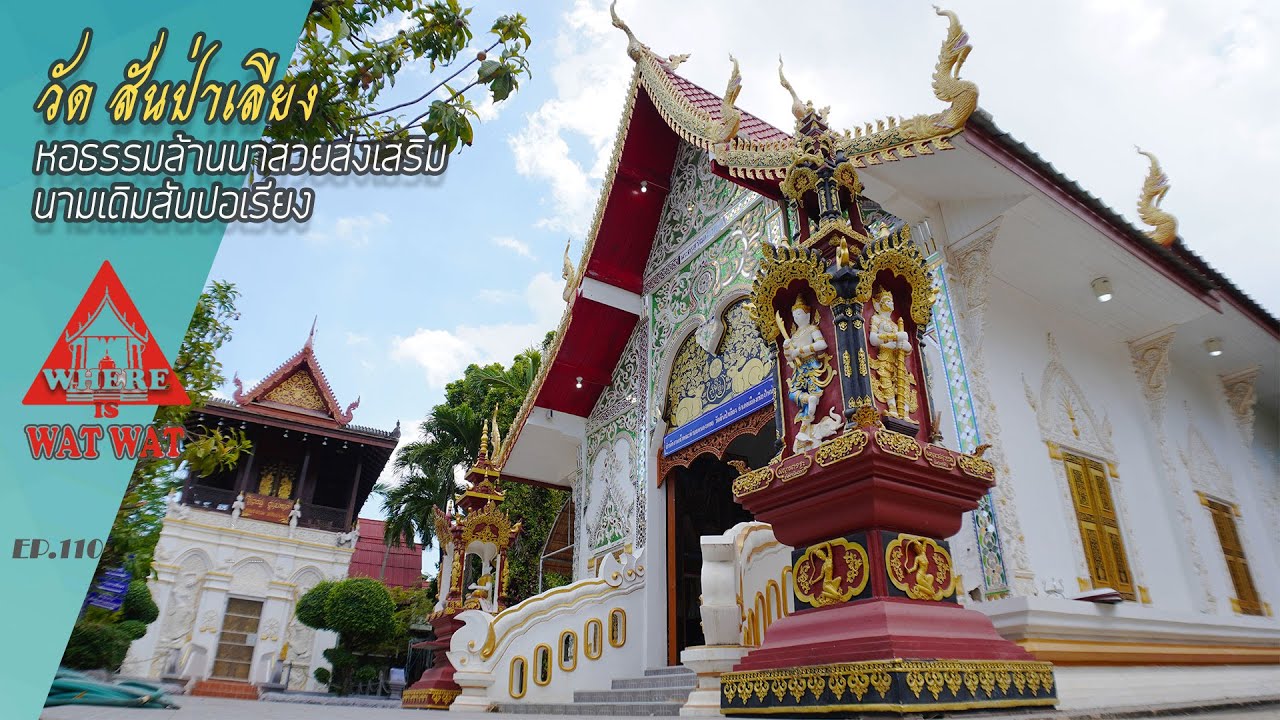
 Click to Access the Navigation Map GPS
Wat San Pa Liang Map
Recommend

 Muang Chiang Mai(121)Chom Thong(47)Mae Chaem(25)Chiang Dao(33)Doi Saket(68)Mae Taeng(85)Mae Rim(69)Samoeng(29)Fang(71)Mae Ai(62)Phrao(70)San Pa Tong(105)San Kamphaeng(66)San Sai(73)Hang Dong(74)Hot(32)Doi Tao(22)Omkoi(11)Saraphi(74)Wiang Haeng(15)Chai Prakan(28)Mae Wang(32)Mae On(22)Doi Lo(34)Galyani Vadhana(1)


