
lovethailand home >North Travel Attractions >Chiang Mai Travel Attractions >Muang Chiang Mai >San Phi Suea > Wat Pa Khoi Nuea
TL;DR: Wat Pa Khoi Nuea is located at Ban Pa Khoi Nuea, Moo 1, San Phi Suea Subdistrict, Mueang Chiang Mai District, Chiang Mai Province, open Daily, hours 08.00 – 17.00.
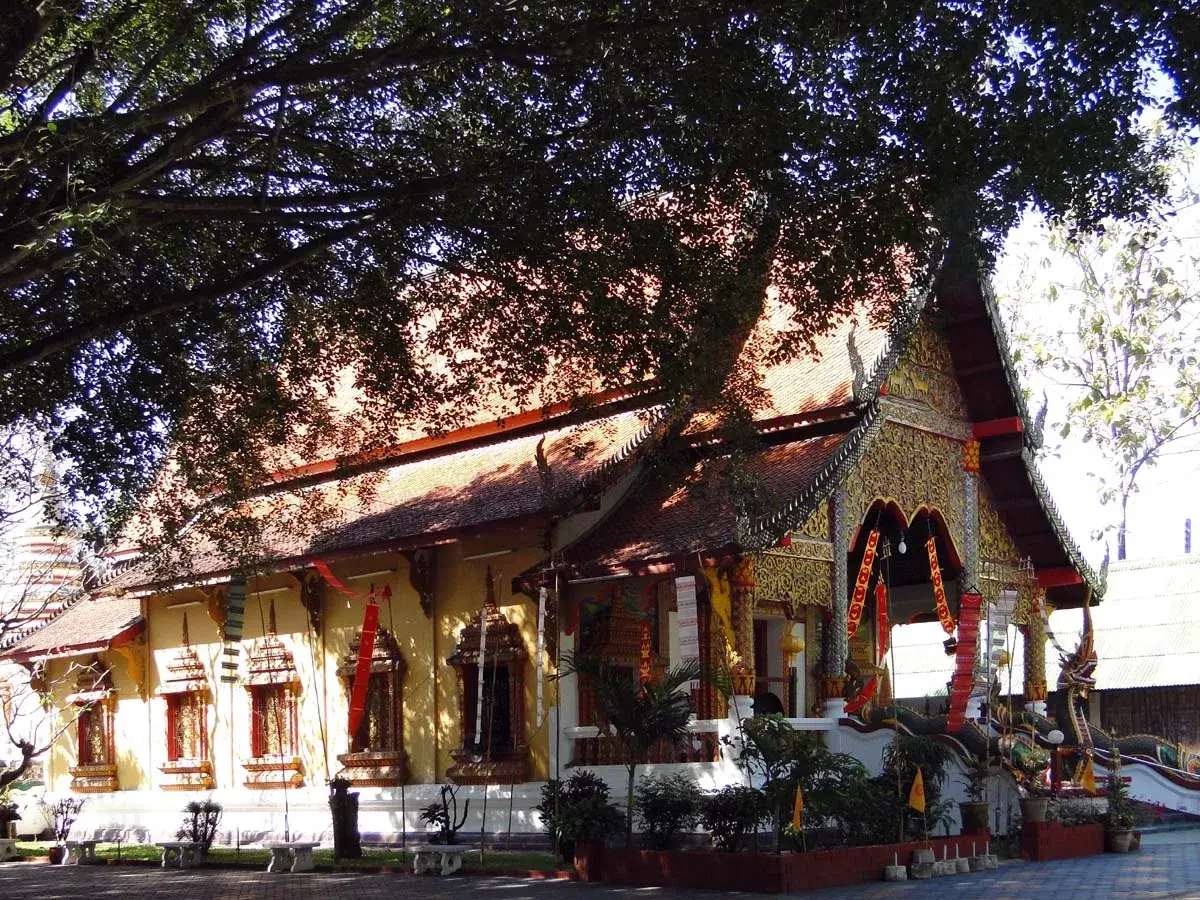
Wat Pa Khoi Nuea
Open Days: Daily
Opening Hours: 08.00 – 17.00
Wat Pa Khoi Nuea in Chiang Mai is a local Buddhist temple under the Maha Nikaya order, located at 63 Moo 1, Ban Pa Khoi Nuea, San Phi Suea Subdistrict, Mueang Chiang Mai District, Chiang Mai 50300. It is an old community temple on the northern side of Chiang Mai city with a history dating back to B.E. 2306, or 1763 CE. The temple is known for its origin as a small monastic residence in an area once dense with khoi trees, its former name Wat Dong Pa Khoi Luang, its revival after being abandoned for many decades, and its continuing role as the spiritual center of Ban Pa Khoi Nuea.
Wat Pa Khoi Nuea is suitable for travelers who want to experience a quieter and more local side of Chiang Mai temple culture. It is not a large tourist temple inside the Old City, but a living community temple in San Phi Suea, an area with a semi-urban and semi-rural character. Around the temple are local houses, community markets, village roads, schools, old temples, and routes connected with the Ping River and northern Chiang Mai. A visit here helps travelers understand Chiang Mai as a network of local communities where temples remain closely connected with faith, daily life, and annual traditions.
The temple occupies 2 rai, 3 ngan, and 83 square wah of land in Ban Pa Khoi Nuea. The name “Pa Khoi Nuea” is linked to the former landscape where khoi trees grew densely, while “Nuea” means north and distinguishes the community from Pa Khoi Tai in the same subdistrict. The temple name therefore preserves both local geography and community memory. It tells visitors that the identity of this place grew from the natural environment before the area developed into the village and temple seen today.
The history of Wat Pa Khoi Nuea began when local Buddhist devotees claimed an open area at the back of the village where khoi trees grew thickly. They established it as a monastic residence and invited monks to stay there, teach Buddhism, guide laypeople, and provide a spiritual center for the community. In its early period, the temple was known as Wat Dong Pa Khoi Luang, a name that clearly reflected the dense khoi-tree landscape and the importance of the monastic site to the surrounding village.
The temple site later became abandoned, with no monks residing there for many decades. This period did not erase the community’s religious memory. Around B.E. 2454, or 1911 CE, records show that monks returned to reside at the temple, working together with local devotees to improve the site, construct monastic buildings, and restore the temple’s function. From that point onward, the temple developed steadily and eventually took the name Wat Pa Khoi Nuea, which remains in use today.
The change from Wat Dong Pa Khoi Luang to Wat Pa Khoi Nuea reflects the temple’s closer connection with the present village name. The new name still preserves the word “Pa Khoi,” keeping the memory of the original tree-filled landscape, while “Nuea” locates the temple clearly within San Phi Suea’s community geography. This makes Wat Pa Khoi Nuea a temple whose name is not an abstract phrase, but a record of nature, settlement, and local identity.
Wat Pa Khoi Nuea received its consecrated boundary, or wisungkhamsima, on March 16, B.E. 2519. The boundary measures 20 meters wide and 40 meters long. This is an important milestone in the temple’s religious development because a consecrated boundary relates to the formal monastic ritual space. Temple history also records that the phanthasima ceremony had not yet been performed because an ubosot had not been constructed according to Buddhist monastic requirements. This gives Wat Pa Khoi Nuea a distinctive profile in the development history of local Buddhist temples.
The heart of Wat Pa Khoi Nuea is not grandeur, but community function. The temple serves as a place for making merit, listening to sermons, participating in Buddhist activities, and gathering for local events. It connects monks, villagers, elders, children, youth, and local organizations through religious and cultural practice. For this reason, the temple should be understood as a living community institution rather than only a point on a travel map.
For cultural travelers, Wat Pa Khoi Nuea is a good entry point into the temple landscape of San Phi Suea. The subdistrict includes several important local temples such as Wat Pa Khoi Tai, Wat Rong O, Wat Tha Duea, and Wat Tha Luk. Visiting Wat Pa Khoi Nuea can therefore be part of a broader route through community temples north of Chiang Mai city. This route offers a different perspective from the Old City temple circuit, showing how Buddhist temples continue to support village life outside the central tourist zone.
The atmosphere of Wat Pa Khoi Nuea is calm, local, and unhurried. Visitors can spend around 30 minutes to 1 hour paying respect, walking through the temple courtyard, observing the entrance, chedi, viharn, worship areas, and monastic spaces. The temple’s appeal lies less in spectacle and more in reading the history of the place through its name, khoi-tree memory, village setting, and revival after a long abandoned period.
The temple compound includes the main elements of a local Buddhist temple: viharn, chedi, temple courtyard, monk residences, worship areas, and spaces used for community activities. The viharn functions as the main hall for worship, sermons, and merit-making, while the chedi serves as a sacred landmark within the temple landscape. These elements work together to form the religious structure of a Lanna community temple.
Wat Pa Khoi Nuea is also linked with local traditions. In B.E. 2569, the temple was the site of a chedi-bathing ceremony attended by the San Phi Suea Municipality and the local community. The bathing of a chedi is an important form of respect in Lanna Buddhist culture. It expresses purification, reverence, renewal, and communal auspiciousness, while also helping preserve local religious traditions.
The temple was also used for a candle-casting and candle-offering ceremony during the Buddhist Lent season in B.E. 2569. This activity allowed local people, children, and youth to participate in merit-making and support monks during the rainy-season retreat. Buddhist Lent candles symbolize light, learning, devotion, and the continuation of Buddhist practice within the community.
The participation of children, youth, local government, and residents in temple activities shows that Wat Pa Khoi Nuea is more than a religious site for older generations. It is a place where people of different ages meet through merit-making, Buddhist learning, cultural participation, and community cooperation. This role is especially important for local temples because it keeps Buddhist traditions connected with everyday life and younger generations.
Phra Athikan Uthen Suchitto is recorded as the abbot of Wat Pa Khoi Nuea. The abbot of a community temple plays a central role in caring for monastic life, maintaining the temple compound, leading ceremonies, coordinating with villagers, and supporting the temple’s ongoing development. The presence of active leadership helps keep Wat Pa Khoi Nuea functioning as a living religious and community center.
For visitors interested in local history, Wat Pa Khoi Nuea is a clear example of how a temple can reflect the development of a village. It began as a monastic residence in a khoi-tree grove, became known as Wat Dong Pa Khoi Luang, was abandoned for a long period, revived around B.E. 2454, and developed into the present Wat Pa Khoi Nuea. This sequence shows that Lanna community temples often pass through periods of growth, abandonment, restoration, and renewed relevance.
For visitors interested in place names, the temple is particularly meaningful. Its name is rooted in real environmental memory. Khoi trees were part of the old landscape, and the word “Nuea” positions the temple in relation to Pa Khoi Tai. The name therefore acts as a cultural map, showing how local people understood and divided their settlement. Wat Pa Khoi Nuea is a useful case for understanding how natural features become preserved in temple names.
Wat Pa Khoi Nuea also works well in a travel route with Wat Pa Khoi Tai because the two names are related and both belong to San Phi Suea. Travelers can compare the northern and southern Pa Khoi communities, then continue to Wat Rong O, Wat Tha Duea, Wat Tha Luk, or Baan Chao Na San Phi Suea. This route expands a single temple visit into a broader understanding of the subdistrict’s cultural landscape.
Compared with temples inside Chiang Mai Old City, Wat Pa Khoi Nuea offers a different kind of value. Old City temples are often known for royal history, large chedis, and highly visited heritage sites. Wat Pa Khoi Nuea is valuable for its community story, local name origin, revival after abandonment, and continuing role in Buddhist activities. It is best suited to travelers who want a slower, more contextual experience of Chiang Mai.
The best time to visit is from morning to before noon, when the atmosphere is quieter and the weather is more comfortable for walking around the temple. Afternoon visits are also possible, but visitors should prepare for stronger sunlight because parts of the compound are open. Those who want to see the temple’s community role may visit during Buddhist activities such as the chedi-bathing ceremony or Buddhist Lent candle events.
Visitors should dress modestly when entering Wat Pa Khoi Nuea. Shoulders should be covered, shorts and skirts should be of appropriate length, and shoes should be removed before entering sacred buildings. Visitors should keep their voices low, avoid disturbing monks or local worshippers, and refrain from touching sacred objects or temple structures unnecessarily.
Photography should be done respectfully. Suitable subjects include the entrance, temple sign, chedi, viharn, courtyard, and surrounding community atmosphere. Visitors should avoid using flash in inappropriate places, avoid photographing monks or worshippers too closely without permission, and should not climb on or touch religious structures. In a community temple, respect for the living religious function of the space is more important than treating the temple only as a photo stop.
Getting There from central Chiang Mai is convenient via Chiang Mai 700-Year Road or routes leading through San Phi Suea toward Ban Pa Khoi Nuea. Travelers can use a private car, red songthaew, taxi, or ride-hailing service. The destination should be entered clearly as Wat Pa Khoi Nuea, 63 Moo 1, San Phi Suea Subdistrict, Mueang Chiang Mai District, to avoid confusion with Wat Pa Khoi Tai or similarly named places.
Drivers should use navigation together with the village and subdistrict names because San Phi Suea has many community lanes and several temples in close proximity. Once inside the village area, visitors should drive carefully because the route passes houses, schools, markets, and local roads. Parking should be done in a considerate way that does not block temple access or community traffic.
A practical half-day route can begin at Wat Pa Khoi Nuea, continue to Wat Pa Khoi Tai, Pa Khoi Tai Market, Wat Rong O, Wat San Mueang Pracharam, or Baan Chao Na San Phi Suea. This route is suitable for travelers who want to see local temples, community markets, learning spaces, and semi-rural Chiang Mai without traveling far from the city.
Food options near Wat Pa Khoi Nuea include coffee shops, made-to-order restaurants, snack shops, local eateries, and restaurants around Pa Khoi Tai Market and San Phi Suea. Nearby accommodations include resorts, boutique hotels, and riverside lodging in the northern Chiang Mai area. This makes the temple convenient for travelers who prefer staying outside the Old City while still having access to central Chiang Mai and the Mae Rim direction.
Overall, Wat Pa Khoi Nuea has several layers of value: its founding in B.E. 2306, its identity rooted in khoi trees, its history of abandonment and revival, its role as the religious center of Ban Pa Khoi Nuea, and its current participation in Buddhist community activities such as chedi bathing and Buddhist Lent candle ceremonies. It is a living temple that preserves local faith rather than a site defined only by architecture.
Wat Pa Khoi Nuea is worth visiting for those interested in old temples, Lanna community history, place-name origins, and slower cultural travel in Mueang Chiang Mai District. Its name, landscape memory, monastic history, community role, and continuing traditions make it more meaningful than a simple worship stop. A visit here offers a deeper understanding of Chiang Mai through faith, village life, and the cultural memory of San Phi Suea.
| Name | Wat Pa Khoi Nuea |
| Location | Ban Pa Khoi Nuea, Moo 1, San Phi Suea Subdistrict, Mueang Chiang Mai District, Chiang Mai Province |
| Address | 63 Moo 1, San Phi Suea, Mueang Chiang Mai District, Chiang Mai 50300, Thailand |
| Coordinates | 18.86817, 98.98700 |
| Land Area | 2 Rai, 3 Ngan, 83 Square Wah |
| Temple Type | Local Buddhist Temple Under The Maha Nikaya Order |
| Highlights | Old community temple of Ban Pa Khoi Nuea, originally known as Wat Dong Pa Khoi Luang, with a history connected to a khoi-tree grove, village faith, abandonment, and revival |
| History | Founded around B.E. 2306, later abandoned for many decades, and clearly revived with resident monks and community development from around B.E. 2454 |
| Consecrated Boundary | Received wisungkhamsima on March 16, B.E. 2519; the boundary measures 20 meters wide and 40 meters long |
| Name Origin | The name comes from the former khoi-tree landscape of Ban Pa Khoi Nuea; “Nuea” distinguishes it from Pa Khoi Tai in San Phi Suea |
| Distinctive Features | Lanna community temple with viharn, chedi, courtyard, monk residences, worship areas, and a calm village atmosphere north of Chiang Mai city |
| Important Sacred Objects And Structures | Viharn, chedi, monk residences, temple courtyard, worship areas, and community Buddhist activity spaces |
| Traditions / Community Activities | Chedi-bathing ceremony, Buddhist Lent candle casting, and Buddhist Lent candle offering with the San Phi Suea community and local organizations |
| Main Areas / Zones | Viharn, chedi, temple courtyard, monk residences, worship areas, community activity spaces, and temple entrance |
| Abbot / Caretaker | Phra Athikan Uthen Suchitto |
| Travel Information | Reachable from central Chiang Mai via Chiang Mai 700-Year Road or San Phi Suea routes toward Ban Pa Khoi Nuea; accessible by private car, red songthaew, taxi, or ride-hailing service |
| Current Status | Open to visitors and worshippers; it remains an active Maha Nikaya community temple with religious and community activities in San Phi Suea |
| Open Days | Daily |
| Opening Hours | 08.00 – 17.00 |
| Main Contact Number | 053-379-607 |
| Nearby Tourist Attractions | 1. Wat Pa Khoi Tai, about 1 km 2. Pa Khoi Tai Market, about 2 km 3. Wat Rong O, about 3 km 4. Wat San Mueang Pracharam, about 3 km 5. Baan Chao Na San Phi Suea, about 5 km 6. Elephant Parade Land, about 6 km |
| Nearby Restaurants | 1. TonWan Coffee, about 0.5 km, Tel. 081-112-9586 2. Nub Duean Ro Pa Khoi Nuea, about 0.8 km, Tel. 081-272-8105, 094-260-2766 3. Ruam Hua Kan Thot, about 1 km, Tel. 064-867-4044 4. Baan Thai, about 2 km, Tel. 064-347-1025, 093-134-6629 5. Som Tam Doctor Pa Khoi Tai, about 2 km, Tel. 097-342-2369, 063-789-5285 6. HOP Chafe Wat Pa Khoi Tai San Phi Suea, about 2 km, Tel. 089-433-8891 |
| Nearby Accommodations | 1. Baan Suan Residence, about 2 km, Tel. 053-110-876 2. B2 Resort Boutique & Budget Hotel, about 4 km, Tel. 052-009-567 3. Homeditation for Dreamers, about 5 km, Tel. 095-698-1895 4. Villa San Pee-Seua, about 5 km, Tel. 053-854-265, 080-015-6789 5. Lanna Dusita Riverside Boutique Resort, about 6 km, Tel. 053-110-345 |
Frequently Asked Questions (FAQ)
Q: Where is Wat Pa Khoi Nuea located?
A: Wat Pa Khoi Nuea is located at 63 Moo 1, Ban Pa Khoi Nuea, San Phi Suea Subdistrict, Mueang Chiang Mai District, Chiang Mai 50300, Thailand.
Q: Why is Wat Pa Khoi Nuea important?
A: Wat Pa Khoi Nuea is an old Maha Nikaya community temple in San Phi Suea. It began as a monastic residence in a dense khoi-tree area, was founded around B.E. 2306, and continues to serve as the spiritual center of Ban Pa Khoi Nuea.
Q: What does the name Wat Pa Khoi Nuea mean?
A: The name comes from an area where khoi trees once grew densely. The word “Nuea” means north and distinguishes this community from Pa Khoi Tai in the same subdistrict.
Q: What are the opening hours of Wat Pa Khoi Nuea?
A: Wat Pa Khoi Nuea is open daily from 08.00 to 17.00.
Q: What traditions or activities are associated with Wat Pa Khoi Nuea?
A: Wat Pa Khoi Nuea is associated with local Buddhist activities such as the chedi-bathing ceremony, Buddhist Lent candle casting, and Buddhist Lent candle offering with the San Phi Suea community.
Q: Can visitors reach Wat Pa Khoi Nuea without a private car?
A: Yes. Visitors can use a red songthaew, taxi, or ride-hailing service from central Chiang Mai by setting the destination as Wat Pa Khoi Nuea, 63 Moo 1, San Phi Suea Subdistrict, Mueang Chiang Mai District.
Q: What nearby attractions can be visited with Wat Pa Khoi Nuea?
A: Nearby attractions include Wat Pa Khoi Tai, Pa Khoi Tai Market, Wat Rong O, Wat San Mueang Pracharam, Baan Chao Na San Phi Suea, and Elephant Parade Land.
Q: What should visitors wear when visiting Wat Pa Khoi Nuea?
A: Visitors should dress modestly, cover their shoulders, wear appropriate-length clothing, remove shoes before entering sacred buildings, keep quiet, and avoid disturbing monks or local worshippers.
 Category: ●Places of Worship
 Group: ●Temple
Last Update : 6 HourAgo
 Last Update : 6 HourAgo
 Click to Access the Navigation Map GPS
 Muang Chiang Mai(121)Chom Thong(47)Mae Chaem(25)Chiang Dao(33)Doi Saket(68)Mae Taeng(85)Mae Rim(69)Samoeng(29)Fang(71)Mae Ai(62)Phrao(70)San Pa Tong(105)San Kamphaeng(66)San Sai(73)Hang Dong(74)Hot(32)Doi Tao(22)Omkoi(11)Saraphi(74)Wiang Haeng(15)Chai Prakan(28)Mae Wang(32)Mae On(22)Doi Lo(34)Galyani Vadhana(1)


