
lovethailand home >North Travel Attractions >Chiang Mai Travel Attractions >Muang Chiang Mai >San Phi Suea > Wat Tha Duea
TL;DR: Wat Tha Duea is located at Ban Tha Duea, Moo 6, San Phi Suea Subdistrict, Mueang Chiang Mai District, Chiang Mai Province, open Daily, hours 08.00 – 17.00.
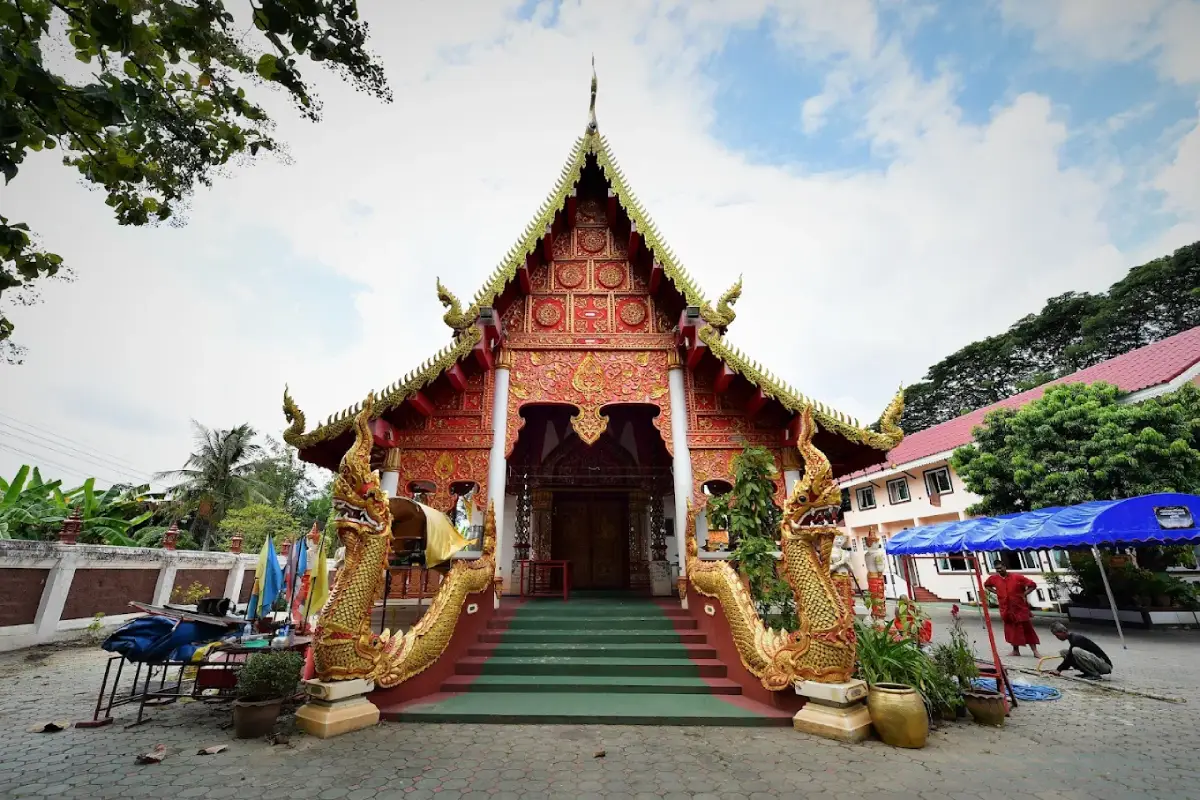
Wat Tha Duea
Open Days: Daily
Opening Hours: 08.00 – 17.00
Wat Tha Duea in Chiang Mai is a local Buddhist temple under the Maha Nikaya order, located at 127 Moo 6, Ban Tha Duea, on the Fa Ham-San Phi Suea Road in San Phi Suea Subdistrict, Mueang Chiang Mai District. It is an old community temple closely connected with Ban Tha Duea, the Ping River landscape, and the quieter northern side of Chiang Mai city. The temple is known for its story of revival from an abandoned temple surrounded by dense fig trees, its important Buddha image known as Phra Chao Saen Sae, its water-surrounded ordination hall built over an old pond, and its continuing role as a spiritual center for the Ban Tha Duea community.
Wat Tha Duea is suitable for travelers who want to see a quieter and more local side of Chiang Mai temple culture. It is not a large or crowded tourist temple like many famous temples in the Old City. Instead, its value lies in its community atmosphere, local history, Buddhist faith, and connection with everyday life in San Phi Suea. Visitors can experience a working village temple, observe the religious buildings, and understand how the temple continues to serve the community around Ban Tha Duea.
The history of Wat Tha Duea begins with an abandoned temple site. The area was once overgrown with dense fig trees and surrounded by rice fields on all four sides. Because of this thick vegetation and its deserted condition, people did not live inside the abandoned temple compound for a long period. Later, Phaya Phitsanu Rattanakraisri, who oversaw the San Phi Suea area, consulted with Khruba Kantha, who was staying at the old temple site, together with around 50 local households. They agreed that the abandoned place should be restored as a proper temple for Ban Tha Duea, giving local Buddhists a place for merit-making, ceremonies, and community devotion.
The restoration began with permission from the Department of Religious Affairs. Khruba Kantha, Phaya Phitsanu, and local villagers then worked together to clear the dense fig trees, build a small monk’s residence, construct a simple viharn roofed with thatch, and install a Buddha image for worship. This transformation from abandoned land into a functioning temple shows the strength of local faith. Wat Tha Duea was not created only by one patron; it grew through the combined effort of monks, local leaders, and villagers who wanted a Buddhist center for their community.
Khruba Kantha later invited Khruba Jui from Wat Mueang Langka to help develop the temple. A more permanent viharn was built, and the community went to Wiang Kum Kam to request a large Buddha image for the new viharn. This image became known as Phra Chao Saen Sae, the principal Buddha image of Wat Tha Duea. The name Saen Sae refers to the pins or joints seen on parts of the Buddha image, giving it a distinctive identity within the temple’s history.
Phra Chao Saen Sae is important to the people of Ban Tha Duea because it serves as the main sacred image of the temple. Local residents have long respected the image and used the temple as a place for worship, merit-making, and Buddhist activities. Because this Buddha image was brought to the temple during the period of revival, it represents the spiritual heart of Wat Tha Duea and the renewal of faith in a once-abandoned temple site.
The Department of Religious Affairs officially named the temple Wat Tha Duea on March 29, 1864. The name is connected with Ban Tha Duea and the original landscape of the area, where fig trees grew densely. In local context, “tha” can refer to a landing place or community access point, especially in riverine settlements, while “duea” refers to fig trees. The name Wat Tha Duea therefore preserves the memory of both the natural environment and the local community identity.
Wat Tha Duea was officially permitted as a temple in B.E. 2407, or 1864 CE, and received its consecrated boundary, or wisungkhamsima, on December 28, B.E. 2533. This consecrated boundary allowed the temple’s ordination hall to be used for formal monastic ceremonies. It marked an important stage in the temple’s development, showing how a community temple grew into a fully recognized Buddhist temple with complete religious functions.
The ordination hall of Wat Tha Duea is one of its most distinctive features. It is a water-surrounded ubosot built over an old pond inside the temple compound and is used for Buddhist monastic ceremonies. The hall was built in B.E. 2532 through donations from a kathina-style merit group from Bangkok and local Buddhists in nearby communities. The building is therefore not only an architectural feature but also a record of shared faith between local residents and supporters from outside the community.
The water-surrounded ubosot gives Wat Tha Duea a special atmosphere. In Thai Buddhist temple culture, water is often associated with purity, calmness, and separation between sacred and ordinary space. By building the ubosot over an old pond, the temple transformed an existing natural feature into a religious landscape. Visitors should observe the relationship between the ordination hall and its surroundings, as this is one of the clearest ways to understand how the temple used its original landscape to create a meaningful sacred space.
The viharn of Wat Tha Duea is the main worship hall for local Buddhists. Inside it stands Phra Chao Saen Sae as the principal Buddha image. The viharn serves as a place for worship, listening to sermons, making merit, and gathering for Buddhist activities. Although the artistic details of the viharn are not as widely documented as those of major Old City temples, its significance lies in its religious role and its connection with the temple’s revival from an abandoned site into a living community temple.
Visitors should understand Wat Tha Duea as a community center, not merely as a sightseeing stop. The temple stands near Ban Tha Duea Community School, Ban Tha Duea market, small local shops, and neighborhood roads leading toward the Ping River. The surrounding area still reflects local life, with small food shops, household businesses, village houses, and community spaces. A visit to Wat Tha Duea therefore gives a different experience from the famous temples of Chiang Mai Old City because it shows the close relationship between temple, school, market, homes, and local life.
Ban Tha Duea is Moo 6 of San Phi Suea Subdistrict, located north of Chiang Mai city. It is a lowland area with the Ping River flowing nearby and road access connecting it to the Chiang Mai 700-Year Road. The community still preserves local networks of families and village life. The area includes Ban Tha Duea school, a morning market, household shops, small restaurants, and local occupations. For this reason, the history of Wat Tha Duea should be read together with the wider history of Ban Tha Duea, because the temple and the community are closely connected.
San Phi Suea is also interesting because it has a semi-rural character within Mueang Chiang Mai District. Although it is part of the city district, the subdistrict still has riverside areas, agricultural traces, village houses, and local learning sites. Travelers who want a break from the busier Old City can use this area as a cultural route along the Ping River. A trip may begin at Wat Tha Duea, continue through Ban Tha Duea, and connect with Wat Tha Luk, Baan Chao Na, or other community-based attractions in San Phi Suea.
Wat Tha Duea continues to relate to Buddhist and community activities in San Phi Suea. The subdistrict organizes religious and cultural activities involving monks, local government, schools, and residents, including projects that promote Buddhist values and local performing arts. These activities show that temples in San Phi Suea are not active only on Buddhist holy days. They also function as places where religion, education, and community life meet.
The recorded line of abbots reflects the continuity of temple care over many generations. Local records mention Phra Bunma, Phra Khammun, Phra Khampan, Phra Khamla, Phra Krongkaeo, Phra Khamla, Phra Khru Sutham Siriwanno, Phra Thip Kittipanno, Phra Khammun, and Phra Samuh Sawai Thirachitto. Recent ecclesiastical and temple activity information also identifies Phra Samuh Sawai Thirachitto as the abbot of Wat Tha Duea. This continuity shows that the temple remains under active monastic care and continues to function as a religious center for the community.
For travelers interested in local history, Wat Tha Duea is valuable as an example of a temple restored through village faith. The story of the dense fig trees, rice fields, clearing of the abandoned site, small monk’s residence, thatched viharn, installation of Phra Chao Saen Sae, and later construction of a water-surrounded ubosot all show the gradual development of a Lanna community temple. The temple did not grow only through official policy or major patronage; it grew through the persistent faith of local villagers.
For visitors interested in sacred objects, the most important image to pay respect to is Phra Chao Saen Sae in the viharn. The story of bringing the image from Wiang Kum Kam gives it a special place in the temple’s history. It is not just a Buddha image placed in a hall, but a sacred object connected with the revival of the temple and the faith of Ban Tha Duea villagers. Paying respect to this image is therefore the most meaningful devotional act at Wat Tha Duea.
For those interested in northern Thai temple architecture, the water-surrounded ubosot and the temple layout are the main points to observe. The ubosot is distinctive because it was built over an old pond, while the viharn remains the main worship space for the community. A visit to Wat Tha Duea should therefore focus not only on ornate craftsmanship but also on how each building functions in the religious life of the temple and the community.
As a travel destination, Wat Tha Duea works well in a half-day route around San Phi Suea and northern Chiang Mai. Visitors can worship at Wat Tha Duea, walk or drive through Ban Tha Duea, stop at the local morning market if visiting early, continue to Baan Chao Na for a community-based rural experience, or visit Wat Tha Luk, another old temple in the subdistrict. Those who want a broader route can continue toward Wat Chet Yot or family-friendly attractions on the northern side of Chiang Mai.
The main appeal of Wat Tha Duea is its quiet and local character. Visitors do not need to rush. A visit of around 30 minutes to 1 hour is suitable for paying respect, viewing the viharn, seeing the water-surrounded ubosot, walking around the courtyard, and observing the village setting. Morning is a good time to combine the temple with nearby community life, while afternoon visitors should prepare for stronger sunlight because some areas of the temple compound are open.
Visitors should dress modestly when visiting Wat Tha Duea. Shoulders should be covered, shorts or skirts should be of appropriate length, and shoes should be removed before entering the viharn or ubosot. Visitors should keep their voices low, avoid climbing on religious structures, and avoid touching sacred objects unnecessarily. If a ceremony or local activity is taking place, visitors should keep a respectful distance and avoid disturbing monks or villagers.
Getting There from central Chiang Mai is convenient by using the Chiang Mai 700-Year Road or the Fa Ham-San Phi Suea route toward Ban Tha Duea. From Chiang Mai Old City, the distance is about 12 km, depending on the starting point and traffic. Travelers without a private vehicle can use a red songthaew, taxi, or ride-hailing service by setting the destination as Wat Tha Duea, Ban Tha Duea, San Phi Suea, Mueang Chiang Mai District.
Drivers should use navigation carefully because Chiang Mai Province has more than one temple named Wat Tha Duea, including temples in San Pa Tong District and Doi Tao District. This article refers only to Wat Tha Duea in Ban Tha Duea, San Phi Suea Subdistrict, Mueang Chiang Mai District. Including the village, subdistrict, and district name in the search or navigation app will help avoid confusion.
For a fuller trip, Wat Tha Duea can be combined with attractions in San Phi Suea such as Ban Tha Duea market, Baan Chao Na, Wat Tha Luk, and riverside areas along the Ping River. It can also be used as a stop before continuing toward Mae Rim or the northern side of Chiang Mai. The temple is suitable for worshippers, local-history travelers, and visitors who want to see a quieter Chiang Mai community away from the main Old City temple circuit.
In summary, Wat Tha Duea is an important community temple in San Phi Suea with several layers of value. It preserves the memory of an abandoned temple revived from dense fig trees and rice fields, the role of Phaya Phitsanu Rattanakraisri, Khruba Kantha, Khruba Jui, and around 50 local households, the sacred Phra Chao Saen Sae Buddha image, the water-surrounded ubosot built over an old pond, and the temple’s location within Ban Tha Duea by the Ping River. It should not be seen merely as a small local temple in Chiang Mai, but as a living record of Lanna community faith, cooperation, and continuity.
| Name | Wat Tha Duea |
| Location | Ban Tha Duea, Moo 6, San Phi Suea Subdistrict, Mueang Chiang Mai District, Chiang Mai Province |
| Address | 127 Moo 6, Fa Ham-San Phi Suea Road, San Phi Suea, Mueang Chiang Mai District, Chiang Mai, Thailand |
| Highlights | Old community temple revived from an abandoned site surrounded by fig trees, with Phra Chao Saen Sae as the principal Buddha image and a water-surrounded ubosot built over an old pond |
| History | Officially permitted as a temple in B.E. 2407 and received its consecrated boundary on December 28, B.E. 2533 |
| Name Origin | Named after Ban Tha Duea and the former landscape where dense fig trees grew before the abandoned temple was restored |
| Distinctive Features | Viharn housing Phra Chao Saen Sae, water-surrounded ubosot, temple courtyard, and a quiet community-temple atmosphere near the Ping River |
| Important Sacred Objects And Structures | Phra Chao Saen Sae, viharn, water-surrounded ubosot, monk residences, and community worship areas |
| Main Areas / Zones | Viharn, water-surrounded ubosot, temple courtyard, monk residences, worship areas, and community activity spaces |
| Abbot / Caretaker | Phra Samuh Sawai Thirachitto |
| Travel Information | From central Chiang Mai, take Chiang Mai 700-Year Road or the Fa Ham-San Phi Suea route to Ban Tha Duea. The temple is about 12 km from the Old City and can be reached by private car, red songthaew, taxi, or ride-hailing service |
| Current Status | Open to visitors and worshippers; it remains an active Maha Nikaya Buddhist temple used by monks and the Ban Tha Duea community |
| Open Days | Daily |
| Opening Hours | 08.00 – 17.00 |
| Main Contact Number | 053-855-115 |
| Nearby Tourist Attractions | 1. Ban Tha Duea Market, about 1 km 2. Baan Chao Na San Phi Suea, about 2 km 3. Wat Tha Luk, about 3 km 4. Wat Kha Jao, about 5 km 5. Hidden Village Chiang Mai, about 6 km 6. Wat Chet Yot, about 8 km |
| Nearby Restaurants | 1. Krua Makham Wan, about 1 km 2. Pa Jit Tha Duea Khao Soi, about 1 km 3. Food For You Restaurant, about 4 km, Tel. 092-642-9414 4. Made To Order San Phi Suea, about 4 km, Tel. 063-104-4780 5. Kub Khao Kub Kaeng Madame, about 5 km, Tel. 062-440-9161 6. E-saan 102 Restaurant, about 5 km, Tel. 081-035-3797 |
| Nearby Accommodations | 1. B2 Resort Boutique & Budget Hotel, about 4 km, Tel. 052-009-567 2. Baan Suan Residence, about 4 km, Tel. 053-110-876 3. Villa San Pee Seua, about 5 km, Tel. 080-015-6789 4. Homeditation for Dreamers, about 5 km, Tel. 095-698-1895 5. Lanna Dusita Riverside Boutique Resort, about 6 km, Tel. 053-110-345 |
Frequently Asked Questions (FAQ)
Q: Where is Wat Tha Duea located?
A: Wat Tha Duea is located at 127 Moo 6, Ban Tha Duea, Fa Ham-San Phi Suea Road, San Phi Suea Subdistrict, Mueang Chiang Mai District, Chiang Mai Province.
Q: Why is Wat Tha Duea important?
A: Wat Tha Duea is an old community temple revived from an abandoned site surrounded by dense fig trees. It became the main Buddhist center of Ban Tha Duea and remains closely connected with local community life.
Q: What are the main highlights of Wat Tha Duea?
A: The main highlights are Phra Chao Saen Sae, the viharn, the water-surrounded ubosot built over an old pond, and the quiet community-temple setting near the Ping River.
Q: What are the opening hours of Wat Tha Duea?
A: Wat Tha Duea is open daily from 08.00 to 17.00.
Q: What is Phra Chao Saen Sae?
A: Phra Chao Saen Sae is the large principal Buddha image enshrined in the viharn of Wat Tha Duea and is the most important sacred object for the Ban Tha Duea community.
Q: Can visitors reach Wat Tha Duea without a private car?
A: Yes. Visitors can take a red songthaew, taxi, or ride-hailing service from central Chiang Mai by setting the destination as Wat Tha Duea, Ban Tha Duea, San Phi Suea.
Q: What nearby attractions can be visited with Wat Tha Duea?
A: Nearby attractions include Ban Tha Duea Market, Baan Chao Na San Phi Suea, Wat Tha Luk, Wat Kha Jao, Hidden Village Chiang Mai, and Wat Chet Yot.
Q: What should visitors wear when visiting Wat Tha Duea?
A: Visitors should dress modestly, cover their shoulders, wear appropriate-length clothing, remove shoes before entering sacred buildings, keep quiet, and avoid disturbing monks or local worshippers.
 Category: ●Places of Worship
 Group: ●Temple
Last Update : 1 WeekAgo
 Last Update : 1 WeekAgo
 Click to Access the Navigation Map GPS
Wat Tha Duea Map
Recommend

 Muang Chiang Mai(121)Chom Thong(47)Mae Chaem(25)Chiang Dao(33)Doi Saket(68)Mae Taeng(85)Mae Rim(69)Samoeng(29)Fang(71)Mae Ai(59)Phrao(70)San Pa Tong(105)San Kamphaeng(66)San Sai(73)Hang Dong(74)Hot(32)Doi Tao(22)Omkoi(11)Saraphi(74)Wiang Haeng(15)Chai Prakan(28)Mae Wang(32)Mae On(22)Doi Lo(34)Galyani Vadhana(1)


