
lovethailand home >North Travel Attractions >Chiang Mai Travel Attractions >Muang Chiang Mai >Si Phum > Wat Rajamontean
TL;DR: Wat Rajamontean is located at Sri Phum Road, Si Phum Subdistrict, Mueang Chiang Mai District, Chiang Mai Province, open Daily, hours 07.00–18.00.

Wat Rajamontean
Open Days: Daily
Opening Hours: 07.00–18.00
Wat Monthian also known as Wat Rajamontean, is a historic Buddhist temple on Sri Phum Road in Chiang Mai Old City. Located at 149 Sri Phum Road, Si Phum Subdistrict, Mueang Chiang Mai District, Chiang Mai Province, the temple is associated with King Tilokarat, Queen Maha Devi, and Phra Maha Yan Khamphi Maha Thera. Its main highlights include the two-storey Lanna-style Lai Kham viharn, the sandstone Phra Phuttha Ratcha Monthian Buddha image, the large Phra Chao Luang Than Jai statue, old bronze Buddha images, Phra Phum Kao Tue, a Buddha-image-base inscription dated 1492, and a convenient location beside Chiang Mai’s northern moat.
Wat Monthian is one of the historic temples of Chiang Mai Old City, valued for its Lanna history, Buddhist significance, architecture, and living faith. The temple stands on Sri Phum Road in Si Phum Subdistrict, Mueang Chiang Mai District, Chiang Mai Province, along the northern moat of the Old City. Its location places it close to Wat Lok Moli, Wat Khuan Khama, Chang Phueak Gate, and Hua Lin Corner. From the street and moat area, visitors can easily notice the large Phra Chao Luang Than Jai Buddha image before entering the temple compound to worship and explore the richly decorated Lai Kham viharn.
The temple’s older name is Wat Rajamontean, a name that reflects its connection with a royal residence and royal patronage. In the Lanna historical context, “Rajamontean” refers to a royal mansion or palace-related structure. According to temple history, King Tilokarat and Queen Maha Devi ordered the old royal residence to be dismantled and rebuilt as a monastery for Phra Maha Yan Khamphi Maha Thera and his monastic community. The former name therefore preserves more than a place name. It records the transformation of a royal site into a Buddhist religious space.
Wat Monthian is associated with the year 1431, an important period in the history of Chiang Mai. The temple’s foundation is connected with the transition from Phaya Sam Fang Kaen to Thao Lok, who was later known as King Tilokarat. King Tilokarat became one of the major rulers of the Mangrai dynasty and played an important role in the development of Buddhism, learning, and art in Lanna. Wat Monthian is therefore significant as a temple connected with the beginning of his reign and with the wider religious climate of Chiang Mai in that period.
A traditional religious chronicle records that when King Tilokarat heard that Phra Maha Yan Khamphi had returned with the Buddhist teaching, he and Queen Maha Devi were filled with faith. They then ordered the old royal residence to be converted into a dwelling place for the great monk. The temple was named Wat Rajamontean. This story shows that the temple was not created as an ordinary neighborhood monastery. It was founded to support an important monk involved in the preservation and spread of Buddhism.
Phra Maha Yan Khamphi Maha Thera is central to the identity of Wat Monthian. He is remembered as the first abbot of the temple, a learned monk, and a respected figure among Lanna Buddhists. His role extended beyond this temple. He was associated with the strengthening of Buddhism in Lanna and with religious links reaching Kengtung and Sipsong Panna. For this reason, Wat Monthian should be understood not only as a temple with beautiful architecture but also as a site connected with learned monastic leadership in Lanna history.
During the flourishing period of the Mangrai dynasty, Wat Rajamontean was an important monastery under royal patronage. It served as a residence for prominent monks, a place of religious activity, and a symbol of the relationship between kingship, the sangha, and the urban community. Although the present temple compound is not large, its historical status is substantial. The temple represents a layer of Chiang Mai’s religious history that connects the Old City with royal Buddhist patronage.
When the Lanna kingdom declined and Chiang Mai came under Burmese influence for more than 200 years, many temples in the city deteriorated. Wat Rajamontean was part of this wider pattern of decline. Later, during the revival of Chiang Mai under King Kawila, important temples in the Old City were restored so they could return to religious use. Wat Monthian therefore reflects the broader story of Chiang Mai itself: prosperity, decline, restoration, and continuity.
The temple compound covers about 2 rai and 3 ngan. It is compact but rich in important features. Within the grounds are the large Phra Chao Luang Than Jai statue, the two-storey Lai Kham viharn, Phra Phuttha Ratcha Monthian, old Buddha images, Phra Phum Kao Tue, a dressed reclining Buddha image, principal Buddha images on both levels of the viharn, and areas used for merit-making and monastic activity. This makes Wat Monthian a valuable stop for visitors who want to see a smaller temple with dense historical and artistic content.
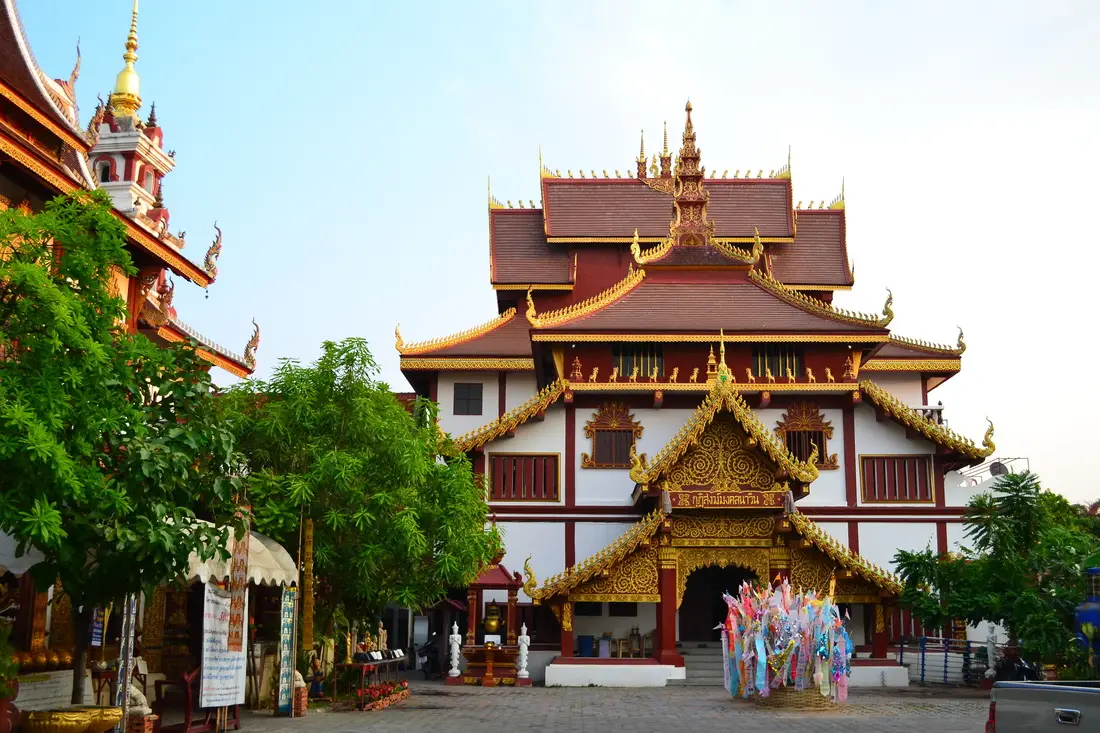
The most important architectural feature of the temple is the Lai Kham Viharn, a two-storey Lanna-style Buddha hall. The building is decorated with stucco work and Lanna gold-pattern ornamentation, giving rise to the name “Lai Kham,” or gold-patterned hall. The older viharn had deteriorated over time, and the present hall was rebuilt and restored between 2002 and 2006 under the leadership of Phra Maha Chatchawan Chotithammo and the temple’s supporters. The new building preserves Lanna artistic identity while serving the practical religious needs of the temple today.
The Lai Kham viharn has a notable functional arrangement. The first floor is used for merit-making by lay worshippers, while the second floor is used for formal monastic acts by monks and novices. The interior includes central columns and surrounding verandas, while the exterior entrance is decorated with applied Lanna stucco motifs, Ava glass, and gold leaf. The result is a striking contemporary Lanna religious building rooted in traditional forms and visual language.
The beauty of the Lai Kham viharn comes from more than color. It lies in the combination of structure, proportion, pattern, and Buddhist meaning. Lanna gold-pattern work uses fine lines, floral motifs, scrolling forms, and auspicious elements to create a sacred atmosphere. When light catches the glass and gold leaf, the façade becomes visually radiant even though the compound itself is not large. Visitors should take time to observe the entrance, walls, verandas, decorative details, and Buddha images inside.
Inside the viharn are mural paintings that narrate episodes in the life of Phra Maha Yan Khamphi. The paintings show themes such as ordination, religious propagation, the journey to Sri Lanka to preserve Buddhism, and the return to Chiang Mai to spread the teaching. These murals are not merely decorative. They help visitors understand the temple’s historical figure through images and make the viharn a space of visual storytelling as well as worship.
The main Buddha image of the viharn is Phra Phuttha Ratcha Monthian, a dressed Lanna-style Buddha image carved from sandstone. This sandstone Buddha image is one of the temple’s defining features. Sandstone Buddha images are not commonly produced in Chiang Mai today, and the idea recalls older Lanna traditions, including the sandstone Buddha image associated with Wat Ram Poeng during the time of King Mueang Kaeo. The use of sandstone from Phayao gives this temple a distinctive identity among Chiang Mai Old City temples.
Phra Phuttha Ratcha Monthian is important not only because of its material but also because it connects the restoration of the viharn with the continuation of temple faith. The sandstone surface gives the Buddha image a sense of weight, calmness, and permanence different from metal or stucco images. Visitors should observe the face, attire, proportions, and placement of the image within the hall. It is one of the strongest artistic markers of Wat Monthian.
The Buddha images created together with the new Lai Kham viharn comprise 7 images: the principal Buddha image on the first floor, the principal Buddha image on the second floor, 4 secondary principal images, and 1 dressed reclining Buddha image. This arrangement makes the viharn a major worship area within the temple. It also allows visitors to experience several forms of Buddhist imagery in a single building.
Wat Monthian also preserves a number of older Buddha images with artistic and devotional value. These include the former principal Buddha image of the old viharn, Phra Phum Kao Tue, Phra Chao Phum or Phra Phum in the Mara-subduing posture, bronze Buddha images, and the principal image of the old ubosot. These images show that the temple is not significant only because of modern restoration. It also continues to preserve older Lanna religious art.
Phra Phum Kao Tue is especially meaningful because it is described as having been created in connection with Phra Chao Kao Tue of Wat Suan Dok. This connection reveals a network of faith among important temples in Chiang Mai. Wat Monthian should therefore be understood as part of Chiang Mai’s wider Buddhist landscape rather than as an isolated temple. Recognizing these links gives a visit to the temple greater historical depth.
Another important image is associated with Phra Maha Yan Khamphi and Sri Lanka. Historical tradition states that the monk brought several sacred items from Lanka, including a Bodhi tree branch, a Buddha image, scriptures, and a chest. The Bodhi branch was planted at Wat Pa Daeng, the scriptures were taken to Wat Pa Tan, and the Buddha image was preserved at Wat Monthian. This links the temple with wider Buddhist networks beyond Lanna and highlights the role of monks who traveled, studied, and brought sacred objects back to Chiang Mai.
One of the most visible features of Wat Monthian today is Phra Chao Luang Than Jai, the large Buddha image prominently enshrined within the temple compound. The image has a lap width of about 5.5 meters and a height of about 11 meters. It was built through the faith of Buddhist devotees during the restoration of the temple. Its size and position make it highly visible from Sri Phum Road and the moat, and it has become one of the modern visual symbols of Wat Rajamontean.
The name “Than Jai” is commonly associated with focused prayer and quick fulfillment in popular devotion. From a cultural-travel perspective, however, the important point is that the image connects an old Lanna temple with contemporary Buddhist practice. It gives modern visitors a clear focal point for worship while also drawing them into the older historical layers of the temple, including the Lai Kham viharn, sandstone Buddha image, old bronze images, and inscription evidence.
Another important historical source is the Wat Monthian Buddha-image-base inscription, dated to 1492. The inscription appears on the base of a bronze Buddha image in the Mara-subduing posture. It uses Lanna Tham script and Thai language, and its content is related to the creation of a Buddha image, donations, and merit-making in the Lanna period. This evidence links the temple with a specific date, object, script tradition, and act of Buddhist devotion.
The 1492 inscription shows that the creation of Buddha images in the past was not only an artistic act. It was also part of a social and religious system involving donations, merit-making, monks, and lay supporters. A Buddha image could therefore function as both a sacred object and a historical document. When visiting Wat Monthian, the old images and inscriptions should be read as evidence of past lives, faith, and community relationships.
Wat Monthian underwent significant restoration from 2000 onward. The restoration included the development of the two-storey Lanna-style viharn, the sandstone principal Buddha image, and support for monks and novices. This restoration helped bring an old temple back into active use and gave the compound a strong visual identity. The temple seen today is therefore a combination of old historical memory and modern Buddhist renewal.
In artistic terms, Wat Monthian is distinctive for its deep red, gold, stucco, and Lai Kham decorative language. The viharn differs from wooden or whitewashed Lanna temples through its stronger color scheme and elaborate ornamentation. Ava glass, gold leaf, and stucco motifs create a vivid exterior, while Phra Chao Luang Than Jai provides a large visual anchor visible from the moat. These elements make the temple highly recognizable among Chiang Mai Old City temples.
Wat Monthian is also well suited to a walking route through the northern part of Chiang Mai Old City. It is close to Wat Lok Moli across the moat, Wat Khuan Khama, Chang Phueak Gate, Wat Chiang Yuen, and Sri Phum Road’s cafés and restaurants. Visitors can begin at Wat Lok Moli, cross toward Wat Monthian, continue to Wat Khuan Khama and Chang Phueak Gate, or move back into the Old City toward Wat Chiang Man, Three Kings Monument, Chiang Mai City Arts & Cultural Centre, and Lanna Folklife Museum.
Getting There is easy. Visitors staying inside Chiang Mai Old City can walk or cycle along the northern moat to reach the temple. Wat Monthian is located at 149 Sri Phum Road in Si Phum Subdistrict, close to the bridge leading across to Wat Lok Moli. From Chang Phueak Gate, it is within a short walking distance. Travelers coming from outside the Old City can use a red songthaew, tuk-tuk, taxi, rental car, or ride-hailing service by setting the destination to Wat Rajamontean or Wat Monthian on Sri Phum Road.
Visitors arriving by private car should allow extra time for parking. The temple is located along Sri Phum Road in the Old City, where traffic can be steady throughout the day. Parking within or near the temple is limited, especially on weekends, in the evening, and during festivals. For travelers planning to visit several nearby temples, parking once and continuing on foot is usually the most practical approach. Walking also allows visitors to enjoy the moat, old streets, small lanes, cafés, and nearby temples more naturally.
The best times to visit are morning and late afternoon. The weather is usually more comfortable, and natural light brings out the details of the Lai Kham viharn, Phra Chao Luang Than Jai, stucco decoration, and gold ornamentation. Morning is suitable for worship and quiet photography, while late afternoon works well for a temple walk followed by nearby cafés or restaurants. The moat-side view and the front of the viharn are useful angles for photography.
Temple etiquette is important because Wat Monthian remains an active Buddhist temple. Visitors should dress respectfully, remove shoes before entering religious buildings, keep voices low, avoid touching Buddha images, inscriptions, or old objects unnecessarily, and avoid disturbing monks or worshippers. Photography should be done with consideration, especially inside the viharn or around people making merit. A respectful visit helps preserve the calm atmosphere and religious value of the site.
Wat Monthian helps visitors understand Chiang Mai at several levels. On the urban level, it stands beside the northern moat and Sri Phum Road. On the royal level, its old name connects it with a royal residence and King Tilokarat. On the monastic level, it is associated with Phra Maha Yan Khamphi. On the artistic level, it preserves Lanna gold-pattern decoration, a sandstone Buddha image, and old bronze images. On the community level, it continues to be a place for worship, merit-making, and quiet reflection.
What makes Wat Monthian stand out is the way it brings together royal Lanna history, the transmission of Buddhism, Lai Kham art, sandstone Buddha-image carving, Phra Chao Luang Than Jai, and inscription evidence in one compact compound. A general visit does not require much time, but visitors who want to understand the temple properly should allow 45 minutes to 1 hour. This gives enough time to worship, observe the building details, and appreciate the historical layers of the site.
Wat Monthian is also suitable for comparing Lanna temple styles. It can be visited together with Wat Lok Moli, known for its historic atmosphere and large chedi; Wat Khuan Khama, with its own local story; Wat Chiang Man, one of Chiang Mai’s oldest temples; and Wat Phra Singh, a major royal temple. In this group, Wat Monthian is especially distinctive for its Lai Kham viharn, sandstone Buddha image, and the large Phra Chao Luang Than Jai statue.
For a half-day route in the northern Old City, visitors can start at Wat Lok Moli, cross the moat to Wat Monthian, continue to Wat Khuan Khama and Chang Phueak Gate, then stop at nearby cafés or restaurants along Sri Phum and Singharat roads. With more time, the route can extend to Wat Chiang Man, Three Kings Monument, Chiang Mai City Arts & Cultural Centre, Lanna Folklife Museum, and Wat Chedi Luang. This route reveals the relationship between temples, the moat, city gates, museums, and Old City life.
Overall, Wat Monthian is a highly worthwhile temple for visitors who want to understand Chiang Mai in depth. Its value is not limited to the large Phra Chao Luang Than Jai statue visible from the street. The deeper importance lies in the history of Wat Rajamontean, the transformation of a royal residence into a monastery, the role of Phra Maha Yan Khamphi, the two-storey Lai Kham viharn, Phra Phuttha Ratcha Monthian, Phra Phum Kao Tue, old Buddha images, and the 1492 inscription. For a meaningful temple walk in Chiang Mai Old City, Wat Monthian deserves a clear place in the itinerary.
| Name | Wat Monthian |
| Other Names | Wat Rajamontean / Wat Ratchamonthian |
| Temple Type | Private Buddhist Temple Under The Maha Nikaya Order |
| Location | Sri Phum Road, Si Phum Subdistrict, Mueang Chiang Mai District, Chiang Mai Province |
| Address | 149 Sri Phum Road, Si Phum Subdistrict, Mueang Chiang Mai District, Chiang Mai 50200, Thailand |
| Coordinates | 18.79544, 98.98270 |
| Temple Area | About 2 Rai 3 Ngan |
| Highlights | Two-storey Lai Kham viharn, Phra Phuttha Ratcha Monthian, Phra Chao Luang Than Jai, Phra Phum Kao Tue, old Buddha images, a 1492 Buddha-image-base inscription, and a moat-side Old City location |
| History | Founded in 1431 as Wat Rajamontean, associated with King Tilokarat, Queen Maha Devi, and Phra Maha Yan Khamphi Maha Thera in the Lanna period |
| Name Origin | The former name Wat Rajamontean comes from the royal residence that King Tilokarat had converted into a monastery for Phra Maha Yan Khamphi and his monastic community |
| Distinctive Features | A red-and-gold Lanna temple beside the moat, with Lai Kham decoration, stucco work, Ava glass, gold leaf, and a dressed sandstone Buddha image |
| Important Objects And Areas | Lai Kham viharn, Phra Phuttha Ratcha Monthian, Phra Chao Luang Than Jai, principal Buddha images on the first and second floors, 4 secondary Buddha images, a dressed reclining Buddha image, Phra Phum Kao Tue, bronze Buddha images, and the Buddha-image-base inscription |
| Traditions / Rituals | Worship, merit-making, alms and offering ceremonies, devotion to Phra Chao Luang Than Jai, and formal monastic acts on the second floor of the viharn |
| Travel Information | Accessible on foot, by bicycle, red songthaew, tuk-tuk, taxi, rental car, or ride-hailing service; set the destination to Wat Monthian or Wat Rajamontean on Sri Phum Road in Chiang Mai Old City |
| Current Status | Open as an active Buddhist temple for worship, merit-making, and cultural visits |
| Open Days | Daily |
| Opening Hours | 07.00–18.00 |
| Fees | Free Entry |
| Facilities | Worship area, merit-making area, offering area, Lai Kham viharn, temple courtyard, and limited parking depending on Old City conditions |
| Main Areas / Zones | Phra Chao Luang Than Jai area, first floor of the Lai Kham viharn, second floor of the Lai Kham viharn, sandstone Buddha image area, old Buddha image area, temple courtyard, and monastic area |
| Nearby Tourist Attractions | 1. Wat Lok Moli, about 0.2 km 2. Wat Khuan Khama, about 0.2 km 3. Chang Phueak Gate, about 0.4 km 4. Wat Chiang Yuen, about 0.6 km 5. Wat Chiang Man, about 0.8 km 6. Three Kings Monument, about 1.1 km 7. Chiang Mai City Arts & Cultural Centre, about 1.1 km 8. Lanna Folklife Museum, about 1.2 km |
| Nearby Restaurants | 1. Rich Garden House Homemade Bakery & Cafe, about 0.1 km, Tel. 053-223-838 2. Khao Soi Khun Yai, about 0.3 km 3. Jok Sompet, about 0.8 km, Tel. 053-210-649 4. Fern Forest Cafe, about 1 km, Tel. 053-416-204 5. Baan Landai Fine Thai Cuisine, about 1.2 km, Tel. 065-848-4464 6. Its Good Kitchen, about 1.5 km, Tel. 089-432-2323 |
| Nearby Accommodations | 1. Rich Garden House Boutique Hotel, about 0.1 km, Tel. 053-223-939 2. ISTY Design Hotel, about 0.6 km, Tel. 053-230-662 3. Glory Boutique Suites, about 0.8 km, Tel. 052-000-559 4. POR Singharat, about 0.9 km, Tel. 095-050-5049 5. The Twenty Lodge, about 1 km, Tel. 053-326-233 6. 99 The Heritage Hotel, about 1.3 km, Tel. 053-326-287 |
Frequently Asked Questions (FAQ)
Q: Where is Wat Monthian located?
A: Wat Monthian is located at 149 Sri Phum Road, Si Phum Subdistrict, Mueang Chiang Mai District, Chiang Mai Province, beside the northern moat of Chiang Mai Old City near Wat Lok Moli, Wat Khuan Khama, and Chang Phueak Gate.
Q: What are the opening hours of Wat Monthian?
A: Wat Monthian is open daily from 07.00 to 18.00. Morning and late afternoon are suitable times to worship and view the Lai Kham viharn because the weather is more comfortable and the natural light highlights the temple’s details.
Q: Is there an admission fee for Wat Monthian?
A: No. Wat Monthian has free entry. Visitors can enter for worship, merit-making, and cultural sightseeing while observing proper temple etiquette.
Q: Why is Wat Monthian historically important?
A: Wat Monthian was formerly known as Wat Rajamontean. It was founded in 1431 and is associated with King Tilokarat, Queen Maha Devi, and Phra Maha Yan Khamphi Maha Thera, making it an important Lanna-period temple in Chiang Mai Old City.
Q: What are the main highlights of Wat Monthian?
A: The main highlights are the two-storey Lai Kham viharn, the sandstone Phra Phuttha Ratcha Monthian Buddha image, the large Phra Chao Luang Than Jai statue, old Buddha images, Phra Phum Kao Tue, and the 1492 Buddha-image-base inscription.
Q: How large is Phra Chao Luang Than Jai?
A: Phra Chao Luang Than Jai has a lap width of about 5.5 meters and a height of about 11 meters. It is the large Buddha image prominently visible from Sri Phum Road and the moat.
Q: What is special about the Lai Kham viharn?
A: The Lai Kham viharn is a two-storey Lanna-style Buddha hall. The first floor is used for merit-making, while the second floor is used for formal monastic acts. It contains important Buddha images and murals about Phra Maha Yan Khamphi.
Q: What nearby places can be visited with Wat Monthian?
A: Nearby places include Wat Lok Moli, Wat Khuan Khama, Chang Phueak Gate, Wat Chiang Yuen, Wat Chiang Man, Three Kings Monument, Chiang Mai City Arts & Cultural Centre, and Lanna Folklife Museum.
 Category: ●Places of Worship
 Group: ●Temple
Last Update : 4 DayAgo
 Last Update : 4 DayAgo
 Click to Access the Navigation Map GPS
Wat Rajamontean Map
Recommend

 Muang Chiang Mai(121)Chom Thong(47)Mae Chaem(25)Chiang Dao(33)Doi Saket(68)Mae Taeng(85)Mae Rim(69)Samoeng(29)Fang(71)Mae Ai(62)Phrao(70)San Pa Tong(105)San Kamphaeng(66)San Sai(73)Hang Dong(74)Hot(32)Doi Tao(22)Omkoi(11)Saraphi(74)Wiang Haeng(15)Chai Prakan(28)Mae Wang(32)Mae On(22)Doi Lo(34)Galyani Vadhana(1)


