
lovethailand home >North Travel Attractions >Chiang Mai Travel Attractions >Muang Chiang Mai >Si Phum > Wat Thung Yu
TL;DR: Wat Thung Yu is located at Ratchadamnoen Road, Si Phum Subdistrict, Mueang Chiang Mai District, Chiang Mai Province, open Daily, hours 08.00 – 17.00.

Wat Thung Yu
Open Days: Daily
Opening Hours: 08.00 – 17.00
Wat Thung Yu is a historic Buddhist temple in Chiang Mai Old City, located at 1 Ratchadamnoen Road, Si Phum Subdistrict, Mueang Chiang Mai District. It stands close to Wat Phra Singh, Wat Si Koet, and the Sunday Walking Street route. The temple is significant for its association with the Mangrai dynasty period, its name connected with the ancient word “thui yu,” meaning a ceremonial umbrella used as a symbol of rank, its Lanna-style viharn, small marble-faced and gilded ubosot, round chedi with Burmese-Mon artistic influence, and an important Buddha-image-base inscription dating to B.E. 2037.
Wat Thung Yu is a public Buddhist temple under the Maha Nikaya sect. It is located at 1 Ban Thung Yu, Ratchadamnoen Road, Si Phum Subdistrict, Mueang Chiang Mai District, Chiang Mai Province, inside the historic core of Chiang Mai Old City. The temple stands in one of the city’s most culturally important walking areas, close to Wat Phra Singh, Wat Si Koet, Wat Chai Phra Kiat, Wat Pha Bong, Wat Chedi Luang, Wat Phan Tao, and the Sunday Walking Street route along Ratchadamnoen Road. This makes Wat Thung Yu a practical and meaningful stop for visitors who want to combine temple worship, Lanna architecture, and Old City walking routes in a single itinerary.
The character of Wat Thung Yu is not defined by monumental scale. Its value lies in the density of historical and artistic layers contained within a relatively compact temple compound. The temple preserves a memory of early Lanna history, a name connected with ancient literature and traditional rank symbolism, traces of restoration by Chiang Mai rulers, Lanna-style monastic architecture, and a chedi whose form reflects Burmese and Mon artistic influence. Visitors who walk into the temple encounter a quiet neighborhood temple rather than a crowded landmark, but the site rewards careful observation.
The history of Wat Thung Yu should be understood as a layered historical record. Local sources describe it as an old temple from the Mangrai dynasty period, and its name appears in the Nirat Hariphunchai, a classical northern Thai literary work composed around B.E. 2060. Another record states that the temple was founded in B.E. 2119 and was formerly known as Wat Tuy Yu, Wat Thui Yu, or Wat Ban Thung Yu. The source material also preserves a tradition that the temple may have been founded as early as B.E. 2019. These different dates are best read together as evidence of the temple’s deep historical roots rather than as a simple modern chronology. Like many old Lanna temples, Wat Thung Yu carries oral memory, written records, later temple documentation, and material evidence within the same site.
One of the strongest historical anchors for Wat Thung Yu is the inscription on the base of a Buddha image from the temple. This inscription, written in Fak Kham script and Thai language, records the creation of a bronze Buddha image in the Mara-Vijaya posture in B.E. 2037. The Buddha image associated with the inscription is 94 centimetres high and was found at Wat Thung Yu in Si Phum Subdistrict, Mueang Chiang Mai District. Epigraphic evidence is especially important because it gives the temple a dated historical connection to Buddhist patronage in Chiang Mai in the late 15th century CE.
The name Wat Thung Yu is also culturally important. The word “thui yu” appears in old literature and legal texts and refers to an umbrella used as a ceremonial insignia of rank for nobles or rulers. This meaning connects the temple name with the symbolic vocabulary of Lanna court culture. Another local explanation links the name to the phrase “thung yu,” meaning a field where grass used for making brooms once grew. Both interpretations show that the temple name carries linguistic, social, and community memory. It is not merely a label on a map, but a clue to the cultural world of old Chiang Mai.
The temple’s changing names—Tuy Yu, Thui Yu, Ban Thung Yu, and Wat Thung Yu—also reflect the way place names evolve across speech, manuscripts, temple records, and official usage. Many Lanna temples preserve such layered naming histories. In the case of Wat Thung Yu, the name helps visitors understand how local language, social rank, craft memory, and Buddhist place-making intersected in Chiang Mai’s Old City.
Wat Thung Yu was restored and supported by Chiang Mai rulers over time. A key record states that in B.E. 2452, Chao Inthawarorot Suriyawong, the eighth ruler of Chiang Mai, commissioned the umbrella finial for the temple chedi. In Buddhist and Lanna symbolic language, the umbrella finial carries strong associations with honor, protection, and veneration. This act of restoration shows that Wat Thung Yu remained a temple of recognized importance in the city, even as Chiang Mai entered a period of political and administrative transition.
Wat Thung Yu received its royal grant of consecrated boundary on 26 October B.E. 2516. This consecrated boundary is significant because it defines the ritual area for the ubosot, where formal monastic acts are performed. The ubosot is therefore more than a small architectural structure. It is a sacred ritual space tied to ordination, monastic discipline, and the continuity of the Sangha within the temple.
The temple covers 2 rai, 3 ngan and 64 square wah. Its position on Ratchadamnoen Road places it within one of Chiang Mai’s most important historic urban axes. Today, Ratchadamnoen Road is widely known for the Sunday Walking Street, but historically it has also linked temples, communities, houses, and civic spaces within the Old City. Wat Thung Yu therefore belongs to a living cultural landscape, not an isolated tourist attraction.
The temple compound includes a viharn, ubosot, preaching hall, monks’ quarters, multipurpose hall, chedi, and courtyard. These elements make Wat Thung Yu a complete neighborhood temple. The viharn supports public worship and merit-making. The ubosot serves formal monastic ceremonies. The preaching hall and multipurpose hall support community activities and Buddhist events. The monks’ quarters sustain daily monastic life. The chedi functions as a sacred architectural focus and a visual marker of the temple’s historical identity.
The viharn of Wat Thung Yu is a key structure for appreciating Lanna architecture. It has a curved eyebrow-like arch without the usual honeycomb-style decorative panel. The pediment is decorated with stucco vine motifs and Ava-style glass. These features give the viharn a distinctive appearance among Chiang Mai’s Old City temples. The curved architectural lines soften the front elevation, while the gilded and reflective decorative surfaces create a sense of sacred brightness. Visitors should begin by observing the façade before entering or moving through the compound, because the front of the viharn reveals the craftsmanship and restoration history of the temple.
The temple also preserves a gilded brick-and-plaster Buddha image as an important object of worship. In Lanna Buddhist temples, Buddha images are not only works of art. They are devotional centers, communal anchors, and material expressions of merit-making across generations. The gilded surface reflects the faith of donors, craftsmen, monks, and local residents who contributed to the temple’s religious continuity.
The ubosot of Wat Thung Yu is a small Lanna-style structure built with concrete, faced with marble, lacquered and gilded, and decorated with wall paintings. Its roof ornaments and finial elements are made from gilded teak. This combination of concrete, marble, lacquer, gold, teak carving, and murals gives the building a distinctive character. The small scale of the ubosot makes its details easier to observe closely, especially for visitors interested in temple restoration and northern Thai craftsmanship.
The chedi is one of the temple’s most important sacred structures. It is a round chedi originally based on a Lanna form, set upon a square relic-chamber base. Later restoration introduced Burmese and Mon stylistic influence. This should not be treated as a loss of authenticity. Instead, it is evidence of artistic movement and cultural exchange in northern Thailand. Chiang Mai has long been connected with surrounding regions through religion, trade, migration, and patronage, and the chedi of Wat Thung Yu preserves a compact visual record of that interaction.
Wat Thung Yu is also important for its epigraphic and Buddha-image history. The Buddha-image-base inscription records the creation of a bronze Buddha image in B.E. 2037. Another inscription, connected with a silver Buddha-image niche, records activity in B.E. 2479 and refers to the making of many silver Buddha images associated with Phra Aphaisaratha and his pupils. Such inscriptions show how Buddhist devotion was recorded through image-making, offerings, restoration, and written dedication. Visitors should understand these records as historical evidence rather than assume that every object mentioned in old inscriptions remains on display in the temple today.
The known line of abbots at Wat Thung Yu includes Phra Uttama Panya, also known as Khruba Uttama, Khruba Chan, Khruba Photha, Phra Aphaisaratha or Uttha Aphiwangso, Phra Thep Wisutthachan, Phra Khru Yongyut Yanasophano, and Phra Khru Samuh Bunruang Chotipunyo. This succession of monastic leadership shows the temple’s continuity as a living religious institution. Wat Thung Yu is not only a historic site. It remains a Buddhist temple cared for by monks and connected with the surrounding community.
For travelers, Wat Thung Yu is especially valuable because it sits very close to Wat Phra Singh but receives less attention from casual visitors. Those who come to the Old City only for the most famous temples may overlook it, yet the temple adds depth to a cultural itinerary. It helps visitors understand that Chiang Mai’s religious landscape is made not only of major royal temples, but also of neighborhood temples that preserve local history, craft traditions, Buddhist learning, and community identity.
A good visit to Wat Thung Yu should begin at the entrance on Ratchadamnoen Road. Visitors can observe the temple’s position within the Old City street grid, then walk slowly through the compound to view the viharn, ubosot, chedi, and courtyard. On Sundays, visitors should allow extra travel time because Ratchadamnoen Road becomes part of the Sunday Walking Street route and can be crowded. Morning or late afternoon visits are usually more comfortable for worship, photography, and architectural observation.
International visitors should treat Wat Thung Yu as an active place of worship rather than only a photography location. Modest clothing is expected. Shoulders and knees should be covered. Visitors should speak quietly, remove shoes before entering sacred buildings, avoid touching Buddha images, murals, old wooden objects, and religious items, and avoid entering monks’ residential areas without permission. These basic practices help protect the temple’s calm atmosphere and show respect to the monks and local community.
Getting There is simple. Visitors staying in Chiang Mai Old City, near Wat Phra Singh, Ratchadamnoen Road, Samlan Road, Inthawarorot Road, or the Three Kings Monument area can walk to Wat Thung Yu easily. From Tha Phae Gate, walk west along Ratchadamnoen Road toward Wat Phra Singh for about 1.3 kilometres. From Chiang Mai International Airport, the temple can be reached by taxi, ride-hailing service, or rental car in about 15–25 minutes depending on traffic. From Chiang Mai Railway Station, travel via Charoen Mueang Road toward Tha Phae Gate and continue into Ratchadamnoen Road.
Wat Thung Yu works well as part of an Old City walking route linking Wat Phra Singh, Wat Thung Yu, Wat Si Koet, Wat Chai Phra Kiat, Wat Pha Bong, Wat Chedi Luang, Wat Phan Tao, and the Three Kings Monument. This route is suitable for visitors who want to compare large landmark temples, smaller community temples, Lanna architecture, and the urban heritage of Chiang Mai in a half-day walk.
Admission to Wat Thung Yu is free. The temple is suitable for visitors who want a calm and economical cultural stop in the Old City. Donations may be made at designated points, but visitors do not need to disturb monks or temple caretakers. Because the temple compound is modest in size, it is best experienced through slow observation, respectful worship, and attention to details rather than a rushed photo stop.
In summary, Wat Thung Yu is a historically rich temple whose value is greater than its physical size. It brings together Mangrai-period memory, a culturally meaningful name, Buddha-image inscriptions, Lanna architecture, restoration history under Chiang Mai rulers, and a strategic location on Ratchadamnoen Road. For travelers seeking a deeper view of Chiang Mai beyond major landmarks, Wat Thung Yu offers a quiet, detailed, and culturally grounded encounter with the Old City.
| Name | Wat Thung Yu |
| Place Type | Public Buddhist Temple / Historic Temple In Chiang Mai Old City |
| Location | Ratchadamnoen Road, Si Phum Subdistrict, Mueang Chiang Mai District, Chiang Mai Province |
| Address | 1 Ban Thung Yu, Ratchadamnoen Road, Si Phum Subdistrict, Mueang Chiang Mai District, Chiang Mai 50200, Thailand |
| Coordinates | 18.788602, 98.984151 |
| Highlights | Mangrai-period historical roots, Lanna-style viharn, small marble-faced and gilded ubosot, round chedi with Burmese-Mon influence, and Buddha-image-base inscription dated B.E. 2037 |
| History / Period | An old temple of Chiang Mai associated with the Mangrai dynasty period. Its name appears in the Nirat Hariphunchai around B.E. 2060. Temple records state that it was founded in B.E. 2119 and received its royal consecrated boundary on 26 October B.E. 2516. |
| Name Origin | Formerly known as Wat Tuy Yu, Wat Thui Yu, or Wat Ban Thung Yu. The word “thui yu” refers to a ceremonial umbrella used as an insignia of rank, while another local explanation connects the name with a field of grass used for making brooms. |
| Sacred Objects / Key Evidence | Gilded brick-and-plaster Buddha image, round chedi, Buddha-image-base inscription from Wat Thung Yu, and historical evidence related to silver Buddha images |
| Artistic Features | Viharn with a curved eyebrow-like arch, stucco vine motifs, Ava-style glass decoration, Lanna-style ubosot with marble facing, gilded teak elements, and wall paintings |
| Main Areas | Viharn, ubosot, preaching hall, monks’ quarters, multipurpose hall, chedi, and temple courtyard |
| Getting There | Walk from Wat Phra Singh, Ratchadamnoen Road, Samlan Road, or the Three Kings Monument area, or travel by red songthaew, tuk-tuk, taxi, ride-hailing service, rental motorbike, or private car |
| Current Status | Open to visitors and remains an active Buddhist temple in Chiang Mai Old City |
| Open Days | Daily |
| Opening Hours | 08.00 – 17.00 |
| Admission Fee | Free Admission |
| Buddhist Sect | Maha Nikaya |
| Temple Area | 2 rai, 3 ngan, 64 square wah |
| Consecrated Boundary | Granted on 26 October B.E. 2516 |
| Abbot / Caretaker | Phra Khru Samuh Bunruang Chotipunyo |
| Main Contact Numbers | 053-360-347, 084-502-0521 |
| Nearby Attractions | 1. Wat Si Koet, about 0.1 km 2. Wat Phra Singh, about 0.2 km 3. Wat Chai Phra Kiat, about 0.3 km 4. Wat Pha Bong, about 0.4 km 5. Wat Chedi Luang, about 0.8 km 6. Wat Phan Tao, about 0.9 km 7. Three Kings Monument, about 0.8 km 8. Tha Phae Gate, about 1.3 km |
| Nearby Restaurants | 1. Akha Ama Phrasingh, about 0.1 km 2. Huen Phen, about 0.7 km, Tel. 086-911-2882 3. Fern Forest Cafe, about 0.7 km, Tel. 084-616-1144 4. By Hand Pizza Cafe, about 1.3 km, Tel. 063-882-8195 5. The House by Ginger, about 1.4 km, Tel. 053-287-681 6. Dash Teak House, about 1.4 km, Tel. 053-279-230 |
| Nearby Accommodations | 1. 99 The Heritage Hotel, about 0.2 km, Tel. 053-326-287 2. U Chiang Mai, about 0.4 km, Tel. 053-327-000 3. De Lanna Hotel, about 0.4 km, Tel. 053-326-266, 053-326-278, 053-326-279 4. Le Naview @Prasingh, about 0.6 km, Tel. 052-087-686 5. El Barrio Lanna, about 0.8 km, Tel. 053-271-465 6. Chala Number 6, about 0.9 km, Tel. 052-010-466 |
Frequently Asked Questions (FAQ)
Q: Where is Wat Thung Yu located?
A: Wat Thung Yu is located at 1 Ban Thung Yu, Ratchadamnoen Road, Si Phum Subdistrict, Mueang Chiang Mai District, Chiang Mai Province, close to Wat Phra Singh, Wat Si Koet, and the Sunday Walking Street route.
Q: What are the opening days and hours of Wat Thung Yu?
A: Wat Thung Yu is open daily from 08.00 to 17.00.
Q: Is there an admission fee for Wat Thung Yu?
A: Admission to Wat Thung Yu is free. Visitors can enter, worship, and walk around the temple compound without an entrance fee.
Q: What is the historical importance of Wat Thung Yu?
A: Wat Thung Yu is an old temple in Chiang Mai associated with the Mangrai dynasty period. Its name appears in the Nirat Hariphunchai around B.E. 2060, and an inscription from the temple records the creation of a Buddha image in B.E. 2037.
Q: What does the name Wat Thung Yu mean?
A: The word “thui yu” refers to a ceremonial umbrella used as an insignia of rank. Another local explanation connects the name with a field of grass used for making brooms.
Q: What are the main highlights of Wat Thung Yu?
A: The main highlights are the Lanna-style viharn, small marble-faced and gilded ubosot, round chedi with Burmese-Mon influence, gilded Buddha image, and ancient inscription evidence.
Q: Who is the abbot of Wat Thung Yu?
A: The abbot of Wat Thung Yu is Phra Khru Samuh Bunruang Chotipunyo, according to publicly available temple information.
Q: Which places can be visited together with Wat Thung Yu?
A: Wat Thung Yu can be visited together with Wat Phra Singh, Wat Si Koet, Wat Chai Phra Kiat, Wat Pha Bong, Wat Chedi Luang, Wat Phan Tao, the Three Kings Monument, and Tha Phae Gate.
 Category: ●Places of Worship
 Group: ●Temple
Last Update : 3 WeekAgo
 Last Update : 3 WeekAgo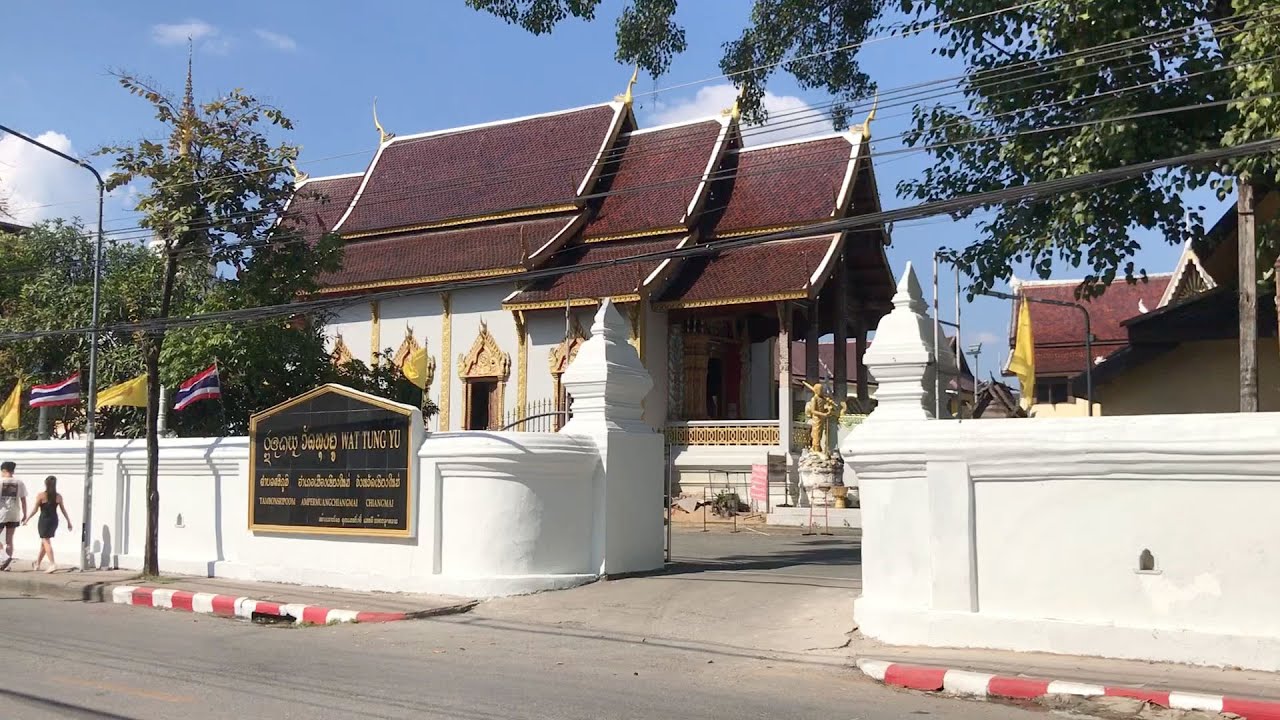
 Click to Access the Navigation Map GPS
Wat Thung Yu Map
Recommend

 Muang Chiang Mai(121)Chom Thong(47)Mae Chaem(25)Chiang Dao(33)Doi Saket(68)Mae Taeng(85)Mae Rim(69)Samoeng(29)Fang(71)Mae Ai(59)Phrao(70)San Pa Tong(103)San Kamphaeng(66)San Sai(73)Hang Dong(73)Hot(32)Doi Tao(22)Omkoi(11)Saraphi(74)Wiang Haeng(15)Chai Prakan(28)Mae Wang(32)Mae On(22)Doi Lo(33)Galyani Vadhana(1)


