
lovethailand home >North Travel Attractions >Chiang Mai Travel Attractions >Muang Chiang Mai >Si Phum > Wat Chai Phra Kiat
TL;DR: Wat Chai Phra Kiat is located at Ratchadamnoen Road, Si Phum Subdistrict, Mueang Chiang Mai District, Chiang Mai Province 50200, Thailand, open Daily, hours 08.00 - 17.00.

Wat Chai Phra Kiat
Open Days: Daily
Opening Hours: 08.00 - 17.00
Wat Chai Phra Kiat, also known as Wat Chai Phrakiat, is a historic Buddhist temple on Ratchadamnoen Road in Si Phum Subdistrict, Mueang Chiang Mai District, Chiang Mai Province. It is located inside Chiang Mai Old City, close to Wat Phra Singh, Wat Chedi Luang, Wat Phan Tao, the Three Kings Monument, and the Sunday Walking Street. The temple is best known for “Phra Chao Ha Tue,” or “Phra Phuttha Mueang Rai,” an important bronze Buddha image associated with merit, honor, reputation, protection, and victory.
Wat Chai Phra Kiat is a strong stop for travelers who want to understand Chiang Mai beyond the city’s most famous landmark temples. It combines old-city accessibility, Lanna religious architecture, local belief, inscription evidence, and a meaningful location on Ratchadamnoen Road. Visitors can include the temple in a walking or cycling route through Chiang Mai Old City, especially because it stands near several important temples and cultural sites.
The temple was formerly called Wat Chai Pha Kiat and has long been regarded as an old monastery of Chiang Mai. Its history is connected with the period of King Mekuti Sutthiwong and Queen Chiraprapha, an important ruler in Lanna history. Local historical accounts explain that Queen Chiraprapha built the temple and the principal Buddha image in honor of King Chairacha of Ayutthaya, who ruled between 1538 and 1545. This background gives the temple’s name a strong auspicious meaning related to victory, honor, and royal prestige.
The principal sacred image of Wat Chai Phra Kiat is Phra Chao Ha Tue, also known as Phra Phuttha Mueang Rai. This large bronze Buddha image is enshrined inside the viharn and remains the central focus of worship at the temple. The name “Ha Tue” refers to the traditional explanation of the image’s great weight, commonly described as 5 tue or about 5,000 kilograms. Because of its scale, craftsmanship, and religious meaning, the image is important both as a sacred object and as evidence of bronze Buddha casting in the Lanna cultural sphere.
The significance of Phra Chao Ha Tue is reinforced by inscriptions on the Buddha image base. The base includes inscriptions in Burmese and Tham Lanna script. These inscriptions record acts of Buddhist merit-making, the gathering of damaged Buddha images, and the casting of a single important Buddha image named Phra Phuttha Mueang Rai Chao. This makes the image valuable not only for worship but also for the study of Lanna religion, language, epigraphy, and art history.
The Princess Maha Chakri Sirindhorn Anthropology Centre records several inscriptions associated with Wat Chai Phra Kiat. One inscription on the base of a bronze Buddha image dates to 1565 and is written in Tham Lanna and Burmese scripts. Its content refers to the creation of Phra Phuttha Mueang Rai Chao by Chao Thap Chai Sangram Chaban together with officials and local people. Another inscription associated with the temple dates to 1517. These records add historical depth to the temple and show that Wat Chai Phra Kiat belongs to the broader history of Lanna Buddhist patronage and sacred image production.
Inside the viharn, Phra Chao Ha Tue is enshrined within an ornate sacred setting. Visitors usually come to pay respect, make merit, and ask for blessings connected with success, dignity, safety, and favorable outcomes. The belief surrounding the image aligns with the temple’s auspicious name, making Wat Chai Phra Kiat one of the temples often included in Chiang Mai merit-making routes.
The viharn itself reflects northern Thai temple architecture. The current building replaced an older structure but preserves a traditional local style. Its gable is decorated with floral motifs, while the roofline includes chofa, bai raka, and naga-style ornamentation. The entrance and gilded doors add to the temple’s visual identity. For travelers interested in Lanna craftsmanship, the viharn is one of the main architectural elements to observe closely.
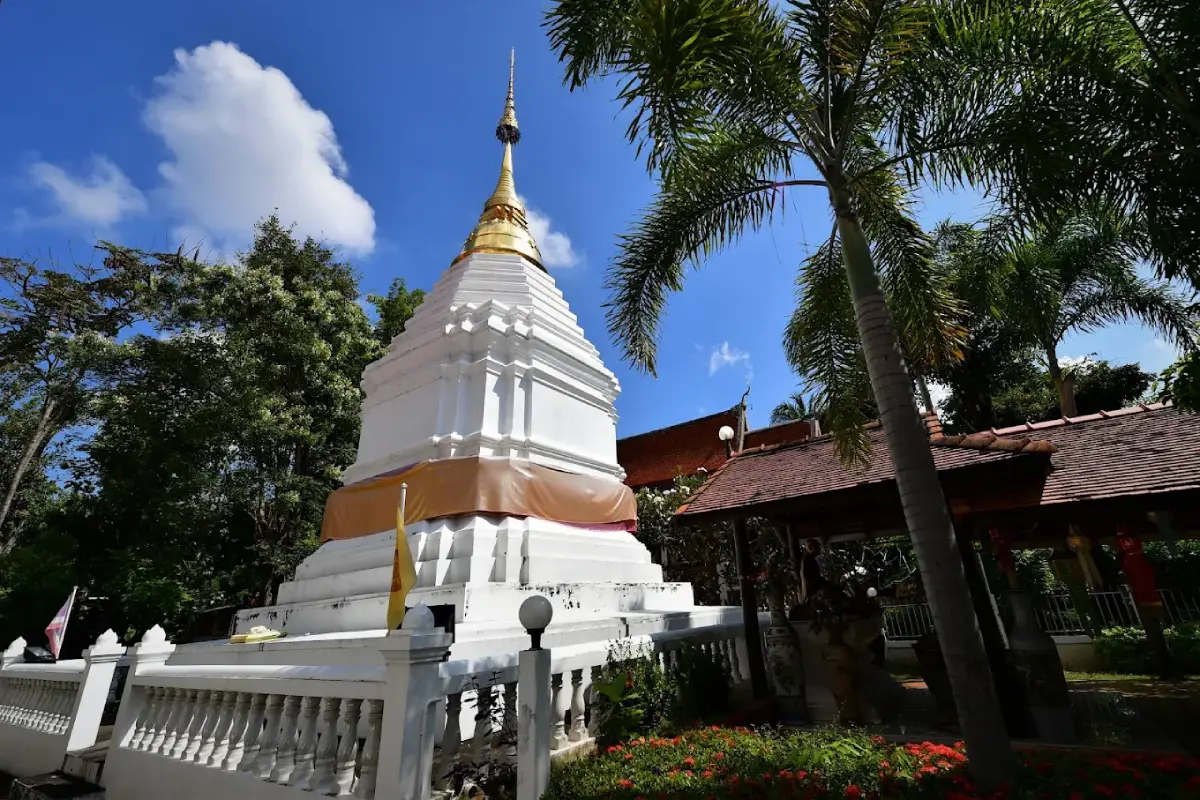
The chedi is another important feature of Wat Chai Phra Kiat. It has a square base, indented lotus elements, five stacked tiers, a round bell-shaped body, a stepped throne, a spire, and a finial, forming a Lanka-style chedi adapted within the northern Thai context. Visitors can walk around the chedi area to observe how the temple’s sacred structures are arranged in relation to the viharn and ubosot.
The ubosot is part of the temple’s religious compound and supports Buddhist monastic activities. The temple also includes areas for merit-making and meditation practice. Wat Chai Phra Kiat therefore remains a functioning religious place, not only a tourist attraction. Visitors should dress respectfully, keep their voices low, remove shoes before entering designated buildings, and avoid touching Buddha images, inscriptions, or religious objects unnecessarily.
The temple’s location is one of its greatest advantages for travelers. Ratchadamnoen Road is a central old-city route and becomes the main Sunday Walking Street in the evening. From Wat Chai Phra Kiat, travelers can easily continue to Wat Phra Singh, Wat Chedi Luang, Wat Phan Tao, the Three Kings Monument, Chiang Mai City Arts & Cultural Centre, and Tha Phae Gate. This makes the temple ideal for a half-day old-city walking itinerary.
A Sunday visit can combine temple worship with the evening walking street. Visitors can come in the afternoon to pay respect to Phra Chao Ha Tue, walk around the viharn and chedi, then continue along Ratchadamnoen Road when the market begins. This route gives travelers a compact experience of Chiang Mai’s temples, local crafts, street food, and old-city atmosphere.
Getting There is simple. From Tha Phae Gate, travelers can walk west along Ratchadamnoen Road for about 0.9 km. From Wat Phra Singh, the temple is about 0.6 km away. From Wat Chedi Luang or Wat Phan Tao, it can also be reached on foot within a short time. Travelers who prefer not to walk can use a red songthaew, tuk-tuk, ride-hailing car, private vehicle, or bicycle rental within the old city.
Visitors arriving by private car should note that Ratchadamnoen Road and the surrounding old-city streets can be busy, especially on weekends and during the Sunday Walking Street. For an itinerary that includes several temples, walking, cycling, or using local transport is often more convenient than moving a car from one stop to another.
A good way to visit Wat Chai Phra Kiat is to begin at the entrance, observe its position on Ratchadamnoen Road, then enter the viharn to pay respect to Phra Chao Ha Tue. Afterward, visitors can walk to the chedi, ubosot, and other merit-making areas. This order helps travelers understand the temple’s core identity, from its principal Buddha image to its architectural and historical context.
For travelers interested in Lanna history, Wat Chai Phra Kiat should be viewed through several layers. The first layer is the temple’s association with Queen Chiraprapha and King Chairacha. The second is Phra Chao Ha Tue, the principal Buddha image also known as Phra Phuttha Mueang Rai. The third is the inscription evidence that records acts of Buddhist merit-making and sacred image creation. These layers make the temple more historically meaningful than its modest size might first suggest.
The area around the temple is convenient for food and accommodation. Restaurants, cafes, northern Thai food shops, vegetarian restaurants, and casual international restaurants are located within walking distance. Nearby accommodations include old-city boutique hotels and heritage-style properties on or near Ratchadamnoen Road, making the temple especially easy to visit for travelers staying in the historic center.
Overall, Wat Chai Phra Kiat is a worthwhile temple for visitors who want an accessible but meaningful cultural stop in Chiang Mai Old City. Its strongest features are Phra Chao Ha Tue, its inscription evidence, Lanna architectural elements, its auspicious meaning, and its excellent location near the Sunday Walking Street and several major old-city attractions.
| Name | Wat Chai Phra Kiat / Wat Chai Phrakiat |
| Location | Ratchadamnoen Road, Si Phum Subdistrict, Mueang Chiang Mai District, Chiang Mai Province 50200, Thailand |
| Address | 90 Ratchadamnoen Road, Si Phum Subdistrict, Mueang Chiang Mai District, Chiang Mai Province 50200, Thailand |
| Coordinates | 18.7888125, 98.9859375 |
| Highlights | Historic old-city temple on Ratchadamnoen Road, home to Phra Chao Ha Tue or Phra Phuttha Mueang Rai, and located near the Sunday Walking Street |
| History | Formerly called Wat Chai Pha Kiat, associated with King Mekuti Sutthiwong, Queen Chiraprapha, King Chairacha of Ayutthaya, and inscription evidence from the 16th century |
| Name Origin | The temple name is linked with the former name Wat Chai Pha Kiat and a local historical account of a memorial built in honor of King Chairacha |
| Distinctive Features | Phra Chao Ha Tue, Lanna-style viharn, Lanka-style chedi, ubosot, merit-making areas, meditation area, and inscriptions on Buddha image bases |
| Travel Information | Reachable on foot, by bicycle, red songthaew, tuk-tuk, ride-hailing car, or private vehicle. About 0.9 km from Tha Phae Gate, 0.6 km from Wat Phra Singh, and 0.4 km from Wat Chedi Luang |
| Current Status | Open as an active Buddhist temple and religious site in Chiang Mai Old City |
| Open Days | Daily |
| Opening Hours | 08.00 - 17.00 |
| Fees | Free entry |
| Facilities | Parking area |
| Main Areas / Zones | Viharn of Phra Chao Ha Tue, chedi, ubosot, merit-making area, and meditation area |
| Main Contact Number | 053-416-150 |
| Nearby Tourist Attractions | 1. Tha Phae Sunday Walking Street, about 0.1 km 2. Wat Chedi Luang, about 0.4 km 3. Wat Phan Tao, about 0.4 km 4. Three Kings Monument, about 0.5 km 5. Chiang Mai City Arts & Cultural Centre, about 0.5 km 6. Wat Phra Singh, about 0.6 km 7. Wat Chiang Man, about 0.9 km 8. Tha Phae Gate, about 0.9 km |
| Nearby Restaurants | 1. Kiat Ocha, about 0.4 km, Tel. 053-327-262 2. Its Good Kitchen, about 0.4 km 3. Huen Phen, about 0.7 km, Tel. 053-277-103 4. Fern Forest Cafe, about 0.8 km, Tel. 084-616-1144 5. Goodsouls Kitchen, about 0.8 km, Tel. 088-819-9669 6. Blue Diamond Breakfast Club, about 0.9 km, Tel. 053-217-120 7. By Hand Pizza Cafe, about 1.0 km, Tel. 063-882-8195 |
| Nearby Accommodations | 1. U Chiang Mai, about 0.2 km, Tel. 053-327-000 2. Tamarind Village, about 0.4 km, Tel. 053-418-896 3. Makkachiva, about 0.5 km, Tel. 053-285-196 4. Chala Number 6, about 0.5 km, Tel. 052-010-466 5. De Lanna Hotel, about 0.6 km, Tel. 053-326-266 6. 99 The Heritage Hotel, about 0.8 km, Tel. 053-326-287 |
Frequently Asked Questions (FAQ)
Q: Where is Wat Chai Phra Kiat located?
A: Wat Chai Phra Kiat is located on Ratchadamnoen Road in Si Phum Subdistrict, Mueang Chiang Mai District, Chiang Mai Province, inside Chiang Mai Old City near Wat Phra Singh, Wat Chedi Luang, and the Sunday Walking Street.
Q: What are the opening hours of Wat Chai Phra Kiat?
A: Wat Chai Phra Kiat opens daily from 08.00 to 17.00.
Q: Is there an admission fee for Wat Chai Phra Kiat?
A: No. Entry to Wat Chai Phra Kiat is free.
Q: What is Phra Chao Ha Tue?
A: Phra Chao Ha Tue, also known as Phra Phuttha Mueang Rai, is the important bronze Buddha image enshrined inside the viharn of Wat Chai Phra Kiat.
Q: Why is Wat Chai Phra Kiat historically important?
A: The temple is historically important because it is linked with Queen Chiraprapha, King Chairacha of Ayutthaya, and several inscriptions on Buddha image bases from the Lanna period.
Q: What should visitors see inside Wat Chai Phra Kiat?
A: Visitors should see Phra Chao Ha Tue, the Lanna-style viharn, the Lanka-style chedi, the ubosot, the merit-making areas, and the temple’s inscription-related heritage.
Q: How can visitors get from Tha Phae Gate to Wat Chai Phra Kiat?
A: Visitors can walk along Ratchadamnoen Road for about 0.9 km or take a red songthaew, tuk-tuk, ride-hailing car, bicycle, or private vehicle.
Q: What nearby attractions can be combined with Wat Chai Phra Kiat?
A: The temple can be combined with Tha Phae Sunday Walking Street, Wat Chedi Luang, Wat Phan Tao, the Three Kings Monument, Chiang Mai City Arts & Cultural Centre, Wat Phra Singh, Wat Chiang Man, and Tha Phae Gate.
 Category: ●Places of Worship
 Group: ●Temple
Last Update : 1 WeekAgo
 Last Update : 1 WeekAgo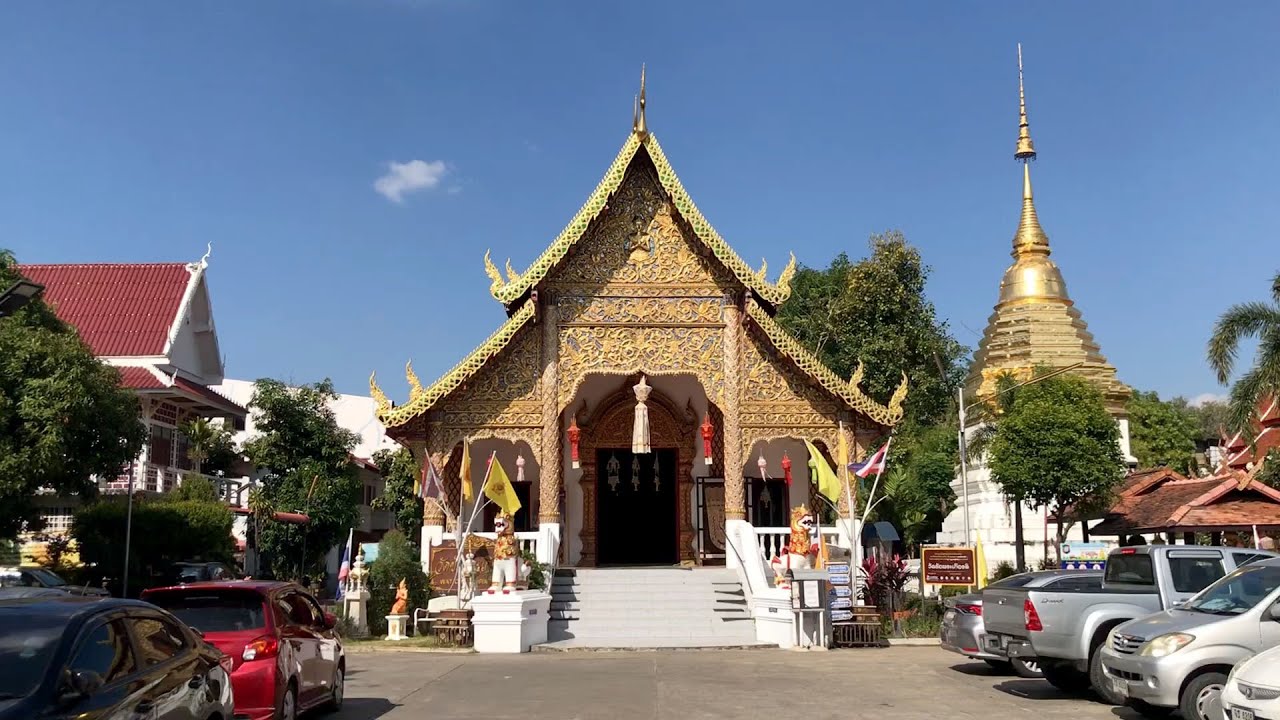
 Click to Access the Navigation Map GPS
Wat Chai Phra Kiat Map
Recommend

 Muang Chiang Mai(121)Chom Thong(47)Mae Chaem(25)Chiang Dao(33)Doi Saket(68)Mae Taeng(85)Mae Rim(69)Samoeng(29)Fang(71)Mae Ai(59)Phrao(70)San Pa Tong(103)San Kamphaeng(66)San Sai(73)Hang Dong(74)Hot(32)Doi Tao(22)Omkoi(11)Saraphi(74)Wiang Haeng(15)Chai Prakan(28)Mae Wang(32)Mae On(22)Doi Lo(34)Galyani Vadhana(1)


