
lovethailand home >North Travel Attractions >Chiang Mai Travel Attractions >Muang Chiang Mai >Fa Ham > Wat Langka
TL;DR: Wat Langka is located at Ban Langka, Village No. 2, Fa Ham Subdistrict, Mueang Chiang Mai District, Chiang Mai Province, open Daily, hours 08.00 – 17.00.

Wat Langka
Open Days: Daily
Opening Hours: 08.00 – 17.00
Wat Langka is an old Buddhist temple in Ban Langka, Fa Ham Subdistrict, Mueang Chiang Mai District, Chiang Mai Province. It is a local temple under the Mahanikaya order and one of the historically meaningful temples in the Fa Ham area. The temple is significant for its connection with King Saen Mueang Ma, Thao Maha Phrom, Lanna political history, monks associated with Lanka, the legend of the broken Langka alms bowl, Lanna Buddhist architecture, murals of the Vessantara Jataka, a Lanna-style chedi, an ubosot, and a distinctive four-storey bell tower that also houses a public library and a palm-leaf manuscript storage area.
Wat Langka is located at No. 141, Ban Langka, Village No. 2, Fa Ham Subdistrict, Mueang Chiang Mai District, Chiang Mai Province. The temple grounds cover 3 rai and 55 square wah. Its location on the eastern side of the Ping River places it within one of Chiang Mai’s long-established riverside communities. Fa Ham is a flat lowland area shaped by the Ping River and Mae Khao waterway, and its villages developed around settlement, local movement, water routes, and the daily life of communities outside the old city walls. Wat Langka therefore helps visitors understand Chiang Mai from the perspective of a living riverside neighborhood, not only from the famous temples inside the old moat.
The atmosphere of Wat Langka is quiet, local, and culturally layered. It is not a large mass-tourism temple, but it offers strong historical and artistic value. Visitors can walk through the viharn, ubosot, chedi, bell tower, halls, and community spaces at an unhurried pace. A visit here is best approached as slow cultural travel: observing the architecture, reading the visual stories on the temple walls, and understanding how Lanna Buddhism, local memory, and community life are connected in Fa Ham.
The history of Wat Langka begins in 1947 B.E. during the reign of King Saen Mueang Ma of the Mangrai dynasty, ruler of Nop Buri Si Nakhon Ping Chiang Mai. The temple later received its Wisungkhamsima in 2480 B.E. and is recorded as a local Buddhist temple under the Mahanikaya order. Its founding story is linked with Lanna political conflict after the passing of King Kue Na. When King Saen Mueang Ma ascended the Chiang Mai throne, Thao Maha Phrom, King Kue Na’s younger brother and the ruler of Chiang Rai, believed that he should have ruled Chiang Mai instead.
Thao Maha Phrom marched from Chiang Rai to attack Chiang Mai, but Chiang Mai’s forces, led by Saen Pha Nong, defeated the Chiang Rai army. Thao Maha Phrom later sought assistance from King Borommaracha I, also known as Khun Luang Pha Ngua, of Ayutthaya. After further conflict, he returned to Chiang Mai and brought Phra Phuttha Sihing as an offering to King Saen Mueang Ma. The king pardoned him and allowed him to return to Chiang Rai. This episode is central to the identity of Wat Langka because it links the temple with the Mangrai dynasty, Lanna political history, and devotion to Phra Phuttha Sihing.
After these events, Thao Maha Phrom wished to make merit and atone for the bloodshed caused by his attempt to seize the throne. At that time, Lanna Buddhism had a strong connection with Lanka. Monks from Lanna traveled to Lanka for Buddhist study, and monks from Lanka came to Lanna to teach and strengthen Buddhist learning. The story of Wat Langka therefore reflects more than a local temple foundation. It also preserves the memory of religious exchange between Lanna and Lanka.
According to the temple’s legend, Thao Maha Phrom instructed his attendants to invite a Thai Ahom monk and to bring a large coconut seed known as “maphrao hua khon.” The coconut was meant as a moral reminder: something may appear large and impressive on the outside while being small and unproductive inside. In the story, the coconut becomes a symbol warning that those without sufficient merit or readiness should not attempt ambitions beyond their capacity. This gives Wat Langka’s foundation story a strong ethical dimension, centered on repentance, humility, and the return to Buddhist merit-making.
During the journey, the Thai Ahom monk and his followers asked for directions to Wang Sing Kham. When they reached Saraphi, the monk asked a traveler whether Wang Sing Kham was near. The traveler replied that it was not far, but the group became uncertain. In northern Thai speech, “sang ka” means doubt or uncertainty, and the story connects that moment with the place name Sangka and a former deserted temple. The group later learned that there were two places known as Wang Sing Kham: one in Saraphi on the western side of the Ping River and another near Mueang Chiang Mai, opposite Wat Fa Ham.
The group eventually crossed back to the eastern side of the river opposite Wat Chai Mongkhon. An old man dressed in white appeared and guided them toward the place where the Langka alms bowl should be buried. As they came close to the destination, the alms bowl slipped from the monk’s hands and broke into two halves. The monk buried one half of the bowl, planted the coconut, and founded a temple at that place. The site later became known as Wat Langka. The other half of the bowl and its lid are linked in the legend with the place names Fa Taek or Pha Taek and Doi Langka in the Doi Saket area.
The name Wat Langka therefore carries several layers of meaning. It refers to the monks associated with Lanka, the broken Langka alms bowl, the relationship between Lanna and Lankan Buddhism, and the foundation of a temple as an act of atonement. The name is not only a geographical or religious label. It preserves a story of political conflict, remorse, Buddhist learning, and moral reflection in Lanna society.
The temple layout reflects its role as both a sacred site and a community center. The temple structures include the ubosot, preaching hall, viharn, monks’ residences, multi-purpose hall, merit-making hall, bell tower, public library, and palm-leaf manuscript storage area. These buildings allow Wat Langka to function as a place of worship, learning, community gathering, merit-making, and cultural preservation.
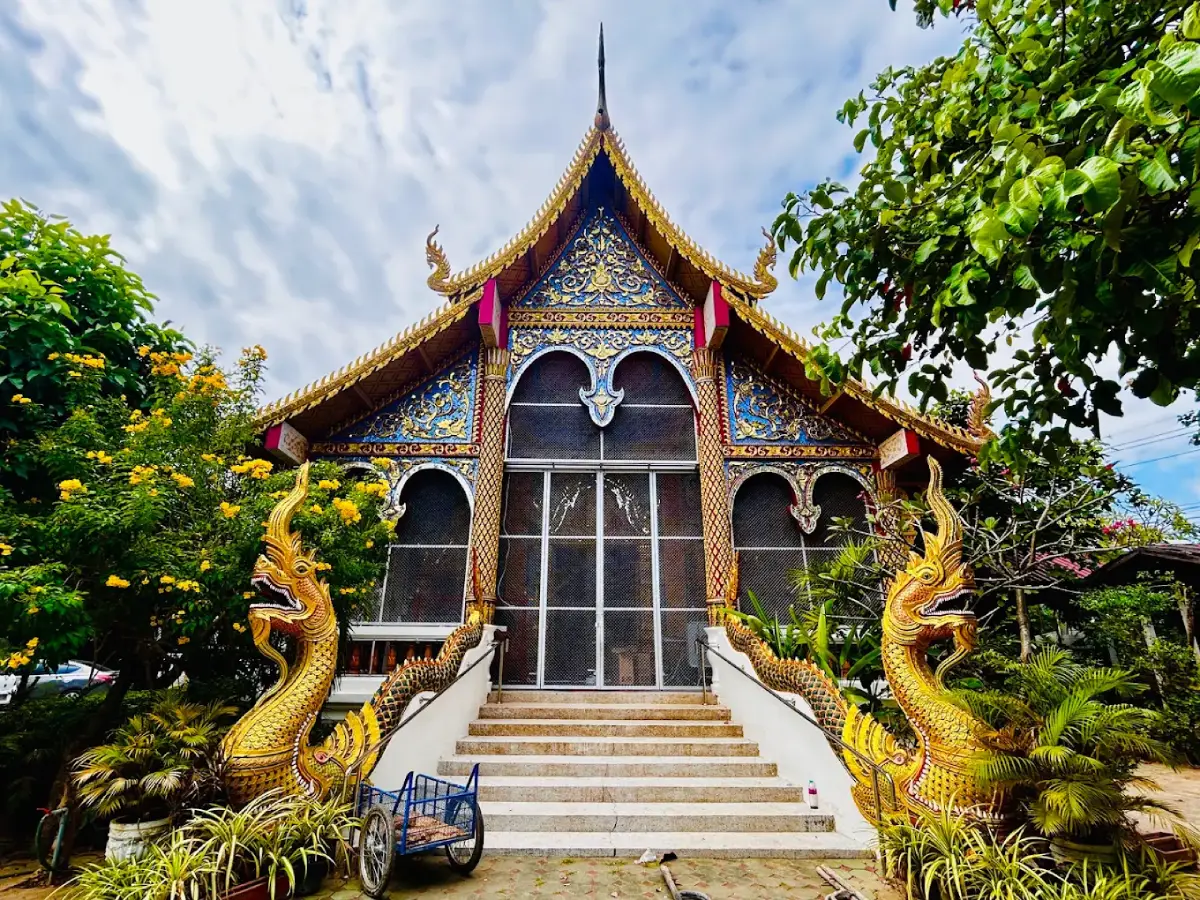
The viharn is the most important structure for visitors interested in Lanna art. It was restored and completed in 2527 B.E. and is built in an applied Lanna style. Its façade includes vine-pattern stucco, three honeycomb-like arched openings, three arched doorways, and large wooden pillars decorated with gilded motifs over a red lacquer base. The viharn carries a strong Lanna identity while also showing the adaptation of traditional temple forms through later restoration.
Inside the viharn is a large Buddha image in the posture of subduing Mara. The interior also contains murals of the Vessantara Jataka, one of the most important Buddhist stories used to teach generosity, sacrifice, and spiritual determination. These murals make the viharn more than an architectural space. It becomes a visual teaching hall where Buddhist values are communicated through narrative painting, figures, colors, and scenes from sacred literature.
The murals at Wat Langka are valuable because they show how northern Thai temples used visual storytelling to make Buddhist teachings accessible to the community. Visitors should take time to observe the characters, costumes, city scenes, linework, and use of color. These details reflect both craftsmanship and the social imagination of the community that supported the temple. The murals should be viewed respectfully and never touched.
The staircase of the viharn includes makara disgorging naga balustrades, a symbolic architectural element found in Lanna and wider Buddhist art. The makara and naga mark the transition from ordinary ground to sacred space. Walking up the staircase is not merely physical movement. It represents entry into a place of worship, reflection, and Buddhist merit.
The ubosot at Wat Langka is an applied Lanna-style brick-and-plaster building. It is about 15 meters wide and 16.50 meters long. The ubosot is central to monastic rites because it is used for important Sangha ceremonies, ordination, and ritual acts that require a formally granted monastic boundary. Its presence reinforces Wat Langka’s status as a complete functioning Buddhist temple.
The chedi is a Lanna-style structure with a raised indented square base, octagonal tiers, a round bell-shaped body, a small indented throne element, and an umbrella finial. Gilded sheets decorate the chedi from the octagonal tiers upward to the pinnacle. A fence surrounds the chedi on all four sides, and a Buddha niche appears on the southern side. This is one of the key points to visit for those interested in Lanna Buddhist architecture.
The four-storey bell tower is one of the most distinctive features of Wat Langka. The ground floor serves as the Wat Langka public library, the second floor stores palm-leaf manuscripts, the third floor functions as the bell tower, and the top floor supports a small round chedi. This structure makes Wat Langka unusual among local community temples because the bell tower combines sound, learning, manuscript preservation, and sacred symbolism in a single vertical building.
The public library and palm-leaf manuscript area expand the meaning of Wat Langka beyond ritual use. In Lanna society, temples were centers of learning as well as worship. Monks, novices, and local residents used temple spaces to study Buddhist teachings, northern Thai scripts, moral literature, and local knowledge. The library and manuscript storage area help preserve that educational role in a visible form.
The monks’ residences at Wat Langka are two-storey applied Lanna-style brick-and-plaster buildings with terrazzo floors and corrugated tile roofing, completed in 2542 B.E. The preaching hall, multi-purpose hall, and merit-making hall support religious and community activities, including merit-making, sermons, meetings, ceremonies, and events connected with everyday life in Ban Langka.
Wat Langka has had a continuous line of abbots and caretakers, reflecting the long-term stewardship of the temple. Current temple information identifies Phra Athikan Chamrat Parisuttho, also known as Phra Achan Anon, as the abbot. Historical local records also preserve the names of earlier abbots, including Khru Ba Kham Pan, Khru Ba Intha, Khru Ba Duang, Khru Ba In Lai, Phra Athikan Bunmi, Phra Khru Bunyuang Phatthammo, and Phra Khru Wisit Sarakhun Bunmi Kantasaro. This continuity shows the sustained religious life of Wat Langka across generations.
Wat Langka remains an active community temple in Fa Ham. It appears in the tourism and accommodation information of Fa Ham Municipality and has also served as a venue for community activities in Village No. 2, Ban Langka. This confirms that the temple is not an abandoned historic site. It continues to function as a religious, social, and cultural space for the local community.
A complete visit to Wat Langka should begin with paying respect inside the viharn, then observing the wooden pillars, gilded motifs, murals, and makara-naga staircase. Visitors can then walk to the ubosot, chedi, bell tower, public library, palm-leaf manuscript area, halls, and temple courtyard. This route allows visitors to understand the temple through history, legend, art, religious practice, and current community use.
Getting There is convenient from central Chiang Mai. Travelers can head toward Fa Ham Subdistrict on the eastern side of the Ping River by using Charoen Rat Road, Faham Samakkhi Road, or local roads leading into Ban Langka. Those driving can search for Wat Langka, Ban Langka, Fa Ham, or use the coordinates 18.81168, 99.00584. Red songthaews, local hired vehicles, and app-based transport are also practical because the temple is still within the urban area of Chiang Mai.
The best time to visit is in the morning or late afternoon, when the weather is more comfortable and natural light is suitable for viewing the architecture. Visitors should allow at least 45 minutes to 1 hour to see the viharn, murals, chedi, ubosot, and bell tower properly. Wat Langka is open daily from 08.00 to 17.00, making it easy to include in a half-day route around Fa Ham and the Ping River communities.
Visitors should dress respectfully when entering Wat Langka. Shoulders and knees should be covered, shoes should be removed before entering the viharn or ubosot, and voices should be kept low. Visitors should not touch murals, wooden pillars, gilded decoration, Buddha images, palm-leaf manuscripts, or ritual objects without permission. If monks, novices, or local residents are conducting a ceremony, visitors should give them space and ask before photographing people or religious activities.
Wat Langka can be combined with nearby places in Fa Ham, such as Wat Kha Chao, Wat Tha Kradat, Wat Fa Ham, Wat San Sai Ton Kok, the public park along the Ping River, and the Saliping Jai Kaew Kwang Lanna folk cultural learning center. Travelers can also extend the route to Wat Ket Karam, Warorot Market, Wat Chiang Man, and Wat Chedi Luang. This itinerary helps visitors see Chiang Mai through riverside communities, local temples, and major historic sites in the old city.
Nearby restaurants include northern Thai, Chinese, noodle, khao soi, and casual local dining options in Fa Ham and nearby areas. Practical choices include Baanrai Yarmyen, Khao Soi Samer Jai Fa Ham, Pad Thai Fah Ham, Kuai Tiao Jai Dee Rot Det Fa Ham, Brownie Steak & Bakery, and Jia Tong Heng Fa Ham Branch. This makes it easy to combine a morning temple visit with lunch in the Fa Ham area.
Accommodations near Wat Langka and Fa Ham include riverside stays, small hotels, homestays, and urban hotels around Fa Ham and Pa Tan. Options include Baan Singkham Resort, Rimthara Residence, Tonnam Homestay, The Balcony Chiang Mai Village, Blessing Place, and The Rise Suites Hotel Chiang Mai. The area is suitable for travelers who want to stay slightly outside the old city while remaining close to Wat Ket, Warorot Market, the Ping River, and central Chiang Mai routes.
Compared with the major temples inside Chiang Mai’s old city, Wat Langka offers a quieter and more local experience. Its value lies in its layered legend, distinctive architecture, murals, four-storey bell tower, manuscript-related space, and continuing community role. Travelers who have already visited Wat Phra Singh, Wat Chedi Luang, or Wat Chiang Man will find Wat Langka useful for understanding another side of Chiang Mai: the side preserved in small community temples outside the most crowded tourist routes.
In summary, Wat Langka is a historically rich temple in Fa Ham that deserves attention from travelers interested in Chiang Mai temples, northern Thai culture, Lanna architecture, and local history. Its importance comes from its foundation in the reign of King Saen Mueang Ma, the legend of Thao Maha Phrom, monks associated with Lanka, the Langka alms bowl, the symbolic coconut, the Vessantara Jataka murals, the Lanna-style viharn, the chedi, the ubosot, and the unique four-storey bell tower. For travelers who want to understand Chiang Mai beyond the old city’s most famous temples, Wat Langka is a meaningful cultural stop.
| Name | Wat Langka |
| Location | Ban Langka, Village No. 2, Fa Ham Subdistrict, Mueang Chiang Mai District, Chiang Mai Province |
| Address | No. 141, Ban Langka, Village No. 2, Fa Ham Subdistrict, Mueang Chiang Mai District, Chiang Mai Province 50000, Thailand |
| Coordinates | 18.81168, 99.00584 |
| Temple Type | Local Buddhist temple under the Mahanikaya order |
| Temple Area | 3 rai and 55 square wah |
| Highlights | Old temple in Ban Langka with the legend of Thao Maha Phrom, the broken Langka alms bowl, the symbolic coconut, an applied Lanna viharn, Vessantara Jataka murals, Lanna chedi, and a four-storey bell tower |
| History | Founded in 1947 B.E. during the reign of King Saen Mueang Ma, with evidence of Wisungkhamsima granted in 2480 B.E. |
| Name Origin | Connected with monks associated with Lanka and the legend of the Langka alms bowl that broke into two halves, one of which was buried at the temple site |
| Distinctive Features | Applied Lanna viharn with vine-pattern stucco, three honeycomb-like arches, red lacquer and gilded wooden pillars, and makara disgorging naga staircase balustrades |
| Important Features Inside The Temple | Viharn, ubosot, chedi, preaching hall, monks’ residences, multi-purpose hall, merit-making hall, bell tower, public library, and palm-leaf manuscript storage area |
| Murals | Murals of the Vessantara Jataka inside the viharn, reflecting Buddhist teaching on generosity and moral perfection through Lanna visual art |
| Suggested Visit Zones | Viharn zone, ubosot zone, chedi zone, bell tower–library–palm-leaf manuscript zone, and hall/community activity zone |
| Travel Information | Travel from central Chiang Mai toward Fa Ham via Charoen Rat Road, Faham Samakkhi Road, or local roads into Ban Langka. Private cars, red songthaews, hired vehicles, and app-based transport are practical options |
| Current Status | Active community temple and religious site in Fa Ham Subdistrict, also used for community activities in Ban Langka |
| Open Days | Daily |
| Opening Hours | 08.00 – 17.00 |
| Abbot / Caretaker | Phra Athikan Chamrat Parisuttho, also known as Phra Achan Anon |
| Contact Number | 053-855-126 |
| Facilities | Viharn, ubosot, chedi, preaching hall, multi-purpose hall, merit-making hall, public library, and community activity spaces |
| Nearby Tourist Attractions | 1. Wat Kha Chao, about 1 km 2. Wat Tha Kradat, about 1 km 3. Wat Fa Ham, about 1 km 4. Public Park Along The Ping River, about 2 km 5. Wat San Sai Ton Kok, about 3 km 6. Saliping Jai Kaew Kwang Lanna Folk Cultural Learning Center, about 3 km 7. Wat Ket Karam, about 3 km 8. Warorot Market, about 4 km |
| Nearby Restaurants | 1. Baanrai Yarmyen, about 0.2 km, Tel. 053-244-796, 053-247-999, 084-808-3119 2. Khao Soi Samer Jai Fa Ham, about 1 km, Tel. 053-242-928, 081-764-8723 3. Brownie Steak & Bakery, about 2 km, Tel. 053-306-667, 086-915-5858 4. Pad Thai Fah Ham, about 2 km, Tel. 098-008-9367 5. Kuai Tiao Jai Dee Rot Det Fa Ham, about 3 km, Tel. 093-924-9753 6. Jia Tong Heng Fa Ham Branch, about 4 km, Tel. 053-242-242 |
| Nearby Accommodations | 1. Baan Singkham Resort, about 2 km, Tel. 082-386-8887 2. Rimthara Residence, about 2 km, Tel. 053-110-430 3. Tonnam Homestay, about 3 km, Tel. 089-853-4402 4. The Balcony Chiang Mai Village, about 4 km, Tel. 065-538-3566 5. Blessing Place, about 4 km, Tel. 089-556-5678 6. The Rise Suites Hotel Chiang Mai, about 5 km, Tel. 098-661-6422 |
Frequently Asked Questions (FAQ)
Q: Where is Wat Langka located?
A: Wat Langka is located at No. 141, Ban Langka, Village No. 2, Fa Ham Subdistrict, Mueang Chiang Mai District, Chiang Mai Province, on the eastern side of the Ping River area.
Q: Why is Wat Langka important?
A: Wat Langka is an old temple from the reign of King Saen Mueang Ma. Its history is linked with Thao Maha Phrom, monks associated with Lanka, the Thai Ahom monk, the Langka alms bowl, and the founding of the temple as an act of atonement.
Q: Why is the temple called Wat Langka?
A: The name is connected with monks associated with Lanka and the legend of a Langka alms bowl that broke into two halves. One half was buried at the temple site, where the temple was later founded.
Q: What can visitors see inside Wat Langka?
A: Visitors can see the applied Lanna viharn, Vessantara Jataka murals, ubosot, Lanna chedi, four-storey bell tower, public library, palm-leaf manuscript storage area, preaching hall, and merit-making hall.
Q: What is special about the viharn at Wat Langka?
A: The viharn features vine-pattern stucco, three honeycomb-like arches, large red lacquer and gilded wooden pillars, a Buddha image in the posture of subduing Mara, and makara disgorging naga staircase balustrades.
Q: What makes the bell tower at Wat Langka distinctive?
A: The bell tower has four storeys: the ground floor is a public library, the second floor stores palm-leaf manuscripts, the third floor is the bell tower, and the top floor supports a small round chedi.
Q: What are the opening hours of Wat Langka?
A: Wat Langka is open daily from 08.00 to 17.00.
Q: What nearby places can be visited with Wat Langka?
A: Nearby places include Wat Kha Chao, Wat Tha Kradat, Wat Fa Ham, the public park along the Ping River, Wat San Sai Ton Kok, Wat Ket Karam, Warorot Market, and Wat Chiang Man.
 Category: ●Places of Worship
 Group: ●Temple
Last Update : 1 WeekAgo
 Last Update : 1 WeekAgo
 Click to Access the Navigation Map GPS
 Muang Chiang Mai(121)Chom Thong(47)Mae Chaem(25)Chiang Dao(33)Doi Saket(68)Mae Taeng(85)Mae Rim(69)Samoeng(29)Fang(71)Mae Ai(59)Phrao(70)San Pa Tong(105)San Kamphaeng(66)San Sai(73)Hang Dong(74)Hot(32)Doi Tao(22)Omkoi(11)Saraphi(74)Wiang Haeng(15)Chai Prakan(28)Mae Wang(32)Mae On(22)Doi Lo(34)Galyani Vadhana(1)


