
lovethailand home >North Travel Attractions >Chiang Mai Travel Attractions >Muang Chiang Mai >Fa Ham > Wat Tha Kradat
TL;DR: Wat Tha Kradat is located at Ban Tha Kradat, Fa Ham Subdistrict, Mueang Chiang Mai District, Chiang Mai Province, open Daily, hours 08.00 – 17.00.

Wat Tha Kradat
Open Days: Daily
Opening Hours: 08.00 – 17.00
Wat Tha Kradat is an old Buddhist temple in Ban Tha Kradat, Fa Ham Subdistrict, Mueang Chiang Mai District, Chiang Mai Province. It is a worthwhile stop for travelers who want to explore a quieter side of Chiang Mai’s temple culture, away from the most crowded routes inside the old city. The temple is closely connected with the local history of Fa Ham, the Ping River, the legend of Phra Phuttha Sihing, the traditional paper-making community, Lanna temple architecture, Tai Lue mural painting, and a revered Buddha image known locally as Phra Chao Than Chai.
The temple is located at No. 38, Moo 1, Ban Tha Kradat, Fa Ham Subdistrict, Mueang Chiang Mai District, Chiang Mai Province. Its temple grounds cover 2 rai, 2 ngan, and 30 square wah. Wat Tha Kradat was officially permitted to be established as a temple in 1934 B.E. and later received its royal boundary marker, or Wisungkhamsima, in 2491 B.E. These details place the temple within a long continuum of community history on the northeastern side of Chiang Mai city. Today, the temple remains an active local Buddhist temple under the Mahanikaya order and continues to serve both religious and community functions.
Wat Tha Kradat is not a large or heavily commercialized tourist temple. Its appeal lies in its quiet atmosphere, local character, and layered cultural details. Visitors who come here will see a neighborhood temple that still carries traces of old Chiang Mai life, especially the relationship between temple, village, river, craft, and faith. The area around Ban Tha Kradat connects naturally with Fa Ham, San Phi Suea, Pa Tan, and the Ping River corridor, making the temple suitable for a slow cultural route rather than a quick photo stop.
The history of Wat Tha Kradat is closely tied to local stories about Fa Ham. According to local tradition, after King Kue Na passed away in 1943 B.E., King Saen Mueang Ma ascended the throne of Chiang Mai. Around that period, Chao Thao Maha Phrom brought the revered Phra Phuttha Sihing image to Chiang Mai. When the procession reached Tha Wang Sing Kham near the Mae Raming, now widely known as the Ping River, a miraculous ray of light is said to have shone toward the northeast. The bright light became associated with the name Fa Ham, a name that evokes brightness, radiance, and local sacred memory.
The same stream of local memory also connects Wat Tha Kradat with the old Tha Phlu area. Over time, erosion along the riverbank affected the former riverside area, and the settlement moved eastward by about 1 km. In the new location, local people were associated with the making of saa paper, a traditional paper made from mulberry bark. This craft background helped shape the name Tha Kradat, meaning a paper-related landing or locality. The temple’s name therefore preserves not only a place name but also the environmental change, craft history, and livelihood of the old community along the Ping River.
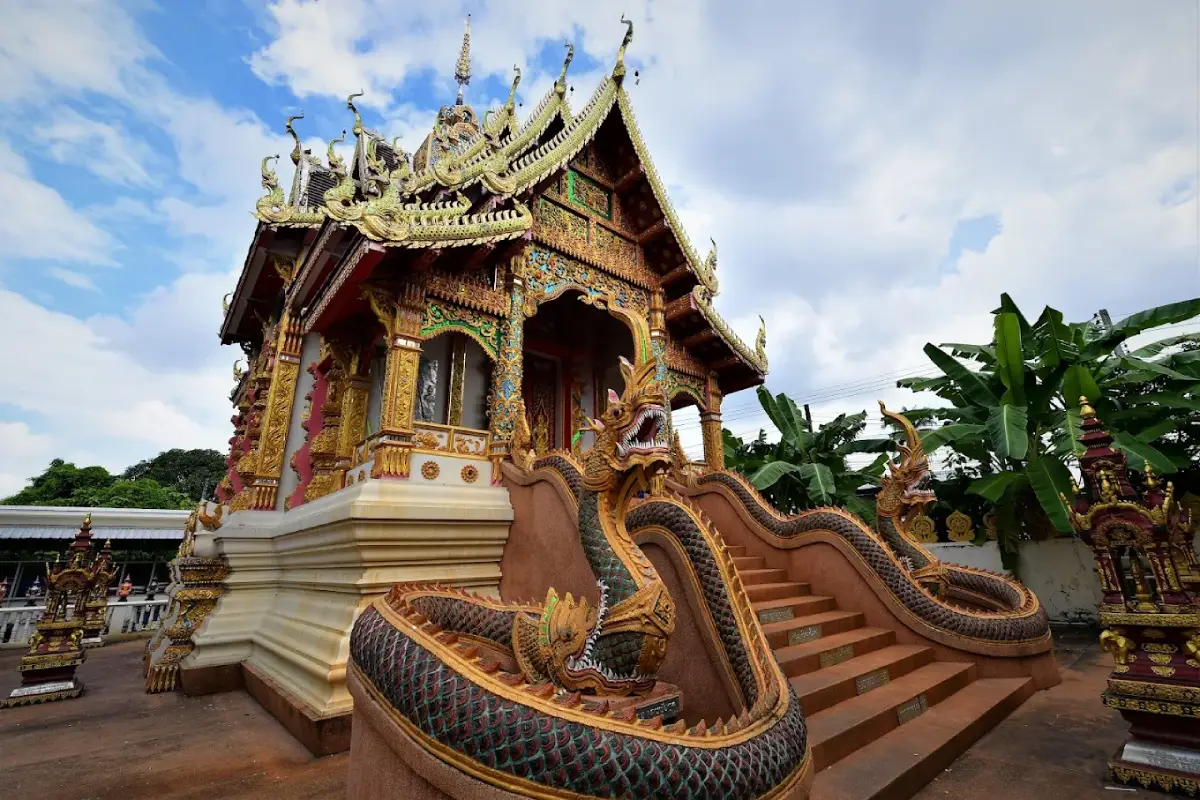
One of the most important features of Wat Tha Kradat is its Lanna-style viharn. The hall is built with brick and mortar, with decorative details that reward close observation. The gable and front composition reflect northern Thai craftsmanship, while the stucco lotus motifs above wave-like patterns and colored glass details add depth to the façade. The staircase features a makara disgorging a three-headed naga, while the side balustrades are shaped like tigers with naga-like tails. These forms combine Buddhist symbolism, local belief, and the imagination of regional artisans.
Inside the viharn is the principal Buddha image in the Mara-vijaya posture, locally known as Phra Chao Than Chai. For the local community, this image is an important sacred focus for worship and merit-making. Local accounts describe the image as being created and restored with careful attention to beauty, reflecting the belief that a graceful Buddha image brings auspiciousness and dignity to the community. In the Lanna Buddhist context, a principal Buddha image is not only a devotional object but also a center of collective identity, faith, and local pride.
The mural paintings inside Wat Tha Kradat are another reason the temple deserves more attention from cultural travelers. The murals are associated with Tai Lue artistic influence and Buddhist narrative traditions, including the story of Chao Bun Long. Their value is not limited to visual beauty. They also show how local artisans told religious stories through composition, color, costume, gesture, and scenes of everyday life. Travelers interested in northern Thai temple murals, Lanna folk narratives, and Tai Lue cultural expression should spend time viewing the paintings respectfully and carefully.
Wat Tha Kradat remains relevant to local life today. The temple continues to function as a place for merit-making, Buddhist ceremonies, and community activities in Fa Ham. In recent years, it has also appeared as a venue for local public meetings, showing that it still serves as a shared community space rather than a site preserved only for sightseeing. This living role is part of what makes the temple culturally meaningful: it connects the past with the present through everyday religious and civic use.
For visitors, Wat Tha Kradat is best experienced slowly. Its value is found in small details: the gable, the staircase, the naga and tiger motifs, the quiet viharn, the story behind the name Tha Kradat, the revered Phra Chao Than Chai image, and the murals linked with Tai Lue artisanship. It is especially suitable for travelers researching Chiang Mai temples, Lanna culture, northern Thai art, Buddhist community temples, and less-visited cultural places outside the old city walls.
Getting There is convenient from Chiang Mai city. Travelers can head toward Fa Ham Subdistrict and the San Phi Suea area, using routes that connect with Fa Ham Road, Charoen Rat Road, Pa Tan, and the Ping River side of the city. For accurate navigation, enter “Wat Tha Kradat Fa Ham” or use the temple coordinates directly. Private cars, hired vehicles, and app-based transport are practical options. Traffic in Chiang Mai can be heavier during morning and evening peak periods, so travelers should plan their timing accordingly.
Visitors should dress respectfully when entering Wat Tha Kradat. Clothing should cover the shoulders and knees, shoes should be removed before entering the viharn, and voices should be kept low inside sacred spaces. Travelers should avoid touching murals, stucco decoration, Buddha images, or ritual objects. If a religious ceremony or local community activity is taking place, visitors should give space to worshippers and ask for permission before photographing people, ceremonies, or sensitive areas inside the temple.
A visit to Wat Tha Kradat can be combined with nearby cultural places such as Wat Kha Chao, Wat Langka, Wat Fa Ham, Wat San Sai Ton Kok, the public park along the Ping River, Chiang Mai National Museum, Wat Chiang Man, and Wat Chedi Luang. This route gives travelers a broader view of Chiang Mai beyond the old city: neighborhood temples, riverside communities, Lanna art, local history, and living Buddhist practice. A practical itinerary can begin at Wat Tha Kradat in the morning, continue along the Ping River and Fa Ham area, and then return toward central Chiang Mai later in the day.
In summary, Wat Tha Kradat is a small but culturally rich temple. Its importance comes from its establishment in 1934 B.E., its connection with the Fa Ham and Phra Phuttha Sihing traditions, the story of the old Tha Phlu area and the paper-making community, its Lanna-style viharn, Phra Chao Than Chai, and mural paintings associated with Tai Lue artisans. For travelers seeking a quieter, more meaningful temple experience in Chiang Mai, Wat Tha Kradat is a strong addition to a cultural itinerary focused on local heritage rather than mainstream sightseeing alone.
| Name | Wat Tha Kradat |
| Location | Ban Tha Kradat, Fa Ham Subdistrict, Mueang Chiang Mai District, Chiang Mai Province |
| Address | No. 38, Moo 1, Ban Tha Kradat, Fa Ham Subdistrict, Mueang Chiang Mai District, Chiang Mai Province 50000, Thailand |
| Coordinates | 18.8172, 99.00381 |
| Temple Area | 2 rai, 2 ngan, 30 square wah |
| Highlights | Old community temple in Fa Ham with a Lanna-style viharn, Phra Chao Than Chai, Tai Lue mural paintings, and local history linked with Ban Tha Kradat |
| History | Officially permitted as a temple in 1934 B.E. and granted Wisungkhamsima in 2491 B.E. |
| Name Origin | The name Tha Kradat is linked with the local saa paper-making community after the former Tha Phlu riverside area changed and the settlement moved eastward |
| Distinctive Features | Brick-and-mortar viharn, Lanna decorative gable, lotus stucco above wave motifs, makara and three-headed naga staircase, tiger-shaped balustrades with naga-like tails, and murals telling the story of Chao Bun Long |
| Important Features Inside The Temple | Phra Chao Than Chai, Lanna viharn, mural paintings, and community religious spaces |
| Travel Information | Travel from Chiang Mai city toward Fa Ham or San Phi Suea, then navigate to Ban Tha Kradat or the temple coordinates. Private cars, hired vehicles, and app-based transport are suitable options |
| Current Status | Active local Buddhist temple under the Mahanikaya order in Fa Ham Subdistrict and used as a community activity venue in 2025–2026 |
| Open Days | Daily |
| Opening Hours | 08.00 – 17.00 |
| Abbot / Caretaker | Phra Athikan Anon Athittadhammo appears as the named abbot in published temple information |
| Main Contact Number | 053-247-393 |
| Nearby Tourist Attractions | 1. Wat Kha Chao, about 0.3 km 2. Wat Langka, about 1 km 3. Wat Fa Ham, about 2 km 4. Wat San Sai Ton Kok, about 2 km 5. Public Park Along The Ping River, about 2 km 6. Chiang Mai National Museum, about 3 km 7. Wat Chiang Man, about 3 km 8. Wat Chedi Luang, about 4 km |
| Nearby Restaurants | 1. Pad Thai Fa Ham, about 1 km, Tel. 098-008-9367 2. Kuai Tiao Jai Dee Rot Det Fa Ham, about 2 km, Tel. 093-924-9753 3. Khao Soi Samer Jai Fa Ham, about 2 km, Tel. 053-242-928, 081-764-8723 4. Homok Michelin Fa Ham Branch, about 3 km, Tel. 095-292-5459 5. Khao Kai Op Sut Det Fa Ham, about 3 km, Tel. 095-816-6748 6. Jia Tong Heng Restaurant Fa Ham Branch, about 4 km, Tel. 053-242-242 |
| Nearby Accommodations | 1. Rimthara Residence, about 0.5 km, Tel. 053-110-430 2. Baan Singkham Resort, about 0.5 km, Tel. 082-386-8887 3. Tonnam Homestay, about 1 km, Tel. 089-853-4402 4. The Balcony Chiang Mai, about 3 km, Tel. 065-538-3566 5. Blessing Place, about 3 km, Tel. 089-556-5678 6. The Rise Suites Hotel, about 4 km, Tel. 098-661-6422 |
Frequently Asked Questions (FAQ)
Q: Where is Wat Tha Kradat located?
A: Wat Tha Kradat is located at No. 38, Moo 1, Ban Tha Kradat, Fa Ham Subdistrict, Mueang Chiang Mai District, Chiang Mai Province.
Q: What is Wat Tha Kradat known for?
A: The temple is known for its Lanna-style viharn, Phra Chao Than Chai, Tai Lue mural paintings, decorative stucco work, and local history connected with Ban Tha Kradat and Fa Ham.
Q: How is Wat Tha Kradat connected with Fa Ham?
A: Local tradition connects Fa Ham with the story of Phra Phuttha Sihing being brought to Chiang Mai and a miraculous ray of light shining toward the northeast, giving the area its association with brightness and radiance.
Q: Why are the murals at Wat Tha Kradat important?
A: The murals are associated with Tai Lue artistic influence and the story of Chao Bun Long, reflecting local Buddhist storytelling, northern Thai culture, and community-based temple art.
Q: Who should visit Wat Tha Kradat?
A: The temple is suitable for travelers interested in old Chiang Mai temples, Lanna architecture, northern Thai mural painting, Tai Lue culture, and peaceful community temples outside the main tourist circuit.
Q: What should visitors wear when visiting Wat Tha Kradat?
A: Visitors should dress respectfully, covering shoulders and knees, remove shoes before entering the viharn, keep voices low, and avoid touching murals, stucco decoration, or sacred objects.
Q: What nearby places can be visited with Wat Tha Kradat?
A: Nearby places include Wat Kha Chao, Wat Langka, Wat Fa Ham, Wat San Sai Ton Kok, the public park along the Ping River, Chiang Mai National Museum, Wat Chiang Man, and Wat Chedi Luang.
Q: Is there a contact number for Wat Tha Kradat?
A: The published contact number for Wat Tha Kradat is 053-247-393.
 Category: ●Places of Worship
 Group: ●Temple
Last Update : 2 WeekAgo
 Last Update : 2 WeekAgo
 Click to Access the Navigation Map GPS
Wat Tha Kradat Map
Recommend

 Muang Chiang Mai(121)Chom Thong(47)Mae Chaem(25)Chiang Dao(33)Doi Saket(68)Mae Taeng(85)Mae Rim(69)Samoeng(29)Fang(71)Mae Ai(59)Phrao(70)San Pa Tong(103)San Kamphaeng(66)San Sai(73)Hang Dong(73)Hot(32)Doi Tao(22)Omkoi(11)Saraphi(74)Wiang Haeng(15)Chai Prakan(28)Mae Wang(32)Mae On(22)Doi Lo(34)Galyani Vadhana(1)


