
lovethailand home >North Travel Attractions >Chiang Mai Travel Attractions >Muang Chiang Mai >Phra Sing > Wat Methang
TL;DR: Wat Methang is located at Phra Sing Subdistrict, Mueang Chiang Mai District, Chiang Mai Province, open Daily, hours 08.00 – 17.00.
Wat Methang
Open Days: Daily
Opening Hours: 08.00 – 17.00
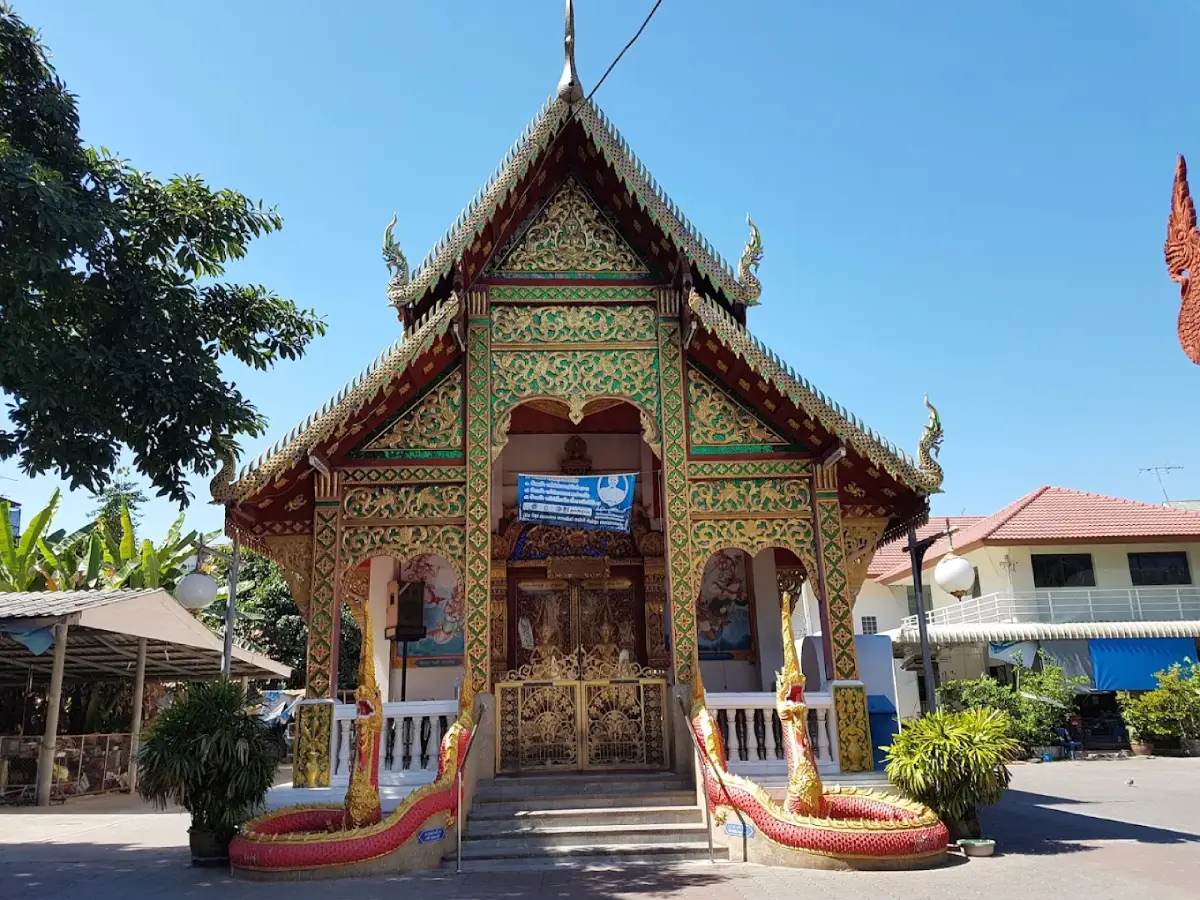
Wat Methang is a community Buddhist temple in the Maha Nikaya tradition, located on Ratchamankha Road in Phra Sing Subdistrict, Mueang Chiang Mai District, Chiang Mai Province. Set within Chiang Mai’s historic old city, the temple is modest in size but rich in Lanna cultural value. Its history reaches back to 1552, when it was originally known as Wat Chang Lan. The temple later became known as Wat Methang after Nan Methang and Nang Kaew, a devout couple who donated land and funds to establish the new temple site.
For travelers exploring Chiang Mai Old City, Wat Methang offers a quieter and more reflective experience than the larger landmark temples nearby. It sits close to Wat Phra Singh, Wat Chedi Luang, Wat Phan Tao, and Ratchadamnoen Walking Street, making it easy to include in a walking route through the historic center. The temple is particularly suitable for visitors who want to understand Chiang Mai beyond its most crowded tourist stops, with a focus on local history, Lanna architecture, Buddhist practice, and the everyday role of small temples in the old city.
Wat Methang occupies an area of 2 rai and 98 square wah. Although the temple grounds are compact, the site contains several important religious structures, including a Lanna-style ordination hall, a Lanna-style viharn, monks’ residences, a scripture hall, a funeral pavilion, and a small indented-corner chedi. These elements make the temple a useful place to observe how a community temple in Chiang Mai combines sacred functions, architectural heritage, and local religious life within a limited urban space.
The temple’s earlier name, Wat Chang Lan, is central to its historical identity. The original site began with the construction of a stupa in 1552. Later, Nan Methang and Nang Kaew donated land and money to build a new temple slightly northwest of the earlier location. Once the new temple was completed, it became known as Wat Methang. The older Wat Chang Lan site eventually fell into ruin, leaving only small traces of its former presence. This history gives Wat Methang a deeper layer of meaning: it is not simply a religious site, but a record of community devotion, relocation, and continuity.
The name Wat Methang preserves the memory of Nan Methang, whose act of donation played a significant role in the temple’s establishment. In the Lanna cultural world, temples were closely tied to local communities and donors. A temple name could therefore carry the story of faith, generosity, and shared responsibility. Wat Methang reflects this tradition clearly. The temple’s name is not an abstract label; it is connected to people who helped create and sustain a place of worship for the local Buddhist community.
Wat Methang received its royal grant of wisungkhamsima in 1971. In Thai Buddhist administration, a wisungkhamsima is the formally designated monastic boundary used for important Sangha ceremonies. This status is significant because it confirms the temple’s role as a functioning Buddhist institution capable of supporting formal religious activities. For travelers, this detail helps explain why Wat Methang should be viewed as a living temple rather than merely a historical site.
The Lanna-style ordination hall is one of the main features of Wat Methang. Ordination halls are used for formal monastic ceremonies, and their architectural form often reflects the religious and artistic identity of the region. At Wat Methang, the Lanna style gives the structure a calm and dignified character. Visitors should take time to observe the proportions, rooflines, and relationship between the building and the surrounding temple grounds, as these details express the quiet elegance often found in northern Thai Buddhist architecture.
The viharn is another important part of the temple. In Lanna temples, the viharn is commonly used for merit-making, chanting, sermons, and community religious activities. At Wat Methang, the viharn contributes strongly to the temple’s peaceful atmosphere. Rather than rushing through the grounds, visitors will gain more from walking slowly, observing the building’s form, and appreciating how the temple continues to serve both religious and cultural functions in the old city.
The scripture hall, or ho trai, is also an important architectural and cultural element. Traditionally, a ho trai is used to store Buddhist scriptures, palm-leaf manuscripts, or religious texts. Although Wat Methang’s scripture hall has been restored, it still represents the temple’s connection to Buddhist learning and preservation. Its presence shows that the temple has long been more than a place of worship; it is also linked to the safeguarding of religious knowledge and cultural memory.
The small chedi at Wat Methang is a highlight for visitors interested in Lanna art and architecture. It features an indented-corner form and has been described as similar in certain stylistic aspects to the chedi of Wat Phra That Doi Suthep. Although it is not large, the chedi is visually meaningful because it connects Wat Methang to the broader language of northern Thai Buddhist architecture. For travelers who enjoy detailed temple visits, this chedi is one of the most rewarding points to examine.
Other structures within the temple grounds, including monks’ residences and the funeral pavilion, show that Wat Methang remains part of local religious life. Small temples in Chiang Mai Old City often continue to support merit-making, Buddhist ceremonies, community gatherings, and seasonal religious activities. Wat Methang is therefore not only a place to photograph old architecture; it is a living Buddhist temple that continues to serve monks and laypeople in the surrounding neighborhood.
Current temple information identifies Phra Khru Sitthiworakhun as the abbot of Wat Methang. Visitors should therefore treat the site with the same respect expected at any active Buddhist temple. Dress modestly, speak quietly, remove shoes before entering designated buildings, avoid disturbing monks or worshippers, and do not enter monastic or restricted areas without permission. Respectful behavior helps preserve the peaceful atmosphere that makes the temple worth visiting.
Wat Methang is especially valuable for travelers who want to understand Chiang Mai through its smaller temples. The old city is not defined only by famous landmarks. It is also shaped by neighborhood temples that have preserved local faith, architecture, and community life for centuries. Wat Methang tells this story through its former name, its donors, its Lanna structures, and its continued religious use. A visit here adds depth to a Chiang Mai cultural itinerary.
Getting to Wat Methang is straightforward. The temple is located on Ratchamankha Road in the Phra Sing area of Chiang Mai Old City. Travelers staying inside the moat or near Wat Phra Singh can reach the temple easily on foot. From other parts of Chiang Mai, visitors can take a private car, red songthaew, local taxi, or ride-hailing service to Ratchamankha Road. Once in the area, walking is often the best way to continue exploring nearby temples and cultural landmarks.
The best time to visit is in the morning or late afternoon, when the weather is more comfortable for walking and observing architectural details. On Sundays, the temple can be paired naturally with Ratchadamnoen Walking Street in the evening. A practical route is to begin around Wat Phra Singh, visit Wat Methang, continue toward Wat Chedi Luang and Wat Phan Tao, and then walk toward the Three Kings Monument or the Sunday market area.
Compared with Chiang Mai’s most famous temples, Wat Methang is quieter and less crowded. This is part of its appeal. Visitors can focus on the details of the buildings, the layout of the grounds, the chedi, the scripture hall, and the atmosphere of a small Lanna temple. The experience suits cultural travelers, temple enthusiasts, history-focused visitors, photographers who prefer calm settings, and anyone looking for a slower old-city route.
Wat Methang is a meaningful stop for travelers who want a complete view of Chiang Mai’s temple landscape. It brings together a documented founding history, a former temple name, local donors, a royal monastic boundary, Lanna-style buildings, a restored scripture hall, and a distinctive small chedi. Its location also makes it easy to combine with major nearby attractions, restaurants, and boutique accommodations in the old city. For visitors seeking a quieter and more thoughtful cultural experience, Wat Methang is a worthwhile place to include in a Chiang Mai itinerary.
| Name | Wat Methang |
| Location | Phra Sing Subdistrict, Mueang Chiang Mai District, Chiang Mai Province |
| Address | 213 Ban Methang, Ratchamankha Road, Phra Sing Subdistrict, Mueang Chiang Mai District, Chiang Mai Province 50200, Thailand |
| Coordinates | 18.78576, 98.97885 |
| Temple Type | Community Buddhist temple in the Maha Nikaya tradition |
| Highlights | Historic old-city temple formerly known as Wat Chang Lan, founded in 1552, with several Lanna architectural elements |
| History | Founded in 1552 as Wat Chang Lan, beginning with the construction of a stupa. Nan Methang and Nang Kaew later donated land and funds to build a new temple northwest of the earlier site. The temple received its royal wisungkhamsima boundary in 1971. |
| Name Origin | The name Wat Methang comes from Nan Methang, one of the key donors who helped establish the new temple together with Nang Kaew. |
| Distinctive Features | Lanna-style ordination hall, Lanna-style viharn, restored scripture hall, and a small indented-corner chedi associated with northern Thai Buddhist architecture |
| Main Areas / Zones | Ordination hall, viharn, monks’ residences, scripture hall, funeral pavilion, and small indented-corner chedi |
| Abbot / Caretaker | Phra Khru Sitthiworakhun |
| Travel Information | Accessible by private car, red songthaew, local taxi, or ride-hailing service to Ratchamankha Road. The temple is convenient for a walking route around Wat Phra Singh, Wat Chedi Luang, and Ratchadamnoen Walking Street. |
| Current Status | Open to visitors and remains an active Buddhist temple in Chiang Mai Old City |
| Open Days | Daily |
| Opening Hours | 08.00 – 17.00 |
| Nearby Tourist Attractions | 1. Wat Phra Singh Woramahawihan, about 0.4 km 2. Wat Prasat, about 0.5 km 3. Wat Chedi Luang Worawihan, about 0.7 km 4. Wat Phan Tao, about 0.9 km 5. Three Kings Monument, about 1.1 km 6. Ratchadamnoen Walking Street, about 0.7 km |
| Nearby Restaurants | 1. Huen Phen, about 0.5 km, Tel. 053-814-548, 081-882-1544 2. SP Chicken, about 0.6 km 3. Its Good Kitchen, about 1 km 4. Fern Forest Cafe, about 1.1 km, Tel. 084-616-1144 5. Fahtara Coffee, about 1.4 km, Tel. 084-623-5999 |
| Nearby Accommodations | 1. Rachamankha Hotel, about 0.2 km, Tel. 053-904-111 2. BED Phrasingh, about 0.5 km, Tel. 053-271-009, 094-636-6171 3. The Inside House, about 0.5 km, Tel. 053-904-699 4. 99 The Heritage Hotel, about 0.5 km, Tel. 053-326-287 5. Tamarind Village, about 1.1 km, Tel. 053-418-896 |
Frequently Asked Questions (FAQ)
Q: Where is Wat Methang located?
A: Wat Methang is located at 213 Ban Methang, Ratchamankha Road, Phra Sing Subdistrict, Mueang Chiang Mai District, Chiang Mai Province, inside Chiang Mai Old City.
Q: What was Wat Methang originally called?
A: Wat Methang was originally known as Wat Chang Lan. It was founded in 1552 before the new temple site was established through the donation of Nan Methang and Nang Kaew.
Q: What makes Wat Methang worth visiting?
A: The temple is worth visiting for its Lanna-style ordination hall, viharn, restored scripture hall, small indented-corner chedi, and quiet old-city atmosphere.
Q: What are the opening hours of Wat Methang?
A: Wat Methang is open daily from 08.00 to 17.00.
Q: Who is Wat Methang suitable for?
A: Wat Methang is suitable for travelers interested in Lanna temples, Chiang Mai history, Buddhist architecture, and quieter cultural routes in the old city.
Q: How can travelers get to Wat Methang?
A: Travelers can reach the temple by private car, red songthaew, local taxi, or ride-hailing service to Ratchamankha Road. Visitors staying near Wat Phra Singh can also walk to the temple.
Q: What nearby attractions can be visited with Wat Methang?
A: Nearby attractions include Wat Phra Singh Woramahawihan, Wat Prasat, Wat Chedi Luang, Wat Phan Tao, the Three Kings Monument, and Ratchadamnoen Walking Street.
 Category: ●Places of Worship
 Group: ●Temple
Last Update : 1 DayAgo
 Last Update : 1 DayAgo
 Click to Access the Navigation Map GPS
Wat Methang Map
Recommend

 Muang Chiang Mai(121)Chom Thong(47)Mae Chaem(25)Chiang Dao(33)Doi Saket(68)Mae Taeng(85)Mae Rim(69)Samoeng(29)Fang(71)Mae Ai(62)Phrao(70)San Pa Tong(105)San Kamphaeng(66)San Sai(73)Hang Dong(74)Hot(32)Doi Tao(22)Omkoi(11)Saraphi(74)Wiang Haeng(15)Chai Prakan(28)Mae Wang(32)Mae On(22)Doi Lo(34)Galyani Vadhana(1)


