
lovethailand home >North Travel Attractions >Chiang Mai Travel Attractions >Muang Chiang Mai >Phra Sing > Wat Puak Taem
TL;DR: Wat Puak Taem is located at Phra Sing Subdistrict, Mueang Chiang Mai District, Chiang Mai Province, open Daily, hours 08.00 – 17.00.

Wat Puak Taem
Open Days: Daily
Opening Hours: 08.00 – 17.00
Wat Puak Taem is an old Buddhist temple in Chiang Mai’s historic old city area. It is located around Samlan Road Soi 7, Phra Sing Subdistrict, Mueang Chiang Mai District, Chiang Mai Province, close to Wat Phra Chao Mengrai, Wat Muen Ngoen Kong, Wat Phra Singh Woramahawihan, Wat Chedi Luang, Nong Buak Haad Park, and the Sunday Walking Street route. The temple is a local Buddhist monastery under the Mahanikaya order and is especially significant for its connection with Lanna craftsmanship, metalwork, decorative umbrellas, and a rare local craft tradition known as kua tong.
The importance of Wat Puak Taem is not based on the size of its compound alone. It is a compact community temple, but it holds exceptional cultural depth. Inside the temple are a Lanna-style viharn, a local-style ordination hall, a scripture hall showing mixed Lanna and Myanmar influence, a stupa with Myanmar, Mon, and Srivijaya artistic elements, and community learning areas connected with metalwork and decorative religious objects. For visitors who want to understand Chiang Mai through craftsmanship, faith, neighborhood identity, and living heritage, Wat Puak Taem is a highly meaningful stop.
The name “Puak Taem” preserves an important clue to the temple’s background. In local usage, “puak” can refer to a village head or a lower-ranking local nobleman, while “taem” is connected with painting, coloring, gilding, and decorative religious art. The name therefore suggests a community or group associated with artistic work, especially mural painting, gilding, and temple ornamentation. Even the name of the temple reveals how closely temples, artisans, and Buddhist devotion were connected in old Lanna society.
Another explanation says that the temple was formerly called Wat Tong Taem. In the northern Thai context, “tong” can relate to carving, piercing, engraving, or perforated decorative work, while “taem” relates to painting and applied color. Together, the two words strongly suggest a craft-based identity. Over time, the name became known as Wat Puak Taem. This explanation fits the cultural landscape of the area, where communities around the temple were associated with perforated metalwork and the making of ceremonial Buddhist ornaments.
This artisan identity makes Wat Puak Taem more than a typical old temple in Chiang Mai. The temple functions as a religious site, a community center, and a place where local craft knowledge has been transmitted across generations. The craft tradition associated with the temple includes decorative umbrellas, ceremonial canopies, silver and gold flower offerings, and metal ornaments used for Buddhist architecture and ritual. These objects are not merely decorative. They are made for sacred use and require knowledge of religious symbolism, pattern design, metalworking, balance, and craftsmanship.
The ceremonial umbrella, or chat, is one of the most important symbols connected with Wat Puak Taem. In Buddhist and Lanna contexts, a chat is an umbrella-like ceremonial ornament that represents sacredness, protection, dignity, and auspicious status. It is commonly placed on stupas, relic monuments, ordination halls, viharns, and important religious structures. The chat is therefore not simply an ornament. It marks a sacred summit and gives a religious building a complete symbolic presence.
In Lanna temples, decorative umbrellas are often placed on the roofs of ordination halls, viharns, and stupas. The Puak Taem craft tradition is known for perforated metalwork and refined ornamental patterns. These patterns include floral motifs, plant scrolls, layered forms, and adapted Lanna designs that give the objects movement and elegance. The beauty of a Puak Taem chat comes from the combination of craft discipline, religious meaning, and the ability to transform sheets of metal into delicate sacred forms.
In 2518 B.E., during the period of Phra Khru Net, Wat Puak Taem became especially active in developing distinctive decorative patterns and ceremonial umbrellas. Traditional patterns were adapted, refined, and organized into a recognizable style associated with the temple. This work helped make Wat Puak Taem known as a center of Lanna perforated metalwork and religious ornamental craft. Phra Khru Net’s importance lies in the way he helped preserve, adapt, and strengthen the craft identity of the temple and its community.
The craft known as kua tong is central to the identity of Wat Puak Taem. Kua tong refers to Lanna metalwork, especially brass or related metal objects that are hammered, cut, perforated, shaped, assembled, and decorated for religious or cultural use. It is not a simple craft. It requires skill in drawing patterns, transferring designs onto metal, controlling perforated lines, shaping forms, finishing edges, and assembling objects that must be both strong and visually refined.
The Puak Taem community is recognized as an old craft community located within Chiang Mai’s historic moat area, with Wat Puak Taem as its center. Houses stand around the temple, and the temple compound has served as a gathering place for metalworking activities. Some parts of the work take place within the temple area, while other work is distributed to households in the community. This system shows how a temple can serve not only as a sacred site, but also as a community-based school of traditional knowledge.
The value of Puak Taem kua tong lies in the fact that it is a Buddhist craft directly linked with temple architecture and ritual. Many objects are not made primarily as commercial products. They are made to decorate stupas, religious buildings, ceremonial spaces, and Buddhist offerings. Decorative umbrellas and ceremonial canopies show this clearly. They join architecture and ritual into one visual system. When visitors look at the stupa, viharn, and metal ornaments together, they can see that kua tong is part of the temple’s sacred design rather than a separate craft display.
The community museum known as Puak Taem Kua Tong helps visitors understand this craft heritage in a more direct way. The museum concept is not only about preserving old objects. It explains the history, background, types, techniques, and real examples of kua tong so that visitors can understand the craft more easily. The presence of a museum within the temple makes Wat Puak Taem a cultural learning site as well as a Buddhist temple. It is especially suitable for travelers interested in Chiang Mai’s craft traditions and living community heritage.
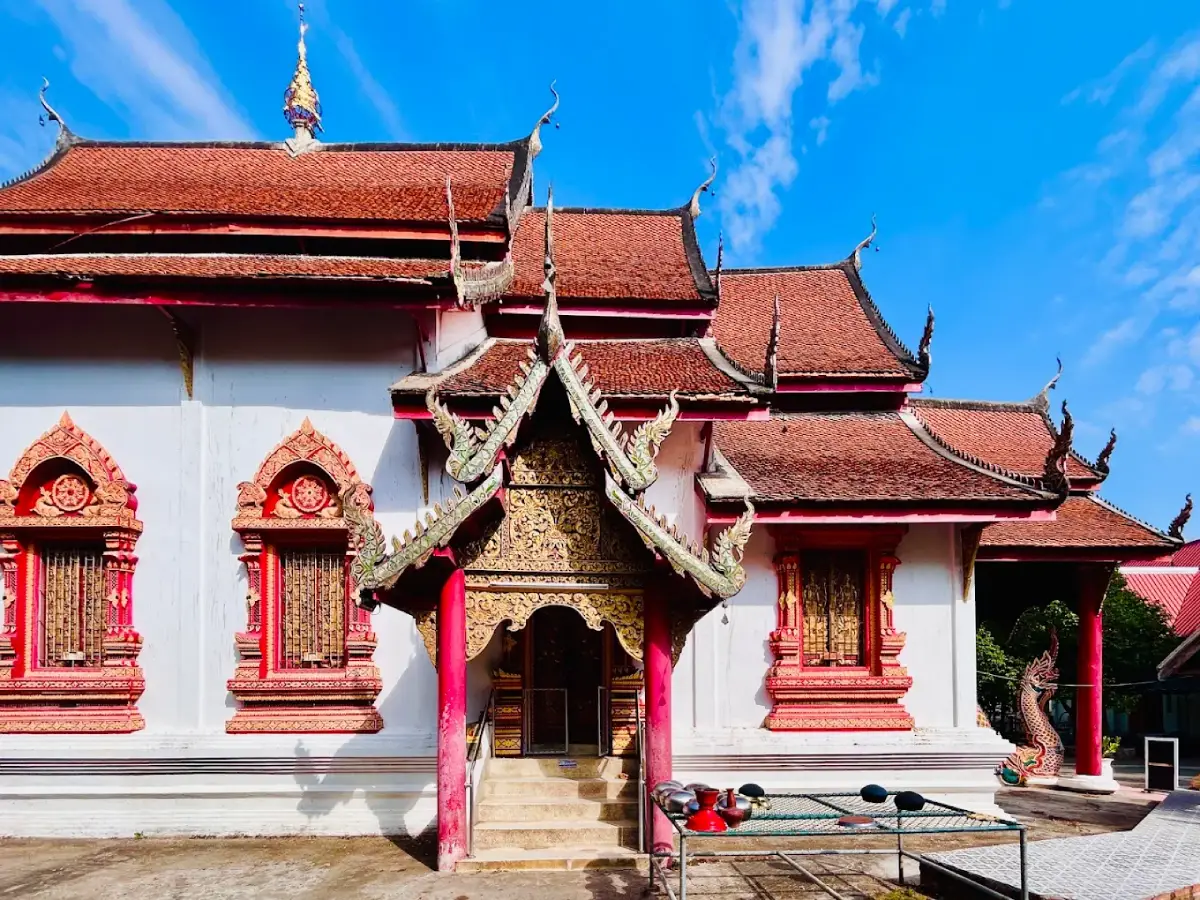
The temple’s architecture also deserves close attention. The viharn is built in Lanna style, with several layered roof tiers. The front section extends outward as a porch covering the naga stairway, and there is also a side entrance. This arrangement reflects Lanna temple architecture, where the approach to the sacred interior is carefully shaped through steps, guardian motifs, front porches, and directional movement. The naga figures at the entrance symbolize protection and mark the transition into a sacred space.
The front gable of the viharn is decorated with floral and plant motifs in gilded carved wood. In Lanna Buddhist art, plant patterns are often associated with growth, abundance, and the flourishing of Buddhism. Their use on the viharn’s façade transforms the building into a sacred architectural surface. The main doors are carved with standing celestial figures with hands pressed together in respectful greeting. These gilded figures function visually as guardians and spiritually as a welcoming presence for worshippers entering the viharn.
The ordination hall at Wat Puak Taem was built in 2486 B.E. and was significantly restored in 2533 B.E. It is a local-style ordination hall with fine carved wooden decoration. In Buddhist monastic life, the ordination hall is one of the most important buildings in a temple. It is used for monastic acts such as ordination-related ceremonies, formal recitation, and activities requiring a consecrated boundary. Even though visitors may first notice the viharn or stupa, the ordination hall confirms the temple’s complete religious function within the monastic system.
The scripture hall, or ho trai, at Wat Puak Taem combines Lanna and Myanmar artistic influences and was later restored and adapted. A scripture hall is used to preserve Buddhist scriptures, palm-leaf manuscripts, and religious texts. This building type shows that temples were not only places for worship and ceremonies. They also preserved knowledge. At Wat Puak Taem, the scripture hall strengthens the temple’s identity as a place where craftsmanship, architecture, and Buddhist learning are interconnected.
The stupa of Wat Puak Taem is especially interesting because it contains Myanmar, Mon, and Srivijaya artistic influences. The upper portion, from the bell-shaped body to the umbrella finial, clearly shows Myanmar and Mon features. This mixed form reveals Chiang Mai as a city of layered cultures. Lanna temples did not exist in isolation. They were shaped by Myanmar, Mon, and other cultural influences through politics, trade, patronage, migration, and artisan networks.
The stupa is also connected with the patronage of Myanmar Buddhist donors. This makes Wat Puak Taem useful for understanding Chiang Mai’s old city as a multi-layered religious landscape. Myanmar and Mon elements in the stupa do not reduce the temple’s Lanna identity. Instead, they show how Chiang Mai absorbed and localized many artistic influences into its Buddhist environment. The result is a temple where local Lanna craftsmanship and wider regional Buddhist art exist together.
Another important historical element at Wat Puak Taem is the Buddha image base inscription. The inscription is written in Lanna Dhamma script with Thai, Pali, and Sanskrit content. It appears on the bronze base of a reclining Buddha image and is dated to 2475 B.E. The inscription records that Phra Aphai Sarathon Phisi Burachan, the chief monk of Chiang Mai Province, Phra Khru Wichian Panya, Phra Khattiya, the abbot of Wat Puak Taem, Khun Boriban, and other devotees jointly cast the Buddha image. It also mentions the artisan names involved in the casting and Nang Bua Cham, who created the viharn for enshrining the image.
This inscription is important because it gives Wat Puak Taem documentary depth beyond oral tradition. It records names, dates, donors, metal casting, and the construction of a viharn for a Buddha image. This evidence fits the temple’s craft identity very strongly. It shows that merit-making, bronze casting, sacred image creation, and temple architecture were part of one connected process. Wat Puak Taem is therefore not only a temple of decorative craft, but also a site with written evidence of devotional art-making.
The reclining Buddha image associated with the inscription adds another layer of meaning. In Buddhist tradition, reclining Buddha images often refer to the final passing of the Buddha into parinirvana. They remind worshippers of impermanence, serenity, and liberation. When viewed together with the inscription, bronze casting, and the viharn built for enshrining the image, this Buddha image carries both religious and historical value.
Wat Puak Taem remains open to worshippers and visitors today. Published visitor information commonly lists the temple as open daily from 08.00 to 17.00. Recent temple database information for the 2569 B.E. Kathin cycle lists Wat Puak Taem in Phra Sing Subdistrict, Mueang Chiang Mai District, Chiang Mai Province, and identifies Phra Khru Wisut Suttharo as the abbot. The temple also appears in contemporary travel and cultural databases, confirming that it remains a visible cultural and religious site within Chiang Mai’s old city.
Visitors should not rush through Wat Puak Taem. A good visit begins with the entrance and the viharn façade, where the carved wood, gilded patterns, naga stairway, and celestial door figures can be observed closely. Visitors can then continue to the stupa, scripture hall, ordination hall, reclining Buddha image area, and the community craft area. If examples of decorative umbrellas, ceremonial canopies, or perforated metalwork are visible, they should be studied carefully because they are the core of the Puak Taem craft identity.
Getting There is convenient because Wat Puak Taem is located within Chiang Mai’s old city. From Wat Phra Singh, visitors can walk toward Samlan Road and continue into Soi 7. From Wat Chedi Luang or Prapokklao Road, visitors can walk through Ratchamankha Road toward the temple neighborhood. Travelers staying near Nong Buak Haad Park, Chiang Mai Gate, Wua Lai Road, or the Sunday Walking Street route can reach the temple on foot or by red songthaew, tuk-tuk, motorcycle taxi, or private car.
Visitors driving to Wat Puak Taem should plan for limited parking. Samlan Road and the nearby lanes are part of the old city, where streets are relatively narrow and accommodation, restaurants, and temples stand close together. Traffic and parking can become more difficult on weekends, in the evening, and on Sundays when the old city walking street is active. Walking from nearby accommodation or using local transport is often easier, especially for visitors who plan to combine several temples in one route.
The best time to visit Wat Puak Taem is in the morning or late afternoon. Natural light is suitable for seeing details on the viharn, stupa, and metal ornaments, while the weather is usually more comfortable. Visitors interested in kua tong or the community museum should allow more time than a normal short temple stop because the temple contains important craft and community-history content.
Wat Puak Taem can be combined with several old-city routes. A craft and temple route can include Wat Puak Taem, Wat Chang Taem, Wat Puak Hong, Wat Muen Ngoen Kong, and Wat Phra Chao Mengrai. A classic old-city route can connect the temple with Wat Phra Singh, Wat Chedi Luang, Wat Phan Tao, and the Sunday Walking Street. A relaxed walking route can continue to Nong Buak Haad Park, Chiang Mai Gate, and Wua Lai Road. These routes help visitors see temples, craft communities, markets, and old-city neighborhoods together.
Visitors should follow normal Thai temple etiquette. Dress respectfully, speak quietly, remove shoes before entering designated sacred areas, avoid disturbing monks or worshippers, and do not touch religious objects, inscriptions, metalwork, tools, or craft displays without permission. If artisans or community members are working on kua tong, visitors should observe from a respectful distance and give priority to the people who maintain the craft and the temple space.
The value of Wat Puak Taem lies in the way it brings many layers of Chiang Mai together: a local Mahanikaya temple, the history of an artisan community, perforated metalwork, decorative umbrellas, kua tong, a community museum, a Lanna viharn, a local-style ordination hall, a scripture hall with mixed influence, a Myanmar-Mon-Srivijaya-influenced stupa, and an inscribed bronze reclining Buddha image dated to 2475 B.E. Few small temples in Chiang Mai express the relationship between faith, craft, and community as clearly as Wat Puak Taem.
In summary, Wat Puak Taem is a worthwhile temple for visitors interested in old Chiang Mai temples, Lanna craft, metalwork, decorative umbrellas, ceremonial canopies, kua tong, and artisan communities inside the old city. Located in Phra Sing Subdistrict near Samlan Road Soi 7, the temple is easy to combine with Wat Phra Chao Mengrai, Wat Muen Ngoen Kong, Wat Phra Singh, Wat Chedi Luang, and Nong Buak Haad Park. Its key strengths are its craft identity, architecture, stupa, inscription evidence, and living community heritage. For travelers who want to understand Chiang Mai beyond major landmarks, Wat Puak Taem is one of the most meaningful small temples in the old city.
| Name | Wat Puak Taem |
| Former / Related Name | Wat Tong Taem |
| Temple Type | Local Buddhist Temple Under The Mahanikaya Order |
| Location | Phra Sing Subdistrict, Mueang Chiang Mai District, Chiang Mai Province |
| Address | Samlan Road Soi 7, Phra Sing Subdistrict, Mueang Chiang Mai District, Chiang Mai Province 50200 |
| Coordinates | Latitude 18.7823860015, Longitude 98.9830579893 |
| Highlights | Old-City Artisan Temple, Kua Tong Metalwork, Perforated Metal Craft, Decorative Umbrellas, Lanna Viharn, Local-Style Ordination Hall, Scripture Hall, And A Stupa With Myanmar, Mon, And Srivijaya Artistic Influence |
| History | An Old Chiang Mai Temple Listed As Registered In 2060 B.E., With Ancient Objects, Religious Structures, And Inscriptions Reflecting Several Historical Layers |
| Name Origin | “Puak” Is Connected With A Local Headman Or Lower-Ranking Nobleman, While “Taem” Relates To Painting, Gilding, And Decorative Art. Another Explanation Links The Name With Wat Tong Taem, Where “Tong” Refers To Carving, Engraving, Or Perforated Craft |
| Temple Craft | Kua Tong, Perforated Metalwork, Decorative Umbrellas, Ceremonial Canopies, Silver And Gold Flower Offerings, And Lanna Buddhist Architectural Ornaments |
| Museum / Learning Area | Puak Taem Kua Tong Community Museum And Community Metalwork Learning Area |
| Important Areas | Lanna Viharn, Local-Style Ordination Hall, Scripture Hall, Stupa, Reclining Buddha Image, Buddha Image Base Inscription, Temple Courtyard, And Kua Tong Craft Area |
| Ordination Hall | Built In 2486 B.E. And Significantly Restored In 2533 B.E.; A Local-Style Ordination Hall With Fine Carved Wooden Decoration |
| Viharn | A Lanna-Style Viharn With Multi-Tiered Roofs, A Front Porch Covering The Naga Stairway, Floral Gable Decoration, And Gilded Wooden Doors Carved With Standing Celestial Figures |
| Stupa | A Stupa With Mixed Myanmar, Mon, And Srivijaya Artistic Features, Especially From The Bell-Shaped Body Up To The Umbrella Finial |
| Key Evidence | Wat Puak Taem Buddha Image Base Inscription In Lanna Dhamma Script With Thai, Pali, And Sanskrit Content On The Bronze Base Of A Reclining Buddha Image, Dated To 2475 B.E. |
| Important Associated Figures | Phra Khru Net, Who Helped Develop The Temple’s Decorative Patterns And Umbrella Craft Around 2518 B.E.; Phra Khru Wisut Suttharo, Listed As The Contemporary Abbot |
| Travel Information | Accessible From Wat Phra Singh, Wat Phra Chao Mengrai, Wat Chedi Luang, Samlan Road, Ratchamankha Road, Nong Buak Haad Park, And The Sunday Walking Street Route By Walking, Red Songthaew, Tuk-Tuk, Motorcycle Taxi, Or Private Car |
| Current Status | Open To Worshippers And Visitors; It Remains A Local Old-City Temple With Religious, Craft, And Community Learning Roles |
| Open Days | Daily |
| Opening Hours | 08.00 – 17.00 |
| Abbot / Caretaker | Phra Khru Wisut Suttharo |
| Facilities | Viharn, Worship Area, Temple Courtyard, Ordination Hall, Scripture Hall, Kua Tong Learning Area, And Limited Parking Depending On Old-City Conditions |
| Main Areas / Zones | Entrance Area, Viharn, Ordination Hall, Scripture Hall, Stupa, Courtyard, Reclining Buddha Image Area, Buddha Image Base Inscription Area, Community Museum, And Kua Tong Craft Area |
| Nearby Tourist Attractions | 1. Wat Phra Chao Mengrai, About 0.2 km 2. Wat Muen Ngoen Kong, About 0.3 km 3. Wat Puak Hong, About 0.4 km 4. Wat Chang Taem, About 0.4 km 5. Nong Buak Haad Park, About 0.5 km 6. Wat Phra Singh Woramahawihan, About 0.7 km 7. Wat Chedi Luang, About 0.8 km 8. Sunday Walking Street, About 0.8 km |
| Nearby Restaurants | 1. Lab Moo Wat Puak Taem, About 0.1 km, Tel. 082-601-8479 2. Lookbua Thai Food Restaurant, About 0.1 km, Tel. 095-721-6688 3. 2C's2son's, About 0.2 km, Tel. 086-327-8325 4. Coconut Shell, About 0.6 km, Tel. 086-654-2746 5. Huen Phen, About 0.7 km, Tel. 053-814-548 6. Rachamankha Restaurant, About 0.8 km, Tel. 053-904-111 7. Dash Teak House, About 1 km, Tel. 053-279-230 |
| Nearby Accommodations | 1. Puak Taem Boutique Hotel, About 0.1 km, Tel. 063-651-5323 2. Pastell Oldtown Chiang Mai, About 0.1 km, Tel. 053-272-989 3. Chiang Mai Hostel, About 0.1 km, Tel. 053-272-414 4. Baba Pim Guesthouse, About 0.1 km, Tel. 095-697-9932 5. Champion Hostel 2, About 0.1 km, Tel. 095-239-1257 6. The Iyara Poshtel, About 0.1 km, Tel. 081-534-2660 |
Frequently Asked Questions (FAQ)
Q: Where is Wat Puak Taem located?
A: Wat Puak Taem is located around Samlan Road Soi 7, Phra Sing Subdistrict, Mueang Chiang Mai District, Chiang Mai Province. It is inside Chiang Mai’s old city, near Wat Phra Chao Mengrai, Wat Muen Ngoen Kong, Wat Phra Singh Woramahawihan, and Nong Buak Haad Park.
Q: What are the opening days and hours of Wat Puak Taem?
A: Wat Puak Taem is open daily from 08.00 to 17.00. It is suitable for worship, viewing Lanna architecture, observing the stupa and scripture hall, and learning about the community’s kua tong metalwork.
Q: What was the former name of Wat Puak Taem?
A: The temple is associated with the former name Wat Tong Taem. “Tong” relates to carving, engraving, or perforated work, while “taem” relates to painting, gilding, and Lanna decorative art.
Q: What are the main highlights of Wat Puak Taem?
A: The main highlights are its artisan community identity, kua tong metalwork, perforated metal craft, decorative umbrellas, Lanna viharn, local-style ordination hall, scripture hall, stupa, and Buddha image base inscription.
Q: What is kua tong at Wat Puak Taem?
A: Kua tong is a Lanna metal craft involving hammered, perforated, shaped, and assembled metalwork. At Wat Puak Taem, it includes decorative umbrellas, ceremonial canopies, silver and gold flower offerings, and religious ornaments used for Buddhist architecture.
Q: Why are decorative umbrellas important at Wat Puak Taem?
A: Decorative umbrellas, or chat, are sacred ceremonial ornaments in Buddhist tradition. They are used on stupas, relic monuments, ordination halls, and viharns to symbolize dignity, sacredness, protection, and auspiciousness. Wat Puak Taem is known for this craft tradition.
Q: What important evidence is found at Wat Puak Taem?
A: The important evidence includes the Wat Puak Taem Buddha image base inscription, written in Lanna Dhamma script with Thai, Pali, and Sanskrit content on the bronze base of a reclining Buddha image. It is dated to 2475 B.E. and records donors, artisans, and the creation of the Buddha image.
Q: What nearby places can be included in the same route?
A: Nearby places include Wat Phra Chao Mengrai, Wat Muen Ngoen Kong, Wat Puak Hong, Wat Chang Taem, Nong Buak Haad Park, Wat Phra Singh Woramahawihan, Wat Chedi Luang, and the Sunday Walking Street route.
 Category: ●Places of Worship
 Group: ●Temple
Last Update : 3 DayAgo
 Last Update : 3 DayAgo
 Click to Access the Navigation Map GPS
Wat Puak Taem Map
Recommend

 Muang Chiang Mai(121)Chom Thong(47)Mae Chaem(25)Chiang Dao(33)Doi Saket(68)Mae Taeng(85)Mae Rim(69)Samoeng(29)Fang(71)Mae Ai(62)Phrao(70)San Pa Tong(105)San Kamphaeng(66)San Sai(73)Hang Dong(74)Hot(32)Doi Tao(22)Omkoi(11)Saraphi(74)Wiang Haeng(15)Chai Prakan(28)Mae Wang(32)Mae On(22)Doi Lo(34)Galyani Vadhana(1)


