
lovethailand home >North Travel Attractions >Chiang Mai Travel Attractions >Hot >Bo Luang > Wat Phra That Doi Liam
TL;DR: Wat Phra That Doi Liam is located at Ban Na Fon, Moo 4, Bo Luang Subdistrict, Hot District, Chiang Mai Province, open Daily, hours 08.00 – 17.00.

Wat Phra That Doi Liam
Open Days: Daily
Opening Hours: 08.00 – 17.00
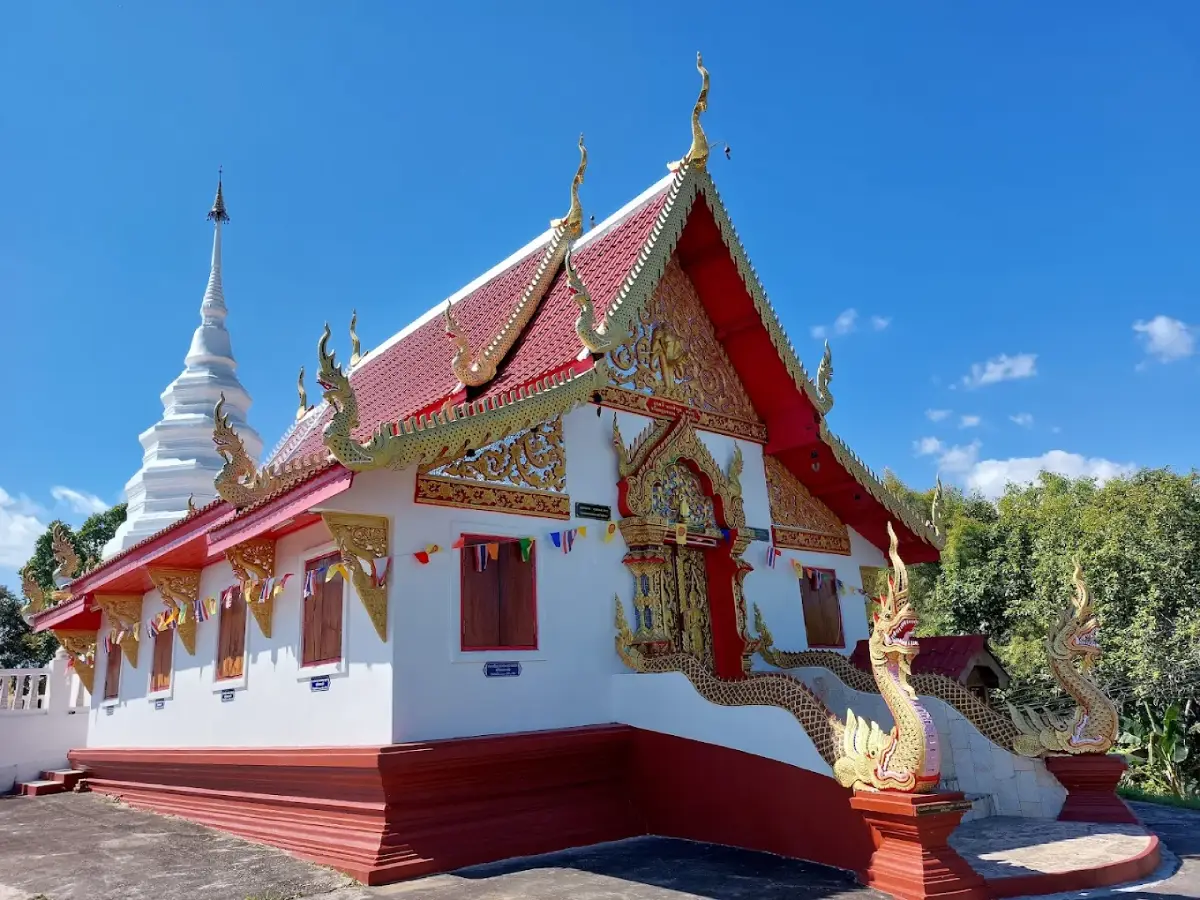
Wat Phra That Doi Liam in Ban Na Fon, Bo Luang Subdistrict, Hot District, Chiang Mai Province, is a small hilltop temple known for its sacred chedi, quiet forest setting, and wide mountain viewpoint. The temple is a meaningful stop for travelers driving along the Chiang Mai – Mae Sariang route, especially those who want to combine Buddhist worship, local culture, and northern mountain scenery in one peaceful visit.
The temple is not a large urban monastery. Its appeal lies in its simplicity, local character, and connection with the highland community of Bo Luang. Visitors who arrive at Wat Phra That Doi Liam will find a calm temple compound surrounded by trees, fresh mountain air, and a viewpoint beside the chedi where the surrounding hills and forests of Hot District can be seen clearly on a fine day. This makes the temple suitable for travelers who prefer quiet cultural places rather than crowded sightseeing spots.
The name Doi Liam is closely connected with the local landscape and community memory of Ban Na Fon. The area was once remembered by villagers as Doi Mo Wiang, a hill associated with local belief and sacred signs. Around 1957, a local story tells of a villager who cleared the hill for rice farming but later experienced unusual events and dreams involving sacred presences, including a herd of elephants. The story strengthened the community’s belief that the hill should become a place of Buddhist merit rather than ordinary farmland.
Later, former village leader Bunma Noosa and local residents invited Phra Khru Phiphat Khanapiban, also known as Ajarn Thong Sirimangkhalo, who was then an important monk in Hot District, to inspect the site and perform a spiritual dedication. After Ajarn Thong traveled to Sri Lanka for Buddhist missionary work and pilgrimage, he met Khru Ba Manop and discussed the possibility of building a chedi on the hill. Khru Ba Manop was later invited from Song District in Phrae Province to help lead the construction. The building of the chedi began in 1980 with support from Lawa, Yang, and other local Buddhist devotees.
The temple therefore carries a strong community story. Wat Phra That Doi Liam was not created as a tourist landmark first; it grew from local faith, shared labor, and respect for a hill believed to be spiritually significant. This background gives the temple a deeper meaning for visitors who want to understand how Buddhist sites in northern Thailand are often tied to mountains, forests, village identity, and long-standing oral traditions.
Bo Luang Subdistrict is a mountainous area in southern Chiang Mai. Local communities include northern Thai residents as well as ethnic groups such as Lawa and Karen, whose ways of life are closely connected with highland agriculture, forest landscapes, and local Buddhist traditions. Wat Phra That Doi Liam reflects this wider cultural setting. It stands not only as a place for worship but also as a spiritual marker for Ban Na Fon and the surrounding community.
The chedi is the central feature of the temple. Visitors usually pay respect to the chedi first, then walk around the upper area and enjoy the viewpoint beside it. From the higher ground, the view opens toward green hills, forested slopes, and the quiet rural landscape of Bo Luang. On a clear day, the layered mountain scenery gives the place a distinct sense of space and stillness, making it a rewarding stop for travelers who enjoy photography, nature, and reflective travel.
The temple compound is modest and easy to understand. The most important areas are the chedi courtyard, the viewpoint, the surrounding forest zone, and the worship area used by visitors and local residents. Publicly confirmed details about every religious building in the compound are limited, so the temple is best appreciated for what clearly defines it: the sacred chedi, the hilltop atmosphere, the forest setting, and the panoramic viewpoint.
Wat Phra That Doi Liam is often visited together with Bo Kaeo Pine Garden and Doi Bo Luang Forest Park. Bo Kaeo Pine Garden is one of the best-known photo stops in Hot District, while Doi Bo Luang Forest Park offers pine forest accommodation and camping areas. Together, these places create a natural and cultural route through Bo Luang: pine forest scenery, a quiet hilltop temple, village culture, and mountain road travel.
The temple is also connected with the local Phra That bathing ceremony, a community merit-making event centered on Wat Phra That Doi Liam in Ban Na Fon. This tradition reflects the role of the chedi as a spiritual center for the village and Bo Luang Subdistrict. For local people, the event is not only a religious ceremony but also a moment for community gathering, merit-making, and the continuation of northern Thai Buddhist culture.
From a cultural perspective, Wat Phra That Doi Liam represents a familiar pattern in northern Thailand: a sacred hill, a chedi built by local devotion, and a temple that becomes part of community identity. In many Lanna communities, a temple is not only a place for rituals. It is also a memory site, a meeting place, and a symbol of how people understand their relationship with the land around them.
The best way to experience Wat Phra That Doi Liam is to travel slowly. Visitors should take time to pay respect at the chedi, look out over the mountains, and observe the quiet atmosphere of the forested compound. Morning and late afternoon are pleasant times for photography and walking, while midday can be hot in open areas. Comfortable shoes, drinking water, and modest clothing are recommended.
Wat Phra That Doi Liam is suitable for several types of travelers: Buddhist visitors seeking a quiet place of worship, photographers looking for a mountain viewpoint, road-trip travelers driving between Chiang Mai and Mae Sariang, and cultural travelers interested in lesser-known temple sites in Hot District. Its strength is not scale or grandeur, but authenticity, calmness, and its close connection with the local community.
Visitors should pay respect to the chedi, avoid climbing on sacred structures, keep noise low, and be careful around viewpoint edges or sloping ground. Photography is generally suitable around the viewpoint and temple grounds, but visitors should avoid disrespectful poses or behavior inappropriate for a Buddhist sacred site. Keeping the area clean is especially important because the temple sits within a forested local environment.
Getting There from Chiang Mai city, take Highway 108 along the Chiang Mai – Hot – Mae Sariang route. After entering Hot District and reaching the clock tower roundabout, turn left toward Mae Sariang. Continue for about 40 km, then turn left at the Omkoi junction and continue toward Bo Luang and Ban Na Fon for about 13 km. The final part of the route passes through mountain and local roads, so drivers should proceed carefully, especially during rain, fog, or low-light conditions. Public transport on the Chiang Mai – Omkoi route includes local songthaews and buses, with onward local transport needed depending on the travel schedule.
For trip planning, Wat Phra That Doi Liam works well as part of a one-day route with Bo Kaeo Pine Garden and Doi Bo Luang Forest Park. Travelers who want to stay overnight can choose accommodation near Doi Bo Luang Forest Park or in Hot District. Those continuing toward Mae Sariang can use the temple as a quiet cultural stop before driving farther along the mountain route.
Wat Phra That Doi Liam adds cultural depth to a journey through Hot District. Many travelers know this area for pine forests and cool mountain scenery, but this temple shows another side of Bo Luang: a landscape shaped by Buddhist faith, village memory, and community traditions. A visit here helps travelers see that the mountains of southern Chiang Mai are not only beautiful viewpoints, but also places of living culture and shared devotion.
| Name | Wat Phra That Doi Liam |
| Location | Ban Na Fon, Moo 4, Bo Luang Subdistrict, Hot District, Chiang Mai Province |
| Address | Ban Na Fon, Bo Luang Subdistrict, Hot District, Chiang Mai 50240, Thailand |
| Highlights | Sacred hilltop chedi, mountain viewpoint, forest surroundings, and a peaceful local temple atmosphere |
| History | The chedi construction began in 1980 through the shared faith of Ban Na Fon villagers, Lawa and Yang communities, and local Buddhist devotees |
| Name Origin | Locally known as Phra That Doi Liam or Phra That Doi Liam (Na Fon), the name is linked with the hill landscape and the spiritual story of Ban Na Fon |
| Distinctive Features | A small temple surrounded by forest, located in the mountainous area of Hot District, with a viewpoint beside the chedi |
| Travel Information | Take Highway 108 from Chiang Mai toward Hot and Mae Sariang, turn at the Omkoi junction, then continue toward Ban Na Fon for about 13 km; public transport on the Chiang Mai – Omkoi route includes songthaews and buses |
| Current Status | Open as a Buddhist temple and local community attraction in Bo Luang Subdistrict, Hot District, Chiang Mai |
| Open Days | Daily |
| Opening Hours | 08.00 – 17.00 |
| Facilities | Temple courtyard, chedi worship area, viewpoint, and parking space according to local temple conditions |
| Main Areas / Zones | Chedi courtyard, viewpoint beside the chedi, surrounding forest area, and worship space |
| Related Local Tradition | The Phra That bathing ceremony is an important merit-making event for Ban Na Fon and Bo Luang communities |
| Main Contact Number | Bo Luang Subdistrict Municipality Tel. 0-5208-1663, 093-137-4778 |
| Official Website / Official Page | Bo Luang Subdistrict Municipality, Hot District, Chiang Mai Province |
| Nearby Tourist Attractions | 1. Bo Kaeo Pine Garden, about 11 km 2. Doi Bo Luang Forest Park, about 15 km 3. Doi OK Vegetable Garden, about 18 km 4. Khun Luang Wilangka Monument, about 25 km 5. Wat Kio Lom, about 28 km |
| Nearby Restaurants | 1. Rabeang Son Cafe, about 11 km, Tel. 062-079-9411 2. Suanson Coffee&rest, about 11 km, Tel. 098-748-8372 3. Na Samoeng Bo Kaeo Coffee, about 12 km, Tel. 097-165-7479 4. Nueng Diao Restaurant, about 18 km, Tel. 086-915-3716 5. Wilaiphon Restaurant & Hod Coffee, about 55 km, Tel. 084-222-2421 |
| Nearby Accommodations | 1. Doi Bo Luang Forest Park by the Forest Industry Organization, about 15 km, Tel. 092-586-9215 2. Tiw Son Resort Hot, about 22 km, Tel. 080-845-1167 3. Huen Hug Hod The Resort, about 55 km, Tel. 085-030-7356 4. Kiss Hod Resort, about 55 km, Tel. 080-135-2992 5. Hod Resort, about 55 km, Tel. 053-460-170 |
Frequently Asked Questions (FAQ)
Q: Where is Wat Phra That Doi Liam located?
A: Wat Phra That Doi Liam is located in Ban Na Fon, Moo 4, Bo Luang Subdistrict, Hot District, Chiang Mai Province.
Q: What is Wat Phra That Doi Liam known for?
A: The temple is known for its sacred hilltop chedi, quiet forest setting, and mountain viewpoint overlooking the Bo Luang area.
Q: What are the opening days and opening hours?
A: The temple is open daily from 08.00 to 17.00.
Q: How do travelers get to Wat Phra That Doi Liam?
A: Travelers can take Highway 108 from Chiang Mai toward Hot and Mae Sariang, turn at the Omkoi junction, and continue toward Ban Na Fon for about 13 km. Public transport on the Chiang Mai – Omkoi route includes songthaews and buses.
Q: What type of trip is Wat Phra That Doi Liam suitable for?
A: It is suitable for temple visits, mountain viewpoints, cultural road trips, and combined routes with Bo Kaeo Pine Garden and Doi Bo Luang Forest Park.
Q: Is there an important local ceremony related to the temple?
A: Yes. The Phra That bathing ceremony is an important community merit-making event connected with Wat Phra That Doi Liam.
Q: What should visitors prepare before visiting?
A: Visitors should wear modest clothing, bring drinking water, wear comfortable shoes, and drive carefully because parts of the route pass through mountain roads.
 Category: ●Places of Worship
 Group: ●Temple
Last Update : 2 WeekAgo
 Last Update : 2 WeekAgo
 Click to Access the Navigation Map GPS
Wat Phra That Doi Liam Map
Recommend

 Muang Chiang Mai(121)Chom Thong(47)Mae Chaem(25)Chiang Dao(33)Doi Saket(68)Mae Taeng(85)Mae Rim(69)Samoeng(29)Fang(71)Mae Ai(59)Phrao(70)San Pa Tong(103)San Kamphaeng(66)San Sai(73)Hang Dong(73)Hot(32)Doi Tao(22)Omkoi(11)Saraphi(74)Wiang Haeng(15)Chai Prakan(28)Mae Wang(32)Mae On(22)Doi Lo(33)Galyani Vadhana(1)


