
lovethailand home >North Travel Attractions >Chiang Mai Travel Attractions >Muang Chiang Mai >Phra Sing > Wat Sai Moon Muang
TL;DR: Wat Sai Moon Muang is located at Phra Sing Subdistrict, Mueang Chiang Mai District, Chiang Mai Province, open Daily.

Wat Sai Moon Muang
Open Days: Daily
General Visiting Hours: 08.00 – 17.00
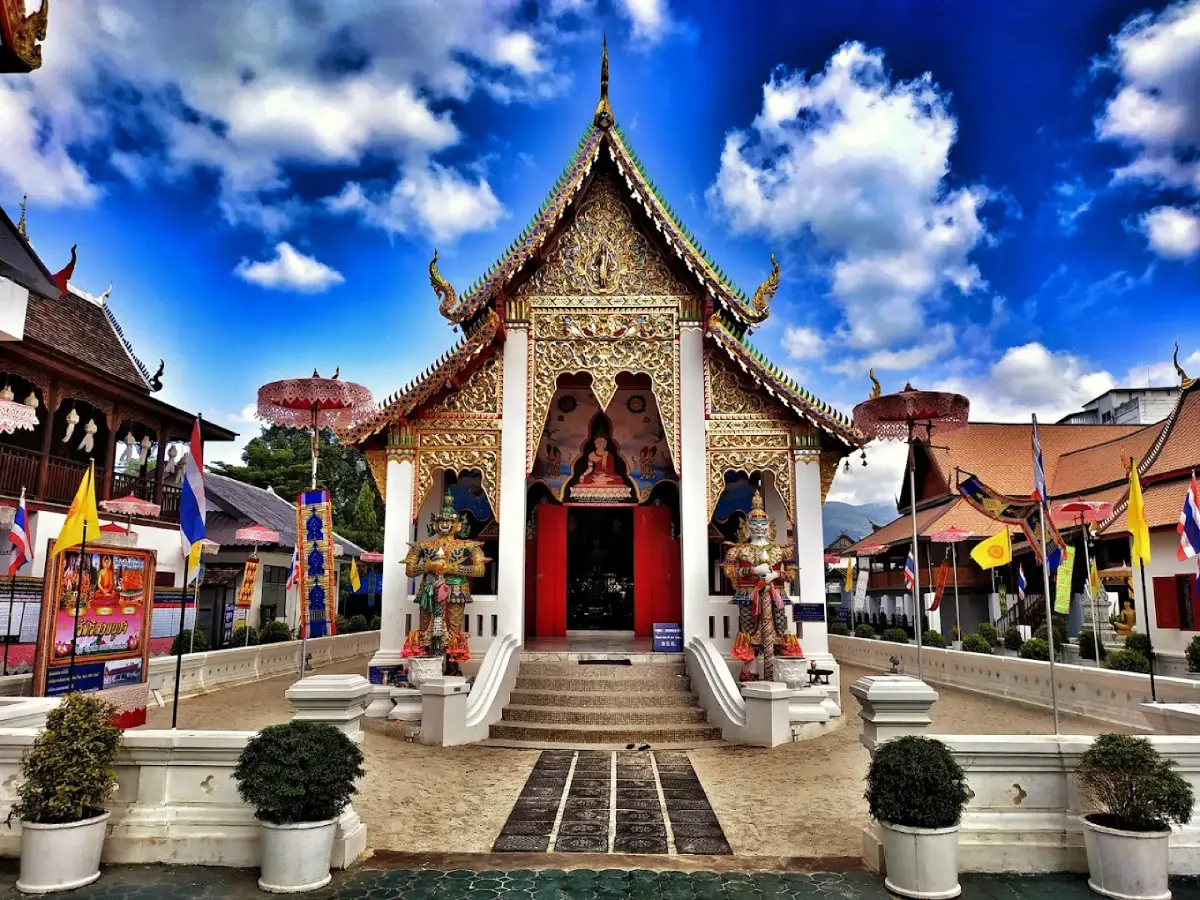
Wat Sai Moon Muang is an old Buddhist temple in Chiang Mai’s historic old city area. It is located on Moon Muang Road in Phra Sing Subdistrict, Mueang Chiang Mai District, Chiang Mai Province, near the southeastern corner of the old city moat, close to Wat Sai Moon Myanmar, Chaeng Ka Tam, Chiang Mai Gate, Chiang Mai Gate Market, and Wat Mueang Mang. Although the temple compound is compact, Wat Sai Moon Muang is historically meaningful because it is closely connected with the old city’s water system, sand deposits, local settlement, and the community landscape around the moat. The temple’s name is therefore not only a place name, but also a record of Chiang Mai’s older geography.
The main appeal of Wat Sai Moon Muang lies in its quiet local character and the surviving traces of old Lanna temple architecture. Two features are especially important: the wooden scripture hall and the wooden monks’ residence. These structures reflect how old community temples in Chiang Mai preserved religious texts, housed monks, and served the surrounding neighborhood. Some older wooden areas should be viewed respectfully from accessible spaces only, but their value is clear. They help visitors understand the temple as a living religious and historical site rather than only a small stop near Chiang Mai Gate.
Wat Sai Moon Muang was founded in 2030 B.E. and later received royal granting of the visungkhamsima in 2450 B.E. Before becoming a fully established temple, the site was connected with an earlier monastery name, Aram Ban Pa. The origin of the name Sai Moon Muang is tied to the local landscape. One explanation says that water flowing from Doi Suthep converged in this area, forming a marsh where sand accumulated. This created the name Nong Sai Moon, which later became associated with the temple name Wat Sai Moon Muang.
Another explanation connects the name with earthworks used in the construction of Chiang Mai’s inner city wall. The area may once have been excavated for soil to make bricks, leaving a hollow or pond-like depression. When the temple later received formal religious status, the name Wat Sai Moon was used. Both explanations point to the same core idea: the temple name is linked with water, soil, sand, and the making of the old city. Wat Sai Moon Muang should therefore be understood together with Chiang Mai’s historical urban geography.
The southeastern corner of Chiang Mai’s old city moat is an important area in the city’s traditional water system. It was associated with drainage from the old city before water continued toward larger waterways. Areas with flowing water often collected sand and sediment, shaping the names of places, communities, and temples. Wat Sai Moon Muang is a clear example of a temple whose name preserves environmental memory within the old city.
Wat Sai Moon Muang is best understood together with nearby Wat Sai Moon Myanmar. The two temples stand very close to one another and have related names, yet their cultural identities differ. Wat Sai Moon Muang is associated with the city community and Lanna cultural setting, while Wat Sai Moon Myanmar has a stronger Myanmar Buddhist identity. Seeing both temples in the same route helps visitors understand the diversity of Chiang Mai’s old city, where Lanna, Myanmar, market, neighborhood, and moat-side histories coexist in a small area.
The Sai Moon Muang area is recognized as an old community around Wat Sai Moon Muang within Chiang Mai Municipality. The neighborhood consists of small lanes behind the temple, single houses, old wooden buildings, and modern structures standing close together. Many residents are connected with trade, small businesses, and food-related commerce. This makes the temple part of a dense urban community rather than an isolated religious site. Wat Sai Moon Muang helps visitors see how temples, houses, markets, lanes, and everyday life are connected in old Chiang Mai.
The wooden scripture hall is one of the most important elements of Wat Sai Moon Muang. In Lanna Buddhist culture, a scripture hall, or ho trai, was used to preserve Buddhist scriptures, palm-leaf manuscripts, and religious texts. Local information describes the southern area of the temple as once extending toward a pond where a scripture hall stood over water. It was built by Lanna craftsmen to protect Buddhist texts and scriptures. Later, when the former area changed in use, the scripture hall was moved into the present temple compound. Its lower level was used by monks, while the upper level preserved the older scripture hall function.
The importance of a scripture hall is not limited to architecture. Its role is to protect Buddhist knowledge. In many Lanna temples, scripture halls were built over water or on raised structures to reduce damage from moisture, insects, and animals. At Wat Sai Moon Muang, the scripture hall helps explain how temples preserved learning, texts, and religious memory. The temple therefore has value not only as a place of worship, but also as a place connected with the conservation of Buddhist knowledge.
The wooden monks’ residence is another meaningful structure at Wat Sai Moon Muang. Old wooden monastic buildings in Chiang Mai often appear simple, but their construction details reveal older building practices. Posts, beams, wall panels, openings, and proportions show how local craftsmen created practical religious buildings for community temples. The presence of both the scripture hall and wooden monks’ residence gives Wat Sai Moon Muang significance as a place where old Lanna wooden architecture can still be observed within the old city.
Inside the temple, visitors can also pay respect to the Five Buddhas. This worship area is meaningful for devotees who come to make merit and pray for auspiciousness. The idea of the Five Buddhas is connected with Buddhist cosmology and the continuity of the Dharma. For visitors, this area adds a devotional dimension to a temple already rich in local history and urban memory.
Another important point of devotion is Thao Wessuwan, a guardian figure widely respected in Thai Buddhist belief. Many worshippers visit Wat Sai Moon Muang to pay respect to Thao Wessuwan for protection, prosperity, and confidence in life. The worship should be approached respectfully and within the wider Buddhist context of merit-making, mindfulness, and good conduct. This keeps the temple’s value grounded in faith, community, and history rather than only in popular belief.
Wat Sai Moon Muang is also important because several inscriptions connected with Buddha images are recorded at the temple. The Thai inscription database lists multiple items associated with Wat Sai Moon Muang, including inscriptions at the bases of Buddha images. These records show acts of merit-making, Buddha image creation, and religious dedication by people in earlier periods. Such inscriptions give the temple documentary and archaeological value beyond its visible buildings.
Buddha image base inscriptions are especially useful for understanding temple history because they can preserve names of donors, dates, and devotional intentions. At Wat Sai Moon Muang, the presence of several inscription records shows that the temple was supported by worshippers across different periods. This gives the temple stronger historical depth than may be apparent from its compact size.
Wat Sai Moon Muang remains an active Buddhist temple today. Recent religious activity in Phra Sing Subdistrict was held at Wat Sai Moon Muang in 2026, with Phra Khru Sangharak Sutthat Sutadssano listed as the abbot. This confirms that the temple is not abandoned. It continues to serve monks, worshippers, and the local community as a living Buddhist site.
The temple’s current role includes worship, merit-making, Dharma activities, and community religious gatherings. At the same time, it serves as a place to learn about Chiang Mai’s old city, its water system, the relationship between Doi Suthep runoff, Huai Kaew, Khlong Mae Kha, the Ping River, and the moat-side communities. Wat Sai Moon Muang therefore has meaning at both the neighborhood level and the city level.
Getting There is convenient because the temple is located inside Chiang Mai’s old city near Chiang Mai Gate and Moon Muang Road. From Chiang Mai Gate, visitors can walk along the inner side of Moon Muang Road toward the temple. From Wat Chedi Luang or Prapokklao Road, visitors can walk south toward Chaeng Ka Tam. Travelers staying around Tha Phae, the Night Bazaar, Loi Kroh Road, or the southern old city can reach the temple by walking, red songthaew, tuk-tuk, motorcycle taxi, or private car.
Visitors driving to Wat Sai Moon Muang should plan carefully because the old city has narrow roads, small lanes, and limited parking. Parking can be more difficult in the evening, on weekends, and during busy periods around Chiang Mai Gate, Wua Lai Walking Street, or the Sunday Walking Street. Walking from nearby accommodation or using local transport is often easier and also allows visitors to experience the old city atmosphere more closely.
The best time to visit Wat Sai Moon Muang is in the morning or late afternoon. The weather is usually more comfortable, and the light is suitable for observing the wooden structures, temple courtyard, worship areas, and old buildings. Visitors who plan to continue to Wat Sai Moon Myanmar, Wat Mueang Mang, or Chiang Mai Gate should consider a connected walking route, as all these places are close to one another.
Wat Sai Moon Muang can be included in an excellent cultural route around Chaeng Ka Tam. Visitors can start at Wat Sai Moon Muang, then continue to Wat Sai Moon Myanmar, Wat Mueang Mang, Wat Puak Chang, Chaeng Ka Tam, Chiang Mai Gate, Chiang Mai Gate Market, Wua Lai Walking Street, and Wat Chedi Luang. This route gives travelers a compact but rich view of Lanna temples, Myanmar Buddhist identity, old neighborhoods, local markets, and the southern side of Chiang Mai’s old moat.
For travelers interested in Lanna architecture, Wat Sai Moon Muang can also be compared with other temples that preserve scripture halls in Chiang Mai, such as Wat Phra Singh, Wat Phan Tao, Wat Chiang Man, and Wat Fon Soi. Scripture halls reveal how temples protected Buddhist texts and how local artisans adapted materials, structure, and design to each temple’s setting. Comparing several examples helps visitors understand that Lanna scripture halls are not all the same; their forms vary by period, craftsmanship, materials, and community context.
Visitors should follow normal Thai temple etiquette. Dress modestly, speak quietly, remove shoes before entering designated sacred areas, avoid disturbing monks or worshippers, and do not enter wooden structures or restricted areas that are not open to visitors. Photography should be done respectfully, especially around Buddha images, Thao Wessuwan, and old wooden buildings that require careful preservation.
The value of Wat Sai Moon Muang lies in its ability to show that Chiang Mai is not only a city of famous landmark temples. It is also a city of small community temples that preserve older knowledge about water, sand, manuscripts, wooden architecture, inscriptions, and local devotion. A visit to Wat Sai Moon Muang is suitable for travelers who want a more detailed understanding of Chiang Mai through temples, lanes, neighborhoods, and historical geography.
In summary, Wat Sai Moon Muang is a meaningful temple for visitors interested in old Chiang Mai temples, Phra Sing Subdistrict, Chaeng Ka Tam, the old city moat, historical water systems, wooden scripture halls, wooden monks’ residences, the Five Buddhas, Thao Wessuwan, and Buddha image base inscriptions. Founded in 2030 B.E. and granted visungkhamsima in 2450 B.E., the temple remains active today. Although compact, it has strong historical, religious, and community value and is highly suitable for inclusion in a cultural walking route around Chiang Mai’s old city.
| Name | Wat Sai Moon Muang |
| Former / Related Names | Aram Ban Pa and Nong Sai Moon |
| Temple Type | Local Buddhist temple in Chiang Mai’s old city area |
| Location | Phra Sing Subdistrict, Mueang Chiang Mai District, Chiang Mai Province |
| Address | Moon Muang Road, Phra Sing Subdistrict, Mueang Chiang Mai District, Chiang Mai Province 50200 |
| Coordinates | Latitude 18.78229, Longitude 98.99134 |
| Highlights | Old temple near Chiang Mai’s southeastern moat corner, wooden scripture hall, wooden monks’ residence, Five Buddhas, Thao Wessuwan, and the Sai Moon Muang old community |
| History | Founded in 2030 B.E. and granted visungkhamsima in 2450 B.E. |
| Name Origin | The name is connected with water flowing from Doi Suthep and nearby streams that formed a marsh with accumulated sand. Another explanation links the name with soil excavation for brick-making used in Chiang Mai’s city wall construction |
| Distinctive Features | A compact old-city temple connected with water, sand, the moat system, market community, and old wooden Lanna temple architecture |
| Important Sacred Objects / Areas | Wooden scripture hall, wooden monks’ residence, Five Buddhas, Thao Wessuwan, viharn, temple courtyard, and community religious activity areas |
| Key Evidence | Several Buddha image base inscriptions associated with Wat Sai Moon Muang, showing merit-making, Buddha image creation, and Buddhist dedication across different periods |
| Community Role | A community temple in the old Sai Moon Muang neighborhood, surrounded by old houses, wooden buildings, modern structures, food businesses, and local trade |
| Travel Information | Accessible from Chiang Mai Gate, Moon Muang Road, Chaeng Ka Tam, Wat Chedi Luang, and Tha Phae area by walking, red songthaew, tuk-tuk, motorcycle taxi, or private car |
| Current Status | Open to worshippers and visitors; it remains an active Buddhist temple with religious activities of the Phra Sing Subdistrict monastic community |
| Open Days | Daily |
| General Visiting Hours | 08.00 – 17.00 |
| Abbot / Caretaker | Phra Khru Sangharak Sutthat Sutadssano |
| Facilities | Viharn, worship areas, temple courtyard, Thao Wessuwan worship area, and limited parking depending on old-city conditions |
| Main Areas / Zones | Viharn, wooden scripture hall, wooden monks’ residence, Five Buddhas area, Thao Wessuwan area, temple courtyard, and religious activity areas |
| Nearby Tourist Attractions | 1. Wat Sai Moon Myanmar, about 0.1 km 2. Chaeng Ka Tam, about 0.2 km 3. Wat Mueang Mang, about 0.2 km 4. Chiang Mai Gate, about 0.3 km 5. Chiang Mai Gate Market, about 0.4 km 6. Wat Puak Chang, about 0.4 km 7. Wua Lai Walking Street, about 0.6 km 8. Wat Chedi Luang, about 0.8 km |
| Nearby Restaurants | 1. Pee Yai Restaurant, about 0.1 km, Tel. 088-232-4074 2. Owen Bistro, about 0.1 km, Tel. 083-322-2052 3. Dash Teak House, about 0.4 km, Tel. 053-279-230 4. See You Soon Cafe, about 0.6 km, Tel. 081-880-8380 5. Tien Sieng Vegetarian Restaurant, about 0.7 km, Tel. 053-206-056, 053-281-487 6. Aroon Rai Restaurant, about 0.8 km, Tel. 053-276-947 7. Huen Phen, about 1 km, Tel. 053-814-548 |
| Nearby Accommodations | 1. All In 1 Guesthouse, about 0.2 km, Tel. 053-207-133 2. Villa Lantara Chiang Mai, about 0.3 km, Tel. 053-282-122 3. Kodchasri Thani Heritage Collections, about 0.4 km, Tel. 053-281-950 4. Hotel De Nara, about 0.5 km, Tel. 053-271-224 5. Wealth Boutique Hotel Chiang Mai, about 0.6 km, Tel. 053-903-703 6. The Old City Wall Inn, about 0.8 km, Tel. 096-679-7990 |
Frequently Asked Questions (FAQ)
Q: Where is Wat Sai Moon Muang located?
A: Wat Sai Moon Muang is located on Moon Muang Road in Phra Sing Subdistrict, Mueang Chiang Mai District, Chiang Mai Province, near Chaeng Ka Tam, Wat Sai Moon Myanmar, Chiang Mai Gate, and Chiang Mai Gate Market.
Q: Is Wat Sai Moon Muang open daily?
A: Wat Sai Moon Muang is open daily. The general visiting period is 08.00 to 17.00, which is suitable for worship and quiet observation.
Q: When was Wat Sai Moon Muang founded?
A: Wat Sai Moon Muang was founded in 2030 B.E. and received royal granting of the visungkhamsima in 2450 B.E.
Q: What is the origin of the name Wat Sai Moon Muang?
A: The name is connected with an area where water converged and sand accumulated. Another explanation links the name with soil excavation for brick-making used in the construction of Chiang Mai’s inner city wall.
Q: What old structures can visitors see at Wat Sai Moon Muang?
A: Important old features include the wooden scripture hall and the wooden monks’ residence, both of which reflect Lanna temple architecture and the religious life of old Chiang Mai communities.
Q: What are the main worship points at Wat Sai Moon Muang?
A: Visitors can pay respect to the Five Buddhas and Thao Wessuwan, along with other worship areas within the temple compound.
Q: How can visitors get to Wat Sai Moon Muang?
A: Visitors can reach the temple from Chiang Mai Gate, Moon Muang Road, Chaeng Ka Tam, Wat Chedi Luang, or Tha Phae area by walking, red songthaew, tuk-tuk, motorcycle taxi, or private car. Parking in the old city can be limited.
Q: What nearby places can be included in the same route?
A: Nearby places include Wat Sai Moon Myanmar, Chaeng Ka Tam, Wat Mueang Mang, Chiang Mai Gate, Chiang Mai Gate Market, Wat Puak Chang, Wua Lai Walking Street, and Wat Chedi Luang.
 Category: ●Places of Worship
 Group: ●Temple
Last Update : 1 DayAgo
 Last Update : 1 DayAgo
 Click to Access the Navigation Map GPS
Wat Sai Moon Muang Map
Recommend

 Muang Chiang Mai(121)Chom Thong(47)Mae Chaem(25)Chiang Dao(33)Doi Saket(68)Mae Taeng(85)Mae Rim(69)Samoeng(29)Fang(71)Mae Ai(62)Phrao(70)San Pa Tong(105)San Kamphaeng(66)San Sai(73)Hang Dong(74)Hot(32)Doi Tao(22)Omkoi(11)Saraphi(74)Wiang Haeng(15)Chai Prakan(28)Mae Wang(32)Mae On(22)Doi Lo(34)Galyani Vadhana(1)


