
lovethailand home >North Travel Attractions >Chiang Mai Travel Attractions >Muang Chiang Mai >Hai Ya > Wat Sri Ping Mueang
TL;DR: Wat Sri Ping Mueang is located at Hai Ya Subdistrict, Mueang Chiang Mai District, Chiang Mai Province, open Daily, hours 08.00 – 17.00.

Wat Sri Ping Mueang
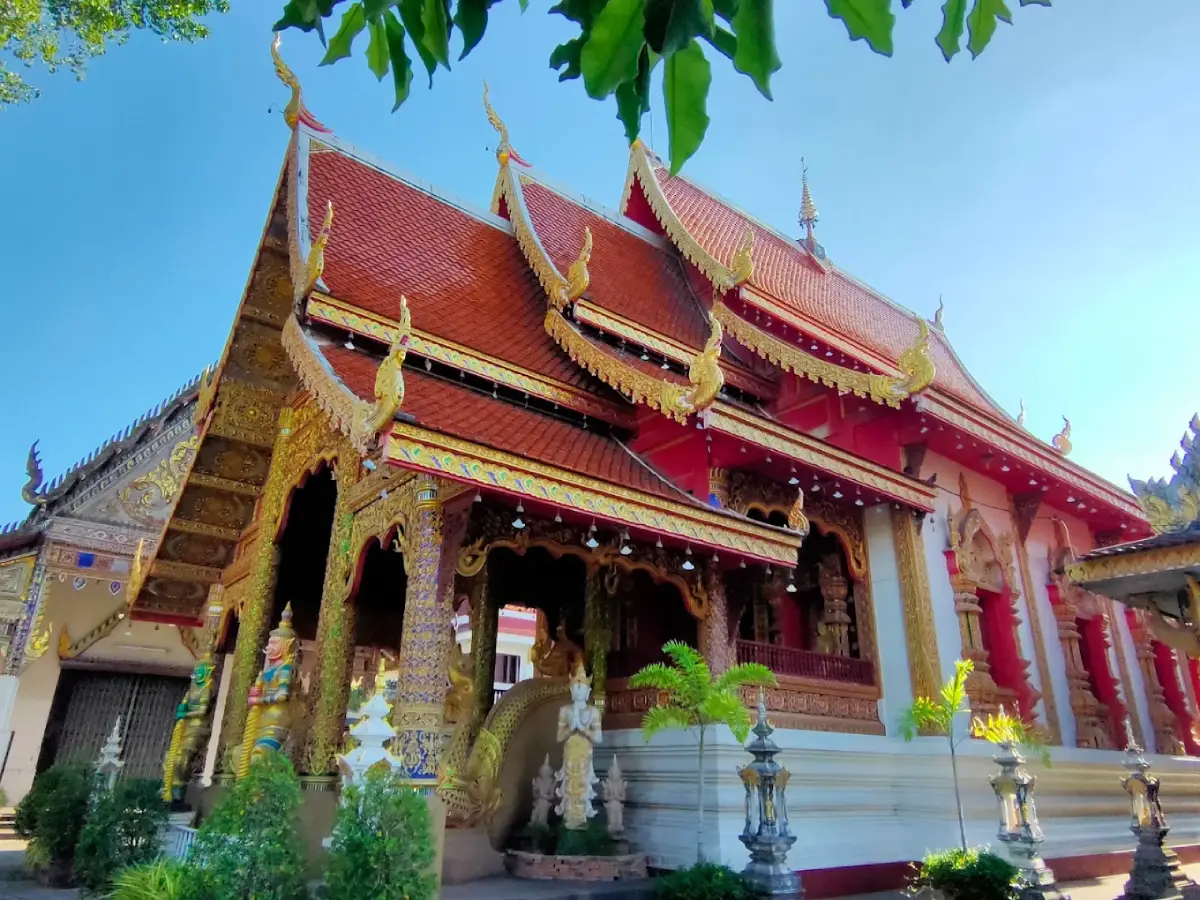
Open Days: Daily
Opening Hours: 08.00 – 17.00
Wat Sri Ping Mueang is an old Buddhist temple in Hai Ya Subdistrict, Mueang Chiang Mai District, Chiang Mai Province. It is located at No. 14 Sri Ping Mueang Road, in the southern part of Chiang Mai’s old urban area, close to Wua Lai Road, the Old Chiangmai Cultural Center, Suan Prung Gate, Chiang Mai Gate, and several historic neighborhoods. The temple is important as a local Buddhist monastery of the Hai Ya community and as a cultural site that preserves the memory of its former name, Wat San Pa Lan, which refers to an area once filled with lan palm trees. The temple was later known as Wat Sri Ping Mueang and continues to use this name today.
The appeal of Wat Sri Ping Mueang lies in its quiet community character and clear historical background. It is not one of Chiang Mai’s largest or most crowded landmark temples, but it is valuable for travelers who want to understand the city through its local neighborhoods. The temple shows how Buddhist monasteries, homes, schools, small roads, and community life are connected in Hai Ya. Visitors can come to pay respect, make merit, walk around the temple grounds, and include the temple in a cultural route near Wua Lai Road and the southern side of Chiang Mai’s old city.
According to the recorded temple history, Wat Sri Ping Mueang was founded in 2432 B.E. and received royal granting of the visungkhamsima on 3 February 2493 B.E. The temple belongs to the Mahanikaya order. These dates place Wat Sri Ping Mueang among the older temples of the Hai Ya area, with continuity from the late Lanna period into modern Chiang Mai. Its location has also changed in meaning over time, from a local settlement area around the city to a modern urban neighborhood surrounded by schools, accommodation, restaurants, and cultural attractions.
Wat Sri Ping Mueang was founded through the cooperation of Phraya Ping, Phra Chai Mongkhon, Phraya Phinit, Kruba Chao Tu, also known as Phra Khru Kawila, who was the abbot of Wat Puak Taem at that time, and local villagers. This group of founders shows that the temple was created through cooperation between local leaders, Buddhist monks, and the community. Such collective temple building was an important feature of Lanna society. A temple served not only as a religious site but also as a center for education, social relationships, local identity, and communal activities.
The former name of Wat Sri Ping Mueang was Wat San Pa Lan. The name came from the presence of many lan palm trees in the area. Lan palms are part of the older natural and cultural landscape of northern Thailand and are associated with shade, village space, and the use of palm leaves in Buddhist manuscript traditions. The name Wat San Pa Lan therefore preserves an image of the area before it became a denser urban neighborhood. It allows visitors to imagine the older landscape of Sri Ping Mueang Road through the temple’s name.
The temple later changed its name from Wat San Pa Lan to Wat Sri Ping Mueang. The present name carries an auspicious meaning connected with the city and the Ping River, the major river of Chiang Mai and Lanna. Although the name changed over time, the temple’s core role remained the same. It continued to serve as a place of Buddhist worship and community gathering for people around Hai Ya and Sri Ping Mueang Road.
The location of Wat Sri Ping Mueang is especially useful for travelers who want to explore Chiang Mai’s southern old-city area. Sri Ping Mueang Road connects with old neighborhoods near Wua Lai Road, the Old Chiangmai Cultural Center, Chiang Mai Gate, Suan Prung Gate, Wat Sri Suphan, Wat Muen San, and Nong Buak Haad Park. Because of this location, the temple can be included in a half-day cultural route covering temples, craft communities, local markets, and quieter residential streets.
Hai Ya is one of Chiang Mai’s historically rich neighborhoods. Several temples in the area have names connected with communities, crafts, occupations, or older landscapes, including Wat Puak Taem, Wat Puak Pia, Wat Puak Chang, Wat Mueang Mang, Wat Muen San, and Wat Sri Suphan. Wat Sri Ping Mueang belongs to this same cultural network. It helps complete the picture of Hai Ya as a neighborhood shaped by religion, craft traditions, education, markets, roads, and community memory rather than only by tourism.
Wat Sri Ping Mueang remains open to worshippers and visitors. It is a local Buddhist temple with resident monks and ongoing religious activity. Recent temple activity data shows that the temple is still part of the Buddhist community network and continues to participate in merit-making activities. This confirms that Wat Sri Ping Mueang is not an abandoned site but a living temple that continues to serve the surrounding community.
The current abbot listed in recent temple activity data is Phra Khru Palat Prasit Ratanamethi, and the temple has 5 resident monks. This information is important for visitors and researchers because it confirms the temple’s active religious status. The presence of resident monks and annual merit-making activities shows that Wat Sri Ping Mueang continues to function as a Buddhist center for the Hai Ya community.
The main areas inside Wat Sri Ping Mueang include the viharn, worship areas, temple courtyard, monks’ quarters, and spaces used for religious activities. The temple is compact, but it is still used as an active religious space. A visit should begin with paying respect in the main worship area, followed by a slow walk around the temple compound to observe its quiet community atmosphere and its relationship with the surrounding neighborhood.
The temple buildings reflect the modest and calm character of a Lanna community temple. Wat Sri Ping Mueang is not defined by grand scale. Its value comes from its historical name, the cooperation of its founders, its location in a changing urban neighborhood, and its continuing role in Buddhist and community life. Travelers interested in local temples will find that sites like this reveal a more grounded and everyday side of Chiang Mai than the city’s most crowded landmarks.
Wat Sri Ping Mueang is also connected with local education. Wat Sri Ping Mueang Municipal School was founded on 1 May 2479 B.E. and first opened inside the temple grounds. In 2481 B.E., it became a public school, and in 2506 B.E. it came under Chiang Mai Municipality. This connection shows the traditional role of Thai temples as centers of learning. Wat Sri Ping Mueang therefore has significance not only as a place of worship but also as part of the educational history of the local community.
The relationship between the temple and the school reflects the familiar Thai community structure of temple, home, and school. The temple provides spiritual grounding, the surrounding homes form the social base, and the school supports knowledge and discipline for younger generations. In this way, Wat Sri Ping Mueang demonstrates how Buddhist temples in Chiang Mai have long been integrated into daily life rather than separated from the community around them.
For travelers seeking a quieter Chiang Mai experience, Wat Sri Ping Mueang is a worthwhile stop. It is easy to reach but less crowded than the major temples inside the old city moat. A visit does not require a long time, but it becomes more meaningful when travelers understand the history of the name Wat San Pa Lan, the founding by local leaders and monks, and the temple’s continuing connection with local education and community identity.
Getting There is convenient from Wua Lai Road, Chiang Mai Gate, Suan Prung Gate, Mahidol Road, and Chiang Mai International Airport. Visitors can reach Sri Ping Mueang Road by private car, red songthaew, tuk-tuk, motorcycle taxi, or on foot from nearby accommodation. Travelers staying in the southern part of the old city or around Wua Lai can include the temple in an easy local route without needing to travel far from the city center.
Visitors driving to Wat Sri Ping Mueang should plan for limited parking, because Sri Ping Mueang Road and nearby lanes are part of a compact urban neighborhood. Parking may be harder during weekends, evenings, and local events. Using local transport or walking from a nearby hotel can be more convenient, especially for travelers who plan to continue to Wua Lai Road, Chiang Mai Gate Market, Wat Sri Suphan, or Nong Buak Haad Park.
The best time to visit Wat Sri Ping Mueang is in the morning or late afternoon. The weather is usually more comfortable, and the atmosphere is suitable for worship and quiet observation. Travelers planning to continue to Wua Lai Walking Street on Saturday should visit the temple earlier in the day and then continue to the walking street later, because the Wua Lai area becomes busy in the evening.
Wat Sri Ping Mueang can be combined with several nearby places. For a temple and craft route, visitors can connect it with Wat Sri Suphan, Wat Muen San, and Wua Lai Walking Street. For a local-history route, it can be combined with Wat Puak Pia, Wat Puak Chang, Wat Mueang Mang, and Wat Sai Moon Muang. For a relaxed city route, visitors can include Nong Buak Haad Park, Suan Prung Gate, Chiang Mai Gate, and Chiang Mai Gate Market. These routes help travelers understand the southern side of Chiang Mai through temples, neighborhoods, crafts, markets, and public spaces.
Visitors should follow normal Thai temple etiquette when visiting Wat Sri Ping Mueang. Dress modestly, speak quietly, remove shoes before entering designated sacred areas, avoid disturbing monks or worshippers, and take photos respectfully. Since the temple remains an active community monastery, respectful behavior helps preserve the peaceful atmosphere for local residents, monks, worshippers, and travelers.
Although Wat Sri Ping Mueang does not have as much widely published historical detail as some of Chiang Mai’s larger temples, the available information is clear and meaningful. It records the founding year, founders, former name, name change, royal granting of the visungkhamsima, current religious activity, and the temple’s relationship with local education. These elements make Wat Sri Ping Mueang a valuable small temple for understanding Chiang Mai through local history rather than only through famous landmarks.
In summary, Wat Sri Ping Mueang is a meaningful temple for travelers interested in old temples, Hai Ya, Sri Ping Mueang Road, and the southern historic neighborhoods of Chiang Mai. Founded in 2432 B.E. and granted visungkhamsima on 3 February 2493 B.E., the temple was formerly known as Wat San Pa Lan before becoming Wat Sri Ping Mueang. Its importance lies in its role as an active local monastery, its community history, its connection with local education, and its convenient location near Wua Lai Road, Chiang Mai Gate, and several cultural attractions. For visitors who want to explore a quieter and deeper side of Chiang Mai, Wat Sri Ping Mueang is a worthwhile stop.
| Name | Wat Sri Ping Mueang |
| Former Names | Wat San Pa Lan and Wat Sri Ping Mueang |
| Location | Hai Ya Subdistrict, Mueang Chiang Mai District, Chiang Mai Province |
| Address | No. 14 Sri Ping Mueang Road, Hai Ya Subdistrict, Mueang Chiang Mai District, Chiang Mai Province 50100 |
| Coordinates | Latitude 18.77135, Longitude 98.98260 |
| Highlights | Old temple on Sri Ping Mueang Road, formerly known as Wat San Pa Lan, connected with Hai Ya community life, Wua Lai Road, and Wat Sri Ping Mueang Municipal School |
| History | Founded in 2432 B.E. and granted visungkhamsima on 3 February 2493 B.E. |
| Founders | Phraya Ping, Phra Chai Mongkhon, Phraya Phinit, Kruba Chao Tu or Phra Khru Kawila, then abbot of Wat Puak Taem, and local villagers |
| Name Origin | The temple was formerly called Wat San Pa Lan because the area once had many lan palm trees. It was later renamed Wat Sri Ping Mueang |
| Distinctive Features | An active local Buddhist temple in Hai Ya with a peaceful community atmosphere and a convenient location near Wua Lai Road and Chiang Mai’s southern old-city area |
| Important Areas | Viharn, worship areas, temple courtyard, monks’ quarters, and religious activity areas |
| Travel Information | Accessible from Wua Lai Road, Chiang Mai Gate, Suan Prung Gate, Mahidol Road, and Chiang Mai International Airport by private car, red songthaew, tuk-tuk, motorcycle taxi, or on foot from nearby accommodation |
| Current Status | Open to worshippers and visitors; it remains an active local Buddhist temple with resident monks and community religious activities |
| Open Days | Daily |
| Opening Hours | 08.00 – 17.00 |
| Main Contact Number | 053-279-365 |
| Abbot / Caretaker | Phra Khru Palat Prasit Ratanamethi |
| Resident Monks | 5 monks |
| Facilities | Viharn, worship areas, temple courtyard, and limited parking depending on neighborhood conditions |
| Main Areas / Zones | Viharn, temple courtyard, monks’ quarters, worship areas, and religious activity areas |
| Nearby Tourist Attractions | 1. Old Chiangmai Cultural Center, about 0.3 km 2. Wat Sri Suphan, about 0.9 km 3. Wua Lai Walking Street, about 1 km 4. Wat Muen San, about 1 km 5. Nong Buak Haad Park, about 1.4 km 6. Suan Prung Gate, about 1.4 km 7. Chiang Mai Gate, about 1.5 km 8. Chiang Mai Gate Market, about 1.5 km |
| Nearby Restaurants | 1. Chill Kuppy Sri Ping Mueang, about 0.3 km, Tel. 061-412-4896 2. The Sandwich, about 0.4 km, Tel. 095-448-8213 3. Nitchakan Coffee, about 0.4 km, Tel. 081-881-9218 4. SOL.CAFE, about 0.5 km, Tel. 097-945-9382 5. Suki Ta-Yai, about 0.4 km, Tel. 062-246-5009 6. Lala Coffee and CC Crispy Chicken, about 0.4 km, Tel. 089-433-1551 7. Tid Cha Cafe, about 0.4 km, Tel. 063-776-3538 |
| Nearby Accommodations | 1. ZT Chiangmai Teak Wood House, about 0.1 km, Tel. 080-562-5005 2. Bupa Montra, about 0.1 km, Tel. 089-116-4964 3. Mild Home Guesthouse, about 0.2 km 4. E-Outfitting Boutique Chiang Mai, about 0.4 km, Tel. 053-282-434, 084-010-8859 5. B2 Airport Deluxe Boutique & Budget Hotel, about 0.7 km, Tel. 052-009-561 6. WE Terminal Hotel, about 0.9 km, Tel. 053-271-100 |
Frequently Asked Questions (FAQ)
Q: Where is Wat Sri Ping Mueang located?
A: Wat Sri Ping Mueang is located at No. 14 Sri Ping Mueang Road, Hai Ya Subdistrict, Mueang Chiang Mai District, Chiang Mai Province, near Wua Lai Road, the Old Chiangmai Cultural Center, Suan Prung Gate, and Chiang Mai Gate.
Q: What are the opening days and hours of Wat Sri Ping Mueang?
A: Wat Sri Ping Mueang is open daily from 08.00 to 17.00. Morning and afternoon are suitable times for worship and a quiet visit.
Q: When was Wat Sri Ping Mueang founded?
A: Wat Sri Ping Mueang was founded in 2432 B.E. and received royal granting of the visungkhamsima on 3 February 2493 B.E.
Q: What was the former name of Wat Sri Ping Mueang?
A: The temple was formerly called Wat San Pa Lan because the area once had many lan palm trees. It was later renamed Wat Sri Ping Mueang.
Q: Who founded Wat Sri Ping Mueang?
A: The temple was founded by Phraya Ping, Phra Chai Mongkhon, Phraya Phinit, Kruba Chao Tu or Phra Khru Kawila, then abbot of Wat Puak Taem, together with local villagers.
Q: What are the main highlights of Wat Sri Ping Mueang?
A: The highlights are its history as Wat San Pa Lan, its role as a local community temple in Hai Ya, its connection with Sri Ping Mueang Road, and its historical relationship with local education through Wat Sri Ping Mueang Municipal School.
Q: How can visitors get to Wat Sri Ping Mueang?
A: Visitors can reach the temple from Wua Lai Road, Chiang Mai Gate, Suan Prung Gate, Mahidol Road, or Chiang Mai International Airport via Sri Ping Mueang Road. It is accessible by private car, red songthaew, tuk-tuk, motorcycle taxi, or on foot from nearby accommodation.
Q: What nearby places can be included in the same route?
A: Nearby places include the Old Chiangmai Cultural Center, Wat Sri Suphan, Wua Lai Walking Street, Wat Muen San, Nong Buak Haad Park, Suan Prung Gate, Chiang Mai Gate, and Chiang Mai Gate Market.
 Category: ●Places of Worship
 Group: ●Temple
Last Update : 1 WeekAgo
 Last Update : 1 WeekAgo
 Click to Access the Navigation Map GPS
Wat Sri Ping Mueang Map
Recommend

 Muang Chiang Mai(121)Chom Thong(47)Mae Chaem(25)Chiang Dao(33)Doi Saket(68)Mae Taeng(85)Mae Rim(69)Samoeng(29)Fang(71)Mae Ai(59)Phrao(70)San Pa Tong(105)San Kamphaeng(66)San Sai(73)Hang Dong(74)Hot(32)Doi Tao(22)Omkoi(11)Saraphi(74)Wiang Haeng(15)Chai Prakan(28)Mae Wang(32)Mae On(22)Doi Lo(34)Galyani Vadhana(1)


