
lovethailand home >North Travel Attractions >Chiang Mai Travel Attractions >Muang Chiang Mai >Hai Ya > Wat Puak Pia
TL;DR: Wat Puak Pia is located at Hai Ya Subdistrict, Mueang Chiang Mai District, Chiang Mai Province, open Daily, hours 05.30 – 20.30.
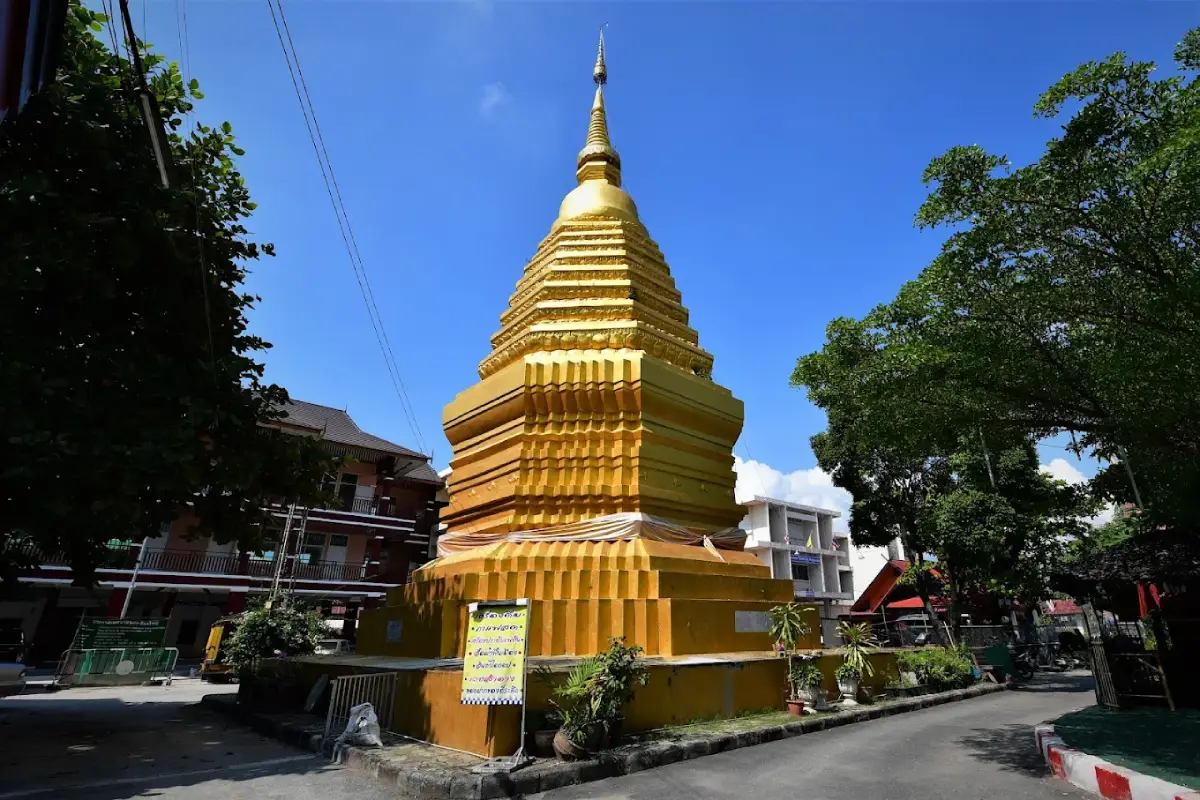
Wat Puak Pia
Open Days: Daily
Opening Hours: 05.30 – 20.30
Wat Puak Pia is an old Buddhist temple in Hai Ya Subdistrict, Mueang Chiang Mai District, Chiang Mai Province. It is located at 50 Thipanet Road, close to Suan Prung Hospital, Suan Prung Gate, Wua Lai Road, and the southern side of Chiang Mai’s old city. The temple is historically meaningful because it connects Lanna Buddhist culture with an old craft community known for making the pia, or pin pia, a traditional northern Thai musical instrument. Although Wat Puak Pia is a modest neighborhood temple, it preserves a rich story of Lanna craftsmanship, religious continuity, urban recovery after periods of conflict, and local devotion.
The temple is a worthwhile stop for travelers who want to explore Chiang Mai beyond the most frequently visited temples. Wat Puak Pia offers a calm local atmosphere and several important cultural details: a Lanna-style viharn with a two-tiered structure, a floral-patterned gable, naga stair elements, a stupa inside the viharn, and Phra Chao Than Chai, an important Buddha image associated with local devotion and auspicious prayer. The temple is compact, but its historical depth makes it valuable for visitors interested in old Chiang Mai communities, Buddhist architecture, and Lanna cultural memory.
The former name of the temple was Wat Puak Pia, with “pia” referring to an ancient Thai musical instrument used in old Lanna culture. The instrument is also known as pin pia, a traditional string instrument with a distinctive soft and resonant sound. The area around the temple was once home to a community of craftsmen who made these instruments. Because of this, villagers called the temple Wat Puak Pia, meaning the temple of the group associated with pia making. Over time, the pronunciation shifted into the present name, Wat Puak Pia. The name therefore functions as a cultural record of the community’s musical craftsmanship.
Understanding the name of Wat Puak Pia helps visitors appreciate the temple more deeply. In Chiang Mai, many old temple names are connected with specific communities, craft groups, or occupational roles. These names preserve how the city once organized social life around specialized local groups. Wat Puak Pia belongs to this pattern. Its name does not simply identify a place; it points to a historical community of instrument makers and helps explain how temples, crafts, and neighborhood identity were closely connected in Lanna urban life.
The temple’s history places its founding around 2040 B.E., during the reign of King Mueang Kaeo of the Mangrai Dynasty. This was an important period for Lanna Buddhism, temple building, and artistic development in Chiang Mai. The local pia-making community established the temple as a Buddhist center for worship, merit-making, and community life. Its location in the outer area of old Chiang Mai near Pratu Hai Ya also shows that the neighborhoods outside the main city wall were active parts of the religious and social landscape of the city.
When Chiang Mai came under Burmese rule around 2111 B.E., Wat Puak Pia fell into abandonment, reflecting the disruption that affected many temples and communities in Lanna during periods of political change. This part of the temple’s history is important because it shows that Wat Puak Pia passed through phases of prosperity, decline, and renewal. The temple’s present role as an active local Buddhist site is therefore the result of long continuity and restoration across several historical periods.
During the period of King Kawila, after Chiang Mai was restored and repopulated, groups of people were brought into the city to revive its communities. The history of Wat Puak Pia mentions that people from the Salween River basin, known as the Khong people, were settled to the east of the temple in 2342 B.E. People from Chiang Rung in Sipsongpanna were also settled near the area that is now associated with Suan Prung Hospital. This makes Wat Puak Pia an important point of reference for understanding the restoration of Chiang Mai and the rebuilding of its population in the post-war Lanna period.
Historical records concerning ordination halls and monastic groups mention Wat Puak Pia in the Pratu Hai Ya area of Chiang Mai’s outer city. The temple had an abbot named Panya, with Thupinthao as the deputy abbot. One recorded rainy-season retreat included 2 monks, while the previous retreat had 1 monk and 4 novices. These details show that Wat Puak Pia functioned as a community temple with a small but active monastic presence. Even though the temple was not large, it remained part of the religious life of the Hai Ya area.
Wat Puak Pia received significant support from Chiang Mai’s ruling elite in 2446 B.E., when Prince Inthawarorot Suriyawong, the seventh ruler of Chiang Mai, built the viharn for the temple and held a celebration. This patronage shows that Wat Puak Pia had recognized importance in the city’s religious landscape. Later, on 9 February 2516 B.E., the temple received royal granting of the visungkhamsima, further strengthening its formal religious status within the Thai Buddhist monastic system.
The temple stands at 50 Thipanet Road in Hai Ya Subdistrict, Mueang Chiang Mai District, Chiang Mai Province. It belongs to the Mahanikaya order. The temple grounds cover 2 rai, 3 ngan, and 79 square wah. The northern and southern boundaries adjoin public roads, the eastern boundary adjoins Thipanet Road, and the western boundary adjoins Suan Prung Hospital. These details show how the temple is embedded in a dense urban neighborhood while still preserving the role of an old community religious site.
The recorded succession of abbots begins with Chao Athikan Panya, who served from 2430 to 2450 B.E. He was followed by Phra Athikan Khat until 2478 B.E., Phra Athikan Muen from 2478 to 2482 B.E., Phra Athikan Bunphat Paphassaro from 2482 to 2496 B.E., Phra Khru Kowit Saratham, also known as Sawai Thammasaro, from 2496 to 2538 B.E., Phra Khru Supunphinan, also known as Boonchu Punyannatho, from 2539 to 2546 B.E., and Phra Palat Arun Arunathammo from 2546 B.E. onward. This succession reflects long-term temple administration and continuity through more than a century.
Phra Khru Kowit Saratham is especially remembered in local accounts as a development-minded monk who improved many temple structures, including the viharn, library hall, pavilions, dining hall, multipurpose hall, ordination hall, and temple wall. His work helped strengthen the temple’s physical and religious role in the Thipanet community. Through these developments, Wat Puak Pia continued to function as a living temple rather than only a historical site.
The viharn is the most important architectural feature at Wat Puak Pia. It is built in a Lanna style with a two-tiered, two-layered roof structure. The gable is decorated with floral patterns, a motif connected with growth, fertility, and the natural symbolism often found in Lanna art. The stair area features naga forms, representing protection and the guarding of sacred Buddhist space. Entering the viharn is therefore not only a physical movement into a building, but also a symbolic transition into a place of worship and reflection.
Inside the viharn are the temple’s stupa and Phra Chao Than Chai. The presence of a stupa within the viharn makes Wat Puak Pia interesting for those who study Lanna temple layouts and sacred space. The stupa serves as a central object of reverence, while Phra Chao Than Chai is a Buddha image that visitors come to worship for auspiciousness. The interior of the viharn therefore combines devotion, historical architecture, and the atmosphere of an old local temple.
Phra Chao Than Chai is an important form of Buddhist devotion in northern Thailand. The name “Than Chai” is associated with prayers that are fulfilled swiftly, but the deeper meaning of worship is connected with sincere intention, mindfulness, and good conduct. Visitors who pay respect to Phra Chao Than Chai at Wat Puak Pia usually do so with quiet devotion and proper temple etiquette. The image adds spiritual significance to the temple and remains one of its most meaningful points of interest.
The artistic charm of Wat Puak Pia lies in the connection between Lanna symbolism and community life. The floral gable and naga stair elements are not merely decorative. They express Buddhist and Lanna cultural ideas through architectural form. Floral designs evoke life and abundance, while naga imagery is associated with protection, water, and the safeguarding of Buddhism. These details reward slow observation and make the temple especially suitable for travelers who appreciate local art and symbolism.
The area around Wat Puak Pia was once a small settlement with only a limited number of houses near the temple. Local memories describe narrow dirt roads, ox carts, cattle passing through the area, waterways, and rice fields stretching toward Ban Pa Daet. These memories reveal that Thipanet was once far less urban than it is today. The temple stood within a semi-rural landscape of houses, gardens, fields, and community pathways.
As Chiang Mai expanded, the area around Wat Puak Pia changed from an outer settlement into an urban neighborhood with roads, hospitals, schools, restaurants, guesthouses, and tourist routes. This transformation gives the temple a special role as a link between past and present. Visitors can stand inside a quiet temple compound while imagining the older Thipanet landscape of fields, waterways, and craft communities. Wat Puak Pia therefore helps travelers understand Chiang Mai as a living historic city, not only as a modern tourist destination.
The atmosphere of Wat Puak Pia remains peaceful and community-oriented. Visitors can pay respect, make merit, observe the viharn, and spend quiet time inside the temple grounds. The temple does not need a long visit, but it deserves an unhurried one. Its beauty is found in its historical layers, symbolic details, and connection with local life rather than in grand scale. The best way to experience the temple is to walk slowly, observe the architecture, and appreciate the way the site continues to serve the surrounding community.
For photography, Wat Puak Pia offers several meaningful angles: the temple sign, boundary wall, Lanna-style viharn, naga stair elements, floral gable, and quiet temple atmosphere. Photography should be respectful. Visitors should avoid blocking entrances, disturbing worshippers, or taking photos during religious activities. Since Wat Puak Pia remains an active Buddhist temple, respectful conduct is part of the visit.
Getting There is convenient from Suan Prung Gate, Nong Buak Haad Park, Wua Lai Road, Chiang Mai Gate, and the southern side of the old city. Travelers can reach the temple via Thipanet Road by private car, red songthaew, tuk-tuk, motorcycle taxi, or on foot from nearby accommodation. Parking space in the neighborhood can be limited, so visitors driving to the temple should plan carefully, especially during busy hours and on Saturday evenings when the Wua Lai Walking Street area becomes crowded.
Wat Puak Pia can easily be included in a half-day cultural route. Travelers may combine it with Wat Sri Suphan, Wat Muen San, Wua Lai Walking Street, Chiang Mai Gate, Chiang Mai Gate Market, Nong Buak Haad Park, and Wat Chedi Luang. This route offers a balanced view of old temples, craft communities, local markets, public spaces, and living Buddhist culture around the southern part of Chiang Mai’s old city.
For travelers interested in urban history, Wat Puak Pia should be read together with the Hai Ya and Thipanet areas. The temple tells the story of a pia-making community, the religious landscape of old Chiang Mai, the impact of Burmese rule, the repopulation of the city during King Kawila’s period, and the continuing role of a neighborhood temple in modern Chiang Mai. This layered history gives the temple a depth that is easy to miss from the outside.
A meaningful visit to Wat Puak Pia begins with paying respect inside the viharn, observing the stupa and Phra Chao Than Chai, looking closely at the naga stair elements and floral gable, and then walking around the temple compound to connect the present-day surroundings with the older story of Thipanet. The temple is not a large sightseeing complex, but it gives visitors a more intimate understanding of Chiang Mai’s Buddhist culture, music-related craftsmanship, community history, and Lanna identity.
Overall, Wat Puak Pia is a small but culturally rich temple for travelers seeking a deeper Chiang Mai experience. Its value comes from its name, its association with pin pia makers, its founding around 2040 B.E., its renewal after periods of disruption, its support from Prince Inthawarorot Suriyawong, its Lanna viharn, the stupa, Phra Chao Than Chai, and the quiet atmosphere of a living community temple. For those who want to understand Chiang Mai beyond major landmarks and crowded walking streets, Wat Puak Pia is a meaningful stop.
| Name | Wat Puak Pia |
| Former Name | Wat Puak Pia, referring to the pia or pin pia, a traditional Lanna musical instrument |
| Location | Hai Ya Subdistrict, Mueang Chiang Mai District, Chiang Mai Province |
| Address | 50 Thipanet Road, Hai Ya Subdistrict, Mueang Chiang Mai District, Chiang Mai Province 50100 |
| Coordinates | Latitude 18.77938, Longitude 98.98070 |
| Highlights | Old temple connected with a pia-making craft community, Lanna-style viharn, stupa inside the viharn, and Phra Chao Than Chai |
| History | Founded around 2040 B.E. during the reign of King Mueang Kaeo of the Mangrai Dynasty, abandoned after Chiang Mai came under Burmese rule around 2111 B.E., and later restored through subsequent periods |
| Name Origin | The name comes from the pia, an old Lanna musical instrument. The surrounding community was once associated with making pia or pin pia instruments |
| Distinctive Features | Two-tiered Lanna-style viharn, floral-patterned gable, naga stair elements, and a temple compound closely connected with the old Thipanet community |
| Important Sacred Objects | Viharn, stupa inside the viharn, Phra Chao Than Chai, naga stair elements, and Buddhist worship areas |
| Travel Information | Accessible from Suan Prung Gate, Nong Buak Haad Park, Wua Lai Road, and Chiang Mai Gate via Thipanet Road by private car, red songthaew, tuk-tuk, motorcycle taxi, or on foot from nearby accommodation |
| Current Status | Open to worshippers and visitors; it remains an active local Buddhist temple in Hai Ya Subdistrict |
| Open Days | Daily |
| Opening Hours | 05.30 – 20.30 |
| Facilities | Viharn, worship areas, temple courtyard, and limited parking depending on temple and neighborhood conditions |
| Main Areas / Zones | Viharn, stupa, Phra Chao Than Chai, naga stair area, temple courtyard, and religious activity areas |
| Abbot Record | The temple history lists Phra Palat Arun Arunathammo as the seventh abbot from 2546 B.E. onward |
| Temple Area | 2 rai, 3 ngan, and 79 square wah |
| Royal Granting of Visungkhamsima | 9 February 2516 B.E. |
| Nearby Tourist Attractions | 1. Wat Sri Suphan, about 0.3 km 2. Nong Buak Haad Park, about 0.4 km 3. Suan Prung Gate, about 0.3 km 4. Wat Muen San, about 0.6 km 5. Wua Lai Walking Street, about 0.7 km 6. Chiang Mai Gate, about 1 km 7. Chiang Mai Gate Market, about 1 km 8. Wat Chedi Luang, about 1.3 km |
| Nearby Restaurants | 1. Mae Chan Mi Kiao, about 0.1 km 2. Kuay Teow Kapi, about 0.1 km, Tel. 063-126-0353 3. Lok Klom Klom, about 0.1 km, Tel. 094-263-2926 4. Nid Som Tam, about 0.1 km, Tel. 083-946-1618 5. Shuang Cafe, about 0.2 km, Tel. 096-532-9452 6. Bua Kham Lab Phrae, about 0.1 km |
| Nearby Accommodations | 1. Noble Thippanate, about 0.1 km, Tel. +66-2-026-1271 2. Smile Lanna Hotel, about 0.2 km, Tel. 053-282-899 3. Pingviman Hotel, about 0.8 km, Tel. 053-281-799 4. The Inside House, about 1.1 km, Tel. 053-904-699 5. Rachamankha Hotel, about 1.2 km, Tel. 053-904-111 to 112 6. Phra Singh Village, about 1.5 km, Tel. 053-272-480 |
Frequently Asked Questions (FAQ)
Q: Where is Wat Puak Pia located?
A: Wat Puak Pia is located at 50 Thipanet Road, Hai Ya Subdistrict, Mueang Chiang Mai District, Chiang Mai Province, near Suan Prung Hospital, Suan Prung Gate, Nong Buak Haad Park, and Wua Lai Road.
Q: What are the opening days and hours of Wat Puak Pia?
A: Wat Puak Pia is open daily from 05.30 to 20.30. Morning and late afternoon are good times for a quiet temple visit.
Q: What is the history of Wat Puak Pia?
A: Wat Puak Pia was founded around 2040 B.E. during the reign of King Mueang Kaeo. It later fell into abandonment when Chiang Mai came under Burmese rule and was restored through later historical periods.
Q: What does the name Wat Puak Pia mean?
A: The name comes from the pia, an old Lanna musical instrument. The surrounding community was once associated with making pia or pin pia instruments.
Q: What are the main highlights of Wat Puak Pia?
A: The highlights include the two-tiered Lanna-style viharn, floral-patterned gable, naga stair elements, stupa inside the viharn, and Phra Chao Than Chai.
Q: Why is Phra Chao Than Chai important at Wat Puak Pia?
A: Phra Chao Than Chai is an important Buddha image worshipped for auspiciousness. At Wat Puak Pia, it is one of the main sacred objects inside the viharn.
Q: How can visitors get to Wat Puak Pia?
A: Visitors can reach the temple via Thipanet Road from Suan Prung Gate, Nong Buak Haad Park, Wua Lai Road, or Chiang Mai Gate. It is accessible by private car, red songthaew, tuk-tuk, motorcycle taxi, or on foot from nearby accommodation.
Q: What nearby places can be included in the same route?
A: Nearby places include Wat Sri Suphan, Nong Buak Haad Park, Suan Prung Gate, Wat Muen San, Wua Lai Walking Street, Chiang Mai Gate, Chiang Mai Gate Market, and Wat Chedi Luang.
 Category: ●Places of Worship
 Group: ●Temple
Last Update : 3 WeekAgo
 Last Update : 3 WeekAgo
 Click to Access the Navigation Map GPS
Wat Puak Pia Map
Recommend

 Muang Chiang Mai(121)Chom Thong(47)Mae Chaem(25)Chiang Dao(33)Doi Saket(68)Mae Taeng(85)Mae Rim(69)Samoeng(29)Fang(71)Mae Ai(59)Phrao(70)San Pa Tong(103)San Kamphaeng(66)San Sai(73)Hang Dong(73)Hot(32)Doi Tao(22)Omkoi(11)Saraphi(74)Wiang Haeng(15)Chai Prakan(28)Mae Wang(32)Mae On(22)Doi Lo(33)Galyani Vadhana(1)


