
lovethailand home >North Travel Attractions >Chiang Mai Travel Attractions >Muang Chiang Mai >Hai Ya > Wat Daowadung
TL;DR: Wat Daowadung is located at Ratchiang Saen Soi 2, Haiya Subdistrict, Mueang Chiang Mai District, Chiang Mai Province, open Daily, hours 08.00 – 17.00.

Wat Daowadung
Open Days: Daily
Opening Hours: 08.00 – 17.00
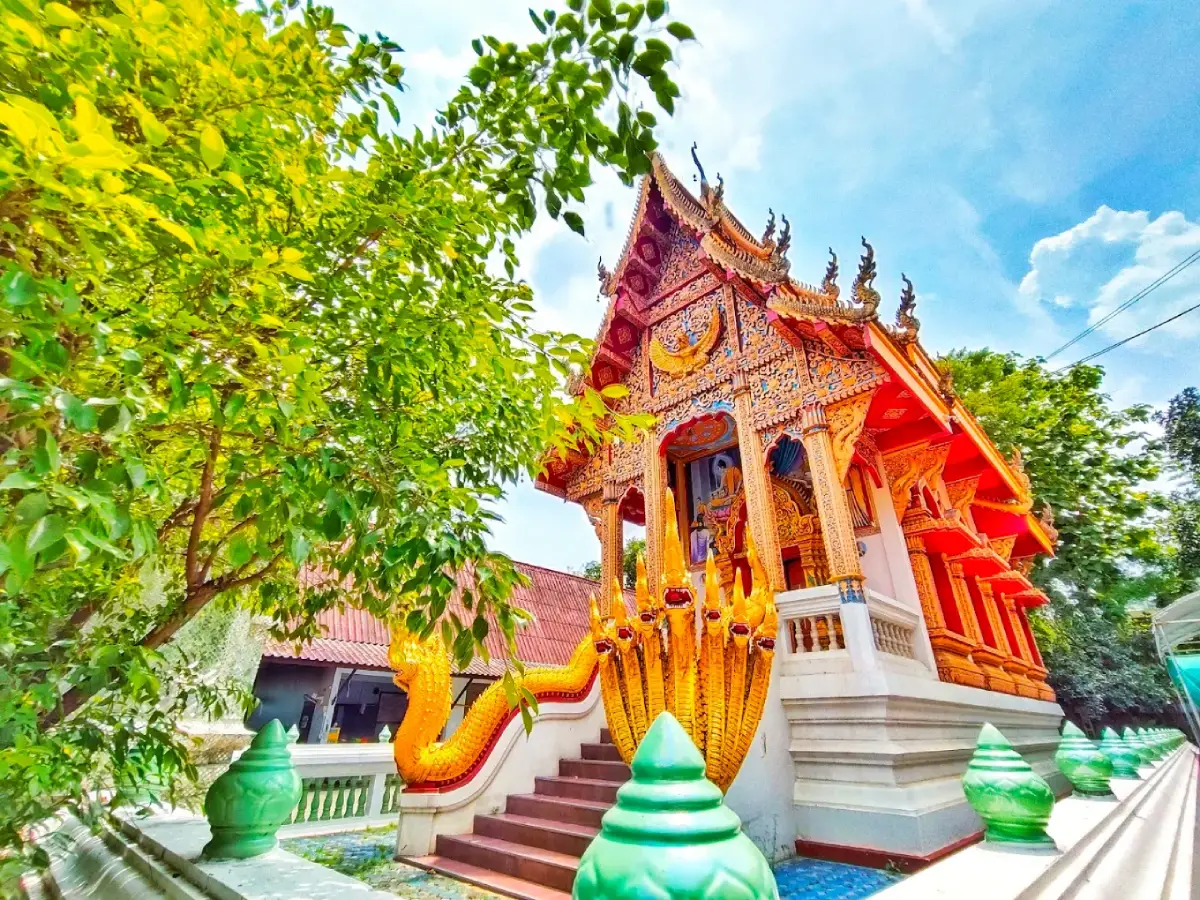
Wat Daowadung, also written as Wat Dao Dueng, is a private Buddhist temple under the Maha Nikaya order, located on Ratchiang Saen Soi 2, Haiya Subdistrict, Mueang Chiang Mai District, Chiang Mai Province. The temple is an old community temple near the southern side of Chiang Mai’s historic city area. It was founded in B.E. 2040, or 1497, and was formerly known as Wat Mueang Sap. Local people have also referred to it as Wat Ban Daowadung. Its main features include an ubosot, viharn, sermon hall, monks’ residences, a Lanna-style chedi, an ancient brick-and-stucco principal Buddha image, and a brass Buddha image in the Mara-vijaya posture.
The location of Wat Daowadung is especially useful for travelers who want to explore the quieter temple landscape around Chiang Mai’s Old City. The temple stands in Haiya, close to Chiang Mai Gate, Ratchiang Saen Road, Kamphaeng Din Road, Wua Lai Road, and Mae Kha Canal. This area contains old communities, local markets, walking streets, small restaurants, boutique hotels, and cultural routes that can be explored easily within a compact distance. A visit to Wat Daowadung can therefore be combined with a half-day walking route around southern Chiang Mai.
The name Daowadung refers to Tavatimsa, the heavenly realm of the Thirty-Three Deities in Buddhist cosmology. The name carries a sense of brightness, elevation, and auspiciousness. As a temple name, it suggests a sacred place where people come to lift the mind away from daily concerns and toward calmness, merit, and Buddhist reflection. The temple’s former name, Wat Mueang Sap, also shows that the site has more than one layer of local memory, including its earlier identity, neighborhood name, and present temple name.
Wat Daowadung was founded in 1497, making it a temple with a long historical background. This period belongs to the wider Lanna historical context in which temples served as the spiritual, educational, and community centers of local settlements. The temple’s survival into the present reflects the continuity of Buddhist faith in Haiya. A community temple can remain active for centuries only when monks, abbots, lay supporters, and local residents continue to maintain it across generations.
The temple land covers 4 rai, 1 ngan, and 10 square wah, with public roads adjoining the temple on all four sides. This detail shows that Wat Daowadung is a true urban community temple. It is not isolated from local life. It stands within a road network and a lived-in neighborhood, surrounded by movement, homes, small businesses, and temple communities. Haiya contains several old temples within a close radius, and Wat Daowadung forms part of this dense religious landscape on the southern side of Chiang Mai.
The main monastic structures include the ubosot, sermon hall, monks’ residences, and viharn. These are the core elements of an active Buddhist community temple. The ubosot is used for formal monastic acts. The viharn is used by laypeople for worship, merit-making, and Dhamma listening. The sermon hall supports ceremonies and community activities, while the monks’ residences provide space for monks living and practicing at the temple. Together, these structures show that Wat Daowadung continues to function as a living Buddhist temple.
The temple’s important sacred objects include an ancient brick-and-stucco principal Buddha image, a brass Buddha image in Mara-vijaya posture, and a Lanna-style chedi. The brick-and-stucco principal image reflects local craftsmanship and older devotional practice. The Mara-vijaya posture represents the Buddha’s victory over Mara before enlightenment, symbolizing mental firmness, clarity, and the overcoming of obstacles. These sacred images give the temple a strong devotional focus for local residents and visitors.
The Lanna-style chedi is another important feature. In northern Thai Buddhist culture, a chedi is more than an architectural structure. It is a symbol of reverence, continuity, and community faith. Visitors should approach the chedi respectfully, avoid unnecessary contact with sacred structures, and take time to understand it as part of the temple’s religious center rather than only as a visual landmark.
Wat Daowadung has a royal monastic boundary measuring 20 meters wide and 40 meters long. A royal monastic boundary is important because it defines the area used for formal Sangha ceremonies. This confirms the temple’s complete status within the Thai Buddhist monastic system and shows that Wat Daowadung is not merely a neighborhood shrine, but an established Buddhist temple with formal religious functions.
Wat Daowadung remains active today. Recent Buddhist-activity information records resident monks at the temple and shows the temple appearing in Kathina activities in B.E. 2568. The temple has also appeared in local temple-development inspection activities in Haiya. These details confirm that Wat Daowadung continues to serve religious and community functions in modern Chiang Mai.
The current abbot identified for Wat Daowadung is Phra Baidika Chatchawan Ariyamethi. The abbot of a community temple has a central role in maintaining the temple compound, guiding resident monks, leading merit-making activities, coordinating with lay supporters, and preserving order within the religious space. The continued presence of monks and Buddhist activities shows that Wat Daowadung remains a living temple for the Haiya community.
Haiya is one of Chiang Mai’s culturally layered urban neighborhoods. It includes Chiang Mai Gate, morning markets, Wua Lai Road, Mae Kha Canal, Kamphaeng Din, and routes connected with the southern edge of the Old City. Wat Daowadung’s position in this area makes it a useful starting point for understanding how temples, markets, gates, canals, and local streets form the living geography of Chiang Mai.
Ratchiang Saen Road and Ratchiang Saen Soi 2 are part of the neighborhood network outside the southern Old City. Chiang Mai’s historic urban landscape is not limited to the area inside the moat. It also includes surrounding communities where temples developed beside roads, markets, and residential areas. Wat Daowadung is one of these community temples, helping preserve the religious identity of Haiya within a changing urban environment.
A meaningful visit should begin in the viharn or main worship area. After paying respect, visitors can continue to the Lanna-style chedi, ubosot, sermon hall, and surrounding temple compound. Wat Daowadung is not a large tourist site, so its value is best appreciated slowly. The temple’s quietness, age, sacred images, and local setting are the main reasons to visit.
Visitors interested in Buddhist images and local craftsmanship should pay attention to the ancient brick-and-stucco principal image and the brass Mara-vijaya Buddha image. These objects represent both local artistic practice and Buddhist meaning. The brick-and-stucco image reflects older local construction methods, while the Mara-vijaya posture expresses inner strength and the triumph of wisdom over disturbance.
Wat Daowadung is also practical for a slow urban route. Nearby places include Mae Kha Canal, Chiang Mai Gate, Wua Lai Walking Street, Art in Paradise Chiang Mai, Tha Phae Gate, Chiang Mai Night Bazaar, and Wat Chedi Luang. Visitors can worship at the temple, then continue on foot or by short ride to markets, canals, art attractions, and historic landmarks.
The temple is associated with ordinary Buddhist activities found in northern Thai community temples, including worship, Buddhist holy day merit-making, Buddhist Lent, the end of Buddhist Lent, Kathina, chanting, Dhamma listening, and community merit ceremonies. These activities keep the temple active throughout the year and show that Wat Daowadung is not only a place for visitors, but also a working religious space for monks and local devotees.
Kathina activity is especially important because it reflects the relationship between monks and lay supporters after the Buddhist Lent season. Devotees gather to offer robes and other support to the temple. This tradition helps maintain temple buildings, religious life, and community participation. Wat Daowadung’s appearance in current Kathina information confirms its continued religious role in Chiang Mai.
Proper conduct is important at Wat Daowadung. Visitors should dress modestly, speak quietly, avoid touching Buddha images or the chedi unnecessarily, and avoid entering monastic areas without permission. Photography should be respectful, especially inside the viharn, around the ubosot, and in areas where monks or local people are making merit.
Getting to Wat Daowadung is convenient from the southern side of Chiang Mai Old City. Travelers can start from Chiang Mai Gate, Kamphaeng Din Road, Ratchiang Saen Road, or Mahidol Road, then enter Ratchiang Saen Soi 2. Those using a private car, taxi, or ride-hailing service should search specifically for Wat Daowadung, Ratchiang Saen Soi 2, Haiya, Mueang Chiang Mai to avoid confusion with similarly named temples elsewhere.
The best time to visit is in the morning or late afternoon, when the weather is more comfortable and the temple atmosphere is calm. Visitors who want to combine the temple with Wua Lai Walking Street or Mae Kha Canal can plan a late-afternoon route, while still respecting the temple’s opening hours. Those who prefer a quieter visit should choose a weekday, as the Haiya and Chiang Mai Gate areas can become busy during weekends and market periods.
Wat Daowadung is worth knowing for travelers interested in Chiang Mai temples and northern Thai Buddhist culture. Its value does not come from size or mainstream fame. It comes from its founding in 1497, former name Wat Mueang Sap, identity as Wat Ban Daowadung, ancient brick-and-stucco Buddha image, brass Mara-vijaya Buddha image, Lanna-style chedi, and location within the culturally rich Haiya neighborhood.
For travelers who want a deeper understanding of Chiang Mai, Wat Daowadung reveals the importance of small community temples. It connects Buddhist history, local craftsmanship, sacred images, Lanna religious space, Ratchiang Saen Road, Haiya community life, Chiang Mai Gate, and the southern edge of the Old City in one compact place. A visit to this temple is a short but meaningful experience of Chiang Mai as a living Buddhist city.
| Name | Wat Daowadung / Wat Dao Dueng |
| Former / Local Name | Wat Mueang Sap / Wat Ban Daowadung |
| Location | Ratchiang Saen Soi 2, Haiya Subdistrict, Mueang Chiang Mai District, Chiang Mai Province |
| Address | Ratchiang Saen Soi 2, Haiya Subdistrict, Mueang Chiang Mai District, Chiang Mai 50100, Thailand |
| Coordinates | 18.77873, 98.99179 |
| Current Status | Open for visits, worship, merit-making, and Buddhist community activities |
| Open Days | Daily |
| Opening Hours | 08.00 – 17.00 |
| Monastic Affiliation | Private Buddhist Temple Under The Maha Nikaya Order |
| Temple Code | 350010301 |
| Temple Land Area | 4 Rai, 1 Ngan, And 10 Square Wah |
| History | Founded in B.E. 2040, or 1497; formerly known as Wat Mueang Sap; an old community temple of Haiya and the southern Old City area of Chiang Mai |
| Royal Monastic Boundary | 20 Meters Wide And 40 Meters Long |
| Monastic Buildings | Ubosot, Sermon Hall, Monks’ Residences, And Viharn |
| Highlights | Old Haiya community temple, ancient brick-and-stucco principal Buddha image, brass Mara-vijaya Buddha image, Lanna-style chedi, and convenient location near Chiang Mai Gate, Wua Lai Road, and Mae Kha Canal |
| Sacred Objects | Ancient brick-and-stucco principal Buddha image, brass Buddha image in Mara-vijaya posture, and Lanna-style chedi |
| Main Areas / Zones | Viharn, ubosot, sermon hall, monks’ residences, chedi, worship areas, and Buddhist activity spaces |
| Traditions / Rituals | Buddhist worship, Buddhist holy day merit-making, Buddhist Lent, the end of Buddhist Lent, Kathina, chanting, Dhamma listening, and community merit ceremonies |
| Abbot / Caretaker | Phra Baidika Chatchawan Ariyamethi |
| Resident Monks | 7 Monks |
| Facilities | Worship areas, viharn, ubosot, sermon hall, and Buddhist activity spaces |
| Travel Information | Travel from the southern side of Chiang Mai Old City, Chiang Mai Gate, Kamphaeng Din Road, Ratchiang Saen Road, or Mahidol Road, then enter Ratchiang Saen Soi 2; search specifically for Wat Daowadung, Haiya, Mueang Chiang Mai |
| Nearby Tourist Attractions | 1. Mae Kha Canal, about 0.4 km 2. Chiang Mai Gate And Chiang Mai Gate Market, about 0.5 km 3. Wua Lai Walking Street, about 0.6 km 4. Art In Paradise Chiang Mai, about 0.8 km 5. Tha Phae Gate, about 1 km 6. Chiang Mai Night Bazaar, about 1.1 km 7. Wat Chedi Luang, about 1.1 km 8. Wat Phra Singh, about 1.6 km |
| Nearby Restaurants | 1. B Samcook Home 16, about 0.3 km 2. Pakorn’s Kitchen, about 0.3 km 3. Toey Dimsum, about 0.3 km, Tel. 087-812-9440 4. Sababa Chiang Mai, about 0.5 km, Tel. 090-957-9068 5. Dash Teak House, about 0.5 km, Tel. 085-347-7445 6. AUM Vegetarian Food, about 0.5 km 7. Kad Kafe, about 0.8 km |
| Nearby Accommodations | 1. Le Ville Old Town Chiang Mai, about 0.1 km 2. Family Home Chiang Mai, about 0.1 km, Tel. 095-134-4545 3. Viangdara Boutique House, about 0.2 km, Tel. 095-941-9824 4. Na BaanYa Chiang Mai, about 0.2 km, Tel. 089-759-1066 5. POR Daowadung, about 0.2 km, Tel. 097-415-5144 6. CREW Hotel, about 0.2 km, Tel. 088-308-5599 7. Chiangmai Gate Hotel, about 0.3 km, Tel. 053-203-895 To 9, 081-980-0178 |
Frequently Asked Questions (FAQ)
Q: Where is Wat Daowadung located?
A: Wat Daowadung is located on Ratchiang Saen Soi 2, Haiya Subdistrict, Mueang Chiang Mai District, Chiang Mai 50100, Thailand.
Q: What are the opening hours of Wat Daowadung?
A: Wat Daowadung is open daily from 08.00 to 17.00 for worship, merit-making, and temple visits.
Q: What is the history of Wat Daowadung?
A: Wat Daowadung was founded in B.E. 2040, or 1497. It was formerly known as Wat Mueang Sap and is an old community temple in Haiya, south of Chiang Mai’s Old City.
Q: What is Wat Daowadung known for?
A: The temple is known for its ancient brick-and-stucco principal Buddha image, brass Buddha image in Mara-vijaya posture, Lanna-style chedi, viharn, ubosot, and location near Chiang Mai Gate, Wua Lai Road, and Mae Kha Canal.
Q: What was the former name of Wat Daowadung?
A: The former name of Wat Daowadung was Wat Mueang Sap, and local people have also referred to it as Wat Ban Daowadung.
Q: Who is the abbot of Wat Daowadung?
A: The abbot of Wat Daowadung is Phra Baidika Chatchawan Ariyamethi.
Q: What type of visit is Wat Daowadung suitable for?
A: It is suitable for worship, merit-making, studying an old community temple in Haiya, and combining with Chiang Mai Gate, Wua Lai Walking Street, Mae Kha Canal, Art in Paradise Chiang Mai, and Chiang Mai Night Bazaar.
Q: How should visitors behave at Wat Daowadung?
A: Visitors should dress modestly, speak quietly, avoid touching Buddha images or the chedi unnecessarily, and photograph respectfully, especially around the viharn, ubosot, chedi, and monastic areas.
 Category: ●Places of Worship
 Group: ●Temple
Last Update : 1 WeekAgo
 Last Update : 1 WeekAgo
 Click to Access the Navigation Map GPS
Wat Daowadung Map
Recommend

 Muang Chiang Mai(121)Chom Thong(47)Mae Chaem(25)Chiang Dao(33)Doi Saket(68)Mae Taeng(85)Mae Rim(69)Samoeng(29)Fang(71)Mae Ai(62)Phrao(70)San Pa Tong(105)San Kamphaeng(66)San Sai(73)Hang Dong(74)Hot(32)Doi Tao(22)Omkoi(11)Saraphi(74)Wiang Haeng(15)Chai Prakan(28)Mae Wang(32)Mae On(22)Doi Lo(34)Galyani Vadhana(1)


