
lovethailand home >North Travel Attractions >Chiang Mai Travel Attractions >Muang Chiang Mai >Pa Tan > Wat Pa Tan
TL;DR: Wat Pa Tan is located at Ban Pa Tan, Pa Tan Subdistrict, Mueang Chiang Mai District, Chiang Mai Province, open Daily, hours 08.00 – 17.00.

Wat Pa Tan
Open Days: Daily
Opening Hours: 08.00 – 17.00
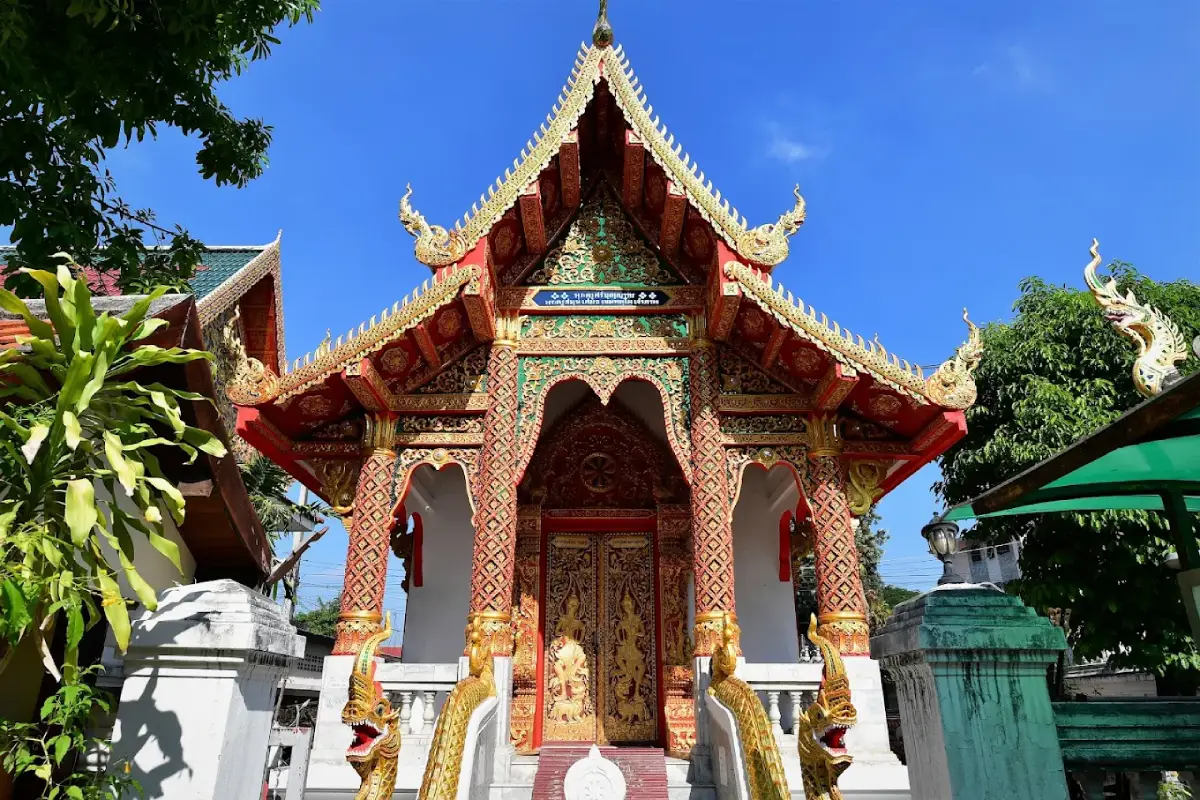
Wat Pa Tan is a private Buddhist temple under the Maha Nikaya order, located at 3 Ban Pa Tan, Chiang Mai-Lampang Super Highway Road, Pa Tan Subdistrict, Mueang Chiang Mai District, Chiang Mai Province. The temple was founded in B.E. 2318, or 1775, and was formerly known as Wat Khok Khwai. It is an old community temple in northern Chiang Mai city, known for its Buddhist murals, Lanna community atmosphere, formal monastic boundary, principal Buddha image made of brick and stucco, and a revered Chiang Saen-style Buddha image in meditation posture. Wat Pa Tan is suitable for visitors who want to worship, make merit, study northern Thai Buddhist art, and understand a local temple that remains closely connected with the Pa Tan community.
Pa Tan is an old community area of Mueang Chiang Mai. It is close to Chiang Mai-Lampang Super Highway Road, Chotana Road, Pa Tan Road, and riverside routes near the Ping River. This makes Wat Pa Tan easy to reach from the Old City, Chang Phueak, Fa Ham, Wat Ket, and the northern side of Chiang Mai. Although the temple is within the urban area, it still preserves the feeling of a community temple where worship, local activities, school life, neighborhood food stalls, and daily movement exist together.
The temple’s former name, Wat Khok Khwai, reflects an older community landscape. Areas around Chiang Mai once included rice fields, irrigation canals, grazing areas, and local village routes. Later, the temple became known as Wat Pa Tan after the name of the community and subdistrict. This change connects the temple directly with its neighborhood. Wat Pa Tan is therefore not only a religious site, but also a place-name that reflects the relationship between village, temple, people, and the historical geography of northern Chiang Mai.
Wat Pa Tan was established in 1775 and has existed for more than 250 years. The temple has passed through several important periods of Chiang Mai’s history, including the later Lanna period, the rebuilding of the city, the expansion of urban communities, and the development of major roads around Chiang Mai. A temple that continues to function for such a long time depends on monks, abbots, lay supporters, and local residents who help maintain it across generations. Wat Pa Tan is therefore a valuable sign of Buddhist and cultural continuity in the Pa Tan community.
Wat Pa Tan received its royal monastic boundary on 17 February 1989. The boundary measures 14 meters wide and 18 meters long. A royal monastic boundary is important because it defines the area used for formal Sangha ceremonies, including ordination and other monastic acts. This status confirms Wat Pa Tan’s formal role within the Buddhist monastic system and shows that it is more than a neighborhood worship site.
The temple land covers 2 rai, 2 ngan, and 48.8 square wah under title deed number 49635. The northern, southern, and eastern sides adjoin public-use roads, while the western side adjoins a public irrigation canal. The temple also has one plot of monastic land measuring 1 rai, 1 ngan, and 98.2 square wah under title deed number 49636. These land details show how the temple is connected with the older structure of the Pa Tan community, especially the irrigation-canal landscape that has long shaped settlement and agriculture in northern Thailand.
The main religious structures at Wat Pa Tan include the ubosot, viharn, worship areas, and spaces for Buddhist activities. The ubosot contains murals of the Ten Jatakas, known in Thai as Thotsachat or Phra Chao Sip Chat. These stories present the previous lives of the Bodhisattva before becoming the Buddha and are closely linked with virtues such as generosity, perseverance, wisdom, truthfulness, and compassion. The murals make the ubosot not only a ceremonial space for monks but also a visual Dhamma classroom for the community.
The viharn contains murals of the Vessantara Jataka, together with scenes of the Buddha’s birth, enlightenment, and passing into parinirvana. These paintings give the viharn strong educational and cultural value. The Vessantara Jataka is one of the most important stories in Thai Buddhist culture because it teaches generosity and sacrifice. The scenes of birth, enlightenment, and parinirvana complete the core narrative of the Buddha’s life. Visitors should take time to observe these murals because they are among the most meaningful features of Wat Pa Tan.
The principal Buddha image in the viharn is made of brick and stucco. This type of image reflects local craftsmanship and the use of traditional materials. The temple also preserves a Chiang Saen-style Buddha image in meditation posture, identified as Singha 3 style, which is revered by the community and said to be around 200 years old. This Buddha image is carefully kept and brought out for bathing on important occasions such as Songkran and the northern Thai New Year.
The Chiang Saen-style Buddha image adds strong devotional value to Wat Pa Tan. Chiang Saen and Singha-style Buddha images are deeply associated with northern Thai Buddhist art. Their facial expression, seated posture, and calm presence often convey stillness, balance, and faith. The fact that the Pa Tan community continues to preserve and ritually bathe this image during the New Year season shows the continuity of local Buddhist devotion.
Songkran, or the northern Thai New Year, is an important period at Wat Pa Tan. Local people visit temples to make merit, bathe Buddha images, listen to Dhamma, and express gratitude to elders, ancestors, teachers, and monks. Bathing the temple’s revered Buddha image is not only an auspicious act. It also connects the present generation with the faith of earlier generations. Visitors who come during this season can see the temple’s community role more clearly than on ordinary days.
Wat Pa Tan also has an annual merit-making event known as Wat Katanyu, connected with gratitude toward former teachers and benefactors. The event is held around 9 January every year and includes merit dedication, Buddhist chanting, offering meals to monks, and a communal robe-offering activity. Local groups, community members, women’s groups, municipal representatives, and general devotees participate. This shows that Wat Pa Tan remains an active religious and community center rather than only a historical temple.
Another important ritual is the Suep Chata Luang ceremony held as part of the annual gratitude event. Suep Chata is a Lanna ceremony associated with extending life, strengthening auspiciousness, and restoring morale. The ceremony includes chanting, merit-making, and symbolic Lanna objects such as silver and gold banners linked with the 12 zodiac signs. This practice helps visitors understand how Wat Pa Tan continues to preserve northern Thai Buddhist traditions in a living form.
The recorded abbots of Wat Pa Tan show continuous monastic care. The known names include Khruba Khittaya, Phra Khru Intha, Phra Athikan Kham Paeng Techawaro from 1933 to 1960, Phra Athikan Somboon Kantasilo from 1960 to 1969, Phra Athikan Kaeo in 1969, Phra Athikan Cha-on from 1969 to 1971, Phra Athikan Inson Kitiwanno from 1971 to 1973, and Phra Khru Suchit Worayan, also known as Phra Plian Yanawaro, from 1974 onward. This succession shows that the temple has been maintained under monastic leadership across many periods.
Phra Khru Suchit Worayan Yanawaro appears in recent information as the abbot of Wat Pa Tan. He has been connected with several community religious activities, including the annual gratitude event, Suep Chata Luang ceremony, Kathina ceremony, and merit-making events. His continuing role shows that Wat Pa Tan is still active in religious practice and community life.
Wat Pa Tan is also connected with local education through Wat Pa Tan School, which is located nearby. In Thai communities, temples and schools have long been closely related. Before modern education expanded, temples were important centers of learning. Even today, many temple schools remain part of community life. The presence of Wat Pa Tan School near the temple reflects the temple’s role as a local center of religion, education, and social identity.
From an artistic perspective, Wat Pa Tan is especially valuable because of its murals. The Ten Jataka murals in the ubosot and the Vessantara Jataka murals in the viharn are important for anyone interested in northern Thai temple art. These paintings are not simply decorative. They are visual teaching tools that communicate Buddhist virtues and stories through color, composition, figures, and narrative sequence. Visitors should view them slowly to understand their religious and cultural meaning.
The atmosphere of Wat Pa Tan is local and accessible. It balances age, community life, and daily religious practice. The religious buildings preserve the temple’s past, while the surrounding roads, school, food stalls, and community movement show its present role. Visitors can experience a temple that is still used for worship, merit-making, Dhamma listening, ceremonies, and annual traditions.
A meaningful visit should begin in the viharn, where visitors can pay respect to the principal Buddha image and observe the Vessantara Jataka and Buddha-life murals. After that, visitors can continue to the ubosot and observe the Ten Jataka murals when the area is open and appropriate to enter. Walking slowly around the temple compound allows visitors to understand the temple as a place of faith, art, history, and community life.
Proper conduct is important at Wat Pa Tan. Visitors should dress modestly, speak quietly, avoid touching Buddha images or murals, avoid entering monastic areas without permission, and photograph respectfully, especially inside the ubosot and viharn. During merit-making events or ceremonies, visitors should give space to monks and local devotees. A good temple visit should help preserve calmness, order, and respect within the sacred space.
Getting to Wat Pa Tan is convenient from central Chiang Mai or Chang Phueak. Travelers can use Chotana Road, Chiang Mai-Lampang Super Highway Road, or Pa Tan Road, then enter Wat Pa Tan Alley. Those using a private car, taxi, or ride-hailing service should search specifically for Wat Pa Tan, Pa Tan Subdistrict, Mueang Chiang Mai, to avoid confusion with similarly named temples in other provinces.
Wat Pa Tan can be combined with several nearby places in a half-day itinerary. For a cultural and market route, visitors can continue to Jing Jai Market, Warorot Market, Wat Ket Karam, and the Ping River area. For a temple and museum route, Wat Pa Tan can be combined with Wat Chet Yot, Chiang Mai National Museum, Wat Lok Molee, Wat Chiang Man, and Tha Phae Gate. These routes help visitors see community temples, important city temples, markets, museums, and old-city landmarks within a compact area.
The best time to visit Wat Pa Tan is in the morning or afternoon. The weather is more comfortable for walking, and visitors can spend time observing the murals and religious buildings without rushing. Those who want to see the temple’s community role should consider visiting during Buddhist holy days, the annual gratitude event, or Songkran. Those who prefer a quieter experience should visit on a weekday.
Wat Pa Tan is worth knowing for travelers interested in Chiang Mai temples and northern Thai Buddhist culture. Its value does not come from size or mainstream fame. It comes from its founding in 1775, its former name Wat Khok Khwai, its role as a Pa Tan community temple, the Ten Jataka murals in the ubosot, the Vessantara Jataka and Buddha-life murals in the viharn, the brick-and-stucco principal Buddha image, the Chiang Saen-style Buddha image, and annual merit-making traditions that keep the temple active today.
For travelers who want a deeper understanding of Chiang Mai, Wat Pa Tan offers a grounded local experience. It connects Buddhist art, Lanna narrative murals, Songkran Buddha-bathing traditions, Suep Chata Luang, Kathina, local education, and the everyday life of Pa Tan community in one place. A visit to Wat Pa Tan is therefore a short but meaningful journey into the living temple culture of northern Chiang Mai.
| Name | Wat Pa Tan |
| Former Name | Wat Khok Khwai |
| Location | Ban Pa Tan, Pa Tan Subdistrict, Mueang Chiang Mai District, Chiang Mai Province |
| Address | 3 Ban Pa Tan, Chiang Mai-Lampang Super Highway Road, Pa Tan Subdistrict, Mueang Chiang Mai District, Chiang Mai 50300, Thailand |
| Current Status | Open for visits, worship, merit-making, and Buddhist community activities |
| Open Days | Daily |
| Opening Hours | 08.00 – 17.00 |
| Main Contact Number | 053-233-768 |
| Monastic Affiliation | Private Buddhist Temple Under The Maha Nikaya Order |
| History | Founded in B.E. 2318, or 1775; formerly known as Wat Khok Khwai; granted its royal monastic boundary on 17 February B.E. 2532 |
| Royal Monastic Boundary | 14 Meters Wide And 18 Meters Long |
| Temple Land Area | 2 Rai, 2 Ngan, And 48.8 Square Wah; Title Deed No. 49635 |
| Monastic Land | 1 Rai, 1 Ngan, And 98.2 Square Wah; Title Deed No. 49636 |
| Temple Boundary | North, south, and east adjoin public-use roads; west adjoins a public irrigation canal |
| Highlights | Ten Jataka murals in the ubosot, Vessantara Jataka murals in the viharn, Buddha-life murals, brick-and-stucco principal Buddha image, Chiang Saen-style Singha 3 Buddha image in meditation posture, and annual Suep Chata Luang ceremony |
| Sacred Objects | Principal Buddha image made of brick and stucco, and a Chiang Saen-style Singha 3 Buddha image in meditation posture, about 200 years old |
| Main Areas / Zones | Ubosot, viharn, worship areas, community merit-making spaces, formal monastic ceremony area, and surrounding community area |
| Traditions / Rituals | Annual gratitude event, Suep Chata Luang ceremony, Kathina ceremony, Buddhist holy day merit-making, Buddha-image bathing during Songkran or northern Thai New Year, and community Buddhist events |
| Abbot / Caretaker | Phra Khru Suchit Worayan Yanawaro |
| Facilities | Parking, public restrooms, worship areas, religious activity spaces, and accessible entry |
| Travel Information | Travel from central Chiang Mai or Chang Phueak via Chotana Road, Chiang Mai-Lampang Super Highway Road, or Pa Tan Road, then enter Wat Pa Tan Alley; search specifically for Wat Pa Tan, Pa Tan Subdistrict, Mueang Chiang Mai |
| Nearby Tourist Attractions | 1. Jing Jai Market Chiang Mai, about 0.8 km 2. Central Festival Chiang Mai, about 2.1 km 3. Wat Ket Karam, about 2.5 km 4. Chiang Mai National Museum, about 2.5 km 5. Wat Chiang Man, about 2.5 km 6. Warorot Market, about 2.6 km 7. Wat Lok Molee, about 2.7 km 8. Three Kings Monument, about 2.9 km 9. Wat Chet Yot, about 2.9 km 10. Tha Phae Gate, about 3 km |
| Nearby Restaurants | 1. Cha Jareen, about 6 m 2. Phongsathon Salapao Sawoei Pa Tan, about 6 m 3. Bubble Tae, about 24 m 4. Daeng Cha Muk, about 59 m 5. Kuai Tiao To Tun, about 72 m 6. Palit Coffee, about 85 m, Tel. 088-268-6836 7. The Baristro @ Ping River, about 200 m 8. Lert Ros Tai Rom Mafueang, about 800 m 9. KHAO-SŌ-i Ping River, about 800 m, Tel. 061-515-4529 10. The Banyan Riverhouse Cafe & Bistro, about 1 km, Tel. 052-001-438 |
| Nearby Accommodations | 1. Buri Sriping Riverside Resort & Spa, about 0.9 km, Tel. 052-001-437 2. The Grand Naphat, about 1.3 km, Tel. 053-231-777, 086-421-0995 3. The Rise Suites Hotel Chiang Mai, about 1.4 km, Tel. 052-005-696, 098-661-6422 4. At Pingnakorn Riverside, about 1.4 km, Tel. 053-249-222 5. Lanna Dusita Riverside Boutique Resort, about 1.4 km, Tel. 053-110-345 6. Wintree City Resort Chiang Mai, about 2.2 km, Tel. 052-081-377 7. ISTY Hotel, about 2.3 km, Tel. 053-230-662 |
Frequently Asked Questions (FAQ)
Q: Where is Wat Pa Tan located?
A: Wat Pa Tan is located at 3 Ban Pa Tan, Chiang Mai-Lampang Super Highway Road, Pa Tan Subdistrict, Mueang Chiang Mai District, Chiang Mai 50300, Thailand.
Q: What are the opening hours of Wat Pa Tan?
A: Wat Pa Tan is open daily from 08.00 to 17.00 for worship, merit-making, and temple visits.
Q: What is the history of Wat Pa Tan?
A: Wat Pa Tan was founded in B.E. 2318, or 1775. It was formerly known as Wat Khok Khwai and received its royal monastic boundary on 17 February B.E. 2532.
Q: What is Wat Pa Tan known for?
A: Wat Pa Tan is known for the Ten Jataka murals in the ubosot, Vessantara Jataka and Buddha-life murals in the viharn, the brick-and-stucco principal Buddha image, and a revered Chiang Saen-style Buddha image.
Q: What important Buddha images are found at Wat Pa Tan?
A: The temple has a brick-and-stucco principal Buddha image in the viharn and a Chiang Saen-style Singha 3 Buddha image in meditation posture, about 200 years old, which is brought out for bathing during important festivals.
Q: What important traditions are associated with Wat Pa Tan?
A: Important traditions include the annual gratitude event, Suep Chata Luang ceremony, Kathina ceremony, Buddhist holy day merit-making, and Buddha-image bathing during Songkran or the northern Thai New Year.
Q: Who is the abbot of Wat Pa Tan?
A: The abbot of Wat Pa Tan is Phra Khru Suchit Worayan Yanawaro.
Q: What nearby places can be visited with Wat Pa Tan?
A: Nearby places include Jing Jai Market Chiang Mai, Wat Ket Karam, Warorot Market, Wat Lok Molee, Wat Chet Yot, Chiang Mai National Museum, and Tha Phae Gate.
 Category: ●Places of Worship
 Group: ●Temple
Last Update : 3 WeekAgo
 Last Update : 3 WeekAgo
 Click to Access the Navigation Map GPS
 Muang Chiang Mai(121)Chom Thong(47)Mae Chaem(25)Chiang Dao(33)Doi Saket(68)Mae Taeng(85)Mae Rim(69)Samoeng(29)Fang(71)Mae Ai(59)Phrao(70)San Pa Tong(103)San Kamphaeng(66)San Sai(73)Hang Dong(73)Hot(32)Doi Tao(22)Omkoi(11)Saraphi(74)Wiang Haeng(15)Chai Prakan(28)Mae Wang(32)Mae On(22)Doi Lo(33)Galyani Vadhana(1)


