
lovethailand home >North Travel Attractions >Chiang Mai Travel Attractions >Muang Chiang Mai >Pa Daet > Wat Pa Daet (Wat Don Kaew)
TL;DR: Wat Pa Daet (Wat Don Kaew) is located at Moo 13, Pa Daet Subdistrict, Mueang Chiang Mai District, Chiang Mai Province, open Daily, hours 08.30 – 17.00.

Wat Pa Daet (Wat Don Kaew)
Open Days: Daily
Opening Hours: 08.30 – 17.00
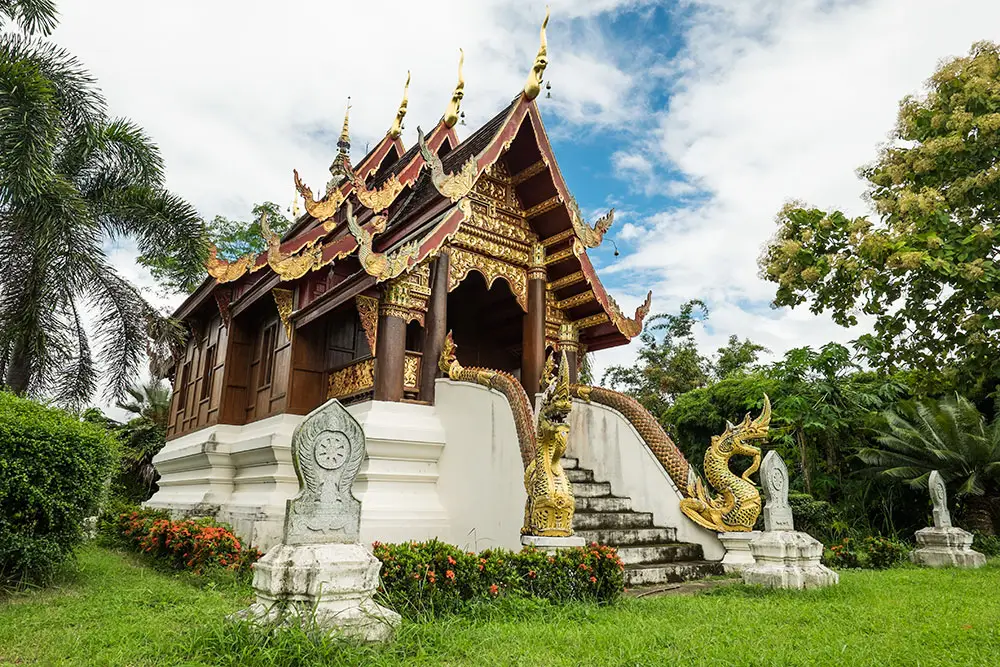
Wat Pa Daet (Wat Don Kaew) is a private Buddhist temple under the Maha Nikaya order, located at 70 Moo 13, Pa Daet Nuea Road, Pa Daet Subdistrict, Mueang Chiang Mai District, Chiang Mai Province. Formerly known as Wat Don Kaew, the temple was established around B.E. 2345, or 1802, and was renovated in B.E. 2475, or 1932. Although the temple compound is not large compared with several major temples in central Chiang Mai, Wat Pa Daet is highly distinctive for its Lanna-style golden main viharn, elegant stucco decoration, golden chedi, Ganesh hall, scripture hall, devotional atmosphere, and continuing role as a Buddhist community temple on the western side of the Ping River.
Wat Pa Daet is located in the southern part of Mueang Chiang Mai, in a community area close to the west bank of the Ping River. The atmosphere around the temple feels quieter than the Old City and offers a more local view of Chiang Mai. Travelers moving south from central Chiang Mai pass from busier urban roads into Pa Daet, an area with neighborhood temples, local restaurants, riverside communities, and cultural routes connected with Wiang Kum Kam. A visit to Wat Pa Daet therefore gives travelers a broader understanding of Chiang Mai as a living Buddhist city, not only a destination of famous monuments.
The temple’s earlier name, Wat Don Kaew, reflects both landscape and auspicious meaning. In Thai and Lanna cultural usage, “don” refers to raised ground, while “kaew” suggests something precious, pure, and auspicious. The later name Wat Pa Daet connects the temple more directly with Pa Daet Subdistrict. Local accounts also link the name Pa Daet with older stories about wooded areas and the orange-red bird known locally as nok saet. These naming layers give the temple a deeper identity: it is both an old temple remembered as Wat Don Kaew and a present-day community temple of Pa Daet.
The history of Wat Pa Daet begins around 1802. This places the temple within a period when Chiang Mai and the Lanna region were rebuilding and reorganizing communities after earlier historical disruption. The survival of the temple into the present shows the strength of local Buddhist faith. A community temple can remain active for generations only when monks, abbots, lay supporters, local families, and donors continue to maintain it. Wat Pa Daet is therefore important not only as a visually beautiful temple, but also as evidence of long religious continuity in southern Chiang Mai.
In 1932, Wat Pa Daet underwent a major renovation. Later, in the contemporary period, several parts of the temple were developed or rebuilt, including the main viharn, the chedi, the Ganesh hall, the scripture hall, and spaces for worship and Buddhist activities. Many of the current buildings are relatively new or recently restored, but their design is rooted in Lanna architectural language. This gives the temple a refined and coherent appearance, with golden decorative work, clean lines, and strong visual unity throughout the compound.
The main viharn, known as Viharn Luang Lai Kham, is the central feature of Wat Pa Daet. It is a concrete building in Lanna style, with chofa finials, bai raka roof elements, hang hong ornaments, and graceful golden stucco decoration. The pediment, door frames, and window arches are decorated with gold-colored floral and Lanna motifs. From the outside, the viharn appears almost entirely golden, creating one of the most memorable images of the temple.
The value of Viharn Luang Lai Kham lies not only in its brightness, but also in its interior design. The hall has no internal pillars blocking the view, allowing visitors to see the principal Buddha image and interior details clearly. The main Buddha image is known to devotees as Luang Pho Ta Wan, an important Buddha image of the temple that is more than 200 years old. Inside the viharn, the atmosphere is calm and dignified, combining devotional stillness with the refined craftsmanship of Lanna-inspired temple art.
The viharn walls are painted with murals related to important principal Buddha images from northern Thai temples. These paintings make the hall more than a place for worship. They also function as a visual record of regional Buddhist devotion, allowing visitors to see how sacred Buddha images from different northern temples are brought together through painted narrative and symbolic representation. This gives Wat Pa Daet a stronger cultural value than a temple admired only for exterior beauty.
The construction and development of the main viharn also reflect the role of lay supporters. Temple accounts record the support of donors from Bangkok, the business sector, and the entertainment industry. The name of Police Lieutenant General Prasert Khunthiprat Hettrakul appears on the exterior pediment of the viharn, while the names of Khun Pravit and Khun Aranya Maleenont appear inside the hall. These details show that Wat Pa Daet’s contemporary development has been supported not only by the local community, but also by wider networks of Buddhist faith.
Behind the main viharn stands the temple’s golden chedi. The chedi has a raised square base, with niches on all four sides containing seated Buddha images in meditation posture. Eight smaller chedis are arranged on the base around the main structure. The main body is a golden bell-shaped chedi, topped with a seven-tiered umbrella. This composition gives the chedi both elegance and religious meaning. It is a place of respect and should be approached quietly and properly.
The Ganesh hall is another major reason Wat Pa Daet is widely known. It stands to the south of the main viharn and is a raised concrete building in Lanna architectural style. The interior is painted in deep red and enshrines a dark bronze Ganesh image with four arms, holding a vajra, a noose, a tusk, and a bowl of sweets. Devotees often visit this hall to pay respect, seek auspiciousness, and strengthen their confidence for work, study, creative projects, and important life decisions.
The Ganesh image at Wat Pa Daet is associated with a name meaning the giver of success in the north. This has made the temple especially well known among people who respect Ganesh. The temple also has devotional practices in which worshippers make wishes according to local belief. Visitors should understand this area within the cultural and religious context of a Buddhist temple. Respect, quiet conduct, and proper behavior remain essential throughout the compound.
The scripture hall, or ho trai, stands east of the Ganesh hall near the front wall of the temple. It is a two-storey concrete structure. The pediment includes wooden decorative work and colored glass, while the upper floor has a wooden balcony. The scripture hall is traditionally associated with the preservation of Buddhist texts. Although visitors cannot currently enter the interior, viewing the building from outside helps complete the architectural picture of Wat Pa Daet.
Wat Pa Daet also includes the Ho Mahathep Buraphachan area, another important devotional space in the temple’s contemporary layout. The structure uses an elevated Lanna-inspired design with red and gold tones that convey ceremonial energy and visual richness. This area is connected with Ganesh worship and reverence for spiritual teachers, giving the temple several layers of devotional practice beyond the main Buddha image in the viharn.
In addition to architecture and sacred images, Wat Pa Daet has an important role in Buddhist practice. It has been approved as Chiang Mai Provincial Meditation Center No. 29. This confirms that the temple is not only a place for visitors and worshippers, but also a site for meditation, mental cultivation, Dhamma practice, and Buddhist training. This role gives the temple significance in both devotional and educational terms.
The latest identified abbot and caretaker of the temple is Phra Khru Phavana Vajiradhamma Vi., also known as Phra Ajarn Phayungsak Thirathammo. Earlier sources record him as Phra Khru Palat Phayungsak Thirathammo, and recent ecclesiastical records also mention the name Phra Khru Palat Nanthawat in connection with his royal ecclesiastical title. His role is closely connected with Wat Pa Daet’s development, meditation activities, devotional reputation, and recognition among Buddhist supporters from Chiang Mai, Bangkok, and other areas.
For visitors, Wat Pa Daet is best experienced in a clear sequence. Begin at Viharn Luang Lai Kham to pay respect to Luang Pho Ta Wan and observe the murals. Then continue to the golden chedi behind the viharn, where the four-sided Buddha niches and small chedis can be seen. After that, visit the Ganesh hall and Ho Mahathep Buraphachan, followed by the scripture hall and the surrounding temple area. This route helps visitors understand the temple from its Buddhist core to its Lanna architecture and contemporary devotional spaces.
Although Wat Pa Daet is well known among Ganesh devotees, its main identity remains that of a Buddhist community temple in Pa Daet. Visitors should therefore give attention not only to the Ganesh hall, but also to the main viharn, the chedi, the Buddha images, and the temple’s Buddhist activities. Understanding the temple in several layers makes the visit more meaningful than following only one popular point of worship.
Visitors should plan their time properly. The temple is open daily for worship and general visits during the daytime, with the main visiting hours listed as 08.30 to 17.00. The gate closes in the evening, and specific Ganesh-related rituals have a rest day on Wednesday. Those who intend to join a specific ritual should check with the temple before visiting, while general visitors can come for worship and temple viewing during normal opening hours.
Wat Pa Daet has no admission fee. Visitors can enter to pray, make merit, and walk through the temple compound during opening hours. Even though there is no entrance charge, visitors should respect the temple as a religious site. Donations may be made according to personal faith, and all visitors should help keep the area clean and orderly.
Proper conduct is important at Wat Pa Daet. Visitors should dress modestly, keep their voices low, avoid touching Buddha images or sacred objects unnecessarily, and photograph respectfully, especially inside the viharn and near ritual areas. Those visiting the Ganesh hall should follow the temple’s order of worship, avoid cutting queues, and avoid disturbing people who are chanting, praying, or meditating.
Getting to Wat Pa Daet is convenient from central Chiang Mai. Travelers can head south toward Pa Daet using Pa Daet Nuea Road, Mahidol Road, the Chiang Mai-Hang Dong route, or the city ring road. Visitors using a private car, taxi, or ride-hailing service should search specifically for Wat Pa Daet, Mueang Chiang Mai, to avoid confusion with similarly named places.
The area around Wat Pa Daet is suitable for a half-day cultural route. Nearby places include Wat Chedi Liam, Wat That Khao Archaeological Site, Wat Chang Kham or Wat Kan Thom, Wiang Kum Kam, and Wat Don Chai. This route is suitable for visitors interested in Lanna history, old settlement patterns, and the temple landscape south of Chiang Mai city. Starting at Wat Pa Daet and continuing to nearby historical sites gives a clearer view of the cultural geography of southern Chiang Mai.
The best time to visit Wat Pa Daet is in the morning or late afternoon. Natural light enhances the golden details of the viharn and chedi, while the temperature is more comfortable for walking through the compound. On weekends or busy devotional periods, visitors should allow more time and remain orderly. Those who want to study the architecture and murals quietly should choose a weekday.
Wat Pa Daet is valuable in several ways. It is an old temple formerly known as Wat Don Kaew, a community temple of Pa Daet, a temple with a striking golden Lanna viharn, a devotional center for Ganesh worship, and a recognized provincial meditation center. Its beauty is not only in the golden architecture, but also in the way it gathers different forms of faith and continues to function as a living Buddhist temple.
For travelers planning a Chiang Mai cultural route, Wat Pa Daet is an excellent stop in the southern part of the city. It offers Lanna architecture, a golden chedi, the Ganesh hall, the scripture hall, Buddhist practice, and an easy connection to Wiang Kum Kam and nearby temples. A visit to Wat Pa Daet is therefore not just a short act of worship, but a chance to experience how the old Wat Don Kaew has developed into one of Pa Daet’s most distinctive living temples today.
| Name | Wat Pa Daet (Wat Don Kaew) |
| Location | Moo 13, Pa Daet Subdistrict, Mueang Chiang Mai District, Chiang Mai Province |
| Address | 70 Moo 13, Pa Daet Nuea Road, Pa Daet Subdistrict, Mueang Chiang Mai District, Chiang Mai 50100, Thailand |
| Coordinates | 18.7516069, 98.9859459 |
| Current Status | Open for visits, worship, merit-making, and respectful devotional practice |
| Open Days | Daily |
| Opening Hours | 08.30 – 17.00; the temple gate closes in the evening |
| Admission Fee | No Admission Fee |
| Main Contact Number | 053-447-319 |
| Abbot / Caretaker | Phra Khru Phavana Vajiradhamma Vi., also known as Phra Ajarn Phayungsak Thirathammo |
| Monastic Affiliation | Private Buddhist Temple Under The Maha Nikaya Order |
| History | Formerly known as Wat Don Kaew, established around B.E. 2345, or 1802, and renovated in B.E. 2475, or 1932 |
| Highlights | Viharn Luang Lai Kham, Luang Pho Ta Wan, murals of important northern Buddha images, golden chedi, Ganesh hall, Ho Mahathep Buraphachan, and scripture hall |
| Sacred Objects | Luang Pho Ta Wan, golden bell-shaped chedi, dark bronze Ganesh image, seated Buddha images in chedi niches, and Lanna-style religious artworks within the compound |
| Traditions / Rituals | Buddhist worship, merit-making, chanting, meditation practice, Buddhist holy day activities, and Ganesh devotional rituals scheduled by the temple |
| Main Areas / Zones | Viharn Luang Lai Kham, golden chedi behind the viharn, Ganesh hall, Ho Mahathep Buraphachan, scripture hall, worship areas, merit-making areas, and meditation spaces |
| Facilities | Parking, restrooms, worship areas, merit-making areas, devotional points, and walking areas within the temple compound |
| Travel Information | Travel south from central Chiang Mai toward Pa Daet using Pa Daet Nuea Road, Mahidol Road, the Chiang Mai-Hang Dong route, or the city ring road; search specifically for Wat Pa Daet, Mueang Chiang Mai |
| Nearby Tourist Attractions | 1. Wat Chedi Liam, about 1.1 km 2. Wat That Khao Archaeological Site, about 1.1 km 3. Wat Chang Kham or Wat Kan Thom, about 1.7 km 4. Wiang Kum Kam, about 1.7 km 5. Wat Don Chai, about 1.8 km 6. Wat Ton Tan Ton, about 2 km |
| Nearby Restaurants | 1. Traditional Coffee In Front Of The Temple, about 43 m, Tel. 062-309-4492 2. Pad Thai Station Wat Pa Daet, about 54 m 3. Coffee Nai Baan Drinks And Fresh Coffee Beside Wat Pa Daet, about 0.1 km, Tel. 086-671-6215 4. Dusadee Bakery And Drinks In Front Of Wat Pa Daet, about 0.1 km, Tel. 062-461-8463 5. The Vorra Bistro At The Chiang Mai Riverside Hotel, about 0.5 km, Tel. 053-447-211 6. Godam, about 0.8 km 7. Fruits Mania, about 0.8 km |
| Nearby Accommodations | 1. The Chiang Mai Riverside Hotel, about 0.5 km, Tel. 053-447-211 2. Baan Udomsuk, about 1.3 km 3. B2 Airport Hotel, about 1.8 km 4. Lanna Rice Barn, about 2 km, Tel. 089-633-2573 5. RatiLanna Riverside Spa Resort Chiang Mai, about 2.1 km 6. Airport Greenery Hotel & Serviced Apartment, about 2.1 km 7. Holiday Inn Chiang Mai, about 2.5 km 8. Oxotel Hostel, about 2.7 km |
Frequently Asked Questions (FAQ)
Q: Where is Wat Pa Daet located?
A: Wat Pa Daet is located at 70 Moo 13, Pa Daet Nuea Road, Pa Daet Subdistrict, Mueang Chiang Mai District, Chiang Mai Province 50100, Thailand.
Q: What are the opening hours of Wat Pa Daet?
A: Wat Pa Daet is open daily from 08.30 to 17.00 for worship, merit-making, and temple visits. The temple gate closes in the evening.
Q: Is there an admission fee for Wat Pa Daet?
A: No. Wat Pa Daet has no admission fee, and visitors can enter during normal opening hours.
Q: What is Wat Pa Daet known for?
A: The temple is known for Viharn Luang Lai Kham, Luang Pho Ta Wan, murals of important northern Buddha images, a golden chedi, the Ganesh hall, Ho Mahathep Buraphachan, and the scripture hall.
Q: Why is Wat Pa Daet famous for Ganesh worship?
A: Wat Pa Daet has a Ganesh hall south of the main viharn, where a dark bronze four-armed Ganesh image is enshrined. Many devotees visit this area to pay respect and seek auspiciousness.
Q: Who is the abbot of Wat Pa Daet?
A: The latest identified abbot is Phra Khru Phavana Vajiradhamma Vi., also known as Phra Ajarn Phayungsak Thirathammo.
Q: Are Ganesh rituals held every day?
A: The temple is open for general worship every day, but specific Ganesh-related rituals have a rest day on Wednesday. Visitors who want to join a specific ritual should check with the temple before traveling.
Q: What nearby places can be visited with Wat Pa Daet?
A: Wat Pa Daet can be combined with Wat Chedi Liam, Wat That Khao Archaeological Site, Wat Chang Kham, Wiang Kum Kam, Wat Don Chai, and Wat Ton Tan Ton in a southern Chiang Mai cultural route.
 Category: ●Places of Worship
 Group: ●Temple
Last Update : 1 WeekAgo
 Last Update : 1 WeekAgo
 Click to Access the Navigation Map GPS
Wat Pa Daet (Wat Don Kaew) Map
Recommend

 Muang Chiang Mai(121)Chom Thong(47)Mae Chaem(25)Chiang Dao(33)Doi Saket(68)Mae Taeng(85)Mae Rim(69)Samoeng(29)Fang(71)Mae Ai(59)Phrao(70)San Pa Tong(105)San Kamphaeng(66)San Sai(73)Hang Dong(74)Hot(32)Doi Tao(22)Omkoi(11)Saraphi(74)Wiang Haeng(15)Chai Prakan(28)Mae Wang(32)Mae On(22)Doi Lo(34)Galyani Vadhana(1)


