
lovethailand home >North Travel Attractions >Chiang Mai Travel Attractions >Muang Chiang Mai >Tha Sala > Wat Sri Bua Ngoen
TL;DR: Wat Sri Bua Ngoen is located at Moo 3, Mae Kha Subdistrict, Fang District, Chiang Mai Province, Thailand, open Daily, hours Open 24 Hours.

Wat Sri Bua Ngoen
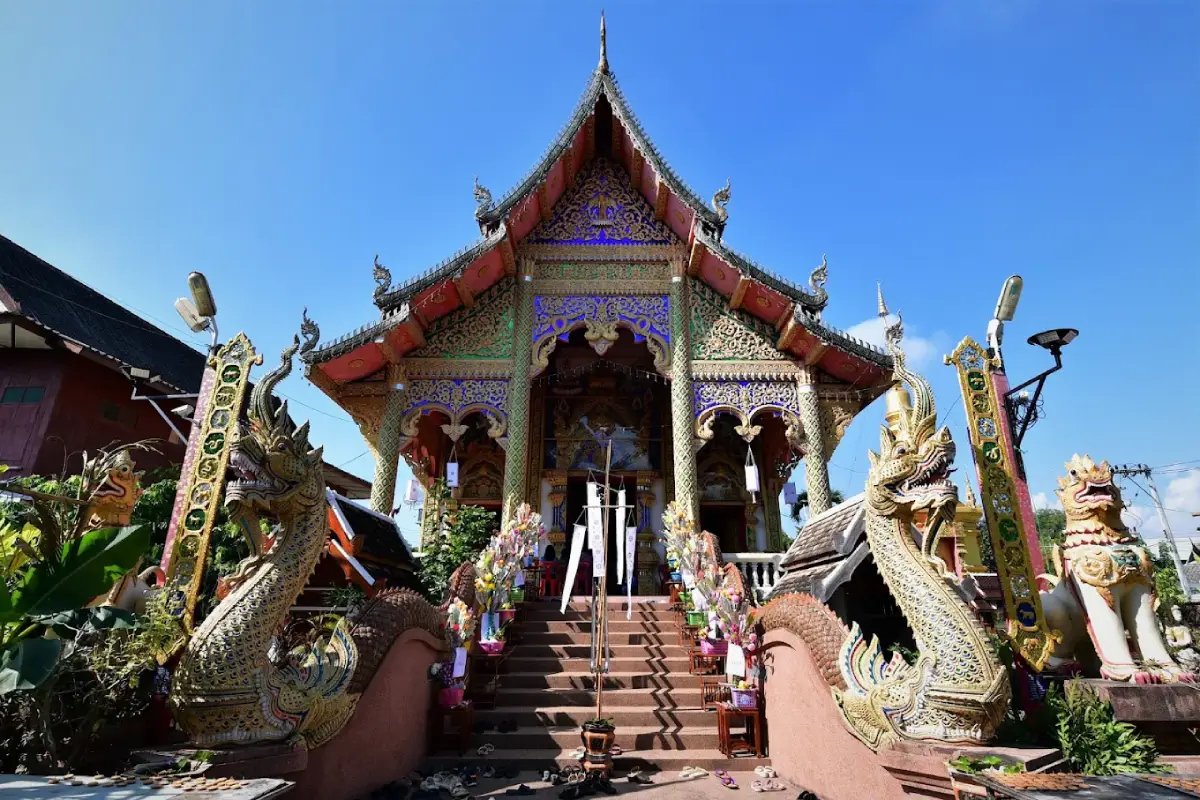
Open Days: Daily
Opening Hours: Open 24 Hours
Wat Sri Bua Ngoen in Mae Kha Subdistrict, Fang District, Chiang Mai Province, is a local Buddhist temple under the Mahanikaya order. The temple is located in Moo 3 of Mae Kha and serves as a religious, cultural, and community center for people in the northern part of Chiang Mai Province. It is not a large mainstream tourist temple like many famous temples in Chiang Mai city. Its value lies in its calm atmosphere, local faith, community roots, and Buddhist art connected with the Fang artisan tradition.
Wat Sri Bua Ngoen is suitable for visitors who want to make merit, pay respect to Buddha images, learn about a community temple in Fang, and experience the cultural setting of Mae Kha. The temple stands within a rural community environment surrounded by villages, nearby temples, and routes leading to important destinations in Fang District, such as Fang Hot Springs, Doi Pha Hom Pok National Park, Doi Ang Khang, local temples in Mae Kha, and community learning attractions. It can be planned as a calm merit-making stop within a half-day or full-day Fang itinerary.
Mae Kha Subdistrict is part of Fang District, an important area in upper Chiang Mai with a landscape and atmosphere very different from Chiang Mai city. Fang includes agricultural communities, valley plains, routes to mountains and hot springs, and local communities that continue to preserve Lanna and northern Thai ways of life. Wat Sri Bua Ngoen belongs to this cultural landscape. It is a temple for local people, a place for religious practice, and a space that reflects the relationship among monks, residents, elders, children, youth, and the wider Mae Kha community.
The name Wat Sri Bua Ngoen carries an auspicious meaning. “Sri” refers to prosperity, grace, and auspiciousness, while “Bua Ngoen” evokes the image of the lotus, an important Buddhist symbol of purity, wisdom, and spiritual growth. Together, the name suggests a calm and auspicious Buddhist place closely connected with Buddhist symbolism. The temple’s atmosphere matches this meaning well. It is simple, peaceful, and rooted in local faith rather than designed for spectacle.
Historical records of Wat Sri Bua Ngoen in Mae Kha show that the temple was officially permitted as a temple in 1915 and received its royal consecrated boundary in 1969. A royal consecrated boundary is significant because it affirms the temple’s status as a proper Buddhist site for important monastic ceremonies. This gives Wat Sri Bua Ngoen a firm place in the ecclesiastical system and shows that the temple has served Mae Kha’s religious life for more than a century.
The temple grounds cover 14 rai and 1 square wah. This area supports the temple’s religious buildings and community activities. The temple’s boundaries are connected with public routes and local waterways, reflecting a common pattern of northern Thai community temples that stand close to residential areas, village paths, and agricultural landscapes. Wat Sri Bua Ngoen is not detached from local life. It forms part of the village structure and remains linked to the everyday rhythm of the Mae Kha community.
The main monastic buildings at Wat Sri Bua Ngoen include a viharn, sermon hall, monks’ residences, alms hall, and dining hall. These structures reflect the temple’s core functions as a place for worship, Dhamma listening, merit-making, food offerings, and monastic residence. The viharn is the main worship space. The sermon hall supports community gatherings and religious activities. The monks’ residences serve the monastic community, while the alms hall and dining hall are connected with food offerings and the daily life of the temple.
The temple’s important sacred objects include Buddha images and a chedi. Among them, the bronze Buddha image associated with the Fang artisan tradition is especially important. This image links the temple with the local Buddhist art of Fang and helps illustrate the development of Lanna craftsmanship in the area. Wat Sri Bua Ngoen therefore has value not only as a community temple but also as a place where local Buddhist art and religious memory have been preserved.
The bronze Buddha image of Wat Sri Bua Ngoen shows distinctive features associated with the Fang school of Buddhist art. Its face is solemn and firm, with prominent eyebrows, lowered eyes, a large nose, a defined nose tip, and clearly shaped lips. These features give the image a calm, composed, and weighty presence. The combination of Lanna form, Ayutthaya influence, and local Fang craftsmanship gives the Buddha image strong cultural and artistic value.
The value of Wat Sri Bua Ngoen is therefore broader than its role as a local temple. It is a place that preserves artistic memory and community faith in Fang. Its Buddha images, chedi, viharn, and monastic structures connect present-day visitors with the long religious and cultural history of the area. A visit here offers not only peaceful worship but also a chance to observe the continuity of local Lanna faith and craftsmanship.
The temple has been administered by several monks over time, including Phra Chu Caravano, Phra Kaew Yanasi, Phra Kham-ai Khunavaro, Phra Khru Siribunrat, and Phra Khru Uppatham Pathumrat Silasaro, the present abbot. The abbot’s role is central to a community temple. He oversees the religious site, leads Buddhist activities, coordinates with local supporters, and helps maintain the temple’s ceremonies, traditions, and community functions.
Phra Khru Uppatham Pathumrat Silasaro, the abbot of Wat Sri Bua Ngoen, also serves within the monastic administration of Mae Kha Subdistrict as the ecclesiastical chief of Mae Kha Area 1. This role gives Wat Sri Bua Ngoen importance beyond being a single local temple. It links the temple with the broader monastic structure of Fang District and strengthens its role in Buddhist administration, local ceremonies, and community religious activities.
Another important dimension of Wat Sri Bua Ngoen is its social and learning role. Mae Kha Subdistrict has promoted elder activities and lifelong learning, and Wat Sri Bua Ngoen has been used as an important space for the Mae Kha elderly school activities. This reflects a traditional role of Thai temples: they are not only places of worship, but also community spaces for learning, gathering, knowledge transfer, and social connection.
The elderly school model shows how the temple grounds can serve public benefit in the present day. Elderly residents gain a space to meet, join activities, support their health, learn practical skills, and remain connected to the community. Wat Sri Bua Ngoen therefore functions as a community center where religion and quality of life meet. For cultural travelers, this makes the temple interesting because it shows a living community institution, not only a site of buildings and sacred objects.
A visit to Wat Sri Bua Ngoen should begin with paying respect in the main worship area. Visitors can then walk quietly around the temple grounds and observe the layout of the viharn, sermon hall, monks’ residences, and other monastic spaces. The beauty of the temple does not come from grandeur or ornament alone. It comes from the quiet character of a village temple that continues to serve its religious role. This simplicity is part of the charm of many temples in Fang District.
For visitors interested in Buddhist art, Wat Sri Bua Ngoen deserves special attention because of its bronze Buddha image associated with the Fang artisan tradition. Fang has a long history within the Lanna cultural region and sits on an important northern route. Buddhist images found in the area are not isolated works of art. They reflect exchanges of faith, craftsmanship, and artistic models between major Lanna centers and local communities.
Many travelers think of Fang in relation to Doi Ang Khang, Fang Hot Springs, Doi Pha Hom Pok National Park, and orange orchards. A stop at Wat Sri Bua Ngoen adds an important cultural layer to the journey. Fang is not only a destination for mountains, hot springs, and agriculture. It also has community temples, Buddhist art, local history, and Lanna faith traditions. With good planning, travelers can begin with Wat Sri Bua Ngoen and nearby temples in Mae Kha before continuing to natural or cultural attractions in Fang.
Traveling from Chiang Mai city to Wat Sri Bua Ngoen generally follows Highway 107 toward Fang District, passing Mae Taeng, Chiang Dao, and Chai Prakan before entering Fang. From there, travelers continue to Mae Kha Subdistrict and Moo 3, where the temple is located. The route combines mountain roads and local communities, so drivers should allow enough time and check their vehicle condition before leaving Chiang Mai, especially if they plan to continue to Doi Ang Khang or Fang Hot Springs.
From central Fang or Wiang Fang, Wat Sri Bua Ngoen is easier to reach by private car, motorcycle, or local hired transport. Visitors should pin the destination as Wat Sri Bua Ngoen, Mae Kha Subdistrict, Fang District, Chiang Mai Province. This is important because Chiang Mai has more than one temple with a similar name. Choosing the Mae Kha, Fang location prevents confusion with temples of the same name in other parts of the province.
The best time to visit Wat Sri Bua Ngoen is in the morning or late afternoon, when the weather is more comfortable for worship and walking around the temple. On Buddhist holy days, major Buddhist festivals, or local merit-making days, visitors may see more community activity than usual. Weekdays are better for a quiet visit, while event days are better for those who want to observe local Buddhist faith and community life.
Visitors should dress modestly, keep a calm manner, avoid loud behavior, and respect monks, novices, and local residents who come to make merit. Sacred objects and old religious items should not be touched unnecessarily. Photography should be done respectfully, especially inside worship spaces and around Buddha images. Visiting a community temple requires attention to etiquette and quietness more than taking photos.
Wat Sri Bua Ngoen can be planned as part of a Mae Kha and central Fang route. Nearby temples include Wat Huai Cho, Wat Khongkha Ram, Wat Udom Mongkhon, and Wat San Ton Pao. Visitors interested in community temples can create a half-day merit-making route through Mae Kha, then continue to restaurants or accommodation in Fang town before visiting Doi Ang Khang or Fang Hot Springs the following day.
Fang District also offers important natural and learning attractions, such as Fang Hot Springs in Doi Pha Hom Pok National Park, Doi Pha Hom Pok, Doi Ang Khang, and the First Royal Factory Museum at Fang. These destinations add nature, highland agriculture, wellness travel, and local development history to the journey. Including Wat Sri Bua Ngoen in the route gives the itinerary a stronger cultural and religious dimension.
What makes Wat Sri Bua Ngoen worth writing about is its authentic relationship with the Mae Kha community. The temple is not known because of scale or mass tourism. Its value comes from long-standing faith, the continuity of monastic leadership, its role as a community space, and its connection to Fang Buddhist art. This makes it a suitable place for travelers who want to understand Chiang Mai beyond the well-known old city temples.
For travelers planning to explore upper Chiang Mai, Wat Sri Bua Ngoen helps complete the image of Fang. Fang is not only a route toward Ang Khang or hot springs. It is a district with temples, communities, history, art, and local life. Wat Sri Bua Ngoen is suitable for peaceful merit-making, learning about local Buddhist art, and experiencing a Lanna community temple in its real environment.
In summary, Wat Sri Bua Ngoen is important in three ways. First, it is a Mahanikaya community temple in Mae Kha. Second, it is a space of local faith and community activities. Third, it preserves a bronze Buddha image connected with the Fang artisan tradition. Visitors should look at the temple with care, not as a quick stop, but as a place where architecture, Buddha images, a chedi, and community life together tell the story of Mae Kha and Fang.
Wat Sri Bua Ngoen is best suited for travelers who enjoy quiet temple visits, community temples, Lanna art, and the deeper cultural side of Fang District. A good visit does not need to be rushed. Paying respect, walking calmly, observing Buddhist art, and linking the visit with nearby temples or attractions is enough to reveal the subtle charm of upper Chiang Mai.
To make the journey worthwhile, Wat Sri Bua Ngoen can be combined with other temples and attractions in Fang District. A half-day itinerary can focus on Mae Kha temples and local dining. A full-day itinerary can continue to Fang Hot Springs or the First Royal Factory Museum. An overnight trip can connect with Doi Ang Khang or Doi Pha Hom Pok. This kind of route turns a temple visit into a fuller understanding of Fang through religion, culture, nature, and local life.
Wat Sri Bua Ngoen is a strong example of a local temple with cultural tourism value. Its beauty is not limited to architecture. It also lies in long-standing faith, community ties, and artistic traces from the past. Travelers visiting Fang should give this temple time as a meaningful stop that adds depth to a journey through upper Chiang Mai.
| Name | Wat Sri Bua Ngoen |
| Type | Local Buddhist temple under the Mahanikaya order |
| Location | Moo 3, Mae Kha Subdistrict, Fang District, Chiang Mai Province, Thailand |
| Address | Moo 3, Mae Kha Subdistrict, Fang District, Chiang Mai Province 50320, Thailand |
| Coordinates | 19.78142, 99.15420 |
| Highlights | A Mae Kha community temple with a bronze Buddha image associated with the Fang artisan tradition, a chedi, a viharn, and community functions |
| History | Officially permitted as a temple in 1915 and granted its royal consecrated boundary in 1969 |
| Temple Area | 14 Rai And 1 Square Wah |
| Distinctive Features | A local temple that reflects Lanna community faith and Buddhist art connected with Fang craftsmanship |
| Important Sacred Objects | Buddha images, a chedi, and a bronze Buddha image associated with the Fang artisan tradition |
| Main Areas / Zones | Viharn Sermon Hall Monks’ Residences Alms Hall Dining Hall Chedi Area Community Activity Area |
| Abbot / Caretaker | Phra Khru Uppatham Pathumrat Silasaro |
| Community Role | A community temple and learning activity space for Mae Kha, including elderly school activities |
| Travel Information | From Chiang Mai city, take Highway 107 toward Fang District through Mae Taeng, Chiang Dao, and Chai Prakan, then continue to Mae Kha Subdistrict and Moo 3 |
| Current Status | Open as a Buddhist temple and religious site for the Mae Kha community in Fang District, Chiang Mai Province |
| Open Days | Daily |
| Opening Hours | Open 24 Hours |
| Nearby Tourist Attractions | 1. Wat Huai Cho, about 1 km 2. Wat Khongkha Ram, about 2 km 3. Wat Udom Mongkhon Mae Kha, about 4 km 4. Chai Prakan Town, about 5 km 5. Fang Hot Springs, about 25 km 6. Doi Pha Hom Pok National Park, about 30 km 7. First Royal Factory Museum Fang, about 30 km |
| Nearby Restaurants | 1. Tiao Ruea Rangsit Mae Kha, about 3 km, Tel. 089-175-3940 2. Ahan Ran Mai, about 5 km, Tel. 086-114-6858 3. Hong Nung Len Fang, about 8 km, Tel. 083-201-8503, 095-134-6442 4. Bamee Je Hua Fang Branch, about 9 km, Tel. 064-721-8851 5. Kha Mu Krop Kai Yang San Ma Fueang, about 10 km, Tel. 081-882-5589, 081-467-3624 |
| Nearby Accommodations | 1. Fak Fang Homestay, about 9 km, Tel. 086-117-6914 2. Fang Modern Hotel, about 10 km, Tel. 086-439-1843 3. Fang Villa Hotel, about 10 km, Tel. 086-451-7682 4. Ban Sathitphon Hotel, about 12 km, Tel. 081-113-8882 5. Huen San Fang Hotel, about 14 km, Tel. 081-881-6430 |
Frequently Asked Questions (FAQ)
Q: Where is Wat Sri Bua Ngoen located?
A: Wat Sri Bua Ngoen is located in Moo 3, Mae Kha Subdistrict, Fang District, Chiang Mai Province 50320, Thailand.
Q: What type of temple is Wat Sri Bua Ngoen?
A: Wat Sri Bua Ngoen is a local Buddhist temple under the Mahanikaya order and serves the Mae Kha community in Fang District.
Q: What is the historical importance of Wat Sri Bua Ngoen?
A: The temple was officially permitted as a temple in 1915 and received its royal consecrated boundary in 1969, giving it a long-established religious role in the community.
Q: What are the important sacred objects at Wat Sri Bua Ngoen?
A: Important sacred objects include Buddha images, a chedi, and a bronze Buddha image associated with the Fang artisan tradition.
Q: Who is the abbot of Wat Sri Bua Ngoen?
A: The abbot is Phra Khru Uppatham Pathumrat Silasaro, who also has a role in the monastic administration of Mae Kha Area 1.
Q: What are the opening hours of Wat Sri Bua Ngoen?
A: Wat Sri Bua Ngoen is open daily and operates 24 hours as a community Buddhist temple.
Q: How can visitors travel to Wat Sri Bua Ngoen?
A: From Chiang Mai city, travelers can take Highway 107 toward Fang District, passing Mae Taeng, Chiang Dao, and Chai Prakan, then continue to Mae Kha Subdistrict and Moo 3.
Q: Which nearby places can be visited with Wat Sri Bua Ngoen?
A: Nearby places include Wat Huai Cho, Wat Khongkha Ram, Wat Udom Mongkhon Mae Kha, Fang Hot Springs, Doi Pha Hom Pok National Park, and the First Royal Factory Museum Fang.
 Category: ●Places of Worship
 Group: ●Temple
Last Update : 6 DayAgo
 Last Update : 6 DayAgo
 Click to Access the Navigation Map GPS
 Muang Chiang Mai(121)Chom Thong(47)Mae Chaem(25)Chiang Dao(33)Doi Saket(68)Mae Taeng(85)Mae Rim(69)Samoeng(29)Fang(71)Mae Ai(62)Phrao(70)San Pa Tong(105)San Kamphaeng(66)San Sai(73)Hang Dong(74)Hot(32)Doi Tao(22)Omkoi(11)Saraphi(74)Wiang Haeng(15)Chai Prakan(28)Mae Wang(32)Mae On(22)Doi Lo(34)Galyani Vadhana(1)


