
lovethailand home >North Travel Attractions >Chiang Mai Travel Attractions >Muang Chiang Mai >Chang Phueak > Wat Santitham
TL;DR: Wat Santitham is located at Chang Phueak Subdistrict, Mueang Chiang Mai District, Chiang Mai Province 50300, Thailand, open Daily, hours Open 24 hours.
Wat Santitham
Open Days: Daily
Opening Hours: Open 24 hours
Wat Santitham in Chiang Mai is an important forest meditation temple in Chang Phueak Subdistrict, Mueang Chiang Mai District. Located on Hasadisewee Road near the Santitham neighborhood and not far from Chiang Mai’s Old City moat, the temple is known for its deep connection with Luang Pu Sim Buddhacaro, the Thai forest meditation tradition, Santi Chedi, the ordination hall, and the Buddha Relics Museum of the great meditation masters. It is a calm temple where visitors can make merit, pay respect to sacred Buddhist sites, learn local religious history, and experience a quieter side of Chiang Mai.
Wat Santitham is more than a neighborhood temple. It preserves the story of devotion, meditation practice, and collective faith that shaped an important Buddhist site in northern Thailand. The temple is closely associated with Luang Pu Sim Buddhacaro, who played a central role in its foundation, and Phra Napeesee Phisankhun, also known as Luang Pho Maha Thong-in Kusolacitto, a key disciple who later continued the temple’s construction and administration. For travelers interested in Thai Buddhist culture, Wat Santitham offers a meaningful look into the forest meditation lineage within the urban setting of Chiang Mai.
The origin of Wat Santitham is connected to the wandering meditation journeys of Luang Pu Sim Buddhacaro. He traveled and practiced in several provinces, including Wat Pa Sa Khong in Lom Sak District, Phetchabun Province, and the Mae Doi monastic residence in Phrao District, Chiang Mai Province, which later developed into Wat Pa Ajahn Mun. During this period, Luang Pu Sim met Luang Pu Mun Bhuridatto, one of the most influential masters of the Thai forest tradition. This encounter strengthened his meditation practice and shaped the spiritual direction that later became deeply connected with Chiang Mai.
From 1940 to 1944, Luang Pu Sim stayed at Wat Rong Tham in San Kamphaeng District, Chiang Mai. At that time, the place was still a modest monastic residence suitable for meditation and retreat. Wat Rong Tham had also been associated with several important forest meditation teachers, including Luang Pu Mun Bhuridatto, Luang Pu Chob Thanasamo, Luang Pu Waen Suchinno, Phra Ajahn Ku Dhammadino, and Luang Pu Tue Achalathammo. This made the Chiang Mai area an important setting for the transmission of forest meditation practice in the Lanna region.
After that, Luang Pu Sim spent time at Tham Pha Phua in Chom Thong District, Chiang Mai, during the difficult years following World War II. Communities were facing hardship, uncertainty, and emotional distress. Luang Pu Sim became a spiritual refuge for local people, offering guidance through the Dhamma and helping restore morale among those affected by war. This period illustrates the role of forest meditation monks not only as practitioners in seclusion, but also as sources of courage and spiritual stability for surrounding communities.
When the Greater East Asia War was nearing its end, Chao Chuen Siroros, who had taken refuge near Tham Pha Phua during the war, returned to Chiang Mai and invited Luang Pu Sim to stay in the city. The residence used at that time was a building belonging to Mae Liang Dokchan Kiritipal on Suthep Road, opposite the route to Chiang Mai Airport. Staying in Chiang Mai city allowed Luang Pu Sim to teach more lay followers, and his Dhamma talks became widely respected for their clarity, calmness, and spiritual power. This urban period eventually led to the creation of Wat Santitham.
During his stay at Mae Liang Dokchan’s building, Luang Pu Sim met Phra Maha Thong-in Kusolacitto, who later became one of the temple’s most important disciples. Phra Maha Thong-in was ordained at Wat Chedi Luang with the support of Chao Mae Kap Kham Na Chiang Mai. He became the first disciple ordained during the period when Luang Pu Sim was staying in Chiang Mai city. In later years, he played a decisive role in carrying forward the temple’s construction and monastic work.
After the war ended, the owners of the building intended to return and use the property again. Luang Pu Sim and his disciples therefore needed a permanent place for monastic residence and religious practice. A turning point came when Luang Pu Sim said during a Dhamma talk that even birds could build their nests, so the faithful community should also be able to build a temple. These words deeply moved Khun Nimmuan Suphawong, also known as Nim Kim Sae Heng, and inspired her to help acquire land for a temple dedicated to Luang Pu Sim and the monastic community.
Khun Nimmuan’s faith developed gradually through her experience of listening to Luang Pu Sim’s teachings. At first, she was unfamiliar with temple customs and felt hesitant about attending sermons, fearing that she might not know the proper way to behave. After hearing others speak highly of Luang Pu Sim’s Dhamma talks and later listening to him in person, she became deeply moved by the clarity and accessibility of his teaching. Her faith eventually led her to donate money toward the purchase of land for a new temple.
The acquisition of land for Wat Santitham was made possible through the cooperation of several supporters. Khun Nimmuan first decided to donate 1,000 baht from money she received for a ring. Pho Noi Ngoen Phromyo helped search for land, while Je Ma and Nai Hang Yin also contributed funds. The group eventually bought land from Khun Phra Asa Songkhram, starting with 5 rai at 900 baht per rai and later adding another 3 rai and 3 ngan. The total land purchase came to 7,568 baht. Donors included Nang Sao Nim Kim Sae Heng, Nai Hang Yin, Mae Ma and their children, Nang Sao Thonglo Khaopraphai, Chao Phua Phat Na Chiang Mai, Mae Bunthong Tungkhomanee, and Mae Kaew Loon Suwanyuen. This foundation story shows that Wat Santitham was born from the faith and determination of lay supporters as much as from monastic leadership.
Khun Phra Asa Songkhram did not only sell the land at a favorable price. He also supported the early construction work with labor, funds, and close supervision. The first stages included clearing the land and building monks’ dwellings, a well, and toilets. Important supporters included Khun Nimmuan Suphawong, Pho Noi Ngoen Phromyoi, Nai Hang Yin, Nang Ma, and their family. Nai Leng Hai designed and supervised the construction of monks’ residences, while Mae Saeng Chinwat and Yom Chuen Siroros contributed funds for labor costs. The temple therefore developed step by step through practical support from a wide circle of faithful people.
When the land was first cleared, old traces were found on the site, including bricks, roof tiles, wall lines, and mounds that resembled remains of an old ordination hall or viharn. These traces indicate that the area had once been a religious site. Although the full history and former name of the old temple cannot be firmly identified in the present article, the remains give Wat Santitham an additional historical dimension. The modern temple was not simply established on empty land; it arose on a site with signs of earlier Buddhist use.
After enough monks’ dwellings had been built, the faithful community invited Luang Pu Sim Buddhacaro and his disciples to stay at the new site. A temporary temple sign was opened on 13 January 1949 under the name “Wat Santitham Nakhon Chiang Mai.” During the first rains retreat, the temple housed 11 monks and 9 novices. In 1950, an official request to establish the temple was submitted, with Nang Sao Nim Kim Sae Heng signing as representative. The process took several years, and official permission to establish the temple was granted on 25 October 1955. The temple was named Wat Santitham, with Luang Pu Sim Buddhacaro appointed as its first abbot.
The ordination hall of Wat Santitham is one of the temple’s most significant structures. In 1952, Luang Pu Sim saw that the temple already had enough basic monastic residences and a Dhamma hall, but still lacked an ordination hall for formal Sangha acts. He therefore began the project by marking the site along the old mound that appeared to be the remains of an earlier ordination hall. His fundraising approach was simple and restrained. When donations were available, construction continued; when funds ran out, the work paused. He did not issue formal fundraising notices, create amulets, or produce charms to raise money. The ordination hall was built steadily through voluntary faith.
In 1957, Wat Santitham received its royal grant of consecrated boundary land, measuring 40 meters wide and 80 meters long. The construction of the ordination hall paused during 1962 and 1963 because Luang Pu Sim was invited to stay at Wat Asokaram in Samut Prakan after the passing of Than Pho Lee Dhammadaro. Wat Asokaram needed a senior meditation master to guide lay followers in meditation practice. Even though Luang Pu Sim was away from Chiang Mai during that time, support for Wat Santitham continued. Devotees at Wat Asokaram learned about the ordination hall project in Chiang Mai and contributed substantial funds toward its completion.
In 1964, Luang Pu Sim assigned Phra Maha Thong-in Kusolacitto to oversee the construction of the ordination hall. In 1965, Luang Pu Sim became ill with kidney disease and resigned from the abbacy so that Phra Maha Thong-in could manage the temple fully. Phra Maha Thong-in became acting abbot and was formally appointed abbot of Wat Santitham in 1967. The ordination hall was completed in 1970 after 18 years of construction. It measures 14 meters wide, 28 meters long, and 30 meters high, with a construction cost of 782,910.10 baht.
Today, Wat Santitham is under the abbacy of Phra Khru Wimon Thammarat, also known as Luang Pho Maha Si Nuan Wimolo. The temple remains a Dhammayut temple and a recognized meditation center in Chiang Mai. Although it is located in the city, its atmosphere remains calm and simple. Visitors will notice the character of a forest meditation temple: restrained architecture, quiet spaces, and an emphasis on inner practice rather than spectacle. It is suitable for travelers who want a meaningful temple visit close to the city center.
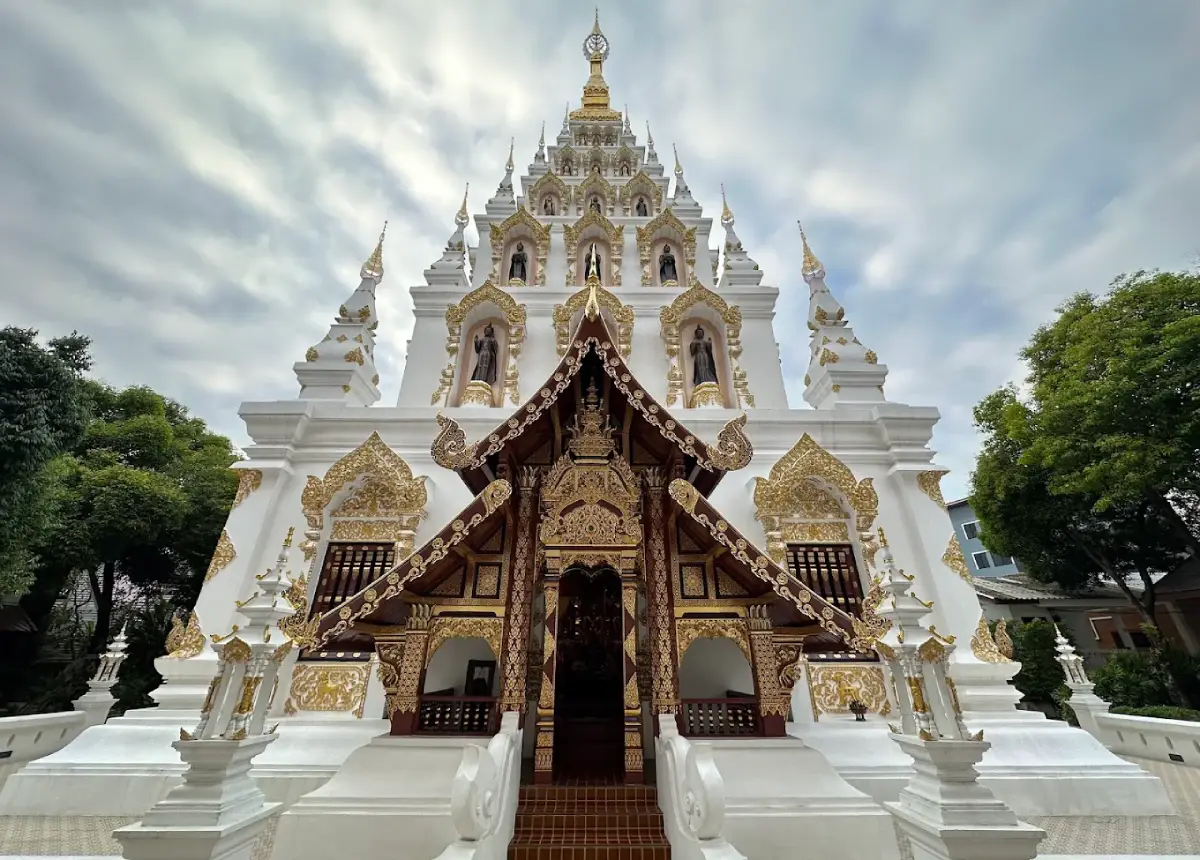
One of the temple’s major highlights is Santi Chedi, a five-tier prasat-style chedi located within the temple grounds. The structure has a square base measuring 12 meters by 12 meters and stands about 31 meters high. Its design draws on ancient Chiang Mai architectural forms. Each level contains Buddha images in niches, with 12 images per level and 60 images in total. The Buddha images represent different postures and meanings, including calming the ocean, carrying an alms bowl, preventing relatives from conflict, contemplating old age, and opening the world. Santi Chedi is therefore both a sacred site for worship and an architectural feature that helps visitors understand Buddhist symbolism.
Another important place inside the temple is the Buddha Relics Museum of the great meditation masters. The lower floor functions as a library, while the upper floor enshrines Buddha relics and sacred relics associated with meditation masters. The museum also displays wax figures and monastic requisites connected with respected teachers. This makes a visit to Wat Santitham more than a short stop for worship; it becomes a chance to learn about the Thai forest meditation lineage and the reverence held for earlier masters.
Visitors interested in meditation will find Wat Santitham especially meaningful. The temple is known as a meditation temple rather than a commercial tourist attraction. Visitors should dress modestly, keep their voices low, respect monks’ living areas, and behave calmly within the temple grounds. For meditation activities or specific religious programs, travelers should contact the temple directly before visiting so that they receive the correct schedule for that period.
Getting to Wat Santitham is convenient from central Chiang Mai. The temple is on Hasadisewee Road in Chang Phueak, close to the Santitham and Nimman areas. From the northern side of the Old City, travelers can pass through the Chang Phueak Gate area and continue toward Hasadisewee Road. Private cars, red songthaews, ride-hailing services, and rental motorbikes are all practical options. Because the temple is not far from the Old City, it can be combined with nearby cultural sites such as Wat Lok Moli, Wat Chet Yot, Wat Phra Singh, and Chiang Mai National Museum.
Wat Santitham is a strong choice for travelers who want to see Chiang Mai beyond its most crowded routes. The temple brings together meditation history, the legacy of Luang Pu Sim, sacred architecture, a relic museum, and a quiet urban temple atmosphere. Visitors do not need to spend a full day here, but it is worth taking time to walk slowly through the ordination hall area, Santi Chedi, the museum, and the peaceful corners of the temple grounds. For those interested in Thai Buddhist history and the forest meditation tradition, Wat Santitham offers one of Chiang Mai’s most meaningful temple experiences.
| Name | Wat Santitham |
| English Name | Wat Santitham / Wat Santidham |
| Type | Dhammayut Buddhist temple and forest meditation temple in Chiang Mai |
| Location | Chang Phueak Subdistrict, Mueang Chiang Mai District, Chiang Mai Province 50300, Thailand |
| Address | 13 Hasadisewee Road, Chang Phueak Subdistrict, Mueang Chiang Mai District, Chiang Mai Province 50300, Thailand |
| Coordinates | 18.7992, 98.9778 |
| Highlights | Santi Chedi, the ordination hall, the Buddha Relics Museum, the history of Luang Pu Sim Buddhacaro, and a peaceful meditation temple atmosphere in central Chiang Mai |
| History | The temporary temple sign was opened on 13 January 1949. Official permission to establish the temple was granted on 25 October 1955. The temple received its royal consecrated boundary in 1957, and the ordination hall was completed in 1970. |
| Distinctive Features | A meditation temple founded through the faith of Luang Pu Sim’s disciples, located on a site with traces of an older religious structure, and home to the five-tier Santi Chedi rising about 31 meters high |
| Travel Information | Accessible from Chiang Mai Old City via Chang Phueak Gate and Hasadisewee Road. Visitors can use a private car, red songthaew, ride-hailing service, or rental motorbike. The temple fits well into a cultural route around central Chiang Mai. |
| Current Status | Open as a Buddhist temple and meditation center in Chiang Mai |
| Open Days | Daily |
| Opening Hours | Open 24 hours |
| Fees | No admission fee |
| Facilities | Parking area, library, worship areas, ordination hall, Santi Chedi, and the Buddha Relics Museum |
| Main Areas / Zones | Ordination Hall Santi Chedi Buddha Relics Museum Library Meditation and quiet areas inside the temple grounds |
| Abbot / Caretaker | Phra Khru Wimon Thammarat, also known as Luang Pho Maha Si Nuan Wimolo |
| Main Contact Number | 053-221-792, 08-7193-3169, 08-6187-3942, 08-1602-7500 |
| Official Website / Official Page | www.santidham.com |
| Nearby Tourist Attractions | 1. Wat Lok Moli, about 1 km 2. Chang Phueak Gate and Chang Phueak Market, about 1.5 km 3. Chiang Mai National Museum, about 2 km 4. Wat Chet Yot, about 2 km 5. Wat Phra Singh Woramahawihan, about 2.4 km |
| Nearby Restaurants | 1. Khao Soi Mae Sai, about 1 km, Tel. 053-213-284 2. Huen Muan Jai, about 1 km, Tel. 053-404-998 3. Akha Ama Coffee, about 0.5 km, Tel. 086-915-8600 4. Som Tam Rong Pladaek Branch 3 Santitham, about 1 km, Tel. 090-330-0127 5. Sai Yang Santitham, about 1 km, Tel. 091-879-7907 |
| Nearby Accommodations | 1. B2 Santitham Boutique & Budget Hotel, about 2 km, Tel. 052-009-570 2. POR Santitham, about 1.5 km, Tel. 087-474-1444 3. S48 Hotel, about 2 km, Tel. 053-357-441 4. BOOK Design Hotel, about 2.5 km, Tel. 053-215-025 5. Glory Boutique Suites, about 2 km, Tel. 052-000-559 |
Frequently Asked Questions (FAQ)
Q: Where is Wat Santitham located?
A: Wat Santitham is located at 13 Hasadisewee Road, Chang Phueak Subdistrict, Mueang Chiang Mai District, Chiang Mai Province 50300, Thailand. It is close to the Santitham neighborhood and not far from Chiang Mai Old City.
Q: Why is Wat Santitham important?
A: Wat Santitham is an important meditation temple in Chiang Mai with a strong connection to Luang Pu Sim Buddhacaro and the Thai forest meditation tradition. It is also home to Santi Chedi and the Buddha Relics Museum.
Q: What are the opening hours of Wat Santitham?
A: Wat Santitham is open daily and open 24 hours. Morning and late afternoon are the most suitable times for a peaceful visit.
Q: Is there an admission fee?
A: No. Wat Santitham has no admission fee. Visitors may make merit or donate voluntarily.
Q: What can visitors see inside Wat Santitham?
A: Important areas include the ordination hall, Santi Chedi, the Buddha Relics Museum, the library, and quiet spaces for worship and meditation.
Q: What is special about Santi Chedi?
A: Santi Chedi is a five-tier prasat-style chedi about 31 meters high. It enshrines 60 Buddha images, with 12 images on each level.
Q: How can travelers get to Wat Santitham?
A: Travelers can reach the temple from Chiang Mai Old City through the Chang Phueak Gate area and Hasadisewee Road. Private cars, red songthaews, ride-hailing services, and rental motorbikes are convenient options.
Q: Which nearby attractions can be visited with Wat Santitham?
A: Nearby places include Wat Lok Moli, Chang Phueak Gate, Chiang Mai National Museum, Wat Chet Yot, and Wat Phra Singh Woramahawihan.
 Category: ●Places of Worship
 Group: ●Temple
Last Update : 3 WeekAgo
 Last Update : 3 WeekAgo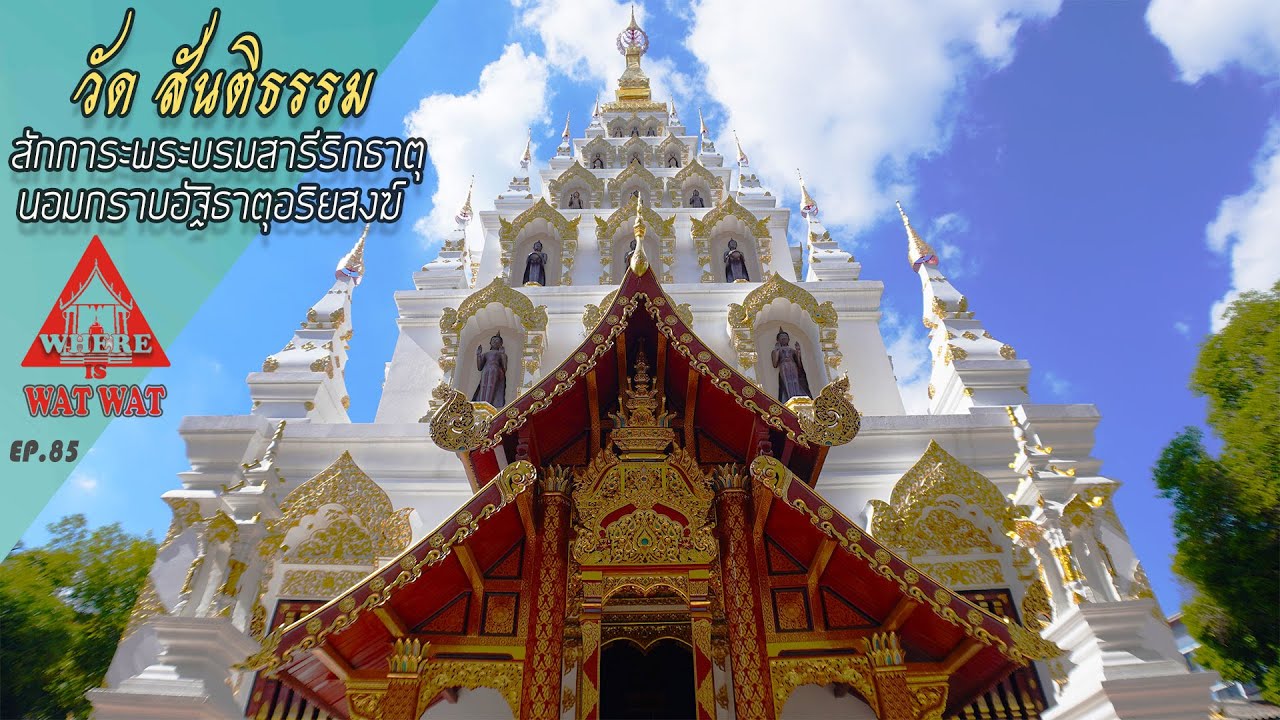
 Click to Access the Navigation Map GPS
Wat Santitham Map
Recommend

 Muang Chiang Mai(121)Chom Thong(47)Mae Chaem(25)Chiang Dao(33)Doi Saket(68)Mae Taeng(85)Mae Rim(69)Samoeng(29)Fang(71)Mae Ai(59)Phrao(70)San Pa Tong(103)San Kamphaeng(66)San Sai(73)Hang Dong(73)Hot(32)Doi Tao(22)Omkoi(11)Saraphi(74)Wiang Haeng(15)Chai Prakan(28)Mae Wang(32)Mae On(22)Doi Lo(33)Galyani Vadhana(1)


