
lovethailand home >North Travel Attractions >Chiang Mai Travel Attractions >Muang Chiang Mai >Mae He Ya > Wat Tamnak Suan Khwan Sirimangkalajarn
TL;DR: Wat Tamnak Suan Khwan Sirimangkalajarn is located at Ban Tamnak, Mae Hia Subdistrict, Mueang Chiang Mai District, Chiang Mai Province, open Daily, hours 08.00 – 17.00.

Wat Tamnak Suan Khwan Sirimangkalajarn
Open Days: Daily
Opening Hours: 08.00 – 17.00
Wat Tamnak Suan Khwan Sirimangkalajarn, commonly known as Wat Tamnak, is a community Buddhist temple under the Mahanikaya order in Ban Tamnak, Mae Hia Subdistrict, Mueang Chiang Mai District, Chiang Mai Province. It is one of the most historically layered temples south of Chiang Mai city. The temple is associated with Phra Sirimangkalajarn, one of Lanna’s great Buddhist scholars, as well as King Phra Mueang Kaeo, King Kawila, the former names Wat Suan Khwan and Wat Weluwanaram, Burmese-period remains, Lanna architecture, and a Burmese-style chedi built over an earlier sacred monument.
Wat Tamnak is suitable for travelers who want to explore Chiang Mai beyond the well-known temples inside the old city. The temple lies south of Chiang Mai International Airport and can be reached from either the Chiang Mai 700th Anniversary Road or Chiang Mai–Hang Dong Road. Its location in Mae Hia places it within a practical route that can also include Royal Park Rajapruek, Chiang Mai Night Safari, Wat Ton Kwen, Wat Phra That Doi Kham, Baan Kang Wat, and other attractions in southern Chiang Mai. A visit to Wat Tamnak gives travelers a deeper view of Chiang Mai as a city of Buddhist scholarship, community memory, and historical change.
The temple’s full name preserves several historical layers. “Wat Suan Khwan” is connected with notes at the end of manuscripts associated with Phra Sirimangkalajarn. “Wat Weluwanaram” means bamboo-grove monastery and is linked with the Phra Mueang Kaeo period. “Wat Tamnak” comes from the royal pavilion, or tamnak, built for King Kawila during the restoration of Chiang Mai. “Wat Sirimangkalajarn” honors the scholar-monk whose works contributed greatly to Lanna Buddhist learning. Bringing these names together, Wat Tamnak Suan Khwan Sirimangkalajarn is not merely a village temple; its name itself tells the story of place, knowledge, devotion, and political restoration.
The older historical layer of the temple is connected with the early sixteenth century, around 1507, during the reign of King Phra Mueang Kaeo of the Mangrai dynasty. This was an important period for Buddhist scholarship, temple patronage, manuscript production, and religious learning in Lanna. The site identified with Wat Weluwanaram or Wat Suan Khwan is remembered as a place connected with Phra Sirimangkalajarn, a major Lanna scholar-monk. This gives the temple exceptional significance: it is not only a local place of worship but also a site linked to the intellectual history of northern Thai Buddhism.
Phra Sirimangkalajarn is central to the identity of Wat Tamnak. He is remembered as a learned monk whose writings helped shape the study and explanation of Buddhist doctrine in Lanna. The temple is associated with his residence and the composition of important works between 1517 and 1520, including the Vessantaradipani, Cakkavaladipani, and Sankhyapakasaka Tika. For visitors, this means the temple should be understood not only as a sacred place but also as a former center of Buddhist authorship and scholarly reflection.
During the reign of King Phra Mueang Kaeo, tradition records that the king came to enshrine relics in a chedi at Wat Weluwanaram in 1519. This event strengthens the religious importance of the site because relic enshrinement transforms a chedi into a central sacred monument for worship and merit-making. The chedi at Wat Tamnak therefore carries several historical meanings: an older Lanna sacred foundation, later Burmese-period architectural transformation, and continued community devotion.
After 1558, when King Bayinnaung’s army captured Chiang Mai, the temple area was affected by warfare, depopulation, and changes in settlement. The older Wat Suan Khwan compound declined, while parts of the site continued to be used for Buddhist practice. The ubosot and original relic monument were restored for religious ceremonies, while new monastic residences and other structures were later built outside parts of the older wall line. This makes Wat Tamnak a good example of how Chiang Mai temples survived through adaptation, partial abandonment, restoration, and renewed community support.
The Burmese period left one of the most visible features of the temple: the Burmese-style chedi built over the earlier relic monument. The structure stands on a square base with three indented tiers. Corner subsidiary chedis appear at the first tier, while the upper tiers have forms resembling ceremonial floral pedestals. Above this rises the chedi body covered with changko metal sheets, with glass decoration on the rings and a seven-tiered golden umbrella at the top. This layered chedi shows how Lanna and Burmese artistic traditions met at the temple over time.
The name Wat Tamnak became prominent during the time of King Kawila. In 1796, as King Kawila led the restoration of Chiang Mai after a long period of decline, his attendants built a temporary royal pavilion in the area. Local people called this pavilion a tamnak. The name was then attached to the village and later to the temple. This story connects Wat Tamnak with the major historical process of rebuilding Chiang Mai and resettling the city in the late eighteenth century.
In 1956, the people of Ban Tamnak invited Phra Panya Sirithammo from Wat Nam Bo Luang in San Pa Tong District to become abbot. He led local devotees in restoring the old temple area, beginning from the ancient khong gateway and the old wall line. A new viharn, monks’ residences, and other monastic structures were built. This restoration was a turning point that helped bring Wat Tamnak back into active religious and community use. The temple today still reflects this balance between ancient remains and restored working spaces.
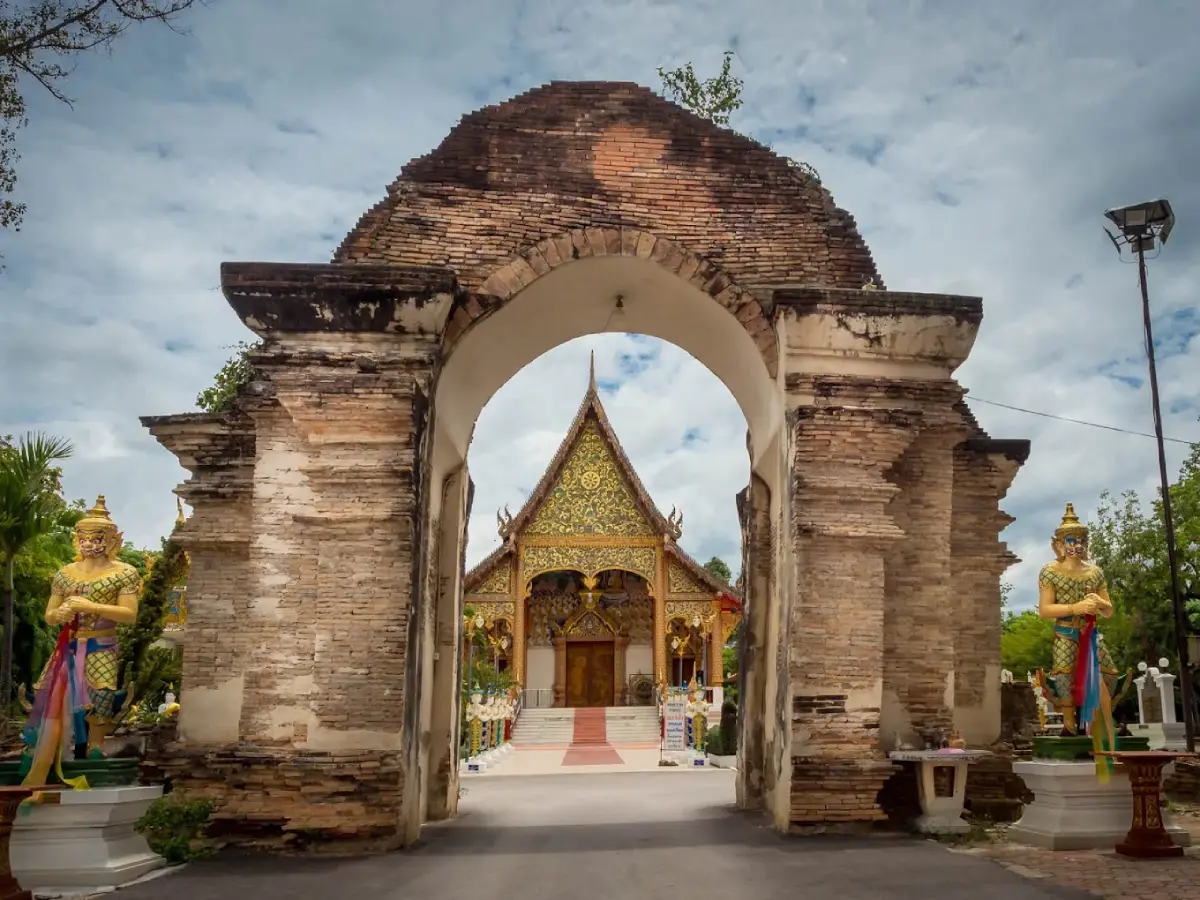
The first feature visitors should observe is the large ancient khong gateway in front of the newer viharn. The gateway remains an important architectural marker of the old temple compound, and parts of the ancient wall can still be seen nearby. This gateway is more than an entrance. It marks the boundary between ordinary village space and a sacred Buddhist compound, while also showing that the older temple was once significant and carefully planned.
The new viharn, built in 1956, is a brick-and-plaster Lanna-style hall. Its gable is decorated with stucco foliate patterns and the dhammachakra, while the front wall contains murals from the life of the Buddha. The wooden door panels are carved with scenes of the Buddha teaching living beings. These elements make the viharn both a worship space and a visual teaching space, where architecture, sculpture, and painting all communicate Buddhist meaning.
The viharn’s decorative program deserves careful attention. The foliate stucco patterns suggest growth, prosperity, and the flourishing of the Dhamma, while the dhammachakra represents the turning of the Wheel of Dhamma. The carved wooden doors emphasize compassion and the Buddha’s teaching role. Visitors who pause at the front of the viharn will see how Lanna religious architecture uses symbolic details to prepare the mind before entering a sacred interior.
The ho trai, or scripture hall, stands beside the newer viharn. It is a two-storey Lanna-style building and is often noted for its resemblance to the scripture hall at Wat Phra Singh in terms of scale, decoration, and stucco angel figures around the building. In Thai and Lanna temples, a ho trai is associated with the preservation of Buddhist texts, scriptures, and knowledge. At Wat Tamnak, this function is especially meaningful because the temple is closely connected with Phra Sirimangkalajarn and manuscript scholarship.
The monument to Phra Sirimangkalajarn stands in front of the ubosot. It was created to honor the scholar-monk associated with the temple and its intellectual heritage. This is one of the most meaningful points in the compound. It helps visitors understand that Wat Tamnak is not only an architectural or historical site; it is also a place of memory for a monk whose works shaped Lanna Buddhist thought.
The ubosot is a Lanna-style structure dating from the temple’s early period and restored over time. Its most distinctive feature is the fine stucco work, especially the makara disgorging naga motif. In Lanna religious art, the makara and naga represent sacred protection and the transition from the ordinary world into a consecrated religious space. Their presence around the ubosot emphasizes the importance of this building as the formal space for monastic acts.
The chedi is one of the strongest visual symbols of Wat Tamnak. Its Burmese form, changko metal covering, colored-glass decoration, and seven-tiered golden umbrella create a striking sacred monument. Yet its importance is not only visual. The chedi stands over an older Lanna relic monument and therefore embodies historical continuity. It is a structure where faith, conquest, adaptation, restoration, and devotion are layered together.
The ancient viharn stands near the ubosot at the front of the temple. It was built during the Burmese period of Chiang Mai and is an old brick-and-plaster Lanna-style building. Its chofa and nak sadung elements are made of wood, and the roof is covered with thin cement slabs. The gable contains low-relief wooden carving with foliate motifs. Inside is a Buddha image in the Subduing Mara posture, with folk murals behind the principal image. This hall preserves a quieter and more local form of sacred art.
The folk murals inside the ancient viharn are valuable because they show local participation in Buddhist storytelling. Unlike highly polished court-style art, folk painting carries the sincerity of community devotion. It teaches Buddhist stories, moral lessons, and devotional values in a form accessible to ordinary villagers. At Wat Tamnak, these murals add a human and community layer to the temple’s historical architecture.
Wat Tamnak also contains a sermon hall, monks’ residences, merit-making spaces, and areas used by the community. The temple is not a passive ruin. It continues to function as a Buddhist temple where local people come to worship, make merit, and join religious and cultural activities. This active role is important because it shows that the old sacred compound has not been separated from living community practice.
Wat Tamnak also helps explain the history of Ban Tamnak and Mae Hia. Ban Tamnak is one of the older communities of Mae Hia, located close to Chiang Mai city, the airport, and the Hang Dong route. The temple preserves memories of bamboo groves, Wat Suan Khwan, Phra Sirimangkalajarn, King Kawila’s pavilion, and later community restoration. Through these layers, the temple becomes a local archive of place, faith, scholarship, and settlement.
Getting to Wat Tamnak is straightforward. From Chiang Mai International Airport or Central Chiang Mai Airport, travel south toward Mae Hia and the Chiang Mai–Hang Dong corridor. Visitors can enter from Chiang Mai–Hang Dong Road or from the Chiang Mai 700th Anniversary Road. Because the temple is inside a local community rather than directly on a major tourist street, using a navigation app with the full destination name “Wat Tamnak Suan Khwan Sirimangkalajarn, Mae Hia” is the clearest option.
Travelers can reach the temple by private car, motorcycle, red songthaew, tuk-tuk, or taxi-app service. If using hired transport, give the destination as Wat Tamnak, Ban Tamnak, Mae Hia. The temple can be combined easily with Royal Park Rajapruek, Chiang Mai Night Safari, Wat Ton Kwen, Wat Phra That Doi Kham, Baan Kang Wat, and Wat Umong. These places form a practical southern Chiang Mai route for travelers who want temples, gardens, viewpoints, family attractions, and local neighborhoods in one itinerary.
The best time to visit Wat Tamnak is in the morning or late afternoon. Morning is suitable for worship and quiet observation. Late afternoon is good for photographing the khong gateway, viharn, ho trai, chedi, ancient wall remains, and Burmese-Lanna architectural details. A careful visit should take around 45–90 minutes, especially for visitors who want to study the temple’s connection with Phra Sirimangkalajarn and observe the older structures without rushing.
Visitors should follow normal Thai temple etiquette. Dress modestly, remove shoes before entering sacred buildings, keep voices low, and avoid touching murals, carved wood, stucco, colored glass, changko metal sheets, or old architectural elements. Do not climb on the chedi base. If monks, local worshippers, or community activities are present, visitors should give priority to religious use of the space.
Wat Tamnak is also suitable for cultural and architectural photography. Important subjects include the ancient khong gateway, old wall line, newer viharn, ancient viharn, two-storey ho trai, monument to Phra Sirimangkalajarn, Lanna ubosot, and Burmese-style chedi. Photography should be done respectfully, without flash near murals or sacred objects, and without approaching fragile decorative features too closely.
Compared with better-known Chiang Mai temples, Wat Tamnak stands out because of its depth of narrative. It brings together multiple temple names, the scholarship of Phra Sirimangkalajarn, King Phra Mueang Kaeo’s religious patronage, relic enshrinement, the Burmese conquest period, a Burmese-style chedi over an older monument, King Kawila’s restoration-era pavilion, and the twentieth-century revival led by local devotees. This makes Wat Tamnak a compact but exceptionally meaningful temple for travelers who want to understand Chiang Mai through history rather than only through famous landmarks.
Overall, Wat Tamnak Suan Khwan Sirimangkalajarn is a historically important temple in Mae Hia that deserves a place in a southern Chiang Mai itinerary. It offers Lanna history, Buddhist scholarship, Burmese-period remains, sacred architecture, community faith, and a calm local atmosphere in one compound. For travelers interested in the intellectual and spiritual history of Chiang Mai, Wat Tamnak provides a clear connection between place, memory, religious learning, and the long transformation of the city.
| Name | Wat Tamnak Suan Khwan Sirimangkalajarn |
| Common Name | Wat Tamnak |
| Former / Related Names | Wat Suan Khwan, Wat Weluwanaram, Wat Tamnak Suan Khwan, Wat Sirimangkalajarn |
| Location | Ban Tamnak, Mae Hia Subdistrict, Mueang Chiang Mai District, Chiang Mai Province |
| Address | Ban Tamnak, Chiang Mai–Hang Dong Road, Mae Hia Subdistrict, Mueang Chiang Mai District, Chiang Mai 50100, Thailand |
| Coordinates | 18.74792, 98.95670 |
| Temple Type | Community Buddhist Temple Under The Mahanikaya Order |
| Highlights | Historic Mae Hia temple associated with Phra Sirimangkalajarn, ancient khong gateway, old wall remains, Lanna viharn, two-storey ho trai, Lanna ubosot with makara-and-naga stucco, Burmese-style changko-covered chedi, and ancient viharn |
| History | Linked with the Phra Mueang Kaeo period around 1507, later affected by the Burmese occupation of Chiang Mai, and named Wat Tamnak after King Kawila’s temporary royal pavilion in 1796 |
| Buddhist Significance | Associated with Phra Sirimangkalajarn, a major Lanna scholar-monk who composed important Buddhist works such as the Vessantaradipani, Cakkavaladipani, and Sankhyapakasaka Tika |
| Name Origin | The name Wat Tamnak comes from the royal pavilion, or tamnak, built for King Kawila when he led the restoration of Chiang Mai in 1796. |
| Major Restoration | In 1956, local devotees invited Phra Panya Sirithammo to become abbot and restore the old temple area, building a new viharn, monks’ residences, and supporting religious structures. |
| Chedi Features | Burmese-style chedi built over an earlier relic monument, with a square base, three indented tiers, subsidiary corner chedis, pedestal-like upper tiers, changko metal covering, colored-glass decoration, and a seven-tiered golden umbrella |
| Historic Structures / Key Features | Ancient khong gateway, old wall remains, newer viharn, ubosot, chedi, ancient viharn, ho trai, monument to Phra Sirimangkalajarn, sermon hall, and monks’ residences |
| Current Abbot / Caretaker | Phra Maha Somboon Wachirapanyo |
| Main Contact Number | 053-804-623 |
| Open Days | Daily |
| Opening Hours | 08.00 – 17.00 |
| Current Status | Open for worship, merit-making, temple visits, and local religious or community activities in Ban Tamnak |
| Facilities | Viharn, ubosot, chedi, ho trai, sermon hall, monks’ residences, merit-making areas, walking areas, and Wat Tamnak parking area |
| Main Areas / Zones | Ancient khong gateway, old wall remains, newer viharn, ho trai, monument to Phra Sirimangkalajarn, ubosot, Burmese-style chedi, ancient viharn, sermon hall, monks’ residences, and community merit-making areas |
| Travel Information | Accessible from Chiang Mai 700th Anniversary Road or Chiang Mai–Hang Dong Road. From Chiang Mai Airport, travel south toward Mae Hia and Ban Tamnak, using the full temple name in navigation. |
| Visitor Guidelines | Dress modestly, remove shoes before entering sacred buildings, do not touch murals, woodcarving, stucco, colored glass, changko metalwork, or old architectural features, do not climb the chedi base, and respect monks and worshippers. |
| Nearby Tourist Attractions | 1. Wat Ton Pin, About 2 km 2. Wat Intharawat Or Wat Ton Kwen, About 3 km 3. Royal Park Rajapruek, About 4 km 4. Chiang Mai Night Safari, About 4 km 5. Wat Phra That Doi Kham, About 5 km 6. Baan Kang Wat, About 5 km 7. Wat Umong Suan Phutthatham, About 5 km 8. Central Chiang Mai Airport, About 5 km |
| Nearby Restaurants | 1. Daddy’s Antique Cafe & Restaurant, About 2 km, Tel. 094-764-1441 2. Mae Kham Paeng Khao Soi, About 3 km, Tel. 095-495-6695 3. Saen Kham Terrace, About 3 km, Tel. 053-838-990, 091-853-4690 4. Krua Ob Boon Mae Hia, About 4 km, Tel. 097-989-9060 5. Chamcha At Doi Kham, About 4 km, Tel. 083-473-9494 6. Khaomao–Khaofang Chiang Mai, About 4 km, Tel. 053-838-444 |
| Nearby Accommodations | 1. Pool Suite Chiang Mai, About 2 km, Tel. 099-236-3222 2. Donpin 8 / Timeless House Chiang Mai, About 2 km, Tel. 099-103-4820 3. Vdara Resort and Spa, About 3 km, Tel. 061-270-5888 4. Pimlada Hotel, About 3 km, Tel. 099-269-4256 5. Sukruethai Hotel Chiang Mai, About 4 km, Tel. 081-137-0949 6. Mountain Creek Wellness Resort Chiang Mai, About 5 km, Tel. 053-111-424 |
Frequently Asked Questions (FAQ)
Q: Where is Wat Tamnak Suan Khwan Sirimangkalajarn located?
A: Wat Tamnak Suan Khwan Sirimangkalajarn is located in Ban Tamnak, Mae Hia Subdistrict, Mueang Chiang Mai District, Chiang Mai Province, south of Chiang Mai International Airport. It can be reached from Chiang Mai 700th Anniversary Road or Chiang Mai–Hang Dong Road.
Q: What are the opening hours of Wat Tamnak?
A: Wat Tamnak is open daily from 08.00 to 17.00.
Q: Why is Wat Tamnak historically important?
A: Wat Tamnak is important because it is associated with Phra Sirimangkalajarn, a major Lanna scholar-monk, and preserves Lanna and Burmese-period remains that reflect several layers of Chiang Mai history.
Q: What is the origin of the name Wat Tamnak?
A: The name comes from a temporary royal pavilion, or tamnak, built for King Kawila when he led the restoration of Chiang Mai in 1796. The name later became attached to the village and temple.
Q: What former names are connected with Wat Tamnak?
A: The temple is connected with several names, including Wat Suan Khwan, Wat Weluwanaram, Wat Tamnak Suan Khwan, and Wat Sirimangkalajarn.
Q: What should visitors see inside Wat Tamnak?
A: Important features include the ancient khong gateway, old wall remains, newer viharn, two-storey ho trai, monument to Phra Sirimangkalajarn, Lanna ubosot, Burmese-style changko-covered chedi, ancient viharn, sermon hall, and monks’ residences.
Q: Who is the current abbot of Wat Tamnak?
A: The current abbot recorded in public temple information is Phra Maha Somboon Wachirapanyo.
Q: What nearby places can be visited with Wat Tamnak?
A: Nearby places include Wat Ton Pin, Wat Ton Kwen, Royal Park Rajapruek, Chiang Mai Night Safari, Wat Phra That Doi Kham, Baan Kang Wat, Wat Umong, and Central Chiang Mai Airport.
 Category: ●Places of Worship
 Group: ●Temple
Last Update : 6 HourAgo
 Last Update : 6 HourAgo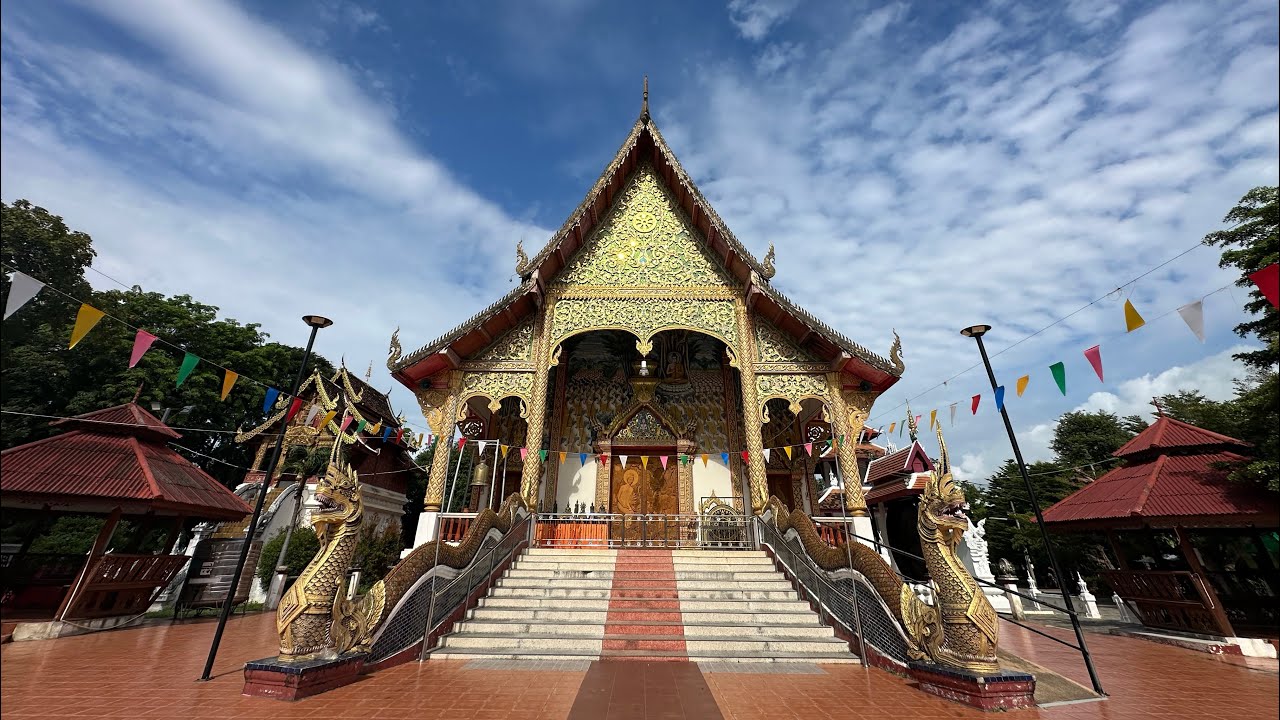
 Click to Access the Navigation Map GPS
Wat Tamnak Suan Khwan Sirimangkalajarn Map
Recommend

 Muang Chiang Mai(121)Chom Thong(47)Mae Chaem(25)Chiang Dao(33)Doi Saket(68)Mae Taeng(85)Mae Rim(69)Samoeng(29)Fang(71)Mae Ai(62)Phrao(70)San Pa Tong(105)San Kamphaeng(66)San Sai(73)Hang Dong(74)Hot(32)Doi Tao(22)Omkoi(11)Saraphi(74)Wiang Haeng(15)Chai Prakan(28)Mae Wang(32)Mae On(22)Doi Lo(34)Galyani Vadhana(1)


