
lovethailand home >North Travel Attractions >Chiang Mai Travel Attractions >Muang Chiang Mai >Mae He Ya > Wat Ton Pin
TL;DR: Wat Ton Pin is located at Ban Don Pin, Chiang Mai–Hot Road, Mae Hia Subdistrict, Mueang Chiang Mai District, Chiang Mai Province, open Daily, hours 08.00 – 17.00.

Wat Ton Pin
Open Days: Daily
Opening Hours: 08.00 – 17.00
Wat Ton Pin in Chiang Mai is a community Buddhist temple under the Mahanikaya order, located at 110 Moo 5, Ban Don Pin, Chiang Mai–Hot Road, Mae Hia Subdistrict, Mueang Chiang Mai District, Chiang Mai Province. The temple is closely connected with the old Wat Phra Chan site, a pair of standing Buddha images on a raised altar, Khruba Upanantha Thera, Khruba Siwichai, and the local place name “Ton Pin,” which relates to a mound of bael trees known in northern Thai as “ma pin.” Wat Ton Pin remains an active neighborhood temple where local people come to make merit, worship, join community activities, and maintain the Buddhist traditions of Ban Don Pin and Mae Hia.
Wat Ton Pin is a useful temple to visit for travelers who want to explore Chiang Mai beyond the old city moat, Tha Phae Road, and the best-known central temples. The temple stands south of the city on the Chiang Mai–Hot route, the main road toward Hang Dong, San Pa Tong, Doi Lo, Chom Thong, and Doi Inthanon. This location places the temple within the Mae Hia area, which combines older villages, residential communities, schools, markets, restaurants, hotels, and major attractions such as Royal Park Rajapruek, Chiang Mai Night Safari, and Wat Intharawat, also known as Wat Ton Kwen. A visit to Wat Ton Pin adds a local historical and religious dimension to a Mae Hia or Hang Dong itinerary.
The history of Wat Ton Pin has several layers. The temple was formerly associated with Wat Phra Chan, or the Moon Temple. The name relates to 2 standing Buddha images on a chukchi altar, which are remembered as temple Buddha images from the earlier site and are now connected with the present viharn of Wat Ton Pin. Local memory places the former Wat Phra Chan around the area of Ban Don Pin Witthayakhom School. Later, Khruba Upanantha Thera and local devotees moved the temple to a new site at Don Matuem, about 500 meters east of the older location. In northern Thai, matuem, or bael fruit, is called ma pin, and this local landscape became the basis for the name Wat Ton Pin.
The name Wat Ton Pin is therefore more than a temple name. It preserves local language, old geography, and the memory of a religious site that moved from the older Wat Phra Chan location to a new mound associated with bael trees. In Lanna culture, many temple names are connected with trees, ponds, mounds, irrigation channels, fields, or earlier settlement features. These names show that temples grew from the life of local communities rather than existing separately from the landscape. Wat Ton Pin is a clear example of a temple whose name records the older environment of Ban Don Pin.
The temple’s historical record includes an early foundation tradition around 1757 and the movement of the temple to the Don Matuem area around 1823. The information provided for this article records the temple area as 5 rai and 1 ngan, and notes that Wat Ton Pin received its consecrated boundary in 1980. These details show the temple’s different historical layers: the older Wat Phra Chan memory, the relocation to the Ton Pin site, and the later formal recognition of the temple’s consecrated boundary for monastic rites.
Wat Ton Pin received its consecrated boundary on 3 July 1980. The boundary measures 30 meters wide and 40 meters long. This is important in Buddhist practice because a consecrated boundary marks the formal area for Sangha ceremonies, especially ordination and other monastic acts. Wat Ton Pin is therefore not only a temple with local stories; it is a formally functioning Buddhist temple with continuing religious use in Mae Hia.
The character of Wat Ton Pin lies in its calm and shaded atmosphere. It is a temple outside the densest tourist core of Chiang Mai, yet still close enough to the city for an easy visit. The compound has mature trees, an orderly temple layout, and the slower rhythm of a local community temple. Visitors can worship, walk through the grounds, observe the architecture, and rest quietly without the heavy crowds often found around the most famous temples in the old city.
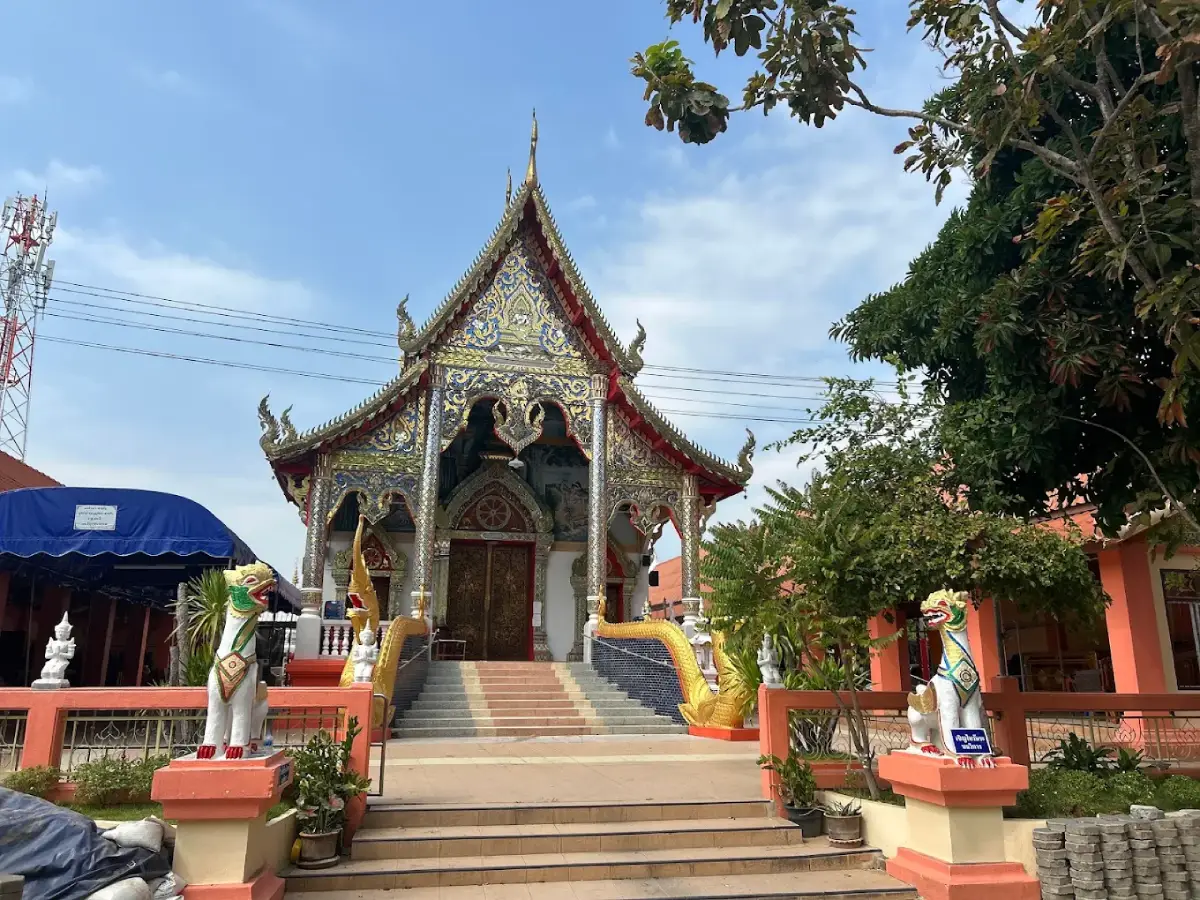
The viharn is one of the most important structures to see. It is a Lanna-style hall with a front façade decorated with colored glass that reflects sunlight attractively. The gable features Indra, celestial figures, and foliate motifs. The entrance arch includes a dhammachakra and kneeling deer, referring to the Buddha’s first sermon and the turning of the Wheel of Dhamma. These details give the viharn both artistic and doctrinal meaning. It is not merely a building that houses a principal Buddha image; it is a teaching space expressed through architecture.
Inside the viharn, the principal Buddha image is seated in the Subduing Mara posture on a raised altar. It is flanked by 2 standing Buddha images associated with the former Wat Phra Chan. These standing images are especially important because they link the present Wat Ton Pin with the earlier temple site. Even though the temple was moved from the old location to Don Matuem, these sacred images preserve continuity between the older and present community memory.
The standing Buddha images are also connected with the memory of Phra Chao Kham Khing and Khruba Siwichai. The story of images whose height relates to Khruba Siwichai adds a broader Lanna devotional layer to Wat Ton Pin. Khruba Siwichai is one of northern Thailand’s most revered monks and is remembered for restoring temples, building roads, and strengthening Buddhist faith throughout Lanna. This connection makes Wat Ton Pin more than a village temple; it also belongs to the wider network of devotion surrounding Khruba Siwichai.
The viharn murals depict the Ten Birth Stories of the Buddha and scenes from the Buddha’s life. These paintings are important because temple murals in Lanna communities are not merely decorative. They function as visual teaching tools, helping people understand moral lessons, generosity, patience, effort, compassion, and the path of spiritual cultivation. Visitors who take time to observe the murals can see how Wat Ton Pin communicates Buddhist ideas through art.
The ubosot has a form similar to the viharn but is smaller. It is a Lanna-style religious building located in front of the viharn. The gable is decorated with stucco foliate patterns and colored glass. The wooden entrance doors are carved with Buddhist narrative themes, and 2 guardian lions stand at the front. As the building connected with formal monastic acts, the ubosot should be approached respectfully. Visitors should avoid touching woodcarving, decorative glass, or old architectural elements.
The main chedi stands behind the viharn. It is a Lanna-style chedi with a square base, a raised indented lotus-moulded base, and niches on each side containing Buddha images in the Pacifying the Relatives posture. Above this are 7 octagonal malaitha tiers supporting a golden bell-shaped body, and the summit is crowned with a 9-tiered golden umbrella. The chedi combines Lanna architectural balance, sacred symbolism, and decorative detail in a compact but meaningful form.
The Buddha images in the Pacifying the Relatives posture around the chedi have a strong ethical meaning. This posture is associated with the calming of conflict and the restoration of peace among relatives and communities. When placed around the chedi, the images reinforce the temple’s role as a place of harmony, restraint, compassion, and social peace. For a local community temple, this message is especially appropriate.
The Two Khruba Pavilion is another important feature. It enshrines images of 2 revered monks connected with Wat Ton Pin: Khruba Upanantha Thera, the first abbot of the temple, and Khruba Siwichai, the saintly monk of Lanna. This pavilion helps visitors understand that a temple survives not only through buildings but also through the faith, leadership, and memory of monks and lay supporters across generations.
The ho trai, or scripture hall, stands near the entrance to the temple. It is a 2-storey brick-and-plaster building with a wooden gable carved in foliate patterns over a blue colored-glass background. In Thai and Lanna Buddhist temples, the ho trai is connected with the preservation of scriptures, Buddhist texts, and religious knowledge. Its presence at Wat Ton Pin adds an educational and doctrinal layer to the temple, showing that a temple is not only a place of worship but also a place where teachings are preserved.
The line of abbots at Wat Ton Pin begins with Khruba Upanantha Thera and continues through several monks who helped maintain the temple, including Khruba Luang Mueang Udon, Chao Athikan Kham Mao Chittadhammo, Phra Kham Nanphiyo, Phra Kasem Sumetho, Phra Khru Duangkaeo Maniwanno, Phra Khru Bunthong Thanissaro, and Phra Palat Wirat Aphatharo. Current public temple information records the abbot as Phra Khru Aphat Rattanathada, with resident monks at the temple. This confirms Wat Ton Pin as a living religious institution rather than an abandoned temple or purely historical site.
Wat Ton Pin also serves the current community of Ban Don Pin and Mae Hia. The temple has a multipurpose building used for community and public activities. Local municipal activities, public service events, and village gatherings have taken place in the temple area, showing that Wat Ton Pin continues to function as a community anchor. The temple connects Buddhist practice, local administration, education, and neighborhood cooperation in a practical way.
The relationship between the temple and Ban Don Pin Witthayakhom School is another meaningful detail. The former Wat Phra Chan site is remembered in relation to the school area. This creates a shared historical root between religious space and education in the community. In Thai society, the relationship between home, temple, and school has long supported local identity and moral learning. Wat Ton Pin should therefore be understood as part of the social memory of Ban Don Pin, not only as a place for visitors.
Getting to Wat Ton Pin is straightforward from Chiang Mai city. From the Airport Intersection or Central Chiang Mai Airport, follow Chiang Mai–Hang Dong Road south toward Hang Dong. After passing Mae Hia Samansamakkee Intersection for about 1 kilometer, look for the Wat Ton Pin sign on the left. Turn into the lane and continue for about 300 meters to reach the temple. The route is suitable for private cars, motorcycles, red songthaews, tuk-tuks, and taxi-app services.
Visitors using public or hired transport should give the destination as “Wat Ton Pin, Ban Don Pin, Soi Don Pin 2, Mae Hia.” This helps avoid confusion with similarly named places. From Tha Phae Gate, the old city, Nimmanhaemin, or Chiang Mai International Airport, travel time depends on traffic, especially during morning and evening rush periods. Chiang Mai–Hang Dong Road is a major route, so it is best to allow extra time.
For itinerary planning, Wat Ton Pin combines well with attractions in Mae Hia and Hang Dong. A practical route can begin in Chiang Mai city or near the airport, continue to Wat Ton Pin for worship and Lanna architecture, then move to Wat Ton Kwen, Royal Park Rajapruek, Chiang Mai Night Safari, Wat Phra That Doi Kham, and Baan Kang Wat. A local temple route can also combine Wat Ton Pin with Wat Tamnak, Wat Tha Kham, and Wat Mae Hia. This route gives visitors a view of southern Chiang Mai through temples, local villages, public parks, family attractions, and community spaces.
The best time to visit Wat Ton Pin is in the morning or late afternoon. Morning is suitable for worship and quiet observation, while late afternoon is suitable for photography of the viharn, colored glass, gable details, dhammachakra entrance motif, deer figures, chedi, and ho trai. A careful visit usually takes around 30–60 minutes. Visitors should move quietly because the temple is an active religious and community space.
Standard Thai temple etiquette should be followed. Dress modestly, remove shoes before entering sacred buildings, keep voices low, and avoid touching Buddha images, murals, carved wood, colored glass, or old architectural features. Do not climb the chedi base. If ceremonies, merit-making events, or community activities are taking place, visitors should allow monks and local people to use the space first.
Wat Ton Pin is suitable for cultural and architectural photography. Good subjects include the viharn façade with colored glass, the Indra gable, foliate motifs, the dhammachakra and deer entrance, the paired standing Buddha images, the Lanna-style chedi with niches, the 2-storey ho trai, and the Two Khruba Pavilion. Photography should be done respectfully, without flash near murals or sacred objects, and without entering monastic areas without permission.
Compared with more famous temples in Chiang Mai, Wat Ton Pin stands out through its local specificity. It has the older Wat Phra Chan memory, the move to Don Matuem or Ma Pin, the paired standing Buddha images, Phra Chao Kham Khing, the connection with Khruba Upanantha Thera and Khruba Siwichai, a Lanna viharn decorated with colored glass, the main chedi, a 2-storey scripture hall, and a continuing role in the Ban Don Pin community. These details make the temple a compact but culturally rich site.
Overall, Wat Ton Pin is a historic community temple in Mae Hia that is worth visiting when traveling along Chiang Mai–Hot Road or planning a route through Mae Hia, Hang Dong, and the Rajapruek area. The temple preserves the memory of Wat Phra Chan, a name connected with bael trees and local landscape, Lanna religious architecture, paired standing Buddha images, the Two Khruba Pavilion, and an active community function. Travelers who want a quiet temple near the city and a deeper understanding of Ban Don Pin should include Wat Ton Pin in a southern Chiang Mai itinerary.
| Name | Wat Ton Pin |
| Local Name | Wat Don Pin |
| Former Name | Wat Phra Chan |
| Location | Ban Don Pin, Chiang Mai–Hot Road, Mae Hia Subdistrict, Mueang Chiang Mai District, Chiang Mai Province |
| Address | 110 Moo 5, Soi Don Pin 2, Mae Hia Subdistrict, Mueang Chiang Mai District, Chiang Mai 50100, Thailand |
| Coordinates | 18.73491, 98.95745 |
| Temple Type | Community Buddhist Temple Under The Mahanikaya Order |
| Temple Area | 5 rai and 1 ngan |
| History | Formerly associated with Wat Phra Chan, later moved to the Don Matuem or Ma Pin area around 1823, and received its consecrated boundary on 3 July 1980 |
| Name Origin | The name relates to Don Matuem, a mound of bael trees. In northern Thai, matuem is called ma pin, giving rise to the name Ton Pin. |
| Consecrated Boundary | Granted on 3 July 1980. The boundary measures 30 meters wide and 40 meters long. |
| Highlights | Historic Ban Don Pin temple, Lanna viharn with colored glass decoration, paired standing Buddha images from the Wat Phra Chan tradition, Lanna-style chedi, Two Khruba Pavilion, and 2-storey scripture hall |
| Viharn Features | Lanna-style viharn with colored glass on the front façade, an Indra gable with celestial figures and foliate motifs, and an entrance arch with a dhammachakra and kneeling deer |
| Sacred Objects | Principal Buddha image in the Subduing Mara posture, paired standing Buddha images on a chukchi altar, Phra Chao Kham Khing, murals of the Ten Birth Stories and the Buddha’s life, main chedi, Two Khruba Pavilion, and ho trai |
| Chedi Features | Lanna-style chedi behind the viharn, with a square base, raised indented lotus-moulded base, niches containing Buddha images in the Pacifying the Relatives posture, 7 octagonal malaitha tiers, golden bell body, and 9-tiered golden umbrella |
| Current Abbot / Caretaker | Phra Khru Aphat Rattanathada |
| Resident Monks | 7 monks |
| Main Contact Number | 053-804-347 |
| Open Days | Daily |
| Opening Hours | 08.00 – 17.00 |
| Current Status | Open for worship, merit-making, temple visits, and community activities for Ban Don Pin and Mae Hia |
| Facilities | Viharn, ubosot, chedi, Two Khruba Pavilion, ho trai, multipurpose building, monks’ residences, merit-making areas, walking areas, and shaded temple grounds |
| Main Areas / Zones | Viharn, ubosot, principal Buddha image, paired standing Buddha images, main chedi, Two Khruba Pavilion, scripture hall, monks’ residences, multipurpose building, and community activity area |
| Travel Information | From the Airport Intersection or Central Chiang Mai Airport, follow Chiang Mai–Hang Dong Road south toward Hang Dong. After passing Mae Hia Samansamakkee Intersection for about 1 km, look for the temple sign on the left and enter the lane for about 300 meters. |
| Visitor Guidelines | Dress modestly, remove shoes before entering sacred buildings, do not touch Buddha images, murals, carved wood, colored glass, or old architectural elements, do not climb the chedi base, and respect monks and community activities. |
| Nearby Tourist Attractions | 1. Wat Intharawat Or Wat Ton Kwen, About 4 km 2. Royal Park Rajapruek, About 4 km 3. Chiang Mai Night Safari, About 4 km 4. Wat Phra That Doi Kham, About 6 km 5. Baan Kang Wat, About 7 km 6. Wat Umong Suan Phutthatham, About 8 km 7. Grand Canyon Water Park Chiang Mai, About 8 km 8. Central Chiang Mai Airport, About 6 km |
| Nearby Restaurants | 1. Five Star Don Pin, About 0.2 km, Tel. 095-140-2233, 091-069-9671 2. Vibhavadi Chicken Rice Mae Hia–Don Pin Branch, About 0.5 km, Tel. 093-243-8572 3. Tam Grachoot Chiang Mai Branch, About 1 km, Tel. 098-142-5690 4. Im Aroi Rice Porridge 1 Baht Mae Hia, About 1 km, Tel. 088-829-1666, 062-445-9444, 095-446-3363 5. Shabugu Mae Hia, About 2 km, Tel. 053-111-186 6. Pad Thai Boston Mae Hia, About 3 km, Tel. 088-250-7172 7. Khaomao–Khaofang Chiang Mai, About 3 km |
| Nearby Accommodations | 1. Pool Suite Chiang Mai, About 0.2 km, Tel. 099-236-3222, 053-908-456 2. Donpin 8 / Timeless House Chiang Mai, About 0.6 km, Tel. 099-103-4820 3. Stay with Brite The Home-Stay in Chiang Mai, About 1 km 4. Pimlada Hotel, About 2 km, Tel. 099-269-4256 5. Vdara Resort and Spa, About 4 km, Tel. 061-270-5888 6. Sukruethai Hotel Chiang Mai, About 4 km, Tel. 081-137-0949 7. Mountain Creek Wellness Resort Chiang Mai, About 5 km, Tel. 053-111-424 |
Frequently Asked Questions (FAQ)
Q: Where is Wat Ton Pin located?
A: Wat Ton Pin is located at 110 Moo 5, Soi Don Pin 2, Chiang Mai–Hot Road, Mae Hia Subdistrict, Mueang Chiang Mai District, Chiang Mai Province. It is in Ban Don Pin, near the route toward Hang Dong and Royal Park Rajapruek.
Q: What are the opening hours of Wat Ton Pin?
A: Wat Ton Pin is open daily from 08.00 to 17.00.
Q: What is the history of Wat Ton Pin?
A: Wat Ton Pin is connected with the older Wat Phra Chan site, formerly remembered around the area of Ban Don Pin Witthayakhom School. Khruba Upanantha Thera and local devotees later moved the temple to Don Matuem, or Ma Pin, and the temple received its consecrated boundary on 3 July 1980.
Q: What does the name Wat Ton Pin mean?
A: The name relates to Don Matuem, a mound of bael trees. In northern Thai, bael fruit is called ma pin, so the temple name preserves the old landscape and local language of the area.
Q: What should visitors see inside Wat Ton Pin?
A: Key features include the Lanna-style viharn with colored glass decoration, the principal Buddha image in the Subduing Mara posture, the paired standing Buddha images from the Wat Phra Chan tradition, murals of the Ten Birth Stories and the Buddha’s life, the Lanna-style chedi, the Two Khruba Pavilion, and the 2-storey scripture hall.
Q: Who is the current abbot of Wat Ton Pin?
A: The current abbot of Wat Ton Pin is Phra Khru Aphat Rattanathada.
Q: How can travelers get to Wat Ton Pin?
A: From the Airport Intersection or Central Chiang Mai Airport, follow Chiang Mai–Hang Dong Road south toward Hang Dong. After passing Mae Hia Samansamakkee Intersection for about 1 km, turn left into the lane at the Wat Ton Pin sign and continue for about 300 meters. The temple can be reached by private car, motorcycle, red songthaew, tuk-tuk, or taxi app.
Q: What nearby places can be visited with Wat Ton Pin?
A: Nearby places include Wat Intharawat or Wat Ton Kwen, Royal Park Rajapruek, Chiang Mai Night Safari, Wat Phra That Doi Kham, Baan Kang Wat, Wat Umong Suan Phutthatham, Grand Canyon Water Park Chiang Mai, and Central Chiang Mai Airport.
 Category: ●Places of Worship
 Group: ●Temple
Last Update : 6 DayAgo
 Last Update : 6 DayAgo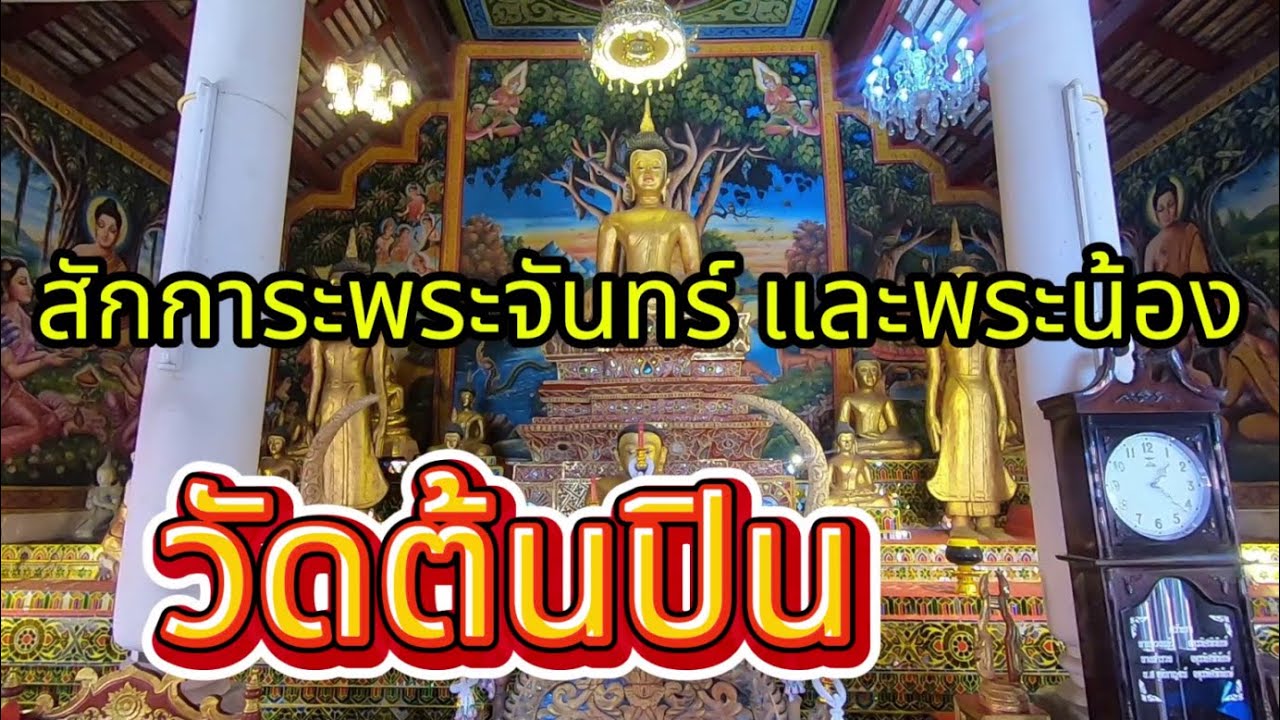
 Click to Access the Navigation Map GPS
Wat Ton Pin Map
Recommend

 Muang Chiang Mai(121)Chom Thong(47)Mae Chaem(25)Chiang Dao(33)Doi Saket(68)Mae Taeng(85)Mae Rim(69)Samoeng(29)Fang(71)Mae Ai(62)Phrao(70)San Pa Tong(105)San Kamphaeng(66)San Sai(73)Hang Dong(74)Hot(32)Doi Tao(22)Omkoi(11)Saraphi(74)Wiang Haeng(15)Chai Prakan(28)Mae Wang(32)Mae On(22)Doi Lo(34)Galyani Vadhana(1)


