
lovethailand home >North Travel Attractions >Chiang Mai Travel Attractions >Muang Chiang Mai >Chang Khlan > Wat Phan Tong
TL;DR: Wat Phan Tong is located at Ban Hom, Loi Kroh Road, Chang Khlan Subdistrict, Mueang Chiang Mai District, Chiang Mai Province, open Daily, hours 08.00 – 17.00.
Wat Phan Tong
Open Days: Daily
Opening Hours: 08.00 – 17.00
Wat Phan Tong in Chiang Mai is a historic Buddhist temple on Loi Kroh Road in Chang Khlan, Mueang Chiang Mai District. Although it stands close to busy tourist areas such as Tha Phae Gate, the Night Bazaar, and Chang Khlan Road, the temple has a calm, shaded atmosphere that makes it a worthwhile cultural stop in central Chiang Mai. It is an active community temple under the Mahanikaya order and is known for its Lanna architecture, old viharn, chedi, ubosot, wooden pulpit, and long connection with the Ban Hom community.
Wat Phan Tong is suitable for travelers who want to visit a quieter temple without leaving the city center. The temple compound is compact, easy to walk around, and rich in detail. Visitors can come for worship, merit-making, cultural photography, or a short rest between walking routes in the old city and the Night Bazaar area. Its shaded grounds and mature trees create a peaceful contrast with the surrounding streets, especially on hot afternoons in Chiang Mai.
The temple was originally known as Wat Phra Ngam, meaning a temple associated with a beautiful Buddha image. It was built around 1457, during the Mangrai dynasty period. The name of the original founder has not been recorded. After a period as an abandoned temple, Wat Phra Ngam was restored during the time of King Kawila, the first ruler of Chiang Mai under the Chet Ton dynasty. This was the period when Chiang Mai was being repopulated and revived after years of political and military upheaval.
King Kawila brought people from Ban Hom in Chiang Saen to settle around this abandoned temple. The Ban Hom community then helped restore the temple and renamed it Wat Phan Thong. The name was linked to a Buddha image brought from Chiang Saen and to the idea of “a thousand chang of gold.” Over time, local pronunciation changed the name from Wat Phan Thong to Wat Phan Tong, which remains the name used today.
This history makes Wat Phan Tong more than a small roadside temple. It preserves memories of Chiang Mai’s urban revival, the movement of people from Chiang Saen, the growth of the Ban Hom community, and the religious life of the Loi Kroh area. A visit to the temple offers a clear view of Chiang Mai as a living city shaped by migration, devotion, restoration, and local craftsmanship.
Wat Phan Tong is located at 61 Ban Hom, Loi Kroh Road, Chang Khlan Subdistrict, Mueang Chiang Mai District, Chiang Mai 50100. The temple grounds cover about 2 rai, 3 ngan, and 20 square wa. Despite its modest size, the compound includes the main viharn, ubosot, sermon hall, monks’ residences, ceremonial hall, dining hall, chedi, and old wooden pulpit. Visitors can see the main areas within a short time, but a more careful visit should take around 30–60 minutes.
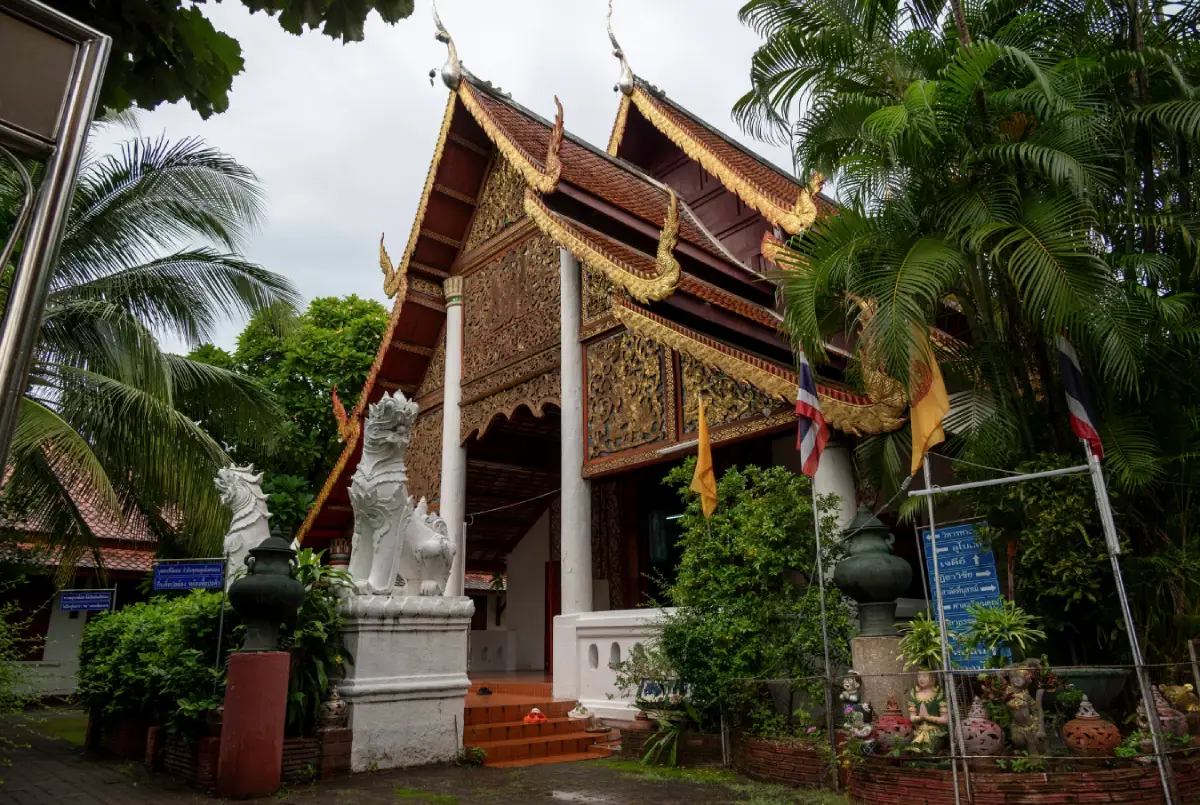
The first major feature to see is the Lanna-style viharn. Its layered roof, silver chofa finials, golden wooden naga bargeboards, and carved wooden gable reflect the elegance of Northern Thai temple architecture. The gable carving of Garuda grasping Naga, surrounded by floral motifs, is one of the temple’s most attractive details. It shows how Lanna artisans combined Buddhist symbolism, mythical creatures, and botanical ornamentation into a single architectural composition.
Inside the viharn is the principal Buddha image in the Subduing Mara posture. A distinctive feature is the five-tiered umbrella above the Buddha’s head, giving the image a strong sense of dignity and sacred presence. Behind the principal image is a gold mural on a red background depicting celestial beings. The interior has a warm devotional atmosphere, and visitors can sit quietly, pay respect, and observe the temple art at close range.
The viharn also contains an old wooden pulpit. In Northern Thai Buddhist culture, a pulpit is not only a practical object for preaching but also a sacred piece of craftsmanship connected with the transmission of the Dhamma. The pulpit at Wat Phan Tong reflects the skill of local woodworkers and the devotion of the community that supported the temple over generations.
Behind the viharn stands the temple’s chedi, a structure combining Lanna and Burmese artistic elements. The chedi rises from a square base and a raised indented platform. A niche houses a Buddha image in the meditation posture facing north. Above the base are five stacked octagonal moulding tiers leading to the bell-shaped body of the chedi, which is decorated with colored glass. The top is crowned with a five-tiered golden umbrella. This chedi is one of the best places in the temple to observe the artistic blending that characterizes many historic temples in Chiang Mai.
The base of the chedi also contains details that visitors often miss. Among them are bas-relief images showing hill-tribe women and narrative scenes. These reliefs add another layer of interest to the temple because they broaden the visual story beyond standard temple ornament. For travelers interested in Lanna art, local culture, and lesser-known temple details, these small elements make Wat Phan Tong especially rewarding.
The ubosot stands near the chedi and is another important structure in the compound. It is built in the Lanna style and is notable for its seven-headed naga decoration, which differs from the two-headed naga designs more commonly seen on many temple buildings. The front gable includes stucco work of Garuda and the name of the restorer. The front pillars feature animal motifs, while the rear gable includes stucco designs of elephants and lotus flowers. These details give the ubosot a distinct artistic identity.
The beauty of Wat Phan Tong lies in detail rather than scale. The temple is not a vast complex, yet it contains a strong concentration of wood carving, stucco work, glass decoration, mural painting, Buddha images, and symbolic architecture. The viharn feels intimate, the chedi feels old and layered with history, and the ubosot adds a refined architectural contrast. The shaded trees throughout the compound help soften the urban surroundings and make the temple feel calm.
Wat Phan Tong remains an active community temple. The current abbot recorded in recent temple-related sources is Phra Khru Sathaphon Khemmakit. The temple continues to serve worshippers and the local community through Buddhist activities such as Kathin ceremonies after Buddhist Lent, candle offerings for Buddhist Lent, and community merit-making events. This living religious role is one of the reasons Wat Phan Tong should be seen as both a historic temple and a functioning spiritual space.
A good way to visit Wat Phan Tong is to begin inside the viharn, pay respect to the principal Buddha image, and then examine the carved gable, naga details, chofa finials, and roofline. After that, walk behind the viharn to see the chedi, its Buddha niche, octagonal moulding tiers, colored-glass decoration, and golden umbrella. Then continue to the ubosot to observe the seven-headed naga, Garuda motif, animal designs, elephant motif, and lotus decoration. This route gives visitors a complete understanding of the main artistic and religious features of the temple.
Wat Phan Tong is also a good place for cultural photography. The most photogenic areas include the Lanna-style viharn, the carved wooden gable, the chedi with glass decoration, the shaded temple grounds, and the stucco details of the ubosot. Photography should be respectful. Visitors should avoid interrupting worshippers, entering closed areas, touching sacred objects, or photographing monks at close range without permission.
The atmosphere of the temple makes it a useful rest stop during a walking itinerary in central Chiang Mai. On hot days, the trees inside the temple compound provide shade and relief from the surrounding streets. Its location also makes it easy to combine with other nearby temples and attractions, including Wat Loi Kroh, Wat Chang Kong, Wat Buppharam, Tha Phae Gate, Chiang Mai Night Bazaar, Anusarn Market, the Iron Bridge, and Warorot Market.
Getting to Wat Phan Tong is simple. From the outer moat road near Kotchasarn Road, continue past the Tha Phae Gate area for about 200 meters, then turn into Loi Kroh Road and continue for about another 200 meters. Visitors can reach the temple by private car, red songthaew, tuk-tuk, taxi app, or on foot from Tha Phae Gate, Chang Khlan Road, and the Night Bazaar area. When giving directions to a driver, say “Wat Phan Tong on Loi Kroh Road” to avoid confusion with similarly named temples in Chiang Mai.
The temple’s location is especially convenient for travelers staying around Tha Phae Gate, Loi Kroh Road, Chang Khlan Road, or the Night Bazaar. Morning is best for a quiet visit and soft light for photography. Afternoon is useful for a shaded break during a walking route. Visitors who want to focus on architecture should allow enough daylight to see the wood carving, stucco work, and chedi details clearly.
As with all Buddhist temples in Thailand, visitors should dress modestly, remove shoes before entering the viharn or ubosot, keep their voices low, and avoid touching Buddha images or old religious objects. Do not climb on the chedi base or enter monastic areas without permission. A respectful visit helps preserve the atmosphere of the temple and supports better cultural tourism in Chiang Mai.
Overall, Wat Phan Tong is one of the more rewarding small temples in central Chiang Mai. It combines Lanna architecture, Ban Hom community history, Chiang Saen connections, old temple art, shaded grounds, and a practical location near major walking routes. For travelers who enjoy quiet temples, historic neighborhoods, and detailed craftsmanship, Wat Phan Tong is a meaningful stop in the Loi Kroh and Tha Phae area.
| Name | Wat Phan Tong |
| Location | Ban Hom, Loi Kroh Road, Chang Khlan Subdistrict, Mueang Chiang Mai District, Chiang Mai Province |
| Address | 61 Ban Hom, Loi Kroh Road, Chang Khlan Subdistrict, Mueang Chiang Mai District, Chiang Mai 50100, Thailand |
| Coordinates | 18.78472, 98.99603 |
| Highlights | Historic temple in central Chiang Mai with a Lanna-style viharn, Lanna-Burmese chedi, seven-headed naga ubosot, old wooden pulpit, and shaded grounds on Loi Kroh Road |
| History | Built around 1457 during the Mangrai dynasty. Formerly known as Wat Phra Ngam, later restored by the Ban Hom community during the time of King Kawila. |
| Name Origin | The name Wat Phan Thong was linked to a Buddha image brought from Chiang Saen and to the idea of a thousand chang of gold. The name later changed in local pronunciation to Wat Phan Tong. |
| Distinctive Features | Two-tiered Lanna viharn, carved wooden Garuda-and-Naga gable, gold mural on red background, chedi decorated with colored glass, and ubosot with seven-headed naga decoration |
| Travel Information | From the Tha Phae Gate area, continue along the outer moat road toward Kotchasarn Road, then turn into Loi Kroh Road for about 200 meters. The temple is reachable by private car, red songthaew, tuk-tuk, taxi app, or on foot from nearby areas. |
| Current Status | Open for worship, merit-making, and temple sightseeing during operating hours |
| Open Days | Daily |
| Opening Hours | 08.00 – 17.00 |
| Fees | Free Entry |
| Facilities | Viharn, ubosot, merit-making areas, sala, shaded grounds, and walking areas inside the temple compound |
| Main Areas / Zones | Viharn, principal Buddha image in the Subduing Mara posture, old wooden pulpit, chedi, ubosot, sermon hall, monks’ residences, ceremonial hall, and dining hall |
| Abbot / Caretaker | Phra Khru Sathaphon Khemmakit |
| Nearby Tourist Attractions | 1. Wat Loi Kroh, About 0 km 2. Wat Chang Kong, About 0 km 3. Wat Buppharam, About 0 km 4. Chiang Mai Night Bazaar, About 1 km 5. Tha Phae Gate, About 1 km 6. Anusarn Market, About 1 km 7. Iron Bridge, About 1 km 8. Warorot Market, About 1 km |
| Nearby Restaurants | 1. Vegan Heaven, About 0 km, Tel. 087-577-5444 2. Chang Cafe Bar & Restaurant, About 0 km, Tel. 065-507-5920 3. Rock Me Burger, About 0 km, Tel. 063-895-2456 4. Aroon Rai Restaurant, About 1 km, Tel. 053-276-947 5. The Red Lion English Pub, About 1 km, Tel. 053-818-847 |
| Nearby Accommodations | 1. Nap In Chiang Mai, About 0 km, Tel. 053-904-480 2. Duangtawan Hotel Chiang Mai, About 1 km, Tel. 053-905-000, 096-690-9169 3. Dusit Princess Chiang Mai, About 1 km, Tel. 053-253-900 4. Mövenpick Suriwongse Hotel Chiang Mai, About 1 km, Tel. 053-270-051 5. Chiang Mai Marriott Hotel, About 1 km, Tel. 053-253-666 6. Royal Lanna Hotel, About 1 km, Tel. 053-818-773-5 |
Frequently Asked Questions (FAQ)
Q: Where is Wat Phan Tong located?
A: Wat Phan Tong is located at Ban Hom on Loi Kroh Road, Chang Khlan Subdistrict, Mueang Chiang Mai District, Chiang Mai Province, close to Tha Phae Gate and Chiang Mai Night Bazaar.
Q: What are the opening hours of Wat Phan Tong?
A: Wat Phan Tong is open daily from 08.00 to 17.00.
Q: Is there an entrance fee at Wat Phan Tong?
A: No. General entry to Wat Phan Tong is free.
Q: What is the history of Wat Phan Tong?
A: Wat Phan Tong was originally called Wat Phra Ngam and was built around 1457 during the Mangrai dynasty. It was later restored by the Ban Hom community during the time of King Kawila, and the name Wat Phan Thong eventually changed to Wat Phan Tong.
Q: What should visitors see inside Wat Phan Tong?
A: Key features include the Lanna-style viharn, principal Buddha image, old wooden pulpit, Lanna-Burmese chedi, chedi-base reliefs, and the ubosot with seven-headed naga decoration.
Q: How can travelers get to Wat Phan Tong?
A: Travelers can reach the temple by private car, red songthaew, tuk-tuk, taxi app, or on foot from Tha Phae Gate, Loi Kroh Road, Chang Khlan Road, and the Night Bazaar area.
Q: Who is Wat Phan Tong best suited for?
A: Wat Phan Tong is ideal for travelers interested in quiet historic temples, Lanna architecture, local Chiang Mai history, temple photography, and cultural walking routes in the city center.
Q: What nearby places can be visited with Wat Phan Tong?
A: Nearby places include Wat Loi Kroh, Wat Chang Kong, Wat Buppharam, Tha Phae Gate, Chiang Mai Night Bazaar, Anusarn Market, Iron Bridge, and Warorot Market.
 Category: ●Places of Worship
 Group: ●Temple
Last Update : 2 DayAgo
 Last Update : 2 DayAgo
 Click to Access the Navigation Map GPS
Wat Phan Tong Map
Recommend

 Muang Chiang Mai(121)Chom Thong(47)Mae Chaem(25)Chiang Dao(33)Doi Saket(68)Mae Taeng(85)Mae Rim(69)Samoeng(29)Fang(71)Mae Ai(62)Phrao(70)San Pa Tong(105)San Kamphaeng(66)San Sai(73)Hang Dong(74)Hot(32)Doi Tao(22)Omkoi(11)Saraphi(74)Wiang Haeng(15)Chai Prakan(28)Mae Wang(32)Mae On(22)Doi Lo(34)Galyani Vadhana(1)


